
HSE-330 · Lesson 6 of 12 · 27 min
Hydrogen sulphide and other toxic exposures
Fire is the hazard most people expect at an oil and gas site, but toxic gases and vapours kill quietly and often more than one person at a time. Hydrogen sulphide is the best known: a few breaths at high concentration can drop a worker where they stand, and the colleague who runs to help can be the second victim. It is not the only toxic exposure. Hydrocarbon vapours released from tanks have killed workers who were gauging or sampling. Benzene causes cancer. Burning sour gas produces sulphur dioxide. Old equipment can carry radioactive scale. This lesson gives an orientation-level picture of these exposures on upstream and midstream sites and of the controls that protect against them.
HSE-244, Hydrogen Sulfide Awareness, is the full course on hydrogen sulphide: its properties, health effects, exposure limits, detection, respiratory protection and emergency response. On many sites, H2S training such as Energy Safety Canada's H2S Alive or an equivalent H2S awareness course is a condition of entry. This lesson summarizes what every person on an oil and gas site must know about H2S and then turns to the other toxic exposures. HSE-240 covers respiratory protection, HSE-242 covers silica, and HSE-102 covers hazard communication.
Hydrogen sulphide in brief
Hydrogen sulphide is a colourless gas, slightly heavier than air, that forms naturally where organic material breaks down without oxygen. It is found in sour gas and oil, in produced water, in tank vapours, in drilling fluids that encounter sour zones, in sludge and in vessels and pipelines that have handled sour fluids. At low concentrations it smells of rotten eggs, but at about 100 ppm it paralyzes the sense of smell within minutes, so the absence of smell is no sign of safety. At several hundred ppm it causes collapse within minutes, and at around 1,000 ppm and above, breathing can stop after a few breaths. Lesson 4 showed that a gas stream with 0.5 percent H2S contains 5,000 ppm.
| Concentration (ppm) | Typical effects |
|---|---|
| 0.01 to 1.5 | Odour threshold: rotten egg smell |
| About 10 to 20 | Eye irritation, headache and nausea with prolonged exposure; above many exposure limits |
| About 100 | Loss of smell within minutes; coughing and eye irritation; immediately dangerous to life or health (NIOSH IDLH) |
| 500 to 700 | Staggering and collapse within minutes; death within 30 to 60 minutes |
| 700 to 1,000 and above | Rapid unconsciousness, breathing stops, death within minutes |
Exposure limits vary between jurisdictions and are covered in HSE-244 Lesson 5. The ACGIH threshold limit values, adopted in 2010, are 1 ppm as an eight-hour time-weighted average and 5 ppm as a short-term exposure limit; several provinces and states still use older, higher limits around 10 ppm. On oil and gas sites, alarm set points are usually between 5 and 15 ppm (Lesson 5), and work above a set concentration, commonly 10 ppm, requires supplied-air respiratory protection. Air-purifying respirators are not used for H2S work in the oil and gas industry because concentrations can rise suddenly far above their limits.
Every person on a site where H2S may be present needs to know five things: where H2S may be on that site and at what concentrations; how to check and wear their monitor; what the alarm sounds and lights mean; which way to go when the alarm sounds, which is upwind and uphill to a muster point; and that they must never attempt a rescue without supplied-air breathing apparatus and training. Rescuers who hold their breath, use a wet cloth or rely on a dust mask die. HSE-244 Lesson 10 describes the rescue steps taught in H2S training.
Hydrocarbon gases and vapours at tanks
Production tanks hold crude oil, condensate and produced water that continue to release hydrocarbon gases and vapours, called HGVs, which build up under the tank roof. When a worker opens a thief hatch to gauge a tank or take a sample, the built-up vapour can rush out in a concentrated plume directly into the worker's face. The plume can contain very high concentrations of light hydrocarbons, which displace oxygen, together with H2S on sour sites. NIOSH and OSHA issued a joint hazard alert in 2016 after NIOSH identified nine deaths of workers who were gauging or sampling at open thief hatches, often working alone. NIOSH later reported eight more deaths in 2015 and 2016 linked to gases and vapours while workers handled process fluids, including sudden cardiac deaths, fires and H2S poisonings.
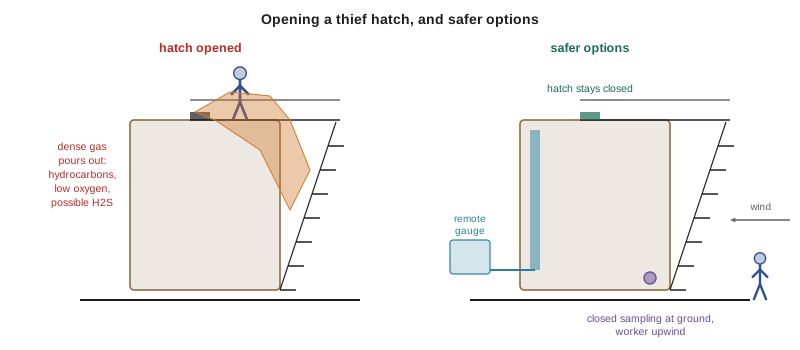
The controls follow the hierarchy. Best is to avoid opening hatches at all, using automatic tank gauges, remote monitoring and closed sampling systems; API's measurement standards describe ways to gauge without opening the hatch. Where hatches must be opened, the site's procedure should require a hazard assessment, a working multi-gas monitor, standing upwind with the head away from the opening, letting the tank vent before approaching, avoiding work alone, and respiratory protection where the assessment calls for it. Fluid transfer and disposal, such as vacuum truck operations and offloading produced water, release vapours in the same way and need the same care.
Sulphur dioxide
When hydrogen sulphide burns, at a flare, an incinerator or a fire, it produces sulphur dioxide, a colourless gas with a sharp, choking smell that irritates the eyes, nose and lungs. People with asthma are especially sensitive. Flares on sour sites are designed and regulated to keep sulphur dioxide at ground level below air quality limits, but workers near flares, in low areas downwind or responding to a fire may be exposed. Some sites add an SO2 sensor to monitors used near flares. Igniting a sour gas release in an emergency converts lethal H2S to less toxic SO2, which is why emergency plans for sour wells include ignition criteria (Lesson 11).
Benzene and other aromatic hydrocarbons
Crude oil, condensate and some gas streams contain benzene, toluene, ethylbenzene and xylenes, together called BTEX. Benzene causes leukemia and other blood disorders after repeated exposure and is classified as a known human carcinogen. Workers can be exposed when tanks are opened, samples are taken, condensate is handled, equipment is drained or cleaned, or glycol dehydrator vents release absorbed aromatics. Exposure limits for benzene are low and have been lowered over the years in many jurisdictions; check the current limit that applies at your site. Controls include closed systems, local ventilation, staying upwind, monitoring with photoionization detectors fitted with benzene-specific tubes or filters, chemical-resistant gloves and respiratory protection where assessment shows it is needed.
Naturally occurring radioactive material
Rocks deep underground contain small amounts of natural uranium and thorium, whose decay products, especially radium, can dissolve in produced water. When the water cools and its pressure drops in tubing, separators, tanks and pipelines, radium can deposit with barium and strontium sulfate scale, or collect in sludge and tank bottoms. Radon gas travels with natural gas and concentrates in propane and ethane streams at gas plants, where its decay products plate out inside equipment. This naturally occurring radioactive material, or NORM, is usually only a small external radiation hazard, but cutting, grinding, cleaning or blasting scaled equipment can release radioactive dust that is harmful if breathed in or swallowed.
In Canada, Health Canada's Canadian Guidelines for the Management of Naturally Occurring Radioactive Materials set out dose limits, classification and controls, and Alberta has published guidelines for handling NORM in western Canada. Provinces apply them through their OHS and environmental rules. Typical controls are surveying equipment and waste with a suitable radiation meter before work and before disposal, keeping scale wet, using respiratory protection and protective clothing for scale removal, controlling access to work areas, washing hands before eating, and sending NORM waste only to approved facilities.
Other exposures on the lease
Hazard assessments for oil and gas work should also consider these exposures:
- Diesel exhaust and carbon monoxide from engines, pumps, heaters and generators, especially in buildings, wellhead shacks and low areas.
- Respirable crystalline silica from sand handling during hydraulic fracturing (HSE-242).
- Methanol, used to prevent hydrates, which is toxic by inhalation, skin contact and swallowing and burns with a nearly invisible flame.
- Glycols, amines, corrosion inhibitors, biocides, scale inhibitors and fracturing additives, each with its own SDS.
- Acids such as hydrochloric acid used in well stimulation, which cause severe burns and release corrosive fumes.
- Mercaptans, used as odorants, which are toxic at high concentrations.
- Produced water and crude oil on the skin, which can cause dermatitis and carry other contaminants.
- Mercury, which occurs in some gas streams and accumulates in gas plant equipment.
- Oxygen-deficient atmospheres where nitrogen is used for purging and pressure testing.
Estimating exposure from monitor data
Monitor data logs let supervisors and hygienists estimate exposures. The program below calculates an eight-hour time-weighted average and the highest 15-minute average from an invented day of H2S readings for a lease operator, and compares them with the ACGIH values. It then shows the inverse-square effect that makes distance a useful control for external radiation from NORM, using an illustrative dose rate measured at a scaled separator.
# Invented H2S readings for a lease operator: (minutes, ppm)
periods = [(120, 0.0), (15, 3.0), (45, 0.4), (10, 8.0), (5, 12.0),
           (60, 0.2), (30, 0.0), (15, 4.0), (180, 0.1)]
total = sum(m for m, _ in periods)
twa = sum(m * c for m, c in periods) / 480        # unmonitored time counted as zero
# highest 15-minute average, minute by minute
minutes = [c for m, c in periods for _ in range(m)]
stel = max(sum(minutes[i:i + 15]) / 15 for i in range(len(minutes) - 14))
print(f"Monitored {total} min; 8-h TWA {twa:.2f} ppm (ACGIH TLV 1 ppm)")
print(f"Highest 15-min average {stel:.1f} ppm (ACGIH STEL 5 ppm)")
print("TWA within TLV" if twa <= 1 else "TWA above TLV", "|",
"STEL exceeded" if stel > 5 else "STEL within limit")Monitored 480 min; 8-h TWA 0.61 ppm (ACGIH TLV 1 ppm) Highest 15-min average 9.3 ppm (ACGIH STEL 5 ppm) TWA within TLV | STEL exceeded
# Inverse-square estimate for external dose rate from scaled equipment.
# Reading taken close to the vessel wall; values are illustrative.
d0, rate0 = 0.1, 20.0      # distance in m from the source, microsieverts per hour
for d in (0.1, 0.5, 1.0, 2.0, 5.0):
print(f"{d:4.1f} m: about {rate0 * (d0 / d) ** 2:7.3f} uSv/h")0.1 m: about 20.000 uSv/h 0.5 m: about 0.800 uSv/h 1.0 m: about 0.200 uSv/h 2.0 m: about 0.050 uSv/h 5.0 m: about 0.008 uSv/h
The operator's eight-hour average is well under 1 ppm, but the highest 15-minute average exceeds the ACGIH short-term limit because of a brief exposure near 12 ppm, which would also have triggered a low alarm on most monitors. That short peak is what an investigation should look at. The radiation estimate treats the scale as a point source, which is only an approximation, but it shows why moving a few metres away and limiting time near scaled equipment greatly reduces external dose. For NORM the bigger concern is usually inhaled or swallowed dust, which distance alone does not control.
Worked problem
A collapsed worker at the tank
A truck driver offloading produced water at the Pinecrest battery sees a lease operator lying on the tank walkway, not moving. The driver's monitor shows 18 ppm H2S where he stands at the bottom of the stairs. What should he do?
Show solution
- Do not climb the stairs. The concentration at the top, near the source, is likely far higher than 18 ppm, and without supplied-air breathing apparatus he would probably collapse too.
- Move upwind and uphill to fresh air and sound the alarm: use the site alarm if there is one, call the emergency number on the site sign and call for help on the radio. Give the exact location, the readings and the number of casualties.
- If he is trained and equipped in H2S rescue with self-contained or supplied-air breathing apparatus, and a second trained person is available, they can follow the site's rescue procedure. Otherwise, he waits upwind and directs the responders.
- Once the casualty is brought to fresh air by protected rescuers, trained first aiders start resuscitation if needed and medical aid is called. Everyone who was near the tank is checked for symptoms.
Answer: Stay out, move upwind and uphill, raise the alarm and call for help; only trained rescuers with supplied air may go in.
Common mistakes
MistakeJudging H2S by smell.
InsteadRely on a working monitor; H2S paralyzes the sense of smell at about 100 ppm.
MistakeRushing in to help a collapsed worker.
InsteadRaise the alarm and let trained rescuers with supplied air go in.
MistakeOpening a thief hatch with your face over the opening.
InsteadUse remote gauging where possible; otherwise stand upwind with your head away, after letting the tank vent.
MistakeUsing an air-purifying respirator for H2S work.
InsteadUse supplied-air respiratory protection above the site's action level.
MistakeGrinding old scale off a separator without checking for NORM.
InsteadSurvey with a radiation meter, keep scale wet and use the specified protection.
Summary and key terms
- H2S is heavier than air, kills at high concentrations within minutes and paralyzes the sense of smell at about 100 ppm, which is the NIOSH IDLH.
- Everyone on a sour site must know where H2S is, wear a bumped monitor, recognize alarms, go upwind and uphill, and never attempt an unprotected rescue.
- Opening thief hatches and handling fluids can release concentrated hydrocarbon vapours that displace oxygen and contain H2S; remote gauging and closed sampling avoid the exposure.
- Burning H2S produces sulphur dioxide, an irritant gas near flares and fires.
- Benzene in crude, condensate and dehydrator vents is a carcinogen with low exposure limits.
- NORM collects in scale, sludge and gas plant equipment; the main risk is inhaling or swallowing dust during cleaning or cutting.
- Other exposures include diesel exhaust, silica, methanol, process chemicals, acids, mercury and oxygen-deficient purge atmospheres.
- IDLH
- Immediately dangerous to life or health; for H2S, NIOSH sets 100 ppm.
- Olfactory fatigue
- Loss of the sense of smell caused by exposure, which for H2S happens at about 100 ppm.
- Thief hatch
- A hatch on a tank roof opened for manual gauging and sampling.
- HGVs
- Hydrocarbon gases and vapours released from tanks and process fluids.
- BTEX
- Benzene, toluene, ethylbenzene and xylenes, aromatic hydrocarbons found in crude and condensate.
- NORM
- Naturally occurring radioactive material, which can concentrate in oil and gas scale, sludge and equipment.
- Supplied-air respiratory protection
- Breathing apparatus that provides clean air from a cylinder or air line, required for H2S work above action levels.
Practice problems
Work each problem on paper first, then reveal the answer to check.
At about what concentration does H2S paralyze the sense of smell?
Show answer
About 100 ppm.
What are the ACGIH TLVs for H2S?
Show answer
1 ppm as an eight-hour TWA and 5 ppm as a STEL.
Why are air-purifying respirators not used for H2S work in oil and gas?
Show answer
Concentrations can rise suddenly far above their limits; supplied air is required.
What did the 2016 OSHA and NIOSH hazard alert address?
Show answer
Deaths of workers gauging or sampling at open thief hatches on production tanks.
Give two safer alternatives to manual gauging through a thief hatch.
Show answer
Automatic or remote tank gauging and closed sampling systems at ground level.
What gas forms when H2S burns?
Show answer
Sulphur dioxide.
What health effect makes benzene especially serious?
Show answer
It causes leukemia and other blood disorders; it is a known human carcinogen.
Where does NORM collect in oil and gas equipment?
Show answer
In scale in tubing, separators, tanks and pipelines, in sludge and tank bottoms, and in gas plant equipment handling propane and ethane.
In the exposure program, which limit was exceeded and why?
Show answer
The 15-minute short-term limit, because of a brief peak near 12 ppm.
What should a worker do on finding a colleague collapsed near a sour tank?
Show answer
Stay out, move upwind and uphill, raise the alarm and call for trained rescuers with supplied air.
Lesson quiz · 5 questions
Score 60% or more to complete this lesson.
Create a free account to save your progress, take quizzes and earn a certificate.