
HSE-330 · Lesson 5 of 12 · 26 min
Gas detection and monitoring
Most of the gases that kill oil and gas workers cannot be seen, and the most dangerous of them cannot be trusted to be smelled. Hydrogen sulphide deadens the sense of smell at high concentrations, methane is odourless, and oxygen deficiency gives no warning at all. Gas detectors are therefore the eyes and nose of everyone who works on a lease. This lesson explains the detectors used on oil and gas sites, how their sensors work and fail, how to check them before use, what alarm set points mean, how to sample before entering an area and how fixed detection protects facilities.
HSE-244 Lessons 6 and 7 covered gas detectors, bump tests, calibration and fixed monitoring for hydrogen sulphide in depth, and HSE-211 Lesson 6 covered atmospheric testing for confined space entry. This lesson builds on both and concentrates on what is particular to oil and gas sites: multi-gas monitors, flammable gas sensors and the mixed hydrocarbon atmospheres they must read, and the way monitoring fits into site routines.
The four-gas monitor
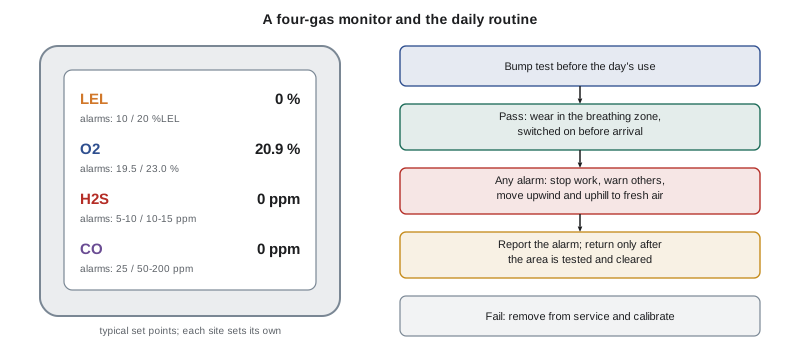
The standard personal monitor in the oil and gas industry is the four-gas monitor. It measures flammable gas as percent of the LEL, oxygen as percent by volume, hydrogen sulphide in ppm and carbon monoxide in ppm. It sounds, flashes and vibrates when a reading passes an alarm set point, and it records readings and alarms in a data log that can be downloaded. Many operators require every person on a sour site, and often on every site, to wear one, clipped in the breathing zone on the collar or chest. Additional sensors are available for sulphur dioxide (produced when H2S burns, for example at flares), volatile organic compounds and benzene (photoionization detectors), and other gases where a hazard assessment calls for them.
How the sensors work, and how they fail
Each sensor has a different principle, and each can be fooled. Knowing the limits is part of using a monitor safely.
| Sensor | How it works | Limitations to know |
|---|---|---|
| Catalytic bead (LEL) | Flammable gas burns on a heated bead, changing its resistance | Needs oxygen to work and reads falsely low in oxygen-deficient air; can be poisoned by silicones, lead and some sulphur compounds; high concentrations above the LEL can damage it or give misleading readings |
| Infrared (LEL or carbon dioxide) | Gas absorbs infrared light at particular wavelengths | Does not detect hydrogen; response differs between hydrocarbons; not poisoned and works without oxygen |
| Electrochemical (H2S, CO, O2, SO2) | Gas reacts at an electrode, producing a current proportional to concentration | Cross-sensitive to some other gases; can saturate or be damaged by very high H2S; affected by extreme cold and drying; limited life |
| Photoionization (VOCs, benzene) | Ultraviolet light ionizes organic vapours | Responds to many organics at once; needs a benzene-specific tube or filter to measure benzene alone; humidity and methane can lower readings |
Flammable gas sensors deserve extra care on oil and gas sites, because they are usually calibrated on one gas but asked to read mixtures of many. A sensor's response to a gas other than its calibration gas is described by a response or correction factor in the manual. A catalytic sensor calibrated on methane, for example, typically under-reads heavier hydrocarbons such as pentane, so the real percentage of the LEL may be higher than the display shows. Some sites calibrate on pentane or propane for that reason, accepting that the monitor will then over-read methane, which errs on the safe side. The program later in this lesson shows how a correction factor changes the reading.
Bump tests and calibration
A monitor that has not been checked cannot be trusted. A bump test, also called a function check, exposes the sensors briefly to a known gas to confirm that they respond and that the alarms work. Industry practice, and most manufacturers, call for a bump test before each day's use; many operators require it before each shift or before entering a hazardous area. A calibration adjusts the monitor's readings to match a certified test gas and is done at the interval the manufacturer specifies or whenever a bump test fails. Docking stations do both automatically and keep the records.
If a monitor fails a bump test, it must not be used until it has been calibrated and passes. A monitor that has been exposed to a very high concentration of gas, dropped, submerged or exposed to silicone sprays should be checked before further use. Watch the display for sensor error messages, low battery warnings and calibration due dates; a monitor that shuts off halfway through a task leaves the wearer unprotected.
Alarm set points
Each monitor has alarm set points for each gas. A low alarm warns that a hazard is developing; a high alarm means leave now. For toxic gases there are often also time-weighted average and short-term exposure alarms based on the data log. The site, not the worker, sets the levels, based on the law, the hazard assessment and the operator's standards. The values below are typical of oil and gas practice, but they vary, and some operators use lower H2S set points that reflect the ACGIH threshold limit values discussed in HSE-244.
| Gas | Typical low alarm | Typical high alarm | Why it matters |
|---|---|---|---|
| Flammable gas | 10% LEL | 20% LEL | Gives time to leave before a flammable mixture forms; hot work is usually not allowed above a small percentage |
| Oxygen | 19.5% (low) | 23.0% (high) | Low oxygen from displacement by gas or nitrogen; high oxygen increases fire risk |
| Hydrogen sulphide | 5 or 10 ppm | 10 or 15 ppm | Low alarm warns of exposure above limits; high alarm means evacuate to fresh air |
| Carbon monoxide | 25 ppm | 50 to 200 ppm | Engine exhaust, heaters and fires in poorly ventilated areas |
| Sulphur dioxide (if fitted) | 2 ppm | 5 ppm | Produced when H2S burns at flares and incinerators |
When a monitor alarms, the response must be automatic. Stop work, warn others nearby, and move upwind and, for heavy gases, uphill to fresh air, using the wind socks to choose the direction. Do not stay to finish the task, and do not silence and ignore the alarm. Report the alarm so that the cause can be found. Do not return until the area has been tested and cleared by a competent person. If someone has collapsed, do not rush in to help without respiratory protection; Lesson 6 and HSE-244 explain why rescuers become casualties.
Sampling before entering
A personal monitor tells you about the air where you are standing. Before entering an area where gas may have collected, such as a tank top, a cellar around a wellhead, an excavation, a building or a low-lying area, sample it from outside first. Pumped monitors draw air through a sample tube so that you can test before entering. Test at several heights, because methane rises while heavier gases sink, and allow enough time for the sample to travel through the tube to the sensors; manufacturers give a draw time per length of tube. Test oxygen first, because catalytic flammable sensors give falsely low readings when oxygen is low, then flammable gas, then toxic gases. HSE-211 covers sampling for confined space entry in detail.
Area monitors and fixed detection
Personal monitors protect individuals; area and fixed monitors protect places. Portable area monitors are set up around a work zone during jobs such as well servicing, fracturing, pipeline tie-ins and tank cleaning, often linked by radio so that an alarm at one sounds at all of them and at the supervisor's station. Fixed detectors are installed at batteries, compressor stations, gas plants and well sites with sour gas, wired to a control system that can sound alarms, start ventilation and shut in wells or isolate equipment automatically. Fixed systems must be inspected, bump tested and calibrated on schedule like portable ones; a fixed detector that has been bypassed or left in fault is an impairment and must be managed as one.
Reading a monitor fleet
Supervisors are responsible for making sure that every monitor on site works. The program below checks an invented fleet of monitors for a day's work at Pinecrest: it flags monitors whose last bump test is more than one day old, whose calibration is past due or whose last bump result was outside 10 percent of the test gas value. It also shows how a methane-calibrated LEL sensor reading should be corrected when the gas is mostly pentane, using an illustrative correction factor; real factors come from the manufacturer.
from datetime import date
today = date(2026, 3, 9)
TEST_H2S = 25.0  # ppm in the bump gas (illustrative)
fleet = [  # id, last bump, last calibration, calibration interval days, H2S bump reading
    ("MON-01", date(2026, 3, 9), date(2026, 2, 20), 90, 24.0),
    ("MON-02", date(2026, 3, 6), date(2026, 1, 15), 90, 25.5),
    ("MON-03", date(2026, 3, 9), date(2025, 11, 30), 90, 23.8),
    ("MON-04", date(2026, 3, 9), date(2026, 3, 1), 90, 19.0),
]
for mid, bump, cal, interval, reading in fleet:
    problems = []
    if (today - bump).days > 1:
        problems.append(f"bump {(today - bump).days} days old")
    if (today - cal).days > interval:
        problems.append(f"calibration {(today - cal).days - interval} days overdue")
    if abs(reading - TEST_H2S) / TEST_H2S > 0.10:
        problems.append(f"bump reading {reading} ppm outside 10%")
    print(mid, "OK" if not problems else "REMOVE: " + "; ".join(problems))

# Correcting an LEL reading for gas type (illustrative factor).
display = 12.0          # %LEL shown, sensor calibrated on methane
factor_pentane = 2.0    # multiply reading when the gas is pentane (check manual)
print(f"Displayed {display}% LEL, corrected for pentane about {display * factor_pentane:.0f}% LEL")MON-01 OK MON-02 REMOVE: bump 3 days old MON-03 REMOVE: calibration 9 days overdue MON-04 REMOVE: bump reading 19.0 ppm outside 10% Displayed 12.0% LEL, corrected for pentane about 24% LEL
Three of the four monitors should not be used today: one was not bumped this morning, one is overdue for calibration and one gave a bump reading 24 percent low, which suggests a failing H2S sensor. The correction calculation shows why sites take mixed hydrocarbon atmospheres seriously: a display of 12 percent LEL could, for a heavy hydrocarbon vapour, mean an atmosphere at about 24 percent LEL, already above a typical high alarm.
Worked problem
A low alarm during sampling
A contractor at Pinecrest is taking a produced water sample at the battery when his monitor gives a low H2S alarm at 7 ppm, rising to 9 ppm. The wind is light from the west, and he is standing on the east side of the separator. What should he do, and what should the site do next?
Show solution
- Stop the task and close the sample valve if he can do so immediately and safely. He is downwind of the separator, so the gas is drifting toward him.
- Move upwind and uphill, to the west, using the wind socks to confirm the direction, and warn anyone else nearby. Do not wait to see whether the reading reaches the high alarm.
- Report the alarm to the site supervisor, giving the readings, location and time. The monitor's data log provides a record.
- The site should find the source, which may be the sample point itself, a leaking fitting or a vent, using a competent person with appropriate respiratory protection and gas testing. The sampling procedure should be reviewed: for example, using a closed sampling system, standing upwind or requiring supplied-air protection for sour samples.
Answer: Stop, move upwind and uphill, warn others and report; the site investigates the source with protected, competent staff and improves the sampling method.
Common mistakes
MistakeUsing a monitor that has not been bump tested today.
InsteadBump test before each day's use and remove any monitor that fails.
MistakeClipping the monitor to a belt or leaving it in the truck.
InsteadWear it in the breathing zone and switch it on before arriving.
MistakeSilencing a low alarm and finishing the job.
InsteadTreat every alarm as real: stop, move upwind and report.
MistakeTrusting a catalytic LEL sensor in an oxygen-deficient atmosphere.
InsteadTest oxygen first; catalytic sensors read falsely low when oxygen is low.
MistakeTesting only at chest height before entering a low area.
InsteadSample at several heights and allow the draw time for the sample tube.
Summary and key terms
- The four-gas monitor measures flammable gas (% LEL), oxygen, H2S and carbon monoxide; extra sensors cover SO2, VOCs and benzene.
- Catalytic LEL sensors need oxygen and can be poisoned; infrared sensors miss hydrogen; electrochemical sensors are cross-sensitive and can saturate.
- LEL sensors respond differently to different hydrocarbons; correction factors and the choice of calibration gas matter.
- Bump test before each day's use; calibrate on schedule and after a failed bump test; remove failed monitors from service.
- Low alarms warn and high alarms mean leave; set points are set by the site and vary.
- On any alarm: stop, warn others, move upwind and uphill, report and do not return until cleared.
- Sample before entering low or enclosed areas, at several heights, oxygen first; area and fixed detectors protect work zones and facilities.
- Four-gas monitor
- A personal detector measuring flammable gas, oxygen, hydrogen sulphide and carbon monoxide.
- Bump test
- A brief exposure to test gas confirming that sensors respond and alarms work.
- Calibration
- Adjusting a monitor so that its readings match a certified test gas.
- Correction factor
- A multiplier from the manufacturer for reading a gas other than the one a sensor was calibrated on.
- Catalytic bead sensor
- A flammable gas sensor that burns gas on a heated bead and needs oxygen to work.
- Alarm set point
- The reading at which a monitor sounds a low or high alarm.
- Fixed detection
- Permanently installed gas detectors linked to alarms and automatic safety actions.
Practice problems
Work each problem on paper first, then reveal the answer to check.
Which four gases does a standard four-gas monitor measure?
Show answer
Flammable gas (% LEL), oxygen, hydrogen sulphide and carbon monoxide.
Why must oxygen be tested first when sampling?
Show answer
Catalytic flammable sensors read falsely low in oxygen-deficient air.
What is the difference between a bump test and a calibration?
Show answer
A bump test checks that sensors respond and alarms work; a calibration adjusts readings to match test gas.
How often is a bump test usually required?
Show answer
Before each day's use, or more often if the site requires it.
What should happen to a monitor that fails a bump test?
Show answer
Remove it from service until it is calibrated and passes.
Give a typical low and high alarm for flammable gas.
Show answer
10 percent LEL and 20 percent LEL.
What does a methane-calibrated catalytic sensor typically do when reading pentane?
Show answer
It under-reads, so the true percent LEL is higher than displayed.
Why sample at several heights?
Show answer
Light gases such as methane rise while heavy gases such as H2S and condensate vapour sink.
What is the immediate response to a gas alarm?
Show answer
Stop work, warn others, move upwind and uphill to fresh air, and report.
In the fleet program, why was MON-04 removed?
Show answer
Its H2S bump reading was 19 ppm against 25 ppm test gas, more than 10 percent low.
Lesson quiz · 5 questions
Score 60% or more to complete this lesson.
Create a free account to save your progress, take quizzes and earn a certificate.