
HSE-330 · Lesson 4 of 12 · 27 min
Hydrocarbons and flammable atmospheres
Everything an oil and gas site produces will burn. Natural gas, natural gas liquids, condensate and crude oil are fuels, and the reason the industry exists is that they release a great deal of energy when they burn. On site, that same property means that a small leak, a vented tank or a fluid transfer can create a flammable atmosphere that needs only an ignition source to become a flash fire or explosion. The NIOSH data in Lesson 1 showed that explosions and fires together caused more than a quarter of deaths in US oil and gas extraction. This lesson explains what is in the streams, how flammable limits and vapour density work, where ignition sources hide on a lease and how sites control them.
HSE-311 Lessons 3 and 4 covered flammability, reactivity and the physics of fires and explosions, HSE-211 Lesson 5 covered flammable atmospheres in confined spaces and HSE-216 covered hot work. This lesson does not repeat the theory; it applies it to the materials and equipment found on upstream and midstream sites. Gas detection is the subject of Lesson 5, and hydrogen sulphide toxicity of Lesson 6.
What comes out of the ground
A well rarely produces a single pure substance. Natural gas is mostly methane, with smaller amounts of ethane, propane, butanes and heavier hydrocarbons, together with water vapour and often carbon dioxide, nitrogen and hydrogen sulphide. Gas that contains significant hydrogen sulphide is called sour; gas with little or none is sweet. The heavier components condense out as natural gas liquids or condensate, a light, volatile liquid that looks like pale gasoline and behaves like it. Crude oil ranges from light oil that gives off vapour readily to heavy oil and bitumen that hardly evaporates at all. Wells also produce water, often salty and sometimes carrying dissolved gas, oil, chemicals and naturally occurring radioactive material.
Several trace components matter for safety even in small amounts. Benzene and the other aromatic hydrocarbons in crude oil and condensate are toxic and benzene is a known human carcinogen. Mercaptans, added to sales gas as an odorant and also present naturally in some streams, are toxic at high concentrations and can mask other smells. Lesson 6 covers these toxic exposures; this lesson concentrates on fire and explosion.
Flammable limits
A flammable gas or vapour burns only when it is mixed with air within a certain range of concentrations. Below the lower explosive limit (LEL), the mixture is too lean to burn; above the upper explosive limit (UEL), it is too rich. The terms lower flammable limit and upper flammable limit mean the same thing. Gas detectors on oil and gas sites usually report flammable gas as a percentage of the LEL, so that 100 percent LEL means the mixture has just reached the lower limit. Because one percent by volume equals 10,000 parts per million, methane, with an LEL of about 5 percent, reaches its LEL at about 50,000 ppm, and a detector reading of 10 percent LEL for methane means about 5,000 ppm.
| Substance | LEL (% by volume) | UEL (% by volume) | Vapour density (air = 1) | Behaviour of a release in still air |
|---|---|---|---|---|
| Methane | 5.0 | 15 | 0.55 | Rises and disperses |
| Ethane | 3.0 | 12.4 | 1.04 | Mixes, close to neutral |
| Propane | 2.1 | 9.5 | 1.52 | Sinks, flows to low spots |
| Butane | 1.8 | 8.4 | 2.0 | Sinks, flows to low spots |
| Pentane (condensate vapour) | 1.4 | 7.8 | 2.5 | Sinks, collects in pits and ditches |
| Hydrogen sulphide | 4.0 | 44 | 1.19 | Slightly heavier than air, pools in low areas |
| Benzene | 1.2 | 7.8 | 2.7 | Sinks |
| Hydrogen | 4.0 | 75 | 0.07 | Rises rapidly |
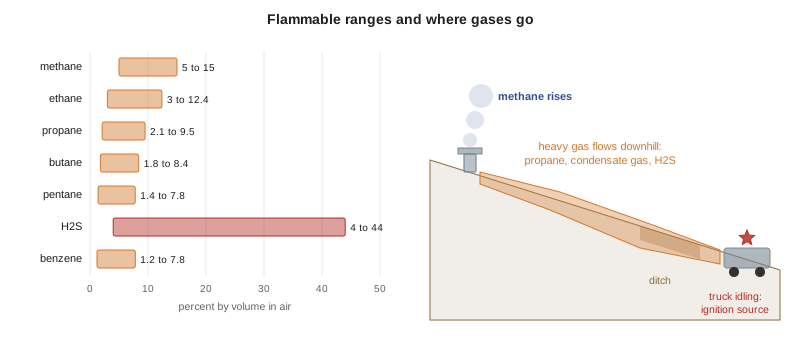
Two practical lessons come from the table. First, most of the heavier hydrocarbons have lower LELs than methane, so a smaller leak of condensate vapour or propane can reach a flammable concentration than the same leak of dry gas. Second, hydrogen sulphide is itself flammable, with a very wide flammable range, but it becomes deadly as a toxic gas at concentrations thousands of times below its LEL, so on sour sites the toxic hazard is reached long before the fire hazard.
Liquids have a flash point, the lowest temperature at which they give off enough vapour to form a flammable mixture just above the surface. Condensate and light crude oil have flash points well below zero, so they give off flammable vapour even in winter. Heavier crude oils and diesel fuel have higher flash points but can still burn readily once heated or sprayed as a mist. Fluids pumped into wells, such as methanol used to prevent hydrate formation and some fracturing additives, are also highly flammable.
Where vapour goes
Vapour density, the weight of a gas compared with air, decides where a release travels in still air. Methane is lighter than air and tends to rise and disperse outdoors, although it can collect under roofs and in the top of buildings. Propane, butane, condensate vapour, hydrogen sulphide and carbon dioxide are heavier than air and flow downhill like water into ditches, pits, excavations, cellars around wellheads, low-lying buildings and valleys. A release of cold gas, such as gas expanding through a leak, can behave as a heavy gas at first even if it is lighter than air when warm. Wind spreads and dilutes releases, but in calm conditions, especially at night and early morning when cold air settles, heavy vapour can travel a long way along the ground and reach an ignition source or a person far from the leak.
Ignition sources on a lease
Controlling ignition sources is the second line of defence after keeping hydrocarbons contained. Oil and gas sites have more ignition sources than many workers realize:
- Vehicles and engines: hot exhaust, catalytic converters, diesel engines that can overspeed on drawn-in gas, and electrical systems.
- Fired equipment: line heaters, heater-treaters, glycol reboilers, flares and incinerators, which have open flames by design.
- Electrical equipment that is not rated for the hazardous area, including extension cords, lights and tools.
- Phones, radios, cameras and other portable electronics that are not intrinsically safe.
- Static electricity from flowing fluids, sand transfer, vacuum trucks, filling containers, synthetic clothing and even steam or gas jets.
- Hot work and sparks from grinding, hammering on steel, or dropped tools.
- Pyrophoric iron sulphide, which forms inside equipment that handles sour fluids and can heat up and glow when exposed to air during maintenance.
- Lightning, especially at tanks and flare stacks.
- Smoking materials, which are banned on almost every site except in designated areas.
Pyrophoric iron sulphide deserves special mention because it surprises people. When sour gas or oil flows through steel equipment, iron sulphide scale builds up inside vessels, tanks and filters. While wet and away from air, it is harmless. When a vessel is opened and the scale dries, it can react with oxygen, heat up and ignite flammable vapour or nearby material, sometimes hours after the equipment was opened. Sites control it by keeping scale wet, purging with inert gas, removing scale carefully and monitoring opened equipment. HSE-332 covers vessel opening in more detail.
Hazardous areas and rated equipment
Where flammable gas or vapour may be present in normal operation or during upsets, the area is classified, and only equipment certified for that classification may be used. The Canadian Electrical Code, Part I, Section 18 uses zones: Zone 0 where a flammable atmosphere is present continuously or for long periods, Zone 1 where it is likely in normal operation, and Zone 2 where it is unlikely and brief. Older installations may still use the class and division system, in which Class I, Division 1 and Division 2 correspond roughly to Zones 0 and 1 together, and Zone 2. API recommended practices guide how petroleum facilities are classified. On site, the practical rules are simple: do not take unrated equipment into marked hazardous areas without a hot work or electrical permit and gas testing, and do not modify rated equipment, for example by leaving covers off explosion-proof enclosures.
Kinds of hydrocarbon fire
Hydrocarbon releases can burn in several ways, and the type of fire affects how people are hurt:
- A flash fire is a cloud of vapour that ignites and burns back to the source in a second or two. It produces intense heat for a short time and causes severe burns to anyone inside the cloud, which is why flame-resistant clothing is required on most sites.
- A jet fire is a burning release from a pressurized leak, which can cut through steel and cause other equipment to fail.
- A pool fire is a burning spill of liquid, such as crude oil or condensate in a tank dike.
- A vapour cloud explosion happens when a large flammable cloud ignites in a congested or confined area, such as among pipework or inside a building, producing a damaging pressure wave.
- A boiling liquid expanding vapour explosion (BLEVE) happens when a vessel of liquefied gas, such as propane, is heated by fire until it ruptures, releasing a fireball.
- A tank fire or explosion can follow ignition of vapour at a tank vent or thief hatch, sometimes blowing the roof off the tank.
Working out concentrations
Detectors and SDSs give concentrations in different units, and mixtures complicate the picture. The program below converts parts per million to percent LEL for several single gases, estimates the LEL of a gas mixture using Le Chatelier's rule (the reciprocal of the mixture LEL is the sum of each component's fraction divided by its LEL) and calculates vapour densities from molar masses, using air at 28.96 g/mol.
LEL = {"methane": 5.0, "ethane": 3.0, "propane": 2.1, "butane": 1.8, "H2S": 4.0}
MW = {"methane": 16.04, "ethane": 30.07, "propane": 44.10, "butane": 58.12, "H2S": 34.08}
AIR = 28.96

def pct_lel(gas, ppm):
    return ppm / (LEL[gas] * 10000) * 100

print("5,000 ppm of each gas as percent of its LEL:")
for g in LEL:
    print(f"  {g:8} {pct_lel(g, 5000):5.1f} %LEL   density vs air {MW[g] / AIR:4.2f}")

# A wet gas mixture by volume (illustrative), H2S included
mix = {"methane": 0.80, "ethane": 0.10, "propane": 0.06, "butane": 0.035, "H2S": 0.005}
lel_mix = 1 / sum(f / LEL[g] for g, f in mix.items())
mw_mix = sum(f * MW[g] for g, f in mix.items())
print(f"Mixture LEL by Le Chatelier: {lel_mix:.2f} % by volume")
print(f"Mixture density vs air: {mw_mix / AIR:.2f}")
print(f"H2S in the mixture: {mix['H2S'] * 1e6:,.0f} ppm")5,000 ppm of each gas as percent of its LEL: methane 10.0 %LEL density vs air 0.55 ethane 16.7 %LEL density vs air 1.04 propane 23.8 %LEL density vs air 1.52 butane 27.8 %LEL density vs air 2.01 H2S 12.5 %LEL density vs air 1.18 Mixture LEL by Le Chatelier: 4.12 % by volume Mixture density vs air: 0.71 H2S in the mixture: 5,000 ppm
The output shows why one ppm figure means very different things for different gases: 5,000 ppm is 10 percent of the LEL for methane but nearly 28 percent for butane. The wet gas mixture has an LEL of about 4.1 percent, below that of pure methane, and is lighter than air overall. Note, too, that the 0.5 percent hydrogen sulphide in the mixture is 5,000 ppm, far above the 100 ppm level that NIOSH considers immediately dangerous to life or health. If this gas leaked, the toxic hazard would be lethal long before the leak reached the LEL.
Worked problem
A reading at the thief hatch
A lease operator at Pinecrest approaches a condensate tank on a calm, cold morning. Her four-gas monitor, clipped at chest height, reads 25 percent LEL and 15 ppm H2S as she reaches the stairs; she has not yet opened anything. What do the readings tell her and what should she do?
Show solution
- The tank or a nearby fitting is already venting, because she has opened nothing. Condensate vapour is heavy and, on a calm cold morning, is flowing down from the tank and pooling at ground level and around the stairs.
- 25 percent LEL is well above the low alarm set point most sites use (often 10 percent LEL) and means a flammable atmosphere may exist closer to the source. 15 ppm H2S is also above typical alarm set points (Lesson 5).
- She should not climb the stairs or open the hatch. She should back away upwind and uphill to fresh air, keep ignition sources such as her truck and phone away from the area, and report the condition to the site supervisor.
- The source must be found and controlled under the site's procedures, possibly with a second person, supplied-air respiratory protection and further gas testing. Gauging should resume only when the tank is safe, preferably using remote or closed gauging that avoids opening the hatch.
Answer: The tank is venting heavy, flammable and toxic vapour; she should retreat upwind and uphill, control ignition sources, report it and not open the hatch until the source is controlled.
Common mistakes
MistakeAssuming natural gas always rises out of the way.
InsteadRemember that wet gas components, condensate vapour and H2S are heavier than air and pool in low areas.
MistakeTreating a reading of a few percent LEL as harmless on a sour site.
InsteadCheck the H2S reading too; toxic levels are reached far below the LEL.
MistakeUsing an ordinary phone or extension cord near a wellhead or tank.
InsteadUse only equipment rated for the hazardous area, or work under a permit with gas testing.
MistakeLetting iron sulphide scale dry out in an opened vessel.
InsteadKeep pyrophoric scale wet or inert and monitor opened equipment.
MistakeThinking condensate is safe in winter because it is cold.
InsteadKnow that condensate has a flash point well below zero and gives off flammable vapour in any season.
Summary and key terms
- Well streams contain methane and heavier hydrocarbons, water, often carbon dioxide and H2S, and trace toxics such as benzene.
- A gas burns only between its LEL and UEL; detectors report flammable gas as percent of LEL, and 1 percent by volume equals 10,000 ppm.
- Heavier hydrocarbons have lower LELs than methane; H2S is flammable but lethal as a toxic gas far below its LEL.
- Condensate and light crude have flash points below zero and vaporize readily all year.
- Heavier-than-air vapours flow downhill and pool in ditches, cellars and low buildings, especially in calm, cold conditions.
- Ignition sources include vehicles, fired equipment, unrated electrical equipment, phones, static, hot work, pyrophoric iron sulphide and lightning.
- Hydrocarbon fires include flash fires, jet fires, pool fires, vapour cloud explosions, BLEVEs and tank fires.
- Lower explosive limit (LEL)
- The lowest concentration of a gas or vapour in air that can burn.
- Upper explosive limit (UEL)
- The highest concentration of a gas or vapour in air that can burn.
- Condensate
- A light, volatile hydrocarbon liquid that condenses from natural gas.
- Sour gas
- Natural gas containing significant hydrogen sulphide.
- Vapour density
- The density of a gas or vapour compared with air; above 1 means heavier than air.
- Pyrophoric iron sulphide
- Iron sulphide scale from sour service that can self-heat and ignite when exposed to air.
- Flash fire
- The rapid burning of a flammable vapour cloud, lasting a few seconds.
Practice problems
Work each problem on paper first, then reveal the answer to check.
How many ppm is 1 percent by volume?
Show answer
10,000 ppm.
At about what concentration does methane reach its LEL?
Show answer
About 5 percent by volume, or 50,000 ppm.
Which is reached first on a sour site as a leak grows: the toxic hazard of H2S or its LEL?
Show answer
The toxic hazard, far below the LEL.
Name three gases or vapours that are heavier than air.
Show answer
Any three of propane, butane, pentane or condensate vapour, H2S, carbon dioxide, benzene.
Why are calm, cold mornings especially hazardous for heavy vapours?
Show answer
Cold air settles and there is little wind to dilute releases, so heavy vapour travels along the ground and pools.
List five ignition sources found on a lease.
Show answer
Any five of vehicles, fired equipment, flares, unrated electrical equipment, phones, static, hot work, sparks, pyrophoric iron sulphide, lightning, smoking.
What is pyrophoric iron sulphide and when is it dangerous?
Show answer
Scale from sour service that can heat and ignite when equipment is opened and the scale dries in air.
What does a hazardous area classification tell you?
Show answer
How likely a flammable atmosphere is, and therefore what equipment ratings are required.
Why is flame-resistant clothing worn on most sites?
Show answer
To reduce burns from flash fires, which last only seconds but are intensely hot.
Using Le Chatelier's rule, what was the LEL of the wet gas mixture in the program?
Show answer
About 4.1 percent by volume.
Lesson quiz · 5 questions
Score 60% or more to complete this lesson.
Create a free account to save your progress, take quizzes and earn a certificate.