
HSE-330 · Lesson 10 of 12 · 26 min
Contractors, prime contractors and multi-employer sites
Few oil and gas sites are worked by a single employer. A typical pad during completion might have the operator's wellsite supervisor, a fracturing company, a wireline contractor, a coiled tubing unit, water transfer and trucking companies, rental equipment providers, a flowback crew, a security service and a steady stream of delivery drivers, each with its own supervisors and procedures. The NIOSH data in Lesson 1 showed that most fatalities were among contractors, especially well servicing workers. When work is split among many employers, hazards fall into the gaps between them: one crew's work endangers another, nobody is sure who is in charge, and everyone assumes someone else has checked. This lesson explains how the law assigns responsibility on multi-employer sites, how operators manage contractors and how workers can keep themselves safe in a crowded workplace.
HSE-221 Lesson 9 covered simultaneous operations and interfaces under permit systems, and HSE-230 covers field-level hazard assessment. HSE-406, Contractor Safety Management, will cover the management system side for safety professionals in depth. This lesson gives the orientation-level view that every worker and new supervisor on an oil and gas site needs.
Who is on site
It helps to know the roles you will meet:
- The licensee or operator: the company that holds the energy regulator's licence and controls the site. Its representative on location is often called the wellsite supervisor, consultant or company representative.
- The prime contractor: the party designated to coordinate health and safety for the whole site when two or more employers are present.
- Contractors: drilling, completion, servicing, construction, maintenance and trucking companies, each the employer of its own workers.
- Subcontractors and owner-operators: companies and self-employed people hired by contractors, often for short tasks.
- Suppliers and service providers: rental equipment companies, chemical suppliers and technicians who deliver and set up equipment.
- Visitors and regulators: landowners, inspectors, engineers and others who need orientation and escort.
How the law assigns responsibility
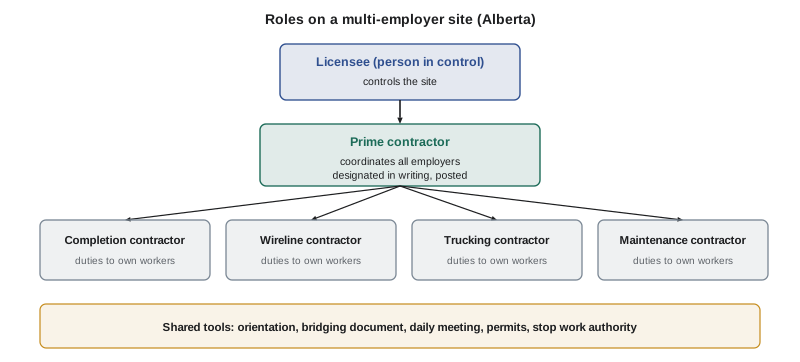
In Alberta, the Occupational Health and Safety Act requires a prime contractor on every oil and gas work site, and every construction site, where two or more employers or self-employed persons are working. The person in control of the work site, usually the licensee, must designate the prime contractor in writing and post its name where it can be seen; if nobody is designated, the person in control is treated as the prime contractor. The prime contractor must establish a system that ensures compliance with the law and cooperation between employers and workers, designate a person to oversee that cooperation and the health and safety committee duties for the site, inform everyone on site of known hazards and keep its own work free of uncontrolled hazards. Each employer, contractor and supplier keeps its own duties as well. British Columbia's Workers Compensation Act has a similar prime contractor requirement for multiple-employer workplaces, with the owner acting as prime contractor unless it designates someone else in writing, and Saskatchewan's law also places coordination duties on contractors and owners at multi-employer worksites.
Managing contractors: the life cycle
Good operators manage contractors through a life cycle rather than relying on a contract clause. Before work, they prequalify contractors by reviewing their safety program, training records, injury statistics and certifications such as a Certificate of Recognition (COR), which Energy Safety Canada administers for the oil and gas industry in Alberta; many use third-party prequalification services. They then plan each job with the contractor, agree how hazards at the interfaces will be controlled and confirm that workers have the required training. During the work, they orient contractor workers, hold coordination meetings, monitor performance and stop work when needed. After the work, they evaluate the contractor's performance and feed the results into future selection.
A key planning tool is the bridging document, which links the operator's safety management system with each contractor's. It records whose procedures apply to which activities (for example, the operator's permit system, the contractor's lifting procedures), who is responsible for gas monitoring, emergency response and incident reporting, and how differences between the two systems will be resolved. Without a bridging document, two crews on the same site may follow different rules for the same hazard.
| Stage | What happens | Common failure |
|---|---|---|
| Prequalification | Review safety program, training, injury rates and certifications | Choosing on price alone; accepting paperwork without checking |
| Job planning | Scope, hazards, bridging document, training requirements, SIMOPS review | No discussion of how one crew's work affects another |
| Mobilization and orientation | Site orientation, ticket checks, equipment inspection | Late-arriving workers skip orientation |
| Execution | Daily coordination meetings, permits, FLHAs, supervision, audits | Supervisors absent; changes made without reassessment |
| Evaluation and close-out | Performance review, lessons learned, feedback to selection | No feedback; same problems repeat on the next job |
New and short-service workers
Workers new to the industry, to a company or to a type of job are injured at higher rates than experienced workers. Many operators and contractors run short-service employee programs: new workers wear a distinctive hard hat colour or sticker for their first months, are assigned a mentor, are limited to a set number per crew and are not allowed to do certain high-risk tasks alone. If you are new, ask questions and say when you have not done a task before; if you are experienced, watch out for new crew members, explain why things are done and stop them before they step into a hazard.
Coordinating on the day
On a busy site, coordination happens through a few routine tools:
- A daily coordination or pre-job meeting where all crews share their plans for the day, identify conflicts and agree on controls.
- Field-level hazard assessments or job safety analyses for each task, reviewed when conditions change (HSE-230).
- A permit system that controls hazardous work and shows who is working where (HSE-221 and HSE-333).
- A simultaneous operations (SIMOPS) plan when different operations, such as production and completion or crane lifts and hot work, happen close together.
- Shift handovers that pass on the state of work, permits and isolations.
- Stop work authority, which allows any worker to stop a task they believe is unsafe, without fear of reprisal.
Stop work authority deserves emphasis. It only works if people use it and supervisors back it. On a multi-employer site, a worker from one company may see a hazard created by another company's crew. Stopping the work and raising the concern is the right thing to do, and most operators make clear that stop work authority extends across company lines. The right to refuse unsafe work under OHS law, explained in HSE-101, protects workers who refuse work they believe endangers them.
Visitors and escorts
Visitors such as engineers, sales representatives, landowners, auditors and new managers often know little about oil and gas hazards. Most sites require every visitor to sign in, receive at least a short orientation covering alarms, muster points, wind direction and restricted areas, wear the required PPE and a gas monitor where H2S may be present, and stay with a trained escort. The escort is responsible for keeping the visitor out of red zones and hazardous areas and for leading them to safety in an emergency. Inspectors from regulators also sign in and receive orientation, although they have legal powers to enter and examine the site.
Incidents on multi-employer sites
When something goes wrong on a site with many employers, reporting and investigation must not fall into the gaps. Every injury, near miss and dangerous occurrence should be reported to the worker's own supervisor and to the coordinating party for the site, whatever company the worker belongs to. Legal reports to the OHS regulator are usually the duty of the injured worker's employer, and some events must also be reported by the operator to the energy regulator. Investigations work best when they involve all the employers whose work contributed, so that each can fix its part, and when lessons are shared across crews and companies rather than kept within one. A contractor that hides incidents to protect its standing with the operator puts everyone on the site at risk; operators that punish contractors for honest reporting encourage exactly that.
Communication is a recurring cause of multi-employer incidents. Crews may use different radio channels, different terms for the same equipment and, sometimes, different working languages. Sites reduce the risk by agreeing a common radio channel for emergencies, using plain language rather than company jargon in coordination meetings, confirming instructions by repeating them back and making sure every worker can understand alarms and emergency instructions.
Measuring contractor safety
Operators compare contractors using injury statistics. The total recordable injury frequency (TRIF) counts injuries that need medical treatment beyond first aid, lost time or restricted work, per 200,000 hours worked, which is roughly 100 workers working for a year. Lost-time injury frequency counts only injuries that cause time away from work. Statistics from small contractors swing widely from year to year, so operators look at trends and at leading indicators such as training completion, inspections and near-miss reporting as well. The program below calculates these rates for three invented contractors bidding for work at Pinecrest.
# Invented contractor data: name, hours worked, recordable injuries, lost-time injuries, COR held
bids = [("Contractor A", 410_000, 3, 1, True),
        ("Contractor B", 95_000, 2, 1, True),
        ("Contractor C", 260_000, 1, 0, False)]
for name, hours, rec, lti, cor in bids:
    trif = rec * 200_000 / hours
    ltif = lti * 200_000 / hours
    flags = [] if cor else ["no COR: review program before award"]
    if hours < 200_000:
        flags.append("small sample: look at 3-year trend")
print(f"{name}: TRIF {trif:4.2f}, LTIF {ltif:4.2f}", "; ".join(flags))Contractor A: TRIF 1.46, LTIF 0.49 Contractor B: TRIF 4.21, LTIF 2.11 small sample: look at 3-year trend Contractor C: TRIF 0.77, LTIF 0.00 no COR: review program before award
No single number decides a contract. Contractor B's rates look worst, but its small number of hours means one or two injuries swing the rate widely, so its three-year trend and program matter more. Contractor C has the best rate this year but raises a different question that needs a closer look at its program. Numbers start a conversation about how each contractor manages its hazards; they do not end it.
Worked problem
Two crews, one hazard
At Pinecrest, a maintenance contractor is replacing a valve on the battery inlet while a trucking contractor loads condensate from the tanks 20 m (66 ft) away. The maintenance crew plans to vent the line to atmosphere before removing the valve. Nobody has told the truck driver. What should have happened, and who is responsible?
Show solution
- The two activities interact: venting releases flammable and possibly sour gas, and the truck's engine and loading operation are ignition sources and put the driver downwind of the vent if the wind shifts.
- The daily coordination meeting or SIMOPS review should have identified the conflict, and the permit for the valve work should have required stopping loading, or scheduling it at another time, before venting.
- The prime contractor is responsible for the system that coordinates the employers; the maintenance contractor, as the employer creating the hazard, must assess and control it; the trucking company must protect its driver. The licensee keeps its own duties for the site.
- Anyone who notices the conflict, including the truck driver, should use stop work authority until the two jobs are coordinated.
Answer: The interaction should have been caught by coordination and permits; responsibility is shared by the coordinating party and each employer, and anyone can stop the work.
Common mistakes
MistakeAssuming the operator handles all safety, so contractors need not plan.
InsteadKnow that each employer keeps its duties to its own workers, and the coordinating party coordinates all employers.
MistakeChoosing contractors on price and paperwork alone.
InsteadPrequalify on program and performance, then plan, monitor and evaluate the work.
MistakeStarting work without telling other crews what you will do.
InsteadShare plans at the coordination meeting and check for simultaneous operations conflicts.
MistakeIgnoring a hazard because another company created it.
InsteadUse stop work authority and report it, whoever created it.
MistakeJudging a small contractor on one year's injury rate.
InsteadLook at trends, leading indicators and the safety program as well.
Summary and key terms
- Oil and gas sites usually have many employers, and most fatalities are among contractors.
- Alberta requires a prime contractor on oil and gas work sites with two or more employers, designated in writing and posted; British Columbia and Saskatchewan have similar coordination duties.
- Every employer keeps its duties to its own workers, and the operator keeps its duties for the site.
- Contractor safety management follows a life cycle: prequalify, plan, orient, execute and monitor, evaluate.
- Bridging documents define whose procedures apply and who does what at the interfaces.
- Short-service employee programs, coordination meetings, permits, SIMOPS plans and stop work authority control multi-employer hazards.
- Injury rates per 200,000 hours help compare contractors but must be read with trends and leading indicators.
- Prime contractor
- In Alberta and British Columbia, the party designated to coordinate health and safety on a site with two or more employers.
- Controlling employer
- Under OSHA's multi-employer policy, an employer with general authority to correct hazards on a site.
- Bridging document
- A document linking the safety management systems of an operator and a contractor for a job.
- Prequalification
- Assessing a contractor's safety program and performance before awarding work.
- Short-service employee
- A worker new to the industry, company or job, often identified and mentored for a period.
- Stop work authority
- The authority of any worker to stop a task believed to be unsafe.
- SIMOPS
- Simultaneous operations: different activities happening close together that may interact.
Practice problems
Work each problem on paper first, then reveal the answer to check.
When does Alberta law require a prime contractor on an oil and gas work site?
Show answer
When two or more employers or self-employed persons are working on the site.
What happens if no prime contractor is designated in Alberta?
Show answer
The person in control of the work site is treated as the prime contractor.
List the stages of the contractor safety management life cycle.
Show answer
Prequalification, job planning, mobilization and orientation, execution and monitoring, evaluation and close-out.
What does a bridging document record?
Show answer
Whose procedures apply to which activities and who is responsible for monitoring, emergency response and reporting.
Why do many companies mark short-service employees?
Show answer
New workers are injured at higher rates, so others can watch out for and mentor them.
Name four coordination tools on a busy site.
Show answer
Any four of daily coordination meetings, FLHAs or JSAs, permits, SIMOPS plans, shift handovers, stop work authority.
How is an injury frequency rate per 200,000 hours calculated?
Show answer
Number of injuries multiplied by 200,000, divided by hours worked.
Why can a small contractor's injury rate be misleading?
Show answer
With few hours, one or two injuries change the rate greatly; trends matter more.
Who may use stop work authority?
Show answer
Any worker, including workers of other companies on the site.
In the venting example, what tool should have caught the conflict?
Show answer
The daily coordination meeting or SIMOPS review, and the permit for the valve work.
Lesson quiz · 5 questions
Score 60% or more to complete this lesson.
Create a free account to save your progress, take quizzes and earn a certificate.