
HSE-330 · Lesson 8 of 12 · 28 min
Mechanical, falling and environmental hazards on sites
Gas, fire and pressure get most of the attention in oil and gas safety, but the NIOSH data in Lesson 1 showed that contact injuries, being struck by, caught in or crushed by equipment and objects, were the second largest cause of death after vehicles. Falls, burns, noise, extreme weather and wildlife injure many more workers every year. This lesson covers the mechanical hazards of oilfield equipment, dropped objects, falls, overhead power lines, noise, hot and cold surfaces and the natural environment that surrounds most sites. Each topic has its own course elsewhere in the safety program; the aim here is to show how they appear on an oil and gas lease.
HSE-215 covers machine guarding, HSE-218 forklifts and mobile equipment, HSE-219 cranes and rigging, HSE-212 and HSE-213 working at heights, ladders and scaffolds, HSE-214 electrical safety including overhead lines, HSE-241 noise and HSE-243 heat and cold stress. Rig floor and pipe handling hazards belong to HSE-331.
Rotating and reciprocating equipment
Production sites have machinery that runs unattended and can start without warning. The pump jack, or beam pumping unit, is the most familiar: an electric motor or engine turns a crank with heavy counterweights that swing through a large arc while the walking beam rocks the polished rod up and down. Workers have been killed by swinging counterweights and caught in belts and the crank when guards were removed or when units started automatically on a timer or remote command. Compressors have belts, flywheels, fans and couplings; pumps have shafts and couplings; generators and engines have fans and belts. Many of these start automatically.
The rules are consistent. Keep guards and fences in place, and never reach past or remove a guard on running equipment. Do not enter the swing area of a pump jack while it can move. Before maintenance, follow the site's lockout procedure: for a pump jack that means stopping the unit, setting the brake, securing the crank or counterweights so that they cannot rotate under their own weight, and locking out the power or engine. Stored mechanical energy in counterweights is easy to forget: a stopped unit with an unsecured crank can roll when the brake is released or when the polished rod clamp is loosened. HSE-210 explains lockout and HSE-215 explains guarding.
Struck by and caught between
Pads are crowded during drilling, completion and servicing. Trucks reverse, loaders and telehandlers carry pipe and equipment, cranes lift loads, and crews connect and disconnect heavy iron. The common injuries are being struck by a moving vehicle or a swinging load, caught between a load and a fixed object, and crushed by shifting pipe or equipment. Controls include traffic plans with one-way routes, spotters for every reversing manoeuvre, keeping out of the swing radius of cranes and loaders, tag lines instead of hands on suspended loads, chocks and pipe stops on pipe racks, and clear communication between equipment operators and ground crew. Stay out of the line of fire: never stand between a moving load and something it could pin you against.
Dropped objects
Anything at height can fall: tools on a tank walkway, a hammer on a rig floor, a bolt from a derrick, an unsecured part on a crane hook, ice from a structure. A small object falling a long way carries enough energy to kill. Industry programs such as DROPS, a dropped objects prevention initiative that started in the offshore industry, provide calculators that classify dropped object outcomes by mass and fall height, and promote tool tethering, secondary retention on fixtures at height, inspections of structures for loose items, and barricaded drop zones beneath overhead work. Hard hats reduce injury from small objects but cannot protect against heavy ones. The program later in this lesson calculates the energy of some typical falling objects.
Falls from height and on the same level
Workers fall from tank tops and walkways, truck decks and trailers, ladders, catwalks, pipe racks and derricks. Gauging tanks, loading and unloading, and inspecting equipment at height are common tasks that lead to falls. Fixed stairs and walkways with guardrails are the best control; where they are missing, fall protection is required at heights set by law, commonly 3 m (10 ft) in Canadian provinces and 4 ft (1.2 m) in US general industry, with lower thresholds for some situations. Slips and trips on the same level are more frequent: mud, oil, drilling fluid, ice and snow, uneven ground, hoses and cables across walkways. Good footwear with suitable soles, ice cleats in winter, housekeeping and lighting all help.
Overhead power lines
Rigs, service unit masts, cranes, picker trucks, dump trucks and vacuum truck booms can contact overhead power lines on or near leases. Contact can kill operators and people touching the equipment or standing nearby, and the ground around a contacted machine becomes energized. Leases are often crossed by distribution lines, and the lines are hard to see against the sky. Before raising a mast or boom, identify all lines, keep the required limits of approach (which increase with voltage and are set in provincial OHS codes and, in the United States, in OSHA standards, commonly at least 3 m (10 ft) for lines up to 50 kV), use a spotter, and ask the utility to de-energize or relocate lines where work must come closer. If a machine contacts a line, stay in the cab if it is safe to do so and warn others to keep away; HSE-214 explains what to do if you must leave.
Noise, heat and cold
Compressors, engines, pumps, flares and fracturing fleets are loud. Noise near a compressor or a frac pump can exceed 100 dBA, enough to damage hearing in minutes. Sites post hearing protection zones, and workers should wear protection wherever they must raise their voice to be heard at arm's length. HSE-241 covers noise measurement and hearing conservation.
Hot surfaces are everywhere: engine exhausts, line heaters, heater-treaters, glycol reboilers, steam lines at in-situ oil sands facilities, flare stacks and the radiant heat zone around a flare. Steam and hot fluid releases cause severe scalds. Cold is the bigger environmental hazard across most of western Canada for much of the year. Air temperatures below −30 °C (−22 °F) with wind create frostbite risk on exposed skin within minutes, and metal surfaces can freeze to bare skin. Environment and Climate Change Canada's wind chill index, which the next program calculates, tells you how cold the wind makes it feel and how quickly skin can freeze. Work-warm-up schedules, insulated clothing, heated shelters and buddy checks for frostbite are standard winter controls. In summer, heat stress affects workers in flame-resistant clothing, especially during heavy work. HSE-243 covers both.
import math
g = 9.81
print("Energy of falling objects (E = m x g x h):")
for name, kg, h in [("radio", 0.4, 6.0), ("wrench", 1.5, 6.0), ("hammer", 2.0, 25.0), ("bolt", 0.2, 30.0)]:
    E = kg * g * h
    v = math.sqrt(2 * g * h)
    print(f"  {name:7} {kg:4.1f} kg from {h:4.1f} m ({h * 3.281:5.1f} ft): {E:5.0f} J, impact {v:4.1f} m/s")

def wind_chill(t_c, v_kmh):
    # Wind chill index used by Environment and Climate Change Canada and the US NWS
    return 13.12 + 0.6215 * t_c - 11.37 * v_kmh ** 0.16 + 0.3965 * t_c * v_kmh ** 0.16
print("Wind chill:")
for t in (-10, -20, -30):
    for v in (10, 30, 50):
        wc = wind_chill(t, v)
print(f" air {t:4d} C ({t * 9 / 5 + 32:5.0f} F), wind {v:2d} km/h ({v / 1.609:4.0f} mph): feels like {wc:6.1f} C ({wc * 9 / 5 + 32:6.1f} F)")Energy of falling objects (E = m x g x h): radio 0.4 kg from 6.0 m ( 19.7 ft): 24 J, impact 10.8 m/s wrench 1.5 kg from 6.0 m ( 19.7 ft): 88 J, impact 10.8 m/s hammer 2.0 kg from 25.0 m ( 82.0 ft): 490 J, impact 22.1 m/s bolt 0.2 kg from 30.0 m ( 98.4 ft): 59 J, impact 24.3 m/s Wind chill: air -10 C ( 14 F), wind 10 km/h ( 6 mph): feels like -15.3 C ( 4.5 F) air -10 C ( 14 F), wind 30 km/h ( 19 mph): feels like -19.5 C ( -3.1 F) air -10 C ( 14 F), wind 50 km/h ( 31 mph): feels like -21.8 C ( -7.2 F) air -20 C ( -4 F), wind 10 km/h ( 6 mph): feels like -27.2 C ( -17.0 F) air -20 C ( -4 F), wind 30 km/h ( 19 mph): feels like -32.6 C ( -26.6 F) air -20 C ( -4 F), wind 50 km/h ( 31 mph): feels like -35.4 C ( -31.7 F) air -30 C ( -22 F), wind 10 km/h ( 6 mph): feels like -39.2 C ( -38.5 F) air -30 C ( -22 F), wind 30 km/h ( 19 mph): feels like -45.6 C ( -50.1 F) air -30 C ( -22 F), wind 50 km/h ( 31 mph): feels like -49.0 C ( -56.3 F)
A 2 kg hammer dropped 25 m strikes with about 490 joules of energy, far more than a hard hat is designed to absorb, and even a 0.2 kg bolt from 30 m arrives at about 24 m/s. That is why tethering and exclusion zones matter more than hard hats for work at height. The wind chill table shows how quickly conditions become dangerous: at −30 °C (−22 °F) with a 50 km/h (31 mph) wind, it feels like about −49 °C (−56 °F), a level at which exposed skin can freeze within a few minutes.
Weather and wildfire
Weather changes the hazards of a site quickly. Lightning strikes tanks, flare stacks, rigs and people standing in the open; many operators stop work at height and on tanks when lightning is within a set distance and resume only after a waiting period without thunder. Tornadoes, hail and straight-line winds threaten rigs and temporary structures on the plains. Blizzards and whiteouts strand workers on lease roads, so journey management and survival kits matter (Lesson 3). Spring thaw and heavy rain flood leases, soften roads and undermine equipment foundations.
Wildfire is a growing hazard for oil and gas operations in both countries. In May 2016, the Horse River wildfire forced the evacuation of the entire city of Fort McMurray, Alberta, about 88,000 people, destroyed about 2,400 buildings and shut in more than one million barrels per day of oil sands production while operators evacuated sites and workers. Smaller fires threaten leases every summer. Sites need wildfire plans that cover monitoring fire bans and fire danger, controlling ignition sources such as hot work, vehicles in dry grass and flares, keeping firebreaks and vegetation clear around facilities, shutting in and evacuating safely, and coping with smoke, which affects air quality far from the fire.
Wildlife and biological hazards
Most leases are in forest, muskeg or farmland, and wildlife is part of the workplace. Black bears and grizzly bears are attracted by food and garbage at camps and sites; carry bear spray where bears are present, keep food and garbage secured, make noise when walking in brush and report sightings. Cougars, wolves and moose are less common hazards on foot but moose and deer are a serious collision hazard on roads at dawn and dusk. Insects bring bites and stings, which can cause severe allergic reactions in some workers, and ticks can carry Lyme disease. Rodents in unused shacks and buildings can leave droppings that carry hantavirus: do not sweep or vacuum droppings dry; wet them with disinfectant first and wear the protection your site specifies.
| Hazard | Where on a lease | Key controls |
|---|---|---|
| Rotating equipment | Pump jacks, compressors, pumps, engines | Guards and fences in place, stay out of swing areas, lock out and secure stored energy |
| Struck by and caught between | Pipe handling, reversing trucks, loaders, cranes | Traffic plans, spotters, tag lines, stay out of swing radius and pinch points |
| Dropped objects | Tank tops, rigs, cranes, structures | Tool tethering, secondary retention, drop zones, inspections |
| Falls | Tank walkways, truck decks, ladders, catwalks | Guardrails, fall protection, three-point contact, ice cleats, housekeeping |
| Overhead power lines | Lease edges, roads, near masts and booms | Identify lines, limits of approach, spotters, utility de-energizing |
| Noise | Compressors, engines, flares, frac fleets | Hearing protection zones, enclosures, limiting time |
| Heat and cold | Heaters, exhausts, steam, flares, weather | Insulation and guards, work-warm-up or work-rest schedules, clothing, buddy checks |
| Weather and wildfire | Whole site | Lightning rules, forecasts, wildfire plans, journey management |
| Wildlife and biological | Treelines, buildings, roads | Bear spray or snake awareness, food and garbage control, safe cleanup of droppings |
Worked problem
A hazard walk at Pinecrest
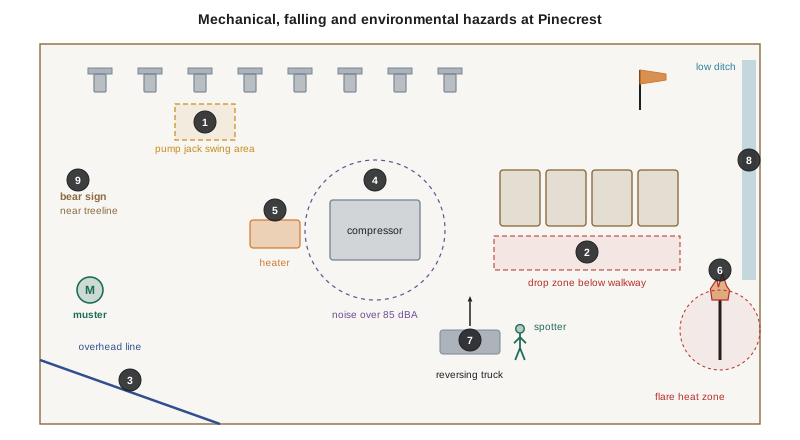
A new lease operator does her first hazard walk at Pinecrest with the area supervisor on a windy October afternoon. Using the figure, list the hazards they should note and one control each.
Show solution
- Pump jacks: check that fences and belt guards are in place and that the units are on automatic timers, so they must be treated as able to start at any time.
- Tank stairs and walkway: check guardrails, ice and housekeeping, and that no tools or loose items are on the walkway above the drop zone.
- Overhead line at the corner of the lease: note its location for any truck with a boom or mast and confirm that warning signs or goal posts are in place.
- Compressor building: hearing protection is required inside; the line heater and flare have hot surfaces and a radiant heat zone to stay out of.
- Reversing area: a spotter is required for trucks backing to the tanks. The low ditch on the east side can collect heavy gas. The bear sign near the treeline means bear spray should be carried and garbage kept in the bear-proof bin.
Answer: Pump jacks, tank stairs and drop zone, overhead line, noise, hot surfaces and flare, reversing trucks, the low ditch and wildlife, each with its control.
Common mistakes
MistakeAssuming a stopped pump jack will stay stopped.
InsteadTreat it as able to start or roll; lock out and secure the crank before work.
MistakeStanding between a reversing truck and a tank or pipe rack.
InsteadStay out of pinch points and use a spotter for reversing.
MistakeCarrying untethered tools onto a tank walkway or derrick.
InsteadTether tools at height and keep a drop zone below.
MistakeRaising a boom without checking for overhead lines.
InsteadIdentify lines first, keep limits of approach and use a spotter.
MistakeSweeping rodent droppings out of a shack.
InsteadWet them with disinfectant first and wear the specified protection.
Summary and key terms
- Contact injuries are the second leading cause of death in US oil and gas extraction after vehicles.
- Pump jacks and compressors can start automatically; keep guards in place, stay out of swing areas and lock out and secure stored energy.
- Traffic plans, spotters, tag lines and line-of-fire awareness control struck-by and caught-between hazards.
- Dropped objects carry lethal energy from height; tether tools and keep drop zones clear.
- Falls from tanks, trucks and ladders need guardrails or fall protection; slips on mud and ice need footwear, cleats and housekeeping.
- Overhead power line contact is prevented by identifying lines, limits of approach and spotters.
- Noise, hot surfaces, cold, lightning, wildfire, wildlife and biological hazards are part of most leases and need planned controls.
- Pump jack
- A beam pumping unit that lifts fluid from a well using a crank, counterweights and a walking beam.
- Swing area
- The space through which counterweights or other moving parts travel.
- Spotter
- A person who guides a vehicle or equipment operator and watches for hazards.
- Drop zone
- A barricaded area below overhead work where falling objects could land.
- Tool tethering
- Attaching tools to the worker or structure so that they cannot fall.
- Limit of approach
- The minimum distance that people and equipment must keep from energized power lines.
- Wind chill
- An index of how cold the air feels on exposed skin when wind is combined with low temperature.
Practice problems
Work each problem on paper first, then reveal the answer to check.
What is the second leading cause of death in US oil and gas extraction after vehicles?
Show answer
Contact injuries (struck by, caught in or crushed by equipment and objects).
Why must a stopped pump jack be secured before work?
Show answer
It may start automatically, and counterweights can rotate under their own weight when the brake is released.
Give three controls for struck-by hazards on a busy pad.
Show answer
Any three of traffic plans, spotters, tag lines, staying out of swing radius, chocks and pipe stops, clear communication.
How much energy does a 2 kg hammer have after falling 25 m?
Show answer
About 490 joules.
What OSHA limit of approach applies to lines up to 50 kV?
Show answer
At least 10 ft (3 m).
What noise level can occur near compressors and frac pumps?
Show answer
Over 100 dBA.
What does the wind chill index tell you?
Show answer
How cold the wind makes it feel on exposed skin and how quickly skin can freeze.
What happened during the 2016 Fort McMurray wildfire?
Show answer
About 88,000 people were evacuated, about 2,400 buildings were destroyed and more than one million barrels per day of oil sands production was shut in.
How should rodent droppings in a shack be cleaned up?
Show answer
Wet them with disinfectant first, do not sweep or vacuum dry, and wear the specified protection.
Name three hazards found on the Pinecrest hazard walk.
Show answer
Any three of pump jacks, tank stairs and drop zone, overhead line, compressor noise, hot surfaces and flare, reversing trucks, low ditch, bears.
Lesson quiz · 5 questions
Score 60% or more to complete this lesson.
Create a free account to save your progress, take quizzes and earn a certificate.