
HSE-252 · Lesson 9 of 12 · 25 min
Vulnerable road users, work zones and special vehicles
Not everyone on the road is protected by a steel body, airbags and seatbelts. Pedestrians, cyclists, motorcyclists, e-scooter riders and roadside workers are vulnerable road users: in a collision with a vehicle, they almost always come off worst. Work drivers also share the road with vehicles that behave differently from cars, such as large trucks, buses, school buses and emergency vehicles. This lesson covers how to share the road safely with all of them, and introduces work zones, which HSE-373 covers in depth.
Why vulnerable road users are at such risk
The human body tolerates impact poorly. A pedestrian struck at 30 km/h (about 20 mph) usually survives; at 50 km/h (about 30 mph) the risk of death is several times higher, and above about 60 km/h (about 40 mph) most pedestrians struck are killed. Older pedestrians are more vulnerable at every speed. Large vehicles such as pickups and SUVs with high, blunt fronts tend to strike adults in the torso and children in the head, and research has linked them to higher pedestrian injury severity than lower cars. Pedestrian deaths have risen in both Canada and the United States over the past decade even as other road deaths have changed less, and many happen at night, away from intersections, on wide urban roads.
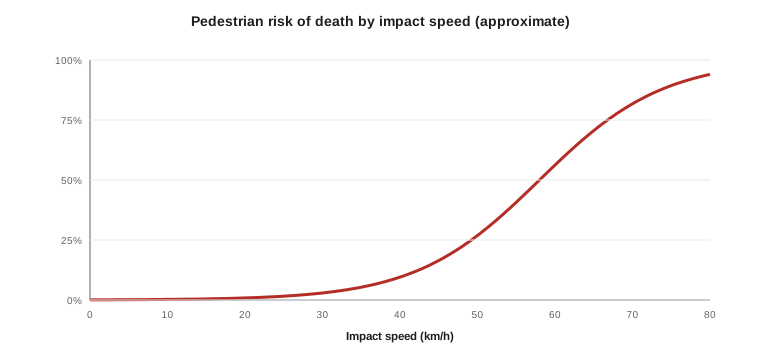
# Illustrative pedestrian fatality risk curve (logistic shape, approximate published values).
import math
def fatality_risk(kmh):
    return 1 / (1 + math.exp(-(kmh - 58) / 8))

for kmh in (20, 30, 40, 50, 60, 70):
print(f"Impact at {kmh:>2} km/h ({kmh / 1.609:4.0f} mph): about {fatality_risk(kmh):4.0%} risk of death (illustrative)")Impact at 20 km/h ( 12 mph): about 1% risk of death (illustrative) Impact at 30 km/h ( 19 mph): about 3% risk of death (illustrative) Impact at 40 km/h ( 25 mph): about 10% risk of death (illustrative) Impact at 50 km/h ( 31 mph): about 27% risk of death (illustrative) Impact at 60 km/h ( 37 mph): about 56% risk of death (illustrative) Impact at 70 km/h ( 44 mph): about 82% risk of death (illustrative)
Pedestrians
Expect pedestrians wherever they could be: near schools, bus stops, shopping areas, parking lots and residential streets, and also on rural roads without sidewalks. At night, people in dark clothing may be visible only at very short range. Slow down and scan crosswalks and road edges, especially when turning, because many pedestrian collisions happen when a turning driver is focused on finding a gap in traffic and does not see someone crossing. Never pass a vehicle that has stopped at a crosswalk; it may be stopped for someone you cannot see. Make eye contact where you can, but do not assume a pedestrian has seen you.
Cyclists and micromobility
Cyclists have the same rights to the road as drivers in most places, and many cities are adding bike lanes and separated paths. E-bikes and e-scooters travel faster than many drivers expect. Common collisions include right hooks (a driver turns right across a cyclist going straight), left crosses (a driver turns left across an oncoming cyclist), dooring (a driver or passenger opens a door into a cyclist) and unsafe passing.
| Situation | Defensive action |
|---|---|
| Turning right | Check mirrors and shoulder check for cyclists on your right before turning; yield |
| Turning left | Watch for oncoming cyclists, who may be moving faster than they appear |
| Opening a door | Use the far hand (the "Dutch reach") so you turn and see behind you |
| Passing | Wait for a safe gap and leave plenty of room; many jurisdictions set a minimum |
| Bike lanes | Do not drive, stop or park in them; cross them only to turn, after checking |
| Parking and loading | Do not block bike lanes for deliveries; find a legal space |
Several provinces set a minimum passing distance for cyclists. Ontario requires drivers to leave about 1 m where practical when passing a cyclist; Nova Scotia requires 1 m, with more at higher speeds, and other provinces have similar rules or general duties to pass safely. Dooring is an offence in several provinces.
Motorcyclists
Motorcycles are small and easily hidden by other vehicles, pillars and glare, and drivers often misjudge their speed. Many motorcycle collisions happen when a car turns left across an oncoming motorcycle. Look twice before turning or changing lanes, give motorcyclists a full lane width, and allow a larger following gap behind them, because they can stop quickly and may slow without using brakes.
Large trucks and buses
Heavy trucks and buses are long, heavy and slow to stop. They need wide turns, and their drivers have large blind spots, sometimes called no-zones: directly in front, directly behind, and along both sides, especially the right side. A useful rule is that if you cannot see the truck driver's face in their side mirror, they cannot see you. Do not cut in front of a truck and slow down, because it may need two or three times the distance a car needs to stop. Pass quickly and do not linger alongside. Leave a big gap when stopped behind a truck on a hill, because it may roll back. Watch for trucks swinging wide to turn right; never squeeze into the space on their right.
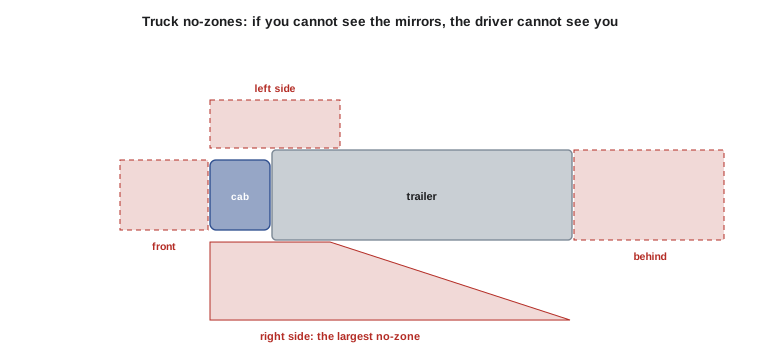
Work drivers who operate large vehicles themselves must manage these blind spots from the other side: adjust mirrors, use convex mirrors and cameras where fitted, signal early, check before turning and use a spotter when manoeuvring in tight spaces. Many fleets fit side guards, cameras and blind-spot sensors to heavy trucks to protect cyclists and pedestrians.
School buses
When a school bus has its red lights flashing and stop arm extended, drivers in both directions must stop, unless the road is divided by a median, and must not pass until the lights stop flashing. Fines for passing a stopped school bus are high, and in several provinces the vehicle owner can be charged based on evidence from stop-arm cameras. Children can be unpredictable around buses, so slow down when you see amber lights flashing as a bus prepares to stop.
Emergency vehicles
When an emergency vehicle approaches with lights and siren, pull to the right as far as safely possible and stop, unless you are in an intersection, in which case clear it first. Do not stop in a way that blocks the emergency vehicle's path, and do not follow it closely afterwards. When passing stopped emergency vehicles, tow trucks and, in many places, other service vehicles with flashing lights, follow the move-over rules in lesson 4.
Work zones
Road work zones change the normal layout of the road: lanes shift and narrow, speed limits drop, workers and equipment are close to traffic, and flaggers direct traffic by hand. Collisions in work zones kill both workers and drivers, and rear-end crashes in queues approaching work zones are common. Slow down to the posted speed, obey flaggers and signs, increase your following gap, merge early when signs tell you to, and be alert for sudden stops. Fines are often doubled in work zones when workers are present.
Some work drivers enter work zones as part of their job, for example utility crews, surveyors and inspectors. Their employers need traffic control plans, trained traffic control persons, proper signs and vehicles with warning lights. HSE-373 covers temporary traffic control, flagging and work zone layouts in detail.
Worked problem
The right hook
A delivery driver in a cube van stops at a red light, intending to turn right. While waiting, a cyclist rides up the bike lane on his right. The light turns green. What should he do?
Show solution
- Before turning, check the right mirror and convex mirror, and look over his shoulder for anything in the bike lane.
- Recognize that the cyclist is going straight and has the right of way through the intersection.
- Wait until the cyclist has cleared the intersection, then check again for pedestrians in the crosswalk he is turning across.
- Turn slowly, watching the right side throughout.
Answer: Wait for the cyclist to go first and check again before turning. Right-hook collisions with vans and trucks are often fatal for cyclists.
Parking lots, yards and loading areas
Many collisions with pedestrians happen at low speed in parking lots, yards and loading docks, where people walk between vehicles and drivers are focused on finding a space or a door. Drive slowly, at walking pace near entrances, and watch for people stepping out from between parked vehicles, especially children, who are hard to see. At customer sites and in your own yard, use designated walkways and marked routes where they exist, and follow site rules on speed and reversing. HSE-218 covers traffic management for forklifts and other mobile equipment inside workplaces, which shares many of the same principles.
Children and older pedestrians
Children are small, move suddenly and do not judge traffic well; they may run into the road after a ball or a friend. Near schools, playgrounds and residential streets, slow down and watch for movement between parked cars. Older pedestrians may walk more slowly, have poorer hearing and vision, and be more seriously injured in any collision. Give them time to cross, and do not rush them with your vehicle creeping forward.
Animals, riders and farm equipment
In rural areas, work drivers may meet people on horseback, horse-drawn buggies in some communities, and slow-moving farm equipment marked with an orange triangle. Slow down well in advance, pass wide and slowly when it is safe, and do not sound the horn near horses. Farm equipment may turn left into fields without much warning, so avoid passing near field entrances.
Distracted pedestrians and shared spaces
Pedestrians are distracted too. People looking at phones or wearing headphones may step out without checking, and drivers cannot rely on them to notice an approaching vehicle, especially a quiet electric one. In shared spaces, such as downtown streets with low curbs, campuses and busy retail areas, slow down further and expect people to walk anywhere. A driver's job is to prevent the collision whoever is at fault.
Common mistakes
MistakeAssuming a pedestrian has seen you because they looked toward you.
InsteadSlow down and be ready to stop; eye contact is helpful but not a guarantee.
MistakeTurning right across a bike lane without checking.
InsteadMirror and shoulder check, and yield to cyclists going straight.
MistakeCutting in front of a truck and then slowing.
InsteadLeave space; trucks need far longer to stop.
MistakePassing a vehicle stopped at a crosswalk.
InsteadStop as well; someone may be crossing out of your view.
MistakeSpeeding through a work zone with no visible workers.
InsteadObey posted limits; equipment, lane shifts and sudden queues remain hazards.
Summary and key terms
- Pedestrians, cyclists, motorcyclists and roadside workers have little protection; speed sharply increases their risk of death.
- Scan for pedestrians when turning and never pass a vehicle stopped at a crosswalk.
- Prevent right hooks, left crosses and dooring; give cyclists safe passing room.
- Look twice for motorcycles, especially before turning left.
- Stay out of truck no-zones and never cut in front of large vehicles.
- Stop for school buses with red lights flashing and yield to emergency vehicles.
- Slow down and stay alert in work zones; HSE-373 covers traffic control in detail.
- Vulnerable road user
- A person on the road without the protection of a vehicle body, such as a pedestrian or cyclist.
- Right hook
- A collision in which a vehicle turns right across a cyclist travelling straight.
- Left cross
- A collision in which a vehicle turns left across an oncoming cyclist or motorcyclist.
- Dooring
- Opening a vehicle door into the path of a cyclist.
- Dutch reach
- Opening a car door with the far hand, which makes you turn and look behind.
- Micromobility
- Small, light vehicles such as e-bikes and e-scooters.
- No-zone
- A blind area around a large truck or bus where its driver cannot see other vehicles.
- Stop arm
- The sign that swings out from a school bus to tell traffic to stop.
- Work zone
- A section of road where construction, maintenance or utility work is taking place.
- Flagger
- A trained person who directs traffic through a work zone by hand.
Practice problems
Work each problem on paper first, then reveal the answer to check.
Why does impact speed matter so much for pedestrians?
Show answer
Risk of death rises steeply above about 30 km/h (20 mph).
Why should you not pass a vehicle stopped at a crosswalk?
Show answer
It may be stopped for a pedestrian you cannot see.
What is a right hook?
Show answer
A vehicle turning right across a cyclist going straight.
What is the Dutch reach?
Show answer
Opening a car door with the far hand so you turn and look for cyclists.
What passing distance does Ontario require when passing a cyclist?
Show answer
About 1 m where practical.
Why should you look twice for motorcycles?
Show answer
They are small, easily hidden and their speed is hard to judge.
Where are a truck's no-zones?
Show answer
Directly in front, directly behind and along both sides, largest on the right.
What must drivers do when a school bus has red lights flashing?
Show answer
Stop in both directions unless the road is divided, and wait until the lights stop.
What should you do when an emergency vehicle approaches with siren?
Show answer
Pull right and stop where safe, clearing intersections first.
Name three behaviours for driving through a work zone.
Show answer
Any three: slow to posted speed, obey flaggers, increase gap, merge early, watch for sudden stops.
Lesson quiz · 5 questions
Score 60% or more to complete this lesson.
Create a free account to save your progress, take quizzes and earn a certificate.