
HSE-252 · Lesson 6 of 12 · 24 min
Fatigue and hours of service
Fatigue is one of the most underestimated hazards in work driving. A tired driver reacts more slowly, notices less, makes poorer decisions and can fall asleep at the wheel without warning. Unlike alcohol, there is no roadside test for fatigue, and drivers are poor judges of how tired they are. This lesson explains what causes fatigue, how it affects driving, how to recognize it and manage it, and the hours-of-service rules that limit driving time for commercial drivers.
What causes fatigue
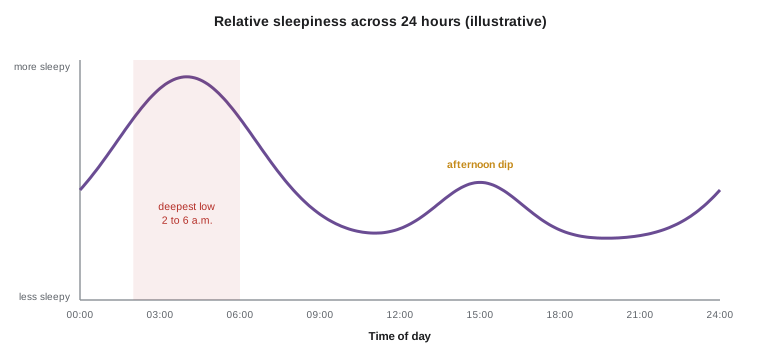
Fatigue in drivers has three main causes, and they often combine. The first is lack of sleep, either a short night or a sleep debt built up over several days. Most adults need seven to nine hours of sleep a night. The second is the body clock, or circadian rhythm. People are naturally sleepiest between about 2 and 6 a.m., and there is a smaller dip in the early to mid afternoon. The third is time on task: long periods of continuous driving, particularly on monotonous roads, wear down attention. Long work shifts before or after driving, shift work, sleep disorders such as obstructive sleep apnea, illness and some medications add to the problem.
How fatigue affects driving
Fatigue slows reaction time, reduces vigilance, narrows attention and makes it harder to maintain a steady speed and lane position. Tired drivers often make poor judgements, take more risks and become irritable. The most dangerous effect is the microsleep, a brief lapse of a few seconds in which the brain falls asleep while the eyes may still be open. At highway speed, a four second microsleep means travelling more than 100 m with no one in control. Fatigue-related crashes are often severe, because the driver does not brake or steer before impact; they typically involve a single vehicle running off the road or drifting across the centre line.
Research has compared fatigue with alcohol. Studies have found that being awake for about 17 to 19 hours can impair performance about as much as a blood alcohol concentration of 0.05 per cent, and being awake for about 24 hours as much as 0.10 per cent. A driver who starts work at 6 a.m. after a short night and drives home at 10 p.m. may be more impaired than the law would allow if the cause were alcohol.
# Hours awake and an approximate alcohol equivalence (from published comparisons; illustrative).
def bac_equivalent(hours_awake):
    if hours_awake <= 16:
        return 0.0
    # rough linear fit through about 17 h -> 0.05 and 24 h -> 0.10
    return round(0.05 + (hours_awake - 17) * (0.05 / 7), 3)

for h in (14, 17, 19, 21, 24):
    print(f"Awake {h:2d} h: impairment similar to roughly {bac_equivalent(h):.2f}% BAC")
# Distance travelled during a microsleep
for kmh in (80, 100):
    for s in (2, 4):
print(f"{s} s microsleep at {kmh} km/h ({kmh / 1.609:.0f} mph): {kmh / 3.6 * s:4.0f} m ({kmh / 3.6 * s * 3.281:4.0f} ft) uncontrolled")Awake 14 h: impairment similar to roughly 0.00% BAC Awake 17 h: impairment similar to roughly 0.05% BAC Awake 19 h: impairment similar to roughly 0.06% BAC Awake 21 h: impairment similar to roughly 0.08% BAC Awake 24 h: impairment similar to roughly 0.10% BAC 2 s microsleep at 80 km/h (50 mph): 44 m ( 146 ft) uncontrolled 4 s microsleep at 80 km/h (50 mph): 89 m ( 292 ft) uncontrolled 2 s microsleep at 100 km/h (62 mph): 56 m ( 182 ft) uncontrolled 4 s microsleep at 100 km/h (62 mph): 111 m ( 365 ft) uncontrolled
Recognizing fatigue
Drivers tend to notice fatigue late. Learn the warning signs and treat any of them as a reason to stop soon, not as a challenge to push through.
| Warning sign | What it means |
|---|---|
| Yawning repeatedly, heavy eyelids, frequent blinking | The body is signalling a need for sleep |
| Drifting in the lane, hitting the rumble strip | Lane-keeping is failing |
| Missing exits, signs or turns | Attention and memory are lapsing |
| Not remembering the last few kilometres | Possible microsleeps or highway hypnosis |
| Speed creeping up and down | Reduced vigilance |
| Head nodding, jerking awake | Microsleeps are happening; stop now |
| Restlessness, irritability, wandering thoughts | Mental fatigue |
Opening the window, turning up the music or chewing gum do not fix fatigue. They may give a moment of alertness, but sleepiness returns quickly. The only real cure is sleep. When signs appear, stop at a safe place. A short nap of 15 to 20 minutes can help, and caffeine taken just before the nap begins to work as the driver wakes. Allow a few minutes after waking for grogginess to pass before driving. If you are seriously fatigued, stop for the night.
Preventing fatigue
Fatigue management starts before the trip. Drivers should get enough sleep, especially before long drives, avoid driving during the early-morning low when possible, and plan breaks: a common guideline is a break of at least 15 minutes every two hours. Long trips should be split, shared with another driver, or replaced by flights, overnight stays or virtual meetings. Heavy meals and some medications increase sleepiness.
Employers have a large role. Schedules should allow for realistic travel times and rest, and not expect workers to drive home after very long shifts or overnight work. Shift rosters should limit consecutive night shifts and early starts. Some employers set policies such as a maximum workday including driving (for example 14 hours), a maximum driving time per day for non-commercial drivers, and paid overnight stays when a trip would end late. They also make it acceptable for a driver to say they are too tired to drive. Screening and treatment for sleep apnea, which is common among drivers and strongly linked to crashes, is part of many commercial fleet programs.
Worked problem
The trip home after a long day
An inspector starts work at 7 a.m. and drives three hours to a remote site, works there until 6 p.m., and plans to drive the three hours home the same night. What is the fatigue risk and what should the employer do?
Show solution
- By the time she reaches home she will have been at work for about 15 hours and awake for perhaps 17 or more.
- The drive home falls in the evening, and in darkness for much of the year, when fatigue builds.
- Her impairment by the end could be comparable to a BAC around 0.05 per cent.
- The employer should allow and pay for an overnight stay near the site, or schedule the visit over two days, or reduce work time on site.
Answer: The risk is high. An overnight stay or rescheduling is the safer choice, and the employer's policy should make that the default.
Hours-of-service rules for commercial drivers
Commercial truck and bus drivers face legal limits on driving and on-duty time. For federally regulated carriers, the Commercial Vehicle Drivers Hours of Service Regulations under the Motor Vehicle Transport Act apply south of the 60th parallel. Provinces apply similar rules to intra-provincial carriers, often adopting the federal rules with some differences. Since 12 June 2021, federally regulated carriers have had to use certified electronic logging devices (ELDs), with progressive enforcement ending on 1 January 2023 across jurisdictions.
| Canadian federal rule (south of 60°) | Limit |
|---|---|
| Daily driving | No driving after 13 hours of driving in a day |
| Daily on-duty | No driving after 14 hours on duty in a day |
| Daily off-duty | At least 10 hours off duty in a day, 2 of which may be in blocks of at least 30 minutes |
| Work shift | No driving after 16 hours have passed since the start of the work shift |
| Before a new shift | At least 8 consecutive hours off duty |
| Cycle 1 | 70 hours on duty in 7 days; 36 hours off resets |
| Cycle 2 | 120 hours on duty in 14 days, with 24 hours off before reaching 70; 72 hours off resets |
| Recovery | At least 24 consecutive hours off duty in any 14 days |
These limits are maximums, not targets. A driver can be legally within hours and still dangerously tired, for example after a poor night's sleep or when driving through the early-morning low. Fleets should treat hours-of-service compliance as the minimum and manage fatigue beyond it. Hours-of-service rules also generally do not apply to drivers of ordinary cars, pickups and light vans below the commercial weight thresholds, so employers need their own policies for those workers.
# A simple daily log check against Canadian federal limits (illustrative, not a compliance tool).
# Each entry: (status, hours) in order for one day.
day = [("off", 8), ("on", 1), ("drive", 5), ("on", 0.5), ("drive", 4.5), ("on", 1), ("drive", 3), ("off", 1)]
driving = sum(h for s, h in day if s == "drive")
on_duty = sum(h for s, h in day if s in ("drive", "on"))
off_duty = sum(h for s, h in day if s == "off")
print(f"Driving {driving} h, on duty {on_duty} h, off duty {off_duty} h")
print("Canada: driving <= 13 h:", driving <= 13, "| on duty <= 14 h:", on_duty <= 14, "| off duty >= 10 h:", off_duty >= 10)
# The same driving pattern under the US 11-hour driving limit
print("US: driving <= 11 h:", driving <= 11)Driving 12.5 h, on duty 15.0 h, off duty 9 h Canada: driving <= 13 h: True | on duty <= 14 h: False | off duty >= 10 h: False US: driving <= 11 h: False
The log in that example shows a common situation: a day that complies with the Canadian 13-hour driving limit but exceeds the US 11-hour limit, and does not include the 10 hours off duty the Canadian rule requires within the day. Carriers operating across the border must comply with the rules of the country they are driving in.
Commuting after work
Fatigue risk does not end when the work shift does. Workers who finish a long or overnight shift and drive home are at high risk of falling asleep at the wheel, and those crashes may not be recorded as work related. Employers with shift workers should consider rest areas, transport home, carpools and scheduling that avoids very long shifts followed by long drives.
Fatigue on short trips
Fatigue is not only a long-haul problem. Many fatigue-related crashes happen on short, familiar trips: the drive home after a night shift, the early-morning run to the first job, or the afternoon trip after a heavy lunch. Familiar roads make highway hypnosis more likely, and short trips feel too brief to need a break. The same rules apply: if you notice warning signs, stop, even if you are only a few minutes from your destination. Arriving a little late is far better than not arriving at all.
Common mistakes
MistakeFighting sleepiness with loud music, cold air or gum.
InsteadStop safely and nap or rest; only sleep fixes fatigue.
MistakeAssuming you can tell when you are about to fall asleep.
InsteadMicrosleeps happen without warning; treat early signs as a reason to stop.
MistakeTreating hours-of-service limits as safe targets.
InsteadThey are legal maximums; drivers can be fatigued within them.
MistakeScheduling a long drive home after a long day on site.
InsteadAllow overnight stays or reschedule.
MistakeIgnoring snoring and daytime sleepiness in drivers.
InsteadScreen for and treat sleep apnea, a major fatigue risk.
Summary and key terms
- Fatigue comes from lack of sleep, the body clock and time on task, often combined.
- Fatigue slows reactions and causes microsleeps, leading to severe run-off-road and head-on crashes.
- Being awake 17 to 24 hours can impair driving about as much as 0.05 to 0.10 per cent BAC.
- Learn the warning signs and stop at the first safe place; only sleep cures fatigue.
- Plan sleep and breaks, avoid early-morning driving, and schedule realistic days.
- Commercial drivers must follow hours-of-service rules recorded on electronic logging devices.
- Hours-of-service limits are maximums; fleets must manage fatigue for all drivers beyond them.
- Fatigue
- A state of reduced mental and physical capacity from lack of sleep, long activity or the body clock.
- Circadian rhythm
- The roughly 24-hour body clock that controls sleepiness and alertness.
- Sleep debt
- The cumulative shortfall of sleep over several days.
- Microsleep
- A brief, involuntary lapse into sleep lasting a few seconds.
- Time on task
- The length of time spent continuously on an activity such as driving.
- Obstructive sleep apnea
- A sleep disorder in which breathing repeatedly stops, causing daytime sleepiness.
- Hours of service
- Legal limits on driving and on-duty time for commercial drivers.
- Electronic logging device
- A device connected to the engine that records a driver's hours of service.
- Duty status
- Whether a driver is driving, on duty not driving, off duty or in a sleeper berth.
- Cycle
- A rolling period of days over which on-duty hours are limited.
Practice problems
Work each problem on paper first, then reveal the answer to check.
What are the three main causes of driver fatigue?
Show answer
Lack of sleep, the circadian body clock and time on task.
When are people naturally sleepiest?
Show answer
Roughly 2 to 6 a.m., with a smaller dip in the early to mid afternoon.
What is a microsleep?
Show answer
A lapse into sleep of a few seconds, sometimes with eyes open.
Being awake about 24 hours impairs performance roughly like what BAC?
Show answer
About 0.10 per cent.
List four warning signs of fatigue.
Show answer
Any four: yawning, heavy eyelids, drifting, missed exits, not remembering the road, speed changes, head nodding, irritability.
What is the only real cure for fatigue?
Show answer
Sleep.
What is a common guideline for breaks on long drives?
Show answer
At least 15 minutes every two hours.
What is the daily driving limit under the Canadian federal rules?
Show answer
No driving after 13 hours of driving in a day.
Do hours-of-service limits guarantee a driver is rested?
Show answer
No; they are maximums, and drivers can be fatigued within them.
Why is sleep apnea important for fleets?
Show answer
It causes daytime sleepiness and is strongly linked to crashes.
Lesson quiz · 5 questions
Score 60% or more to complete this lesson.
Create a free account to save your progress, take quizzes and earn a certificate.