
HSE-252 · Lesson 7 of 12 · 25 min
Winter, night and adverse conditions
Weather and darkness change everything about driving: how far you can see, how well others see you, how much grip your tires have and how long it takes to stop. Many fleet collisions cluster on the first snowy day of the season, in fog banks, at dusk and on wet roads after a dry spell. This lesson covers how to prepare for and drive in winter, rain, fog, wind and darkness, and the laws on winter tires and chains. Lesson 3's stopping-distance principles apply throughout: less grip and less visibility mean lower speeds and larger gaps.
Winter driving: the basics
Snow and ice reduce tire grip dramatically. On glare ice, braking distance can be ten times or more what it is on dry pavement. The most important winter defence is simply to slow down and leave far more space, at least double the normal following gap. Accelerate, brake and steer gently, because sudden inputs break traction. Look further ahead so you can slow early for intersections, curves and hills. Bridges, overpasses and shaded spots freeze first. Black ice, a thin clear layer that looks like wet pavement, is common near freezing, early in the morning and at night.
# Braking distance from 50 km/h (31 mph) on different surfaces (illustrative friction).
g = 9.81
v = 50 / 3.6
for surface, mu in [("dry asphalt", 0.7), ("wet asphalt", 0.45), ("packed snow", 0.2), ("glare ice", 0.07)]:
    d = v ** 2 / (2 * mu * g)
print(f"{surface:12s} (mu={mu:4.2f}): braking {d:5.1f} m ({d * 3.281:5.0f} ft)")dry asphalt (mu=0.70): braking 14.0 m ( 46 ft) wet asphalt (mu=0.45): braking 21.8 m ( 72 ft) packed snow (mu=0.20): braking 49.2 m ( 161 ft) glare ice (mu=0.07): braking 140.5 m ( 461 ft)
Winter tires
Winter tires are made of rubber compounds that stay soft and flexible in the cold, with deep treads and many small slits (sipes) that grip snow and ice. All-season tires harden as temperatures drop below about 7 °C (45 °F) and lose much of their grip. Tests in Canada and elsewhere have shown winter tires can shorten braking distances on snow and ice substantially compared with all-season tires. Look for the three-peak mountain snowflake symbol, which marks tires that meet a standard snow traction test. The mud and snow (M+S) marking alone does not guarantee winter performance.
| Jurisdiction | Winter tire or chain rule (check current rules) |
|---|---|
| Quebec | Winter tires mandatory on light passenger vehicles from 1 December to 15 March |
| British Columbia | Winter tires (mountain snowflake or M+S) or chains required on many highways, mostly 1 October to 30 April, as posted |
| Other provinces | Not mandatory, but strongly recommended; Ontario and Manitoba offer insurers' discounts or low-interest financing for winter tires |
| Mountain passes | Commercial vehicles may be required to carry chains on designated routes in BC and Alberta |
Preparing the vehicle and the driver
Before the season starts, fleet vehicles need winter tires installed, batteries tested, wipers and washer fluid rated for freezing temperatures, and coolant checked. Each vehicle should carry a winter kit. Before each trip, clear all snow and ice from windows, mirrors, lights, the roof and the hood. Snow left on a roof can slide onto the windshield when you brake, or blow off into the vehicle behind. Many jurisdictions fine drivers for driving with obstructed windows or for snow and ice falling from vehicles.
| Item | Purpose |
|---|---|
| Snow brush and ice scraper | Clear all glass, lights and roof |
| Shovel and traction aid (sand, kitty litter or traction mats) | Get unstuck |
| Booster cables or a jump pack | Restart a dead battery |
| Warm clothing, boots, hat, gloves and blanket | Stay warm if stranded; see HSE-243 for cold stress |
| Flashlight, reflective triangles or flares | Be seen and work safely at the roadside |
| Water and high-energy snacks | Sustain you while waiting for help |
| Charged phone and charger | Call for help |
| First aid kit | Treat minor injuries |
Drivers also need to plan. Check the weather and road reports before leaving, allow extra time, tell someone your route and expected arrival time, and keep the fuel tank at least half full so you can run the engine for heat if stranded. If conditions are severe, the safest trip is the one not taken. Fleet policies should give drivers and supervisors clear authority to delay or cancel trips when road authorities advise against travel.
Skids
A skid happens when tires lose grip. In a front-wheel skid (understeer), the vehicle keeps going straight even though the wheels are turned. Ease off the accelerator and avoid adding more steering until the front tires regain grip. In a rear-wheel skid (oversteer), the back of the vehicle slides out. Look and steer where you want to go, and ease off the accelerator without braking hard. With antilock brakes (ABS), which almost all modern vehicles have, press the brake firmly and keep pressing in an emergency stop; the pedal may pulse and the system will let you steer. Do not pump ABS brakes.
If you are stranded
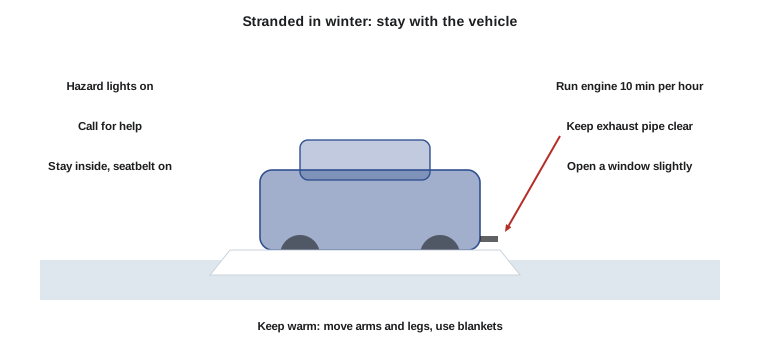
If you become stuck or stranded in winter, stay with your vehicle unless help is very close and visible. A vehicle is shelter and is easier for rescuers to find. Turn on hazard lights and call for help. Run the engine for about 10 minutes each hour for heat, and keep the exhaust pipe clear of snow to prevent carbon monoxide build-up inside the vehicle. Open a window slightly for fresh air. Move your arms and legs to stay warm, and watch for signs of hypothermia and frostbite, covered in HSE-243.
Rain and wet roads
Wet roads reduce grip and visibility. The first rain after a dry spell is particularly slippery, because oil and dust on the road mix with water into a slick film. Hydroplaning happens when a layer of water builds up between the tires and the road and the tires lose contact. It is more likely at higher speeds, with worn tires and in standing water. If you hydroplane, ease off the accelerator, keep the steering straight and do not brake hard until you feel the tires grip again. Avoid cruise control on wet roads, because it can keep the wheels driving when you need to slow down. Never drive into flooded roads: as little as 30 cm (about 1 foot) of moving water can float many vehicles.
Fog, smoke and dust
Fog, wildfire smoke and blowing dust or snow can reduce visibility to almost nothing within seconds. Slow down gradually so drivers behind you have time to react, use low-beam headlights and fog lights, not high beams, which reflect off the fog and dazzle you. Increase your following gap. If visibility becomes so poor you cannot see the road edge, pull completely off the road, well away from traffic, turn off your driving lights so others do not follow you and run into you, keep hazard lights on and wait. Wildfire smoke has become a more frequent hazard across much of North America in recent summers, and road closures can come with little warning.
Wind
Strong crosswinds can push vehicles across lanes, especially high-sided vans, trucks with empty trailers, and vehicles towing trailers. Wind is strongest on bridges, in open areas and in gaps between hills or buildings. Slow down, keep both hands on the wheel, and allow extra space when passing or being passed by large vehicles. Road authorities may restrict high-sided vehicles on exposed bridges and highways during high winds.
Night driving
Driving at night is riskier per kilometre than daytime driving. Visibility is shorter, judging speed and distance is harder, fatigue is more likely and impaired drivers are more common. Pedestrians in dark clothing can be almost invisible until very close. Headlights on low beam typically light the road only about 50 to 60 m (160 to 200 ft) ahead, so at highway speeds a driver may be overdriving the headlights, travelling too fast to stop within the lit distance.
# Overdriving your headlights: can you stop within the lit distance? (illustrative)
g, mu, t_r = 9.81, 0.7, 1.5
for beam, lit_m in [("low beam", 55), ("high beam", 120)]:
    for kmh in (60, 80, 100):
        v = kmh / 3.6
        stop = v * t_r + v ** 2 / (2 * mu * g)
        ok = "can stop" if stop <= lit_m else "CANNOT stop in time"
print(f"{beam:9s} lights ~{lit_m} m ({lit_m * 3.281:.0f} ft); {kmh} km/h needs {stop:4.0f} m to stop: {ok}")low beam lights ~55 m (180 ft); 60 km/h needs 45 m to stop: can stop low beam lights ~55 m (180 ft); 80 km/h needs 69 m to stop: CANNOT stop in time low beam lights ~55 m (180 ft); 100 km/h needs 98 m to stop: CANNOT stop in time high beam lights ~120 m (394 ft); 60 km/h needs 45 m to stop: can stop high beam lights ~120 m (394 ft); 80 km/h needs 69 m to stop: can stop high beam lights ~120 m (394 ft); 100 km/h needs 98 m to stop: can stop
Use high beams on dark roads when there is no oncoming or preceding traffic, and dip them for oncoming drivers. Keep windshields clean inside and out to reduce glare. If an oncoming vehicle dazzles you, look toward the right edge of the road until it passes. Older drivers need much more light to see and recover from glare more slowly, which employers should consider when scheduling night driving.
Wildlife
Collisions with large animals such as moose, deer and elk are common on rural highways, especially at dawn and dusk and in autumn and spring. In parts of Canada, wildlife collisions are among the most common causes of vehicle damage claims, and moose collisions are often fatal because the animal's body strikes the windshield. Watch for warning signs, scan the road edges, and slow down at night in wildlife areas. If an animal appears, brake firmly and stay in your lane; swerving often causes worse crashes.
Worked problem
A sudden whiteout
A driver on a rural highway runs into blowing snow that cuts visibility to a few metres. There is a car somewhere behind her. What should she do?
Show solution
- Slow down gradually rather than braking hard, so the car behind has time to react.
- Turn on low beams and hazard lights; do not use high beams.
- If she cannot see the road edge, pull completely off the road at the first safe place, such as a driveway or wide shoulder.
- Once stopped well off the road, keep hazard lights on, turn off headlights so others do not follow her lights, keep her seatbelt on and wait for visibility to improve.
Answer: Slow gradually, light up, and get completely off the road if she cannot see. Stopping in a live lane in a whiteout invites a chain collision.
Common mistakes
MistakeRelying on all-season tires in deep cold.
InsteadWinter tires with the mountain snowflake symbol grip far better below about 7 °C (45 °F).
MistakeClearing only a small patch of the windshield.
InsteadClear all windows, mirrors, lights and the roof before driving.
MistakePumping antilock brakes in an emergency stop.
InsteadPress firmly and hold; steer around the hazard.
MistakeUsing high beams in fog.
InsteadUse low beams and fog lights; slow down and increase your gap.
MistakeSwerving to avoid a deer or moose.
InsteadBrake firmly and stay in your lane.
Summary and key terms
- Snow, ice and wet roads greatly increase stopping distance; slow down and at least double your gap.
- Winter tires grip far better in the cold; some jurisdictions require them or chains on certain roads.
- Prepare vehicles for winter, carry a winter kit and clear all snow and ice before driving.
- Know how to handle skids and use ABS correctly; stay with your vehicle if stranded and keep the exhaust clear.
- Watch for hydroplaning, flooded roads, fog, smoke and crosswinds, and get off the road if visibility fails.
- At night, avoid overdriving your headlights, manage glare and watch for pedestrians and wildlife.
- Employers should give drivers authority to delay or cancel trips in severe conditions.
- Black ice
- A thin, clear layer of ice that looks like wet pavement.
- Winter tire
- A tire with a cold-flexible compound and tread designed for snow and ice.
- Three-peak mountain snowflake
- A symbol showing a tire meets a standard snow traction test.
- Understeer
- A front-wheel skid in which the vehicle turns less than the steering asks.
- Oversteer
- A rear-wheel skid in which the rear of the vehicle slides outward.
- Antilock brakes (ABS)
- A system that prevents wheels locking under hard braking so the driver can steer.
- Hydroplaning
- Loss of tire contact with the road because of a film of water.
- Overdriving headlights
- Driving too fast to stop within the distance lit by the headlights.
- Whiteout
- A condition where blowing snow or fog reduces visibility to almost nothing.
- Traction law
- A rule requiring adequate tires or traction devices when activated in winter conditions.
Practice problems
Work each problem on paper first, then reveal the answer to check.
How much should you increase your following gap on snow or ice?
Show answer
At least double it.
Below what temperature do all-season tires lose much of their grip?
Show answer
About 7 °C (45 °F).
What symbol shows a tire meets a snow traction standard?
Show answer
The three-peak mountain snowflake.
When are winter tires mandatory in Quebec?
Show answer
From 1 December to 15 March.
How should you brake in an emergency with ABS?
Show answer
Press firmly and hold the pedal, and steer around the hazard.
Why should you keep the exhaust pipe clear when stranded?
Show answer
To prevent carbon monoxide building up inside the vehicle.
What should you do if you start to hydroplane?
Show answer
Ease off the accelerator, keep steering straight and avoid hard braking until grip returns.
Why should you not use high beams in fog?
Show answer
They reflect off the fog and reduce your visibility.
What does overdriving your headlights mean?
Show answer
Driving too fast to stop within the distance lit by your headlights.
What should you do if a moose steps onto the road ahead?
Show answer
Brake firmly and stay in your lane rather than swerving.
Lesson quiz · 5 questions
Score 60% or more to complete this lesson.
Create a free account to save your progress, take quizzes and earn a certificate.