
HSE-252 · Lesson 2 of 12 · 25 min
Collision causes and the human factor
When investigators examine road collisions, they rarely find a single cause. They find a sequence: conditions that set the scene, decisions and errors by one or more people, and a moment when no one had enough time or space left to avoid the crash. Understanding that sequence is the starting point for defensive driving, because a defensive driver's job is to spot the early links and break the chain long before the final moment.
Three groups of factors
Road safety researchers often sort crash factors into three groups: the human (the driver and other road users), the vehicle, and the environment (the road, weather, light and traffic). Large studies of police and in-depth crash reports have found that human factors are involved in the great majority of collisions, often more than nine in ten, either alone or combined with vehicle or environment factors. That does not mean drivers are always to blame in a legal sense. It means that what people perceive, decide and do is almost always part of the chain, and that is where training, rested drivers, and good policies make the most difference.
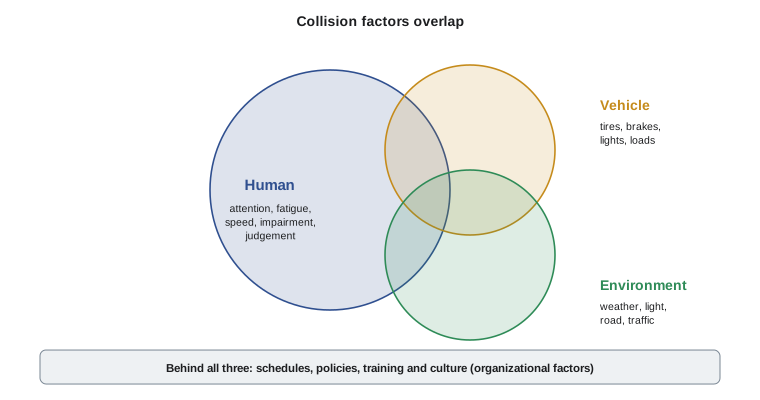
| Group | Examples |
|---|---|
| Human | Distraction, fatigue, speed, impairment, inexperience, misjudging gaps, following too closely, failing to yield, aggression |
| Vehicle | Worn tires, poor brakes, burnt-out lights, unsecured loads, blind spots, defects not reported |
| Environment | Ice, snow, rain, fog, darkness, glare, poor road design, work zones, wildlife, heavy traffic |
The human chain: perceive, decide, act
Every driving decision follows the same basic steps. First you must perceive a hazard: see the brake lights, notice the child near the curb, hear the siren. Then you must recognize what it means and decide what to do: brake, steer, sound the horn, or carry on. Then you act, and the vehicle responds. Each step takes time, and each can fail. Many collisions happen not because a driver reacted badly but because they never perceived the hazard at all: they were looking elsewhere, or their attention was on a conversation, or the hazard was hidden.
The time from when a hazard appears to when the driver starts braking is called perception–reaction time. Under ideal conditions, with a driver who is alert and expecting a hazard, it can be under a second. In real driving, with surprise and divided attention, it is usually longer. Road design guides in North America commonly assume 2.5 seconds for stopping sight distance, because that covers most drivers in most situations. Fatigue, distraction, alcohol, drugs and age all lengthen it. Lesson 3 shows how this time turns into distance.
| Step | What happens | What can go wrong |
|---|---|---|
| Perceive | Eyes and ears detect a change | Looking away, glare, darkness, blind spots, hidden hazards |
| Recognize | Brain identifies it as a hazard | Inattention, inexperience, expecting something else |
| Decide | Choose a response | Hesitation, wrong choice, panic |
| Act | Move foot or hands | Slow movement, wrong pedal, overcorrection |
| Vehicle responds | Brakes, steering act | Worn brakes or tires, poor traction, overloaded vehicle |
# Distance travelled before the brakes even start working.
def reaction_distance_m(kmh, t_s):
    return kmh / 3.6 * t_s

for kmh in (50, 80, 100):
    row = [f"{reaction_distance_m(kmh, t):5.1f} m" for t in (1.0, 1.5, 2.5)]
    print(f"{kmh:>3} km/h ({kmh / 1.609:4.0f} mph): 1.0 s -> {row[0]}, 1.5 s -> {row[1]}, 2.5 s -> {row[2]}")
print("1 m = 3.28 ft, so 69 m at 100 km/h and 2.5 s is about 228 ft")50 km/h ( 31 mph): 1.0 s -> 13.9 m, 1.5 s -> 20.8 m, 2.5 s -> 34.7 m 80 km/h ( 50 mph): 1.0 s -> 22.2 m, 1.5 s -> 33.3 m, 2.5 s -> 55.6 m 100 km/h ( 62 mph): 1.0 s -> 27.8 m, 1.5 s -> 41.7 m, 2.5 s -> 69.4 m 1 m = 3.28 ft, so 69 m at 100 km/h and 2.5 s is about 228 ft
Attention: the scarcest resource
Human attention is limited. A driver can only process a small part of what is in view at any moment, and the brain fills in the rest from expectation. When attention is pulled away, by a phone, a passenger, a worry or a billboard, a driver can look straight at a hazard and not see it. Researchers call this inattentional blindness, and it explains many collisions in which a driver says, honestly, that they looked and the other vehicle came out of nowhere. Motorcycles, bicycles and pedestrians are especially easy to miss because drivers do not expect them and they are small in the visual field.
Attention also falls with time and monotony. On a long, straight, quiet highway, drivers can slip into a kind of automatic driving in which they cover kilometres with little memory of them. This is sometimes called highway hypnosis. It is closely linked to fatigue, which lesson 6 covers, and it is why defensive drivers take breaks and actively vary where they look.
Errors and violations
It helps to separate two kinds of unsafe behaviour. Errors are unintended: misjudging the speed of an oncoming vehicle, failing to see a cyclist, pressing the wrong pedal. Violations are deliberate departures from rules or safe practice: speeding, rolling through a stop sign, texting, following too closely. The distinction matters because the remedies differ. Errors are reduced by training, experience, good design and well-rested drivers. Violations are driven by attitudes, pressure and habits, and are reduced by clear policies, supervision, feedback such as telematics, and a culture where people do not feel pushed to cut corners.
| Type | Examples | Typical remedies |
|---|---|---|
| Perception error | Did not see the pedestrian | Scanning techniques, cleaner windows, better lighting, rest |
| Judgement error | Misjudged gap when turning left | Training, leaving bigger margins, choosing protected turns |
| Action slip | Foot slipped off the brake | Footwear, vehicle design, practice |
| Routine violation | Habitual speeding on familiar road | Policy, telematics feedback, schedules with slack |
| Situational violation | Speeding to make an appointment | Realistic scheduling, no blame for being late |
| Reckless violation | Driving after drinking | Zero-tolerance policy, discipline, law enforcement |
Pressure from the job
Work driving adds its own pressures. A delivery driver with too many stops, a technician paid per call, a nurse with back-to-back visits, or a supervisor late for a meeting all face the same temptation to make up time on the road. Employers sometimes create this pressure without meaning to, through schedules that assume perfect traffic, incentive pay tied to speed, or a culture in which answering the phone instantly is expected. Lesson 11 returns to this point: a fleet safety program that tells drivers to be careful while scheduling them to be rushed will not work.
Worked problem
Finding the chain
A service technician rear-ends a car that stopped suddenly at a yellow light. He had started at 6 a.m., was running 20 minutes late for his fourth call, and was reading the next job details on a tablet mounted on the dash. It was raining and his front tires were close to the wear limit. What links can you find in the chain?
Show solution
- Human: reading the tablet took his eyes and attention off the road (distraction).
- Human: running late created pressure to keep moving (situational pressure); a long day added some fatigue.
- Human: he was probably following too closely for wet conditions.
- Vehicle: worn front tires lengthened his stopping distance on a wet road.
- Environment: rain reduced traction and visibility.
- Organization: the schedule left no slack, and the dispatch system pushed job details while he was driving.
Answer: At least six links. Breaking any one, such as reading jobs only when parked, a larger following gap, replacing tires sooner or a realistic schedule, might have prevented the crash.
Risk perception and compensation
People adjust their behaviour to the risk they perceive. Drivers slow down on an icy road and pay more attention when a child steps toward the curb. That is helpful. But perception can be wrong. Drivers often feel safe in large vehicles, on familiar roads and in good weather, and that sense of safety can lead them to drive faster or pay less attention. Some research suggests that drivers partly compensate for safety features, for example driving a little faster with antilock brakes or all-wheel drive. The lesson is not to reject safety features, which save many lives, but to remember that they reduce the consequences of mistakes; they do not repeal physics.
All-wheel drive is a good example. It helps a vehicle accelerate on snow, but it does nothing to help it stop or corner. Drivers who feel confident because the vehicle moved off easily can arrive at the first curve too fast. Winter tires, covered in lesson 7, help braking and cornering in a way all-wheel drive does not.
Other road users
Defensive driving assumes that other road users will make errors and violations too. The driver who runs the red light, the pedestrian looking at a phone, the cyclist who swerves around a pothole, the truck that changes lanes without seeing you: none of these is your fault, but all of them are your problem if you are in the wrong place. A defensive driver builds in space and time so that someone else's mistake does not become a collision. Lessons 3, 4 and 9 explain how.
# A simple way to see how small factors combine (illustrative probabilities).
import random
random.seed(252)
trips = 100_000
factors = {"phone glance": 0.10, "tired": 0.08, "wet road": 0.15, "close following": 0.20}
crash_if = {0: 0.00001, 1: 0.00005, 2: 0.0003, 3: 0.002, 4: 0.01}  # risk rises with each factor present
crashes = 0
for _ in range(trips):
    n = sum(random.random() < p for p in factors.values())
    crashes += random.random() < crash_if[n]
print(f"Simulated crashes in {trips:,} trips: {crashes}")
print("Removing 'close following' alone cuts the chance that 3 or 4 factors line up.")Simulated crashes in 100,000 trips: 7 Removing 'close following' alone cuts the chance that 3 or 4 factors line up.
The simulation is illustrative, but the pattern is real: each extra factor multiplies risk, so removing even one, such as keeping a proper following distance, can sharply cut the chance that several line up at once.
Learning from near misses
For every collision there are many near misses: the car that braked just in time, the cyclist who appeared from behind a parked van, the moment of drowsiness that ended on the rumble strip. Near misses are free lessons, because they show the same chain of factors without the harm. Drivers who notice and talk about their near misses, and fleets that collect and discuss them without blame, can break chains before they end in a crash. A simple question at a toolbox talk, such as asking what nearly went wrong on the road this week, often brings out hazards that no report would capture.
Common mistakes
MistakeLooking for the single cause of a collision.
InsteadLook for the chain of human, vehicle, environment and organizational factors.
MistakeAssuming that looking means seeing.
InsteadInattention can make drivers miss hazards in plain view, especially small or unexpected ones.
MistakeTreating all unsafe behaviour as the same.
InsteadErrors need training and design fixes; violations need policy, supervision and a supportive culture.
MistakeBelieving all-wheel drive makes winter roads safe.
InsteadIt helps you get moving but not stop or turn; slow down and use winter tires.
MistakeBlaming only the driver for rushing.
InsteadUnrealistic schedules and incentives create pressure that the employer must fix.
Summary and key terms
- Collisions result from a chain of human, vehicle and environment factors, often with organizational pressures behind them.
- Human factors are involved in most collisions, alone or combined with others.
- Perception–reaction time is often 1.5 to 2.5 seconds in real driving, and longer with fatigue or distraction.
- Attention is limited; inattention can hide hazards in plain view.
- Errors and violations have different causes and remedies.
- Job pressure and unrealistic schedules push drivers toward risky choices.
- Defensive drivers expect others to make mistakes and keep space and time to absorb them.
- Perception–reaction time
- The time from a hazard appearing to the driver starting to respond.
- Inattentional blindness
- Failing to see something in plain view because attention is elsewhere.
- Highway hypnosis
- A drowsy, automatic driving state on long monotonous roads.
- Error
- An unintended action or judgement that leads to an unsafe outcome.
- Violation
- A deliberate departure from a rule or safe practice.
- Situational violation
- A violation driven by circumstances such as time pressure.
- Risk compensation
- Changing behaviour in response to perceived safety, sometimes taking more risk.
- Human factors
- Characteristics of people, such as attention and fatigue, that affect performance.
- Stopping sight distance
- The distance needed to perceive, react and stop for an object in the road.
- Contributing factor
- A condition or action that made a collision more likely or more severe.
Practice problems
Work each problem on paper first, then reveal the answer to check.
What are the three groups of collision factors?
Show answer
Human, vehicle and environment.
List the steps of the perception–reaction chain.
Show answer
Perceive, recognize, decide, act, and the vehicle responds.
What perception–reaction time do road design guides commonly assume?
Show answer
About 2.5 seconds.
How far does a vehicle travel at 100 km/h (62 mph) in 2.5 seconds?
Show answer
About 69 m (about 228 ft).
What is inattentional blindness?
Show answer
Not seeing something in plain view because your attention is elsewhere.
Give an example of an error and an example of a violation.
Show answer
Error: misjudging a gap. Violation: texting or speeding deliberately.
How can an employer contribute to situational violations?
Show answer
Through tight schedules, pay tied to speed or expecting instant phone responses.
Why does all-wheel drive not make icy roads safe?
Show answer
It helps acceleration but not braking or cornering.
Why are motorcycles and cyclists often missed by drivers?
Show answer
They are small in the visual field and drivers do not expect them.
What is the main idea of defensive driving regarding other road users?
Show answer
Expect others to make mistakes and keep enough space and time to avoid collisions.
Lesson quiz · 5 questions
Score 60% or more to complete this lesson.
Create a free account to save your progress, take quizzes and earn a certificate.