
HSE-252 · Lesson 12 of 12 · 25 min
Capstone: a fleet safety and journey management plan
This capstone brings the course together in a plan for an invented company. You will see how to assess the company's driving risks, set policies, plan journeys, prepare vehicles and drivers, monitor performance and respond to incidents. The company and all its numbers are invented for illustration, but the structure fits most small and medium fleets.
Tamarack Mechanical is an invented heating, ventilation and air conditioning service company based in Sudbury, Ontario. It has 32 technicians who drive company service vans and pickups, 6 supervisors and estimators who drive their own cars on business, and 2 delivery drivers in a straight truck with a gross vehicle weight above 4,500 kg. Technicians drive between customer sites in the city and to remote mines, camps and First Nations communities up to 300 km away, including on winter highways and some resource roads. Last year the company had 11 collisions, including one rollover on an icy highway that injured a technician, and dozens of minor backing incidents.
Step 1: Understand the risk
The plan starts with data and conversations. The fleet safety coordinator reviews last year's collisions, insurance claims, telematics data from the vans and maintenance records, and meets with technicians and supervisors to hear how their days really work. Several patterns emerge.
| Finding | Evidence | Related lesson |
|---|---|---|
| Rear-end and backing collisions dominate | 6 of 11 collisions; many backing scrapes not reported until recently | Lessons 3 and 4 |
| Winter highway trips are the most severe risk | Rollover on ice; several near misses reported | Lesson 7 |
| Long days with remote trips | Some technicians work 14 hours including a 3 hour drive home | Lesson 6 |
| Dispatch messages sent to moving vans | Technicians read job updates on tablets while driving | Lesson 5 |
| Personal-vehicle drivers outside any program | No checks of insurance or vehicle condition | Lesson 11 |
| Inconsistent pre-trip checks | Two vans found with worn tires and broken backup cameras | Lesson 8 |
# Tamarack's baseline (invented data).
collisions, preventable, km = 11, 7, 1_420_000
injuries = 1
rate = collisions / (km / 1_000_000)
print(f"Baseline collision rate: {rate:.1f} per million km ({collisions / (km / 1.609 / 1_000_000):.1f} per million miles)")
print(f"Preventable: {preventable} of {collisions} ({preventable / collisions:.0%})")
target = rate * 0.6
print(f"Two-year target (40% reduction): {target:.1f} per million km")Baseline collision rate: 7.7 per million km (12.5 per million miles) Preventable: 7 of 11 (64%) Two-year target (40% reduction): 4.6 per million km
Step 2: Leadership and policy
The owner signs a one-page fleet safety policy stating that no job is so urgent that it cannot be done safely, that drivers have authority to delay or cancel trips for weather or fatigue without penalty, and that managers are accountable for scheduling that allows safe driving. Detailed rules follow in a short driver handbook.
| Topic | Tamarack rule |
|---|---|
| Seatbelts | All occupants, every trip |
| Phones and tablets | No handheld use or reading while moving; dispatch messages held while the vehicle is in motion; calls only when parked |
| Impairment | Zero tolerance for alcohol, cannabis and impairing drugs; report medications that may affect driving |
| Fatigue | Maximum 14 hour workday including driving; no remote trip home after a 12 hour day without approval; paid overnight stays |
| Speed | Obey limits; drive for conditions; speeding alerts reviewed weekly |
| Following gap | At least 4 seconds in vans and pickups, 6 in the truck, doubled in winter |
| Backing | Park to drive out; Get Out And Look; use a spotter when available |
| Winter | Winter tires on all vehicles; winter kit; journey plan for remote trips |
| Reporting | All collisions, near misses, defects and licence changes reported promptly; no automatic discipline for reporting |
Step 3: Drivers and vehicles
Every driver's licence and driver abstract is checked at hiring and annually, with consent. The two truck drivers' records are kept as required for the company's CVOR, and they complete daily trip inspections under NSC Standard 13 schedules. Supervisors who drive their own cars provide proof of business-use insurance and confirm their vehicles are roadworthy and fitted with winter tires in season, and the company pays a mileage allowance that covers those costs.
Vans are fitted with racks and bulkheads to secure tools, backup cameras and telematics units. The maintenance schedule follows the manufacturer's intervals, with a fall winter-readiness service. Technicians use a phone app for daily circle checks and defect reports, and the shop acknowledges defects within one working day.
Step 4: Journey management
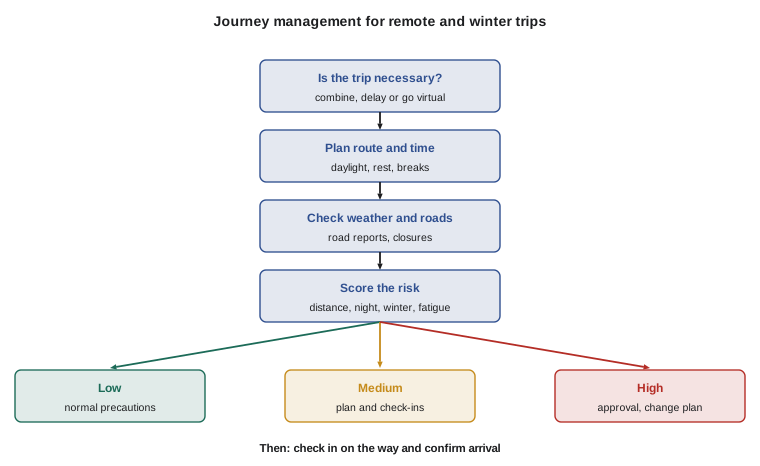
Journey management is the planning of trips to reduce risk before they start. For Tamarack, routine city trips need no special planning beyond the daily schedule. Remote and winter highway trips use a simple journey plan and risk score. The plan asks whether the trip is necessary or could be combined, sets the route and departure time, checks weather and road reports, sets check-in times, and decides whether conditions call for delay, an overnight stay or a second person.
# Journey risk score for an invented remote winter trip (illustrative scoring).
factors = {
    "distance_over_200km": 2,       # long trip
    "night_driving": 2,             # return after dark
    "winter_conditions": 3,         # snow forecast
    "resource_road_section": 2,
    "driver_awake_over_12h": 3,     # if returning same day
    "no_cell_coverage": 2,
}
trip = {"distance_over_200km": True, "night_driving": True, "winter_conditions": True,
        "resource_road_section": False, "driver_awake_over_12h": True, "no_cell_coverage": True}
score = sum(points for name, points in factors.items() if trip[name])
print(f"Journey risk score: {score}")
if score >= 10:
    print("High: supervisor approval needed; overnight stay or change of plan required")
elif score >= 6:
    print("Medium: journey plan with check-in times and winter kit")
else:
    print("Low: normal precautions")
# Same trip with an overnight stay (no long day, no night return)
trip.update({"night_driving": False, "driver_awake_over_12h": False})
print("With overnight stay:", sum(p for n, p in factors.items() if trip[n]))Journey risk score: 12 High: supervisor approval needed; overnight stay or change of plan required With overnight stay: 7
Step 5: Training and coaching
All drivers complete defensive driving awareness training, including this course's content, and a short practical session on backing and winter driving in the company's vehicles. New technicians ride with an experienced technician for their first remote trips. Supervisors are trained on scheduling, journey approval and coaching. Telematics data on harsh braking, speeding and phone use is reviewed weekly; the top issues are discussed in toolbox talks, and individual drivers get private coaching rather than public ranking.
Step 6: Incidents and learning
Every van carries a collision kit with a card listing the steps from lesson 10, a form and the reporting numbers. Drivers call their supervisor after any collision once the scene is safe. The coordinator reviews every collision and near miss, using the questions in lesson 10, and the safety committee looks at trends quarterly. Corrective actions are tracked to completion.
Step 7: Measuring and reviewing
| Indicator | Type | Target |
|---|---|---|
| Collisions per million km or miles | Lagging | 40 per cent reduction in two years |
| Injuries from driving | Lagging | Zero |
| Drivers with current training | Leading | 100 per cent |
| Daily circle checks completed | Leading | 95 per cent or more of vehicle-days |
| Defects repaired within 5 working days | Leading | 90 per cent or more |
| Telematics events per 100 km | Leading | Downward trend |
| Remote trips with journey plans | Leading | 100 per cent |
| Near misses reported | Leading | Upward trend at first, as reporting improves |
Testing the plan: a scenario
A plan is only useful if it works on a real day. Tamarack tests it with a scenario: a technician is dispatched in January to an emergency furnace failure at a remote camp 250 km away. The forecast calls for snow in the afternoon. It is already 1 p.m., and the job will take three hours.
Worked problem
Running the scenario through the plan
Apply the Tamarack plan to the emergency camp call.
Show solution
- Necessity: a furnace failure in winter at an occupied camp is urgent, so the trip is justified, but timing can be managed.
- Risk score: distance, winter conditions, a night return and a long day put the trip in the high band, so a supervisor must approve the plan.
- Options: the supervisor arranges for the camp to use backup heat overnight and schedules the technician to leave at first light, or approves an immediate trip with an overnight stay at the camp and no night return.
- Preparation: winter kit checked, van inspected, route and road reports checked, check-in times set every two hours, satellite messenger issued because part of the route lacks cell coverage.
- Driving: 4 second gap doubled in snow, phone notifications off, breaks every two hours.
- Return: next morning after rest, with a check-in on arrival at the depot.
Answer: The plan turns a high-risk late-afternoon dash into a managed trip with rest, check-ins and no night return. The customer is served and the technician is not put at unnecessary risk.
Making it last
Programs fade if they become paperwork. Tamarack keeps its plan alive by reviewing it every year, involving technicians in changes, recognizing safe driving records, and having the owner talk about driving safety at company meetings. When schedules and safety conflict, the policy says safety wins, and managers show they mean it.
Rolling out the plan
Tamarack rolls out the plan in stages over six months, so drivers are not overwhelmed and early lessons can shape later steps. The first month covers the policy, driver checks and the phone and dispatch changes. The second and third months add circle check apps, vehicle racks and backing training. Winter readiness and journey management start before the first snowfall. Telematics coaching begins once drivers understand what is collected and why. Each stage is explained at a company meeting, with time for questions and suggestions.
Costs and benefits
The plan costs money: training time, racks and cameras, winter tires, overnight stays and the coordinator's time. Tamarack's owner compares these costs with last year's collisions, which cost far more once repairs, deductibles, downtime, the injured technician's time off and higher insurance premiums were added up. Fewer collisions also mean fewer missed appointments and happier customers. Even without counting the human cost of injuries, a well-run fleet safety program usually pays for itself.
What success looks like
After two years, Tamarack hopes to see fewer collisions and no driving injuries, but it also looks for signs that the culture has changed: drivers delaying trips for weather without being asked, supervisors approving overnight stays without argument, near misses reported and discussed openly, and new technicians learning safe habits from experienced ones. Those signs show the plan has become the way the company works, rather than a document on a shelf.
Common mistakes
MistakeWriting a plan without looking at real data and talking to drivers.
InsteadStart with collision, telematics and maintenance data and drivers' experience.
MistakeLeaving personal-vehicle drivers out of the plan.
InsteadInclude them, with insurance, vehicle and policy requirements.
MistakeApproving late-day remote winter trips because the job is urgent.
InsteadUse journey management to change timing, add an overnight stay or find alternatives.
MistakeUsing telematics rankings to shame drivers.
InsteadCoach privately and focus on patterns and causes.
MistakeTreating the plan as finished once it is written.
InsteadMeasure, review and improve it every year with drivers involved.
Summary and key terms
- A fleet safety plan starts with data on collisions, near misses, telematics, maintenance and how drivers really work.
- Leadership sets a clear policy and gives drivers authority to delay trips for weather or fatigue.
- Driver and vehicle requirements cover licences, records, insurance, inspections, maintenance and load securement.
- Journey management plans risky trips before they start, using a simple risk score.
- Training and private coaching target the main risks.
- Collisions and near misses are reported and investigated to fix causes.
- Leading and lagging indicators track progress, and the plan is reviewed and improved yearly.
- Journey management
- Planning and controlling trips to reduce driving risk before they start.
- Journey risk score
- A simple rating of trip risk based on factors such as distance, weather and fatigue.
- Check-in
- A scheduled contact from a driver to confirm progress and safety.
- Satellite messenger
- A device that sends messages and location by satellite where there is no cell service.
- Driver handbook
- A short document setting out fleet safety rules and procedures.
- Toolbox talk
- A brief, informal safety discussion with a work group.
- Baseline
- The starting measurement against which improvement is judged.
- Corrective action tracking
- Recording actions from investigations and following them to completion.
- Mileage allowance
- Payment to employees for business use of their own vehicles.
- Scenario test
- Running a realistic situation through a plan to see if it works.
Practice problems
Work each problem on paper first, then reveal the answer to check.
What sources of information should a fleet safety plan start from?
Show answer
Collision and claim records, telematics, maintenance records and conversations with drivers and supervisors.
What authority should drivers have under the policy?
Show answer
To delay or cancel trips for weather or fatigue without penalty.
Why include personal-vehicle drivers in the plan?
Show answer
They drive for work and face the same risks; their insurance and vehicles need checking.
What is journey management?
Show answer
Planning trips to reduce risk before they start, including route, timing, weather and check-ins.
Which factors raised the risk score for the camp trip?
Show answer
Long distance, winter conditions, night driving, long day and no cell coverage.
How did the plan reduce the camp trip's risk?
Show answer
By changing timing or adding an overnight stay, removing the night return and long day.
Give two leading indicators from the Tamarack plan.
Show answer
Any two: training completion, circle checks, defect repair times, telematics events, journey plans, near-miss reports.
Why might near-miss reports rise at first?
Show answer
Because reporting improves as drivers trust the system.
How should telematics results be used with individual drivers?
Show answer
Through private coaching focused on patterns and causes.
How does Tamarack keep the plan from becoming paperwork?
Show answer
Annual review, involving technicians, recognition and visible leadership commitment.
Lesson quiz · 5 questions
Score 60% or more to complete this lesson.
Create a free account to save your progress, take quizzes and earn a certificate.