
HSE-251 · Lesson 7 of 12 · 29 min
Responding to a spill: the first minutes
The first few minutes after a spill decide most of the outcome. A calm, correct response can stop a drum leak before it reaches a drain, keep people away from vapour and turn a potential environmental incident into a short cleanup. A rushed or wrong response can injure the responder, spread the spill or start a fire. This lesson sets out a sequence of actions that works for most workplace spills. Your site plan may use different words or add steps for particular substances, and you must always follow it and stay within your training.
The core sequence
Many organizations teach spill response with a short memory aid. One widely used version is Stop, Isolate, Notify: stop and think before acting, isolate the area to protect people, and notify the right people. Others use longer sequences. The steps below expand the same ideas into the order most plans follow: assess safely, protect people, stop the source, contain the spill, notify, clean up and report. In practice several happen at once, especially if more than one person is present, but personal safety always comes first.
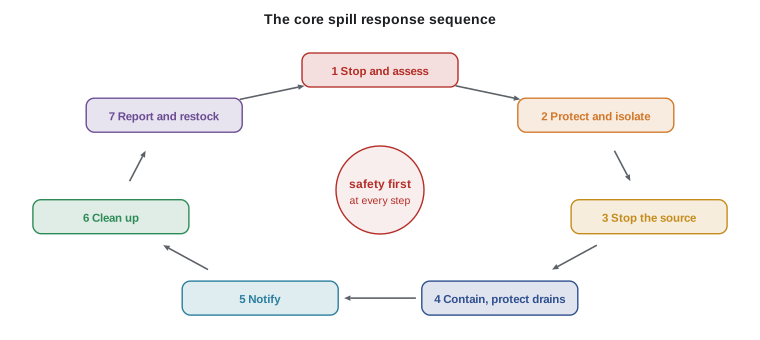
1. Stop and assess from a safe place
Do not rush in. Stop, look and think from a safe distance, upwind and uphill if possible, so that vapour drifts away from you and liquid flows away from you. Ask: What is spilling? How much, and is it still flowing? Where is it going? Is anyone hurt? Is there a fire, smoke, strong odour, hissing, a vapour cloud or a reaction such as fizzing or heat? Are there ignition sources nearby? Is the substance something I am trained and equipped to handle?
Identify the substance from container labels, placards, the safety data sheet, the site inventory or people who know. If you cannot identify it, treat it as hazardous: keep people away and call for help. Never smell, touch or taste an unknown liquid to identify it. If there is a fire, a vapour cloud, people overcome, or anything you are not sure about, it is beyond a first response: get out, warn others, pull the alarm if appropriate and call 911 and the site emergency contact.
| Sign | What it may mean | Action |
|---|---|---|
| Strong odour, eye or throat irritation | Vapour at harmful levels | Withdraw upwind; call for help |
| Hissing, frost on a container | Compressed or liquefied gas release | Evacuate; call 911 |
| Fizzing, smoke, heat, colour change | Chemical reaction | Withdraw; do not add water or absorbent |
| Person collapsed near spill | Toxic atmosphere | Do not enter; call 911; rescue only by equipped responders |
| Unknown liquid, no label | Unknown hazard | Isolate the area; get help to identify it |
| Small oil drip, no odour, no drain nearby | Low hazard | Proceed with spill kit per plan |
2. Protect people and isolate the area
Warn people nearby and keep them away. Cordon off the area with tape, cones or people stationed to turn others back. For flammable liquids, remove ignition sources if it is safe to do so: shut off engines, stop hot work, keep vehicles and phones away from the vapour area and do not operate electrical switches in the vapour zone. Help anyone who has been splashed to an eyewash or shower, remove contaminated clothing and get first aid, following the safety data sheet. Put on the protective equipment the plan requires before going closer.
3. Stop the source if it is safe
If the spill is still flowing and you can stop it safely, do so, because every minute adds volume. Close a valve, turn off a pump, stand a tipped drum upright, turn a leaking container so the hole is at the top, plug a hole with a leak-sealing plug or putty, or place a container under the drip. Use the emergency stop on a fuel dispenser. Do not put yourself in the path of the flow, climb onto a leaking tank, or work in vapour. If the source cannot be stopped safely, focus on containing the spill and call for help.
It helps to know how fast a leak can empty a container. The flow from a hole near the bottom of a tank depends mainly on the size of the hole and the height of liquid above it. The example below uses a standard estimate, Torricelli's law, to show why stopping the source quickly matters.
# Leak rate from a hole in a tank (Torricelli's law with a discharge coefficient).
import math
Cd = 0.6                     # typical discharge coefficient for a sharp-edged hole
g = 9.81
for d_mm in (3, 6, 12, 25):
    area = math.pi * (d_mm / 1000 / 2) ** 2
    for head_m in (0.5, 2.0):
        q = Cd * area * math.sqrt(2 * g * head_m) * 1000 * 60     # L per minute
print(f"hole {d_mm:>2} mm, liquid {head_m} m above it: {q:6.1f} L/min ({q/3.785:5.1f} gal/min)")hole 3 mm, liquid 0.5 m above it: 0.8 L/min ( 0.2 gal/min) hole 3 mm, liquid 2.0 m above it: 1.6 L/min ( 0.4 gal/min) hole 6 mm, liquid 0.5 m above it: 3.2 L/min ( 0.8 gal/min) hole 6 mm, liquid 2.0 m above it: 6.4 L/min ( 1.7 gal/min) hole 12 mm, liquid 0.5 m above it: 12.8 L/min ( 3.4 gal/min) hole 12 mm, liquid 2.0 m above it: 25.5 L/min ( 6.7 gal/min) hole 25 mm, liquid 0.5 m above it: 55.3 L/min ( 14.6 gal/min) hole 25 mm, liquid 2.0 m above it: 110.7 L/min ( 29.2 gal/min)
A 12 mm hole with two metres of liquid above it leaks over 25 litres a minute. In ten minutes that is more than a full drum. Even a pencil-sized hole can release several litres a minute. Plugging, turning or transferring quickly makes a large difference.
4. Contain the spill and protect drains
Stop the spill from spreading and, above all, from reaching drains, ditches, soil and water. Cover or plug any drain the spill could reach, starting with the closest. Ring the spill with absorbent socks or build a temporary dike with socks, a portable berm, sand or earth. Work from the edges inward. On slopes, place socks downhill of the spill first. If liquid is already flowing toward a drain, place the barrier between the spill and the drain rather than chasing the leading edge. Once it is contained, soak up pools with pillows and pads.
For flammable liquids, containment also reduces vapour by limiting the area of the pool. Do not use sawdust or other combustible materials on oxidizers, and do not wash spills away with water, which spreads them toward drains and makes more waste. Neutralizers for acids and bases should be used only by trained people following the plan, because neutralization produces heat and sometimes gas.
Worked problem
Containing a hydraulic oil spill on a slope
A loader's hydraulic hose bursts in a paved yard. Oil is running downhill toward a catch basin about 8 m away. You are alone, trained and have a spill kit nearby. What do you do?
Show solution
- Stop and assess: oil only, no fire, no strong odour, no injuries. Shut down the loader to stop the pump, if you can reach the controls safely.
- Grab the kit and put on gloves and glasses.
- Place the drain cover on the catch basin first, because that is the critical pathway.
- Lay socks across the flow path downhill of the oil, between the spill and the drain, then ring the rest of the spill.
- Call your supervisor to report and get help, then soak up the pool with pillows and pads.
Answer: Stop the pump, protect the drain first, contain downhill, notify and then absorb.
Flammable vapour checks
Fuels and solvents give off vapour that can ignite if it reaches its lower explosive limit, or LEL, the lowest concentration in air that can burn. Many sites with flammable liquids use portable gas detectors that read as a percentage of the LEL (%LEL). Typical practice is that work stops and people withdraw if the reading reaches 10 % of the LEL, and many site procedures set lower action levels. The detector does not need to read 100 % to signal danger: 10 % of the LEL already means flammable vapour is present and could be much higher nearby or in low spots, because most fuel vapours are heavier than air and collect in pits, trenches and drains. Only workers trained in the detector's use should rely on it.
# Converting a gas detector reading in %LEL to an approximate gas concentration in air.
lel_percent_by_volume = {"gasoline (approx.)": 1.4, "propane": 2.1, "methane": 5.0, "acetone": 2.5}
reading_pct_lel = 10                       # common alarm or withdrawal level
for gas, lel in lel_percent_by_volume.items():
    lel_ppm = lel * 10000                  # 1 % by volume = 10,000 ppm
    ppm = reading_pct_lel / 100 * lel_ppm
print(f"{gas:<20} LEL {lel:>3}% = {lel_ppm:>6,.0f} ppm; a {reading_pct_lel}% LEL reading = about {ppm:,.0f} ppm")gasoline (approx.) LEL 1.4% = 14,000 ppm; a 10% LEL reading = about 1,400 ppm propane LEL 2.1% = 21,000 ppm; a 10% LEL reading = about 2,100 ppm methane LEL 5.0% = 50,000 ppm; a 10% LEL reading = about 5,000 ppm acetone LEL 2.5% = 25,000 ppm; a 10% LEL reading = about 2,500 ppm
Remember that a flammable vapour reading is also a health warning. Concentrations far below the LEL can still exceed workplace exposure limits. If you can smell strong fuel or solvent vapour, you are probably exposed, and the right action is to withdraw and ventilate, not to keep working.
5. Notify
Tell your supervisor or the spill coordinator as soon as you can, even while containment is under way if someone else can make the call. Give a clear message: where the spill is, what substance, roughly how much, whether it is still flowing, whether it has reached a drain, soil or water, whether anyone is hurt, and what has been done. The supervisor or coordinator decides on the response level and makes the regulatory calls the plan requires. Lesson 11 covers regulatory reporting. Never delay calling 911 if there is a fire, injury or immediate danger.
| Tell them | Example |
|---|---|
| Where | Fuel pad beside the north gate |
| What | Diesel from a split delivery hose |
| How much | About 40 L so far; flow now stopped |
| Pathway | Some reached the gravel strip; drain covered before any entered |
| People | No injuries; area taped off |
| Actions | Drain covered, socks placed, absorbing now; need more pillows |
6 and 7. Clean up, report and restock
Once the spill is stopped and contained, clean up following the plan: absorb, collect, bag, label and store the waste safely, and clean the surface. Lesson 10 covers cleanup and waste in detail, and lesson 8 covers spills that soaked into soil. Then complete the internal spill report, make sure any regulatory reports have been made, restock the spill kit and take part in the review of what happened. Every spill, even a small one, is a chance to find and fix the cause.
When not to respond
Knowing when to stop is part of a correct response. Do not respond, or stop responding and withdraw, if the substance is unknown, if there is fire, smoke or a reaction, if there is strong vapour or odour, if anyone has collapsed, if the spill is too large for the equipment at hand, if it has entered water and is spreading, if you do not have the protective equipment the safety data sheet requires, or if you are not trained for it. In these cases, isolate the area from a safe distance, keep others away, call for help and wait for trained responders. You can still help by meeting responders and giving them information.
Worked problem
A chemical spill beyond a first response
In a warehouse, a forklift punctures a 20 L pail of an unlabelled liquid. It is fizzing on the concrete and a sharp smell is spreading. What should a worker trained only in this course do?
Show solution
- Recognize the danger signs: unknown substance, fizzing reaction and odour.
- Do not approach or try to absorb it. Leave the area, moving upwind, and warn others.
- Call the supervisor and, if people are affected or the situation is growing, 911, following the site plan.
- Keep people out of the area and meet responders with information: where, what happened, what the container looked like.
Answer: Withdraw, warn, call for help and isolate. This spill is beyond awareness-level response.
Common mistakes
MistakeRunning straight to a spill to stop it before assessing.
InsteadStop and assess from a safe place, upwind and uphill.
MistakeHosing a fuel spill toward the drain to clean the pad.
InsteadContain and absorb; never wash spills into drains.
MistakeChasing the leading edge of a flowing spill.
InsteadPut the barrier between the spill and the drain, downhill first.
MistakeContinuing work in strong fuel vapour.
InsteadWithdraw and ventilate; vapour is both a fire and health hazard.
MistakeSmelling an unknown liquid to identify it.
InsteadTreat unknowns as hazardous; isolate and get help.
Summary and key terms
- Personal safety comes first; stop and assess from upwind and uphill before acting.
- Identify the substance; if it is unknown or shows danger signs, withdraw and call for help.
- Protect people, isolate the area and remove ignition sources if safe.
- Stop the source if safe; even small holes leak litres a minute.
- Contain the spill and protect drains first, working downhill of the flow.
- Notify clearly: where, what, how much, pathway, people and actions.
- Clean up, report, restock and review every spill.
- Stop, Isolate, Notify
- A memory aid for spill response: stop and think, isolate the area, notify the right people.
- Upwind
- The direction the wind is coming from; standing upwind keeps vapour away from you.
- Isolate
- Keep people away from a spill area with barriers, tape or watchers.
- Ignition source
- Anything that can ignite vapour, such as flames, sparks, hot surfaces or electrical equipment.
- Containment (spill response)
- Stopping a spill from spreading, for example with socks, berms or drain covers.
- Lower explosive limit (LEL)
- The lowest concentration of a vapour in air that can ignite.
- %LEL reading
- A gas detector reading showing how close the vapour is to its lower explosive limit.
- Leak-sealing plug
- A tapered plug or putty used to stop a leak from a hole in a container.
- Torricelli's law
- A rule for estimating how fast liquid flows from a hole, based on the height of liquid above it.
- Withdrawal
- Leaving a spill area when conditions are beyond your training or equipment.
Practice problems
Work each problem on paper first, then reveal the answer to check.
Why approach a spill from upwind and uphill?
Show answer
So vapour drifts away from you and liquid flows away from you.
Name three signs that a spill is beyond a first response.
Show answer
Any three of fire or smoke, strong odour or irritation, fizzing or heat, hissing or frost, a person collapsed, unknown substance.
What is the first containment priority on a slope near a drain?
Show answer
Cover the drain and place barriers downhill between the spill and the drain.
Why must you not hose a spill away?
Show answer
It spreads the spill toward drains and creates more contaminated waste.
About how much does a 12 mm hole with 2 m of liquid above it leak?
Show answer
Over 25 litres a minute.
What does a reading of 10 % LEL mean?
Show answer
Flammable vapour is present at a tenth of the level that can ignite; withdraw as the plan directs.
Why are fuel vapours dangerous in pits and drains?
Show answer
Most are heavier than air and collect in low spots.
List the six things to include when notifying a spill.
Show answer
Where, what, how much, pathway, people and actions taken.
What should you do with an unknown fizzing liquid?
Show answer
Withdraw upwind, warn others, call for help and isolate the area.
What should happen after cleanup?
Show answer
Report, restock the kit and review the cause.
Lesson quiz · 5 questions
Score 60% or more to complete this lesson.
Create a free account to save your progress, take quizzes and earn a certificate.