
HSE-251 · Lesson 1 of 12 · 30 min
Why spills matter
A spill is any release of a liquid, solid or gas from where it is supposed to be into where it is not. Most spills at work are small: a few litres of hydraulic oil from a burst hose, a jug of cleaning chemical knocked off a shelf, a drip tray that overflowed overnight. Some are large: a fuel tank that fails, a tanker truck that rolls over, a tailings dam that gives way. Small or large, a spill can hurt the people nearby, damage soil, water and wildlife, shut down a business and lead to fines, cleanup bills and lawsuits that last for years.
This course is about preventing spills at ordinary workplaces and responding safely and correctly when they happen. It is written for workers, lead hands and supervisors at places such as fleet yards, warehouses, farms, construction sites, plants, laboratories, schools and stores. It is awareness and first-responder training. It does not qualify you as a hazardous materials technician, and it does not replace the site-specific training your employer must give you on its own spill plan, equipment and chemicals. Where your work involves responding to large releases of hazardous substances, your employer must provide more advanced training under provincial occupational health and safety law and its emergency response plan.
What counts as a spill
The word spill covers many kinds of release. Liquids are the most common: fuels, lubricating and hydraulic oils, antifreeze, solvents, paints, acids, caustics, pesticides, liquid fertilizers, milk and other food products, and wastewater. Solids can spill too: powders, granular fertilizer, cement, contaminated soil and mine tailings. Gases and vapours escape from cylinders, tanks and lines. A spill does not have to be dramatic. A slow drip from a valve that runs for weeks can release more than a sudden break, and because nobody sees it, it often does more damage.
Regulators usually care about where a spill goes as much as how big it is. A litre of oil on a sealed concrete floor inside a building with no drains is a housekeeping problem. The same litre poured into a storm drain that empties into a creek is pollution of fish habitat, and in many jurisdictions it must be reported. Throughout this course you will see the same idea: the pathway from the spill to people and the environment decides how serious it is and what the law requires.
| Type of release | Typical workplace examples | Main concern |
|---|---|---|
| Fuels | Diesel, gasoline, heating oil, aviation fuel | Fire, vapour, soil and water contamination |
| Oils and lubricants | Hydraulic oil, engine oil, used oil, gear oil | Water and soil contamination, slips |
| Glycols and coolants | Antifreeze, de-icing fluid | Toxic to pets and wildlife; high oxygen demand in water |
| Acids and caustics | Battery acid, drain cleaner, sodium hydroxide | Burns, fumes, reactions, fish kills |
| Solvents and paints | Degreasers, thinners, coatings | Vapour, fire, groundwater contamination |
| Agricultural products | Pesticides, liquid fertilizer, manure | Water contamination, algae blooms |
| Food and process liquids | Milk, syrups, brewery waste | Deplete oxygen in streams and kill fish |
| Solids | Cement, powders, tailings, contaminated soil | Dust, runoff, burial of habitat |
Milk and syrup appear in that table deliberately. Many people assume only toxic chemicals cause environmental harm. But organic liquids such as milk, juice, beer wastes and sugar solutions are food for bacteria. When they reach a stream, bacteria multiply and use up the dissolved oxygen in the water, and fish suffocate. A tanker of milk spilled into a small creek can kill fish for kilometres downstream. This is why environmental laws often define a harmful substance by its effect, not by a list.
Four spills that changed the rules
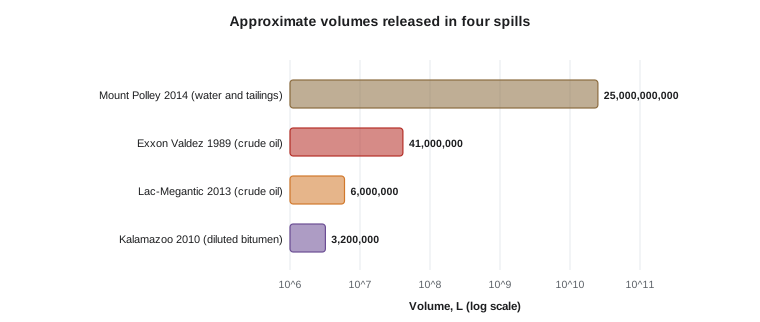
Some spills are remembered because of their size, some because of the lessons they taught. The four cases below come from very different industries, but each one shows how a spill can travel far beyond its source and how expensive and slow the recovery can be.
On 6 July 2013, a runaway train of crude oil tank cars derailed and burned in the centre of Lac-Mégantic, Quebec, killing 47 people. HSE-250 covers the transport lessons. From a spill point of view, roughly six million litres of crude oil escaped. Much of it burned, but oil also soaked into the soil of the downtown and flowed through storm sewers into Lac Mégantic and the Chaudière River, where it affected drinking water supplies downstream. Years of soil excavation and treatment followed, and the downtown had to be rebuilt on cleaned ground.
In July 2010 a pipeline near Marshall, Michigan, ruptured and released diluted bitumen, a heavy oil thinned with lighter hydrocarbons so it can flow through pipes, into a creek that feeds the Kalamazoo River. Estimates put the release at roughly 3.2 million litres (about 843,000 US gallons). The leak went on for many hours before it was stopped, partly because alarms were misread as other problems. Once the lighter thinning components evaporated, much of the heavy oil sank into the river sediment instead of floating where booms could collect it. The cleanup took years and cost more than a billion dollars, and it changed how responders plan for oils that sink.
On 4 August 2014, the tailings storage facility at the Mount Polley copper and gold mine in British Columbia failed. The breach released roughly 25 million cubic metres of water and mine tailings into Polley Lake, Hazeltine Creek and Quesnel Lake. Hazeltine Creek was scoured and buried. An expert panel found the main cause was a weak layer in the foundation that had not been identified in the design. The case is a reminder that a spill can be a slurry of mostly water and fine solids, and that dams and impoundments are containment structures that must be designed and inspected as seriously as tanks.
On 24 March 1989, the tanker Exxon Valdez ran aground in Prince William Sound, Alaska, and spilled about 41 million litres (about 11 million US gallons) of crude oil. Oil eventually reached around 2,000 kilometres of shoreline. Seabirds, sea otters, seals and fish populations were badly hurt, and some effects lasted for decades. The spill led directly to the US Oil Pollution Act of 1990, which strengthened requirements for spill prevention, response planning and liability, and influenced spill rules around the world, including double hulls for tankers.
The workplace spill you are more likely to see
Those famous cases are not typical. The spills most workers will see are small, local and preventable: a fuel nozzle left in a jerrican that overflows, a forklift that punctures a drum, a hose that splits on an excavator, a delivery driver who connects to the wrong tank fill pipe, a drum of used oil stored outside without a lid so rain overflows it. Each of these can usually be stopped and cleaned up in minutes by trained people with the right equipment. Each can also turn into a much bigger problem if no one acts, if the spill reaches a drain, or if people respond in a way that puts themselves in danger.
Small spills add up. A transport company with fifty trucks that each leak a few drops of oil a day is releasing hundreds of litres a year onto its yard, and rain washes that oil into storm drains. Regulators increasingly look at these chronic sources, not just big accidents. The good news is that small spills are also where prevention pays off most: drip trays, maintenance, good storage, and a culture where people report and fix leaks quickly.
# A slow drip adds up (illustrative numbers).
drops_per_minute = 10        # a modest drip from a loose fitting
ml_per_drop = 0.05
minutes_per_year = 60 * 24 * 365
volume_l = drops_per_minute * ml_per_drop * minutes_per_year / 1000
print(f"One fitting dripping {drops_per_minute} drops a minute releases about {volume_l:.0f} L a year")
print(f"That is about {volume_l / 3.785:.0f} US gallons, from one unnoticed drip")
for fittings in (5, 20, 50):
print(f"{fittings:>3} dripping fittings across a fleet: about {fittings * volume_l:,.0f} L a year")One fitting dripping 10 drops a minute releases about 263 L a year That is about 69 US gallons, from one unnoticed drip 5 dripping fittings across a fleet: about 1,314 L a year 20 dripping fittings across a fleet: about 5,256 L a year 50 dripping fittings across a fleet: about 13,140 L a year
Harm to people, the environment and the business
Spills hurt people first. Flammable liquids can ignite and burn. Vapours from fuels and solvents can make people dizzy, sick or unconscious in enclosed spaces. Acids and caustics burn skin and eyes. Some chemicals react with each other or with water to release toxic gases. Slips on oil and glycol cause many injuries. Responders who rush in without protection are often among the casualties, which is why the first rule of spill response, covered in lesson 7, is to protect yourself and others before touching the spill.
The environment is harmed through soil, surface water, groundwater and air. Oil coats birds and smothers plants. Even small amounts of some substances are toxic to fish and insects. Fuels and solvents that soak into the ground can reach groundwater and contaminate wells for decades, as lesson 8 explains. Nutrients from fertilizer and manure cause algae blooms. Sediment from a solids spill buries spawning beds.
The business pays as well. Cleanup of contaminated soil and groundwater is expensive, and the cost rises steeply the longer a spill goes unnoticed. Operations may be shut down. Neighbours may sue. Insurers may raise premiums or refuse coverage. Regulators can order cleanup, impose fines and, in serious cases, prosecute companies, directors and individuals. Reputations suffer when a spill makes the news.
| Cost category | Examples |
|---|---|
| Response | Absorbents, contractors, vacuum trucks, overtime, equipment hire |
| Cleanup and disposal | Excavating soil, treating water, hazardous waste disposal, lab testing |
| Lost operations | Shutdowns, lost product, delayed deliveries |
| Legal | Fines, orders, lawyers, compensation to neighbours |
| Long term | Monitoring wells, insurance premiums, reputation, lost customers |
Penalties can be large. Under the federal Fisheries Act, depositing a deleterious substance into water frequented by fish is an offence, and a corporation convicted on indictment of a first offence faces a fine of $500,000 to $6 million, rising to $1 million to $12 million for a later offence, with lower ranges for small-revenue corporations and individuals. Provinces have their own environmental offences and penalties. Lesson 3 explains how these laws fit together.
Worked problem
Estimating the size of a spill
A delivery driver reports a pool of diesel about 4 m long and 2.5 m wide on a sloped asphalt pad, roughly 5 mm deep on average. How much fuel is on the ground?
Show solution
- Area is 4 × 2.5 = 10 m².
- Depth is 5 mm = 0.005 m, so volume is 10 × 0.005 = 0.05 m³.
- One cubic metre holds 1,000 L, so the pool is about 50 L.
- Some fuel will already have soaked into cracks and run off the edge, so treat this as a minimum.
Answer: About 50 L at least. That is enough to report in many provinces if it reaches soil or water, so the estimate matters.
# Pool volume estimate: area x average depth (works for any shape if you estimate area).
def pool_volume_l(length_m, width_m, depth_mm):
    return length_m * width_m * (depth_mm / 1000) * 1000

for l, w, d in [(4, 2.5, 5), (1.5, 1.0, 3), (10, 6, 2)]:
    v = pool_volume_l(l, w, d)
print(f"{l} m x {w} m at {d} mm deep -> {v:6.1f} L ({v / 3.785:5.1f} US gal)")4 m x 2.5 m at 5 mm deep -> 50.0 L ( 13.2 US gal) 1.5 m x 1.0 m at 3 mm deep -> 4.5 L ( 1.2 US gal) 10 m x 6 m at 2 mm deep -> 120.0 L ( 31.7 US gal)
Worked problem
Spotting the pathway
A worker spills 10 L of antifreeze in a parking lot. It is a warm day and there is no rain. Is this a minor spill?
Show solution
- Look for the nearest storm drain, ditch or bare soil. In most parking lots, a catch basin is within a few metres.
- Antifreeze (ethylene glycol) is sweet tasting and toxic to pets and wildlife, and it dissolves in water.
- If the next rainfall will wash residue into a catch basin that drains to a creek, the spill has a pathway to water.
- The right response is to block or cover the drain, absorb the liquid now, and report according to the site plan.
Answer: Not necessarily minor. Ten litres is small, but a storm drain nearby makes it a potential water pollution incident, so contain it and report it.
The rest of this course
The following lessons work through the problem in a logical order. Lesson 2 looks at where spills happen at work. Lesson 3 maps the laws. Lessons 4 and 5 cover prevention and planning. Lesson 6 covers spill kits. Lesson 7 is the core response procedure. Lessons 8 and 9 look at spills to land and water. Lesson 10 covers cleanup and waste, lesson 11 covers reporting, and lesson 12 brings everything together in a plan for a fleet maintenance yard. Spills during transport are covered in HSE-250, chemical storage in HSE-312 and fuel station spills in HSE-351.
Common mistakes
MistakeThinking only large, dramatic releases count as spills.
InsteadSmall and slow releases count too, and they cause much of the harm at workplaces.
MistakeAssuming food products and other non-toxic liquids are harmless if they reach water.
InsteadMilk, sugars and other organic liquids remove oxygen from streams and can kill fish.
MistakeJudging a spill only by its volume.
InsteadThe pathway to drains, soil and water often matters more than the size.
MistakeTreating awareness training as permission to respond to any release.
InsteadRespond only within your training and the site plan; larger releases need trained responders.
MistakeCounting only the cost of the lost product.
InsteadResponse, cleanup, downtime, fines and legal costs usually far exceed the product cost.
Summary and key terms
- A spill is any release of a substance to where it is not supposed to be, from a slow drip to a major failure.
- Fuels, oils, glycols, chemicals, food liquids and solids can all cause harm.
- The pathway to people, drains, soil and water often decides how serious a spill is.
- Lac-Mégantic, Kalamazoo, Mount Polley and Exxon Valdez show how spills travel and how slow recovery can be.
- Most workplace spills are small and preventable, but they add up and can escalate.
- Spills harm people, the environment and the business, and can lead to large penalties.
- This is awareness training; follow your employer's plan and work within your training.
- Spill
- A release of a substance from its intended container or system into the surroundings.
- Release
- Any escape of a substance into the environment, whether sudden or slow.
- Pathway
- The route by which a spill can reach people, soil, drains, surface water or groundwater.
- Receptor
- A person, animal, plant, water body or well that could be harmed by a spill.
- Deleterious substance
- A substance that degrades water quality and makes it harmful to fish or fish habitat.
- Diluted bitumen
- Heavy crude oil thinned with lighter hydrocarbons so it can flow through pipelines.
- Tailings
- The fine waste rock and water left after ore is processed at a mine.
- Chronic release
- A small leak or drip that continues over a long time.
- Oxygen demand
- The amount of dissolved oxygen that bacteria use as they break down organic matter in water.
- First responder (spills)
- A worker trained to take safe initial actions at a spill within set limits.
Practice problems
Work each problem on paper first, then reveal the answer to check.
Give three examples of spills that do not involve fuel or oil.
Show answer
Any three of: antifreeze, acid or caustic, solvent, paint, pesticide, fertilizer, milk or syrup, cement or powder, tailings.
Why can a spill of milk kill fish?
Show answer
Bacteria feeding on the milk use up the dissolved oxygen in the water.
What is a pathway?
Show answer
The route by which a spill reaches people, soil or water, such as a storm drain or bare ground.
What happened to much of the oil at Kalamazoo, and why did it matter?
Show answer
It sank into the river sediment after the lighter components evaporated, so booms could not collect it.
What law followed the Exxon Valdez spill?
Show answer
The US Oil Pollution Act of 1990.
What did the Mount Polley failure release?
Show answer
About 25 million cubic metres of water and mine tailings.
A pool of oil is 3 m by 2 m and 4 mm deep. Roughly how many litres is that?
Show answer
3 × 2 × 0.004 = 0.024 m³, or about 24 L.
Why are slow drips important?
Show answer
They go unnoticed and can release large total volumes over time.
Name three costs of a spill other than the lost product.
Show answer
Any three of response, cleanup, disposal, downtime, fines, legal costs, monitoring, insurance and reputation.
Does this course certify you to respond to any spill?
Show answer
No. It is awareness training; your employer must train you on its plan and equipment, and larger releases need trained responders.
Lesson quiz · 5 questions
Score 60% or more to complete this lesson.
Create a free account to save your progress, take quizzes and earn a certificate.