
HSE-251 · Lesson 11 of 12 · 27 min
Reporting and documentation
Reporting a spill is not an admission of failure; it is a legal duty and a practical necessity. Regulators need to know about spills so that they can protect drinking water, warn downstream users, send help and make sure cleanup is done properly. Companies need internal reports to learn from spills and to show due diligence. Failing to report a reportable spill is often treated more seriously than the spill itself. This lesson covers who must be told, when, what information to give, and how to document the spill from start to finish.
Internal reporting
Every spill, however small, should be reported inside the organization. The worker who discovers it tells the supervisor or spill coordinator immediately, as lesson 7 explained. The coordinator decides whether the spill is reportable to regulators and makes those calls. Small spills that are not reportable outside the company are still recorded, because patterns of small spills reveal leaking equipment, poor procedures or training gaps before a large spill happens. Many sites use a simple spill log or form that takes a few minutes to complete.
Who to call outside the company
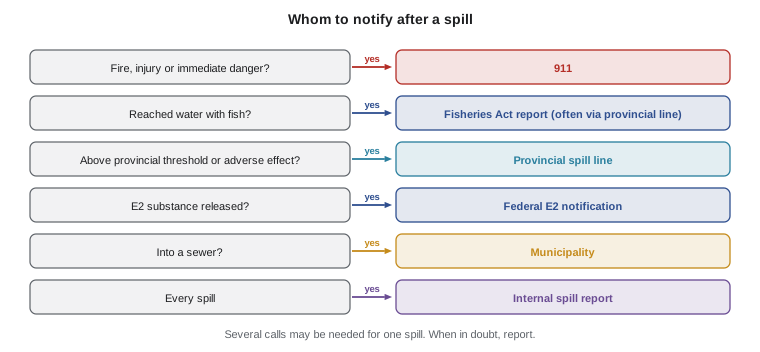
Calls go in a set order. If there is a fire, an injury or an immediate danger to people, call 911 first. Then the spill reporting line for the jurisdiction, then any other agencies the rules require, then the sewer authority if a sewer was affected, and finally anyone downstream who may be affected, such as a neighbouring water intake, if the plan or the regulator asks you to. Your site plan should list the numbers, the triggers for each call and who is authorized to make them.
Reporting in Canada
Each province sets its own reporting triggers and lines. In Ontario, spills of pollutants that cause or are likely to cause an adverse effect must be reported without delay to the Spills Action Centre at 1-800-268-6060 and to the municipality; a regulation sets out some exemptions for certain small spills. In British Columbia, the Spill Reporting Regulation requires an immediate call to the provincial spill line at 1-800-663-3456 for spills above the amounts listed by substance type in its schedule, and for any spill that enters or is likely to enter a body of water regardless of amount; a written report follows within 30 days and an end-of-spill report after the response. In Alberta, releases that may cause an adverse effect must be reported as soon as possible to the provincial environment ministry, or to the energy regulator for energy facilities, followed by a written report. Other provinces have similar systems. Under the federal Fisheries Act, a deposit or serious and imminent danger of a deposit of a deleterious substance in water frequented by fish must be reported; in several provinces, a call to the provincial spill line also satisfies the federal reporting through agreements between governments.
| Trigger | Call |
|---|---|
| Fire, injury, immediate danger | 911 |
| Ontario: spill causing or likely to cause adverse effect | Spills Action Centre 1-800-268-6060, and the municipality |
| British Columbia: above schedule amount, or any spill to water | Provincial spill line 1-800-663-3456 |
| Alberta: release that may cause an adverse effect | Provincial environment ministry, or the energy regulator for energy sites |
| Deleterious substance to fish-bearing water | Fisheries Act report (often via the provincial line) |
| Spill to sanitary or storm sewer | Municipality or sewer authority |
| Dangerous goods in transport | As required by TDG Part 8 (HSE-250); CANUTEC for advice |
Checking a reportable quantity
Where reporting depends on quantity, someone must estimate how much was released, quickly and honestly. Estimates are made from the container size and how much is left, the area and depth of the spill as in lesson 1, flow rates and durations as in lesson 7, or gauge readings before and after. When in doubt, report: regulators would much rather receive a report that turns out to be below a threshold than miss one that was above it. The example below shows a reportable quantity check for US federal rules; Canadian provincial thresholds are usually set in litres or kilograms by substance type and work the same way.
# CERCLA reportable quantity (RQ) check for a release (US federal; RQs in pounds).
RQ_LB = {"benzene": 10, "xylene": 100, "ammonia": 100, "toluene": 1000,
         "sulfuric acid": 1000, "ethylene glycol": 5000}
def check(substance, kg_released):
    lb = kg_released * 2.2046
    rq = RQ_LB[substance]
    status = "REPORT to the NRC" if lb >= rq else "below the federal RQ (check state rules)"
    print(f"{substance:<16} {kg_released:>6.1f} kg = {lb:7.1f} lb; RQ {rq:>5} lb -> {status}")

check("benzene", 5)            # 11 lb
check("ammonia", 30)           # 66 lb
check("sulfuric acid", 500)    # 1,102 lb
check("ethylene glycol", 400) # 882 lbbenzene 5.0 kg = 11.0 lb; RQ 10 lb -> REPORT to the NRC ammonia 30.0 kg = 66.1 lb; RQ 100 lb -> below the federal RQ (check state rules) sulfuric acid 500.0 kg = 1102.3 lb; RQ 1000 lb -> REPORT to the NRC ethylene glycol 400.0 kg = 881.8 lb; RQ 5000 lb -> below the federal RQ (check state rules)
Note that the federal threshold for ethylene glycol is high, but a spill of it to a creek could still be reportable under state or provincial rules and still kill fish. Thresholds are a minimum for reporting, not a measure of harm.
What to say when you call
Regulators need the same basic facts every time. Have them ready before you call, and write down the time of the call, the name of the person you spoke to and any reference number they give you. Many agencies record calls.
| Information | Example |
|---|---|
| Your name, role, company and call-back number | J. Singh, yard supervisor, Northwind Fleet, 555-0142 |
| Location | Address, and where on the site |
| Date and time the spill started and was discovered | Started about 06:40; found 06:55 |
| Substance and its hazards | Diesel fuel, combustible liquid |
| Estimated quantity released and recovered | About 150 L released; 90 L recovered so far |
| Cause and source | Delivery hose split at coupling |
| Where it went | Gravel area and one catch basin; drain to creek covered after about 10 L entered |
| Actions taken | Flow stopped, drain covered, booms at outfall, contractor called |
| Injuries, evacuations, wildlife affected | None |
Report what you know and say clearly what you do not yet know. If the estimate changes, or the spill turns out to have reached water when you thought it had not, call back with an update. Honest, prompt and updated reports build trust with regulators; inaccurate or delayed ones damage it.
Written reports and follow-up
Many provinces require a written report after the initial call, for example within 30 days in British Columbia, and Alberta requires a written report within days of the release. The regulator may also ask for additional reports, sampling results or a cleanup plan. Keep copies of everything submitted.
Documenting the spill
Good documentation starts during the response. A designated person should keep a log of times, actions and decisions. Take photos of the spill, the source, the extent, drains and water before, during and after cleanup, with something in the frame for scale. Sketch the area with distances and the direction of flow. Record estimates of volume released and recovered, the equipment used, the people involved and the agencies called. After the response, complete the site spill report and attach the log, photos, waste records and copies of regulatory reports.
These records serve several purposes. They support accurate regulatory reports and answers to follow-up questions. They help the investigation find the cause. They show due diligence if the company is prosecuted. They support insurance claims and cost recovery from others who caused the spill. And they build a history that helps the company see trends and improve.
Worked problem
Correcting an early report
A supervisor reports a 20 L hydraulic oil spill to the provincial line, believing it stayed on the pavement. An hour later, workers find a sheen in the ditch beyond the storm outfall. What should the supervisor do?
Show solution
- Treat the new information as urgent: the spill has reached water.
- Call the provincial line back with an update, giving the reference number from the first call, and confirm whether federal Fisheries Act reporting is covered.
- Deploy booms or an underflow dam in the ditch and recover the sheen.
- Record the time of discovery and the update call in the log.
Answer: Update the report immediately, notify any agency now triggered, contain the oil in the ditch and document the timeline.
Worked problem
Deciding not to report
A worker spills 2 L of motor oil on the sealed concrete floor of a shop with no floor drains and cleans it up in ten minutes. Must it be reported to a regulator?
Show solution
- The oil stayed on an impervious surface with no pathway to drains, soil or water.
- The amount is small and was fully recovered.
- Check the site plan and the local rules; in most jurisdictions such a spill is not reportable to regulators.
- It must still be recorded in the internal spill log, and the cause noted.
Answer: Probably not reportable outside the company, but record it internally. If in doubt, check the plan or ask the coordinator.
Who is allowed to make the call
Plans should say who is authorized to report to regulators, but they must never stop a worker from reporting when no one else is available. If the coordinator cannot be reached and the spill is clearly reportable, the person in charge at the scene should make the call and inform management afterwards. Delaying a required report while waiting for permission is a common reason companies are prosecuted for late reporting. Some laws also protect employees from reprisal for reporting environmental problems in good faith.
Learning from reports
The spill log is a source of improvement, not just a record. Reviewing it every few months shows where spills keep happening, which equipment leaks, which procedures are skipped and which shifts or tasks have more incidents. A simple tally by location and cause often reveals that a few sources account for most spills. Fixing those sources, and sharing the results with the people who reported the spills, encourages more reporting and fewer spills.
When a spill is investigated, the report should go beyond the immediate cause, such as a split hose, to the underlying causes, such as no hose inspection schedule or a supplier who used the wrong hose rating. HSE-403 covers incident investigation and root cause analysis. Corrective actions should be assigned, given due dates and tracked to completion, and the spill plan updated where the investigation shows a gap.
Common mistakes
MistakeDelaying a report until the cleanup is finished.
InsteadReport immediately or without delay, as the rules require, while the response continues.
MistakeUnderestimating the volume to stay below a threshold.
InsteadEstimate honestly; when in doubt, report.
MistakeNot calling back when new information appears.
InsteadUpdate the report promptly, quoting the reference number.
MistakeSkipping internal records for small spills.
InsteadRecord every spill; patterns reveal problems early.
MistakeTaking no photos during the response.
InsteadPhotograph the spill, extent and cleanup with a scale reference.
Summary and key terms
- Reporting is a legal duty; failure to report is often treated more seriously than the spill.
- Report every spill internally, and let the coordinator decide on regulatory calls.
- Call 911 first for fire, injury or immediate danger, then the required spill lines.
- Provinces set their own triggers and lines; spills to fish-bearing water also trigger the Fisheries Act.
- Estimate quantities honestly; when in doubt, report.
- Give clear facts, say what you do not know, and update reports as information changes.
- Document times, actions, photos, volumes and waste; records support reports, investigations and due diligence.
- Spills Action Centre
- Ontario's 24-hour spill reporting line, 1-800-268-6060.
- Provincial spill line
- A province's 24-hour number for reporting spills to the environment.
- Adverse effect
- Harm to the environment, property, plants, animals or human health.
- Reporting threshold
- The quantity or condition above which a spill must be reported.
- Written report
- A follow-up report submitted after the initial call, within a set time.
- End-of-spill report
- A report submitted after response activities end, as required in some provinces.
- Reference number
- The number an agency assigns to a spill report, used for updates.
- Spill log
- A record of times, actions and decisions made during a spill response.
- CANUTEC
- The Canadian Transport Emergency Centre, which gives advice on dangerous goods emergencies.
- Due diligence records
- Documents that show reasonable steps were taken to prevent and respond to spills.
Practice problems
Work each problem on paper first, then reveal the answer to check.
Why should small, non-reportable spills still be recorded?
Show answer
Patterns reveal leaking equipment, poor procedures or training gaps.
What is the first call if there is a fire or injury?
Show answer
911.
What is the Ontario Spills Action Centre number?
Show answer
1-800-268-6060.
When must a spill be reported in British Columbia regardless of amount?
Show answer
When it enters or is likely to enter a body of water.
Is 5 kg of benzene above the federal US reportable quantity?
Show answer
Yes: 5 kg is about 11 lb, above the 10 lb RQ.
What should you do if you are unsure whether a spill is reportable?
Show answer
Report it, or ask the coordinator to; it is better to report than to miss a required report.
Name five facts to give when reporting a spill.
Show answer
Any five of who you are, location, time, substance, quantity, cause, where it went, actions, injuries.
What should you do if new information shows a spill reached water?
Show answer
Call back immediately with an update and notify any agency now triggered.
What should photos include?
Show answer
The spill, source, extent, drains and water, before, during and after cleanup, with a scale reference.
Give three uses of spill records.
Show answer
Any three of regulatory reports, investigations, due diligence, insurance and cost recovery, trend tracking.
Lesson quiz · 5 questions
Score 60% or more to complete this lesson.
Create a free account to save your progress, take quizzes and earn a certificate.