
HSE-251 · Lesson 4 of 12 · 27 min
Spill prevention: storage, secondary containment and inspection
The cheapest spill is the one that never happens. Prevention works on three fronts: keep substances in good containers in good condition, put a second barrier around them in case the first fails, and inspect often enough to find problems before they become spills. This lesson covers all three. Detailed chemical storage and compatibility rules are covered in HSE-312; here the focus is on preventing releases of fuels, oils and chemicals at ordinary workplaces.
Primary containment
Primary containment is the container that is supposed to hold the substance: a tank, drum, tote, jerrican, bottle, pipe or hose. It must be made of a material compatible with the contents, rated for the pressure and temperature it will see, protected from damage, and kept closed when not in use. Most spills start with a failure of primary containment: a corroded tank bottom, a punctured drum, a split hose, an open lid, a cracked fitting or a container that was the wrong type for the product.
| Primary container | Common failure | Prevention |
|---|---|---|
| Aboveground tank | Corrosion, overfill, failed valve or fitting | Inspection, overfill protection, corrosion control, locked valves |
| Underground tank | Corrosion, leaking piping, overfill | Leak detection, cathodic protection, tightness testing |
| Drum (205 L / 55 gal) | Forklift puncture, corrosion, open bung, freezing | Spill pallets, indoor storage, bungs closed, protection from traffic |
| Tote (intermediate bulk container) | Valve damage, cage damage, UV degradation | Valve guards, inspection, shading, date checks |
| Portable fuel container | Overfill, wrong type, damaged spout | Approved containers, attended filling, correct storage |
| Hoses and piping | Splits, abrasion, loose connections | Pre-use checks, replacement schedule, guards |
Containers should be labelled with their contents and hazards so that nobody fills them with the wrong product or mixes incompatible materials. Old, unlabelled containers of unknown liquids are a frequent source of spills and of dangerous mistakes during cleanup. A regular purge of unneeded chemicals, sending them for proper disposal, reduces both risks.
Secondary containment
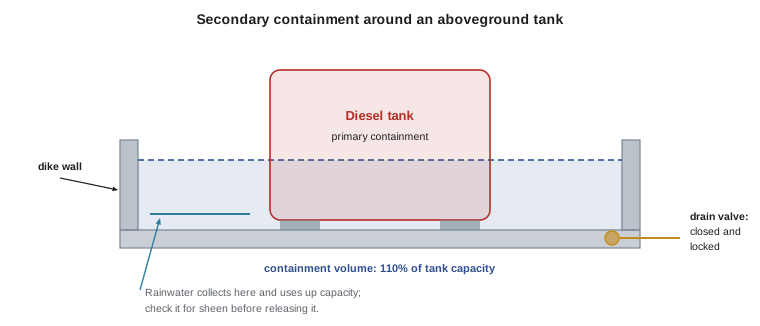
Secondary containment is a second barrier that catches a release if primary containment fails. It may be a dike or berm around a tank, a double-walled tank, a spill pallet under drums, a containment tray under a parts washer, a curbed area with a sealed floor, or a sump that collects leaks. Good secondary containment is large enough to hold a realistic release, made of material the substance cannot easily pass through, free of drains or open valves that would let the substance escape, and kept clean and empty of rainwater so its capacity is available.
Canadian fire codes and the national code of practice for petroleum storage tanks commonly require aboveground tank containment to hold 110 % of the capacity of a single tank, and, where several tanks share one containment area, the capacity of the largest tank plus 10 % of the combined capacity of the others. Many provinces adopt these rules through their fire codes or petroleum storage regulations, and federal regulations for storage tank systems on federal land set similar requirements. Always check the code that applies at your site; some products and sites have stricter rules.
Worked problem
Sizing a dike for one tank
A 10,000 L diesel tank will sit in a rectangular concrete dike 4 m by 3 m. How high must the dike walls be to hold 110 % of the tank's capacity, ignoring the volume the tank itself takes up?
Show solution
- Required volume is 1.10 × 10,000 = 11,000 L, or 11 m³.
- Floor area is 4 × 3 = 12 m².
- Height needed is 11 ÷ 12 ≈ 0.92 m.
- In reality the tank's own footprint takes up some of the floor area, so the walls must be a little higher; an engineer will calculate the exact figure.
Answer: About 0.92 m before allowing for the tank footprint, so a wall of about 1 m is a sensible starting point.
# Containment needed when several tanks share one dike (illustrative volumes in L).
tanks = {"diesel": 10000, "gasoline": 5000, "used oil": 2000}
largest = max(tanks.values())
others = sum(tanks.values()) - largest
canada_rule = largest + 0.10 * others          # common Canadian fire code approach
largest_110 = 1.10 * largest                    # simple 110 % of largest tank
print(f"Largest tank: {largest:,} L; other tanks combined: {others:,} L")
print(f"Largest + 10% of others: {canada_rule:,.0f} L")
print(f"110% of largest:         {largest_110:,.0f} L")
need = max(canada_rule, largest_110)
area_m2 = 6 * 4
print(f"Use the larger, {need:,.0f} L; in a 6 m x 4 m dike the walls must be at least {need/1000/area_m2:.2f} m high (before tank footprints)")Largest tank: 10,000 L; other tanks combined: 7,000 L Largest + 10% of others: 10,700 L 110% of largest: 11,000 L Use the larger, 11,000 L; in a 6 m x 4 m dike the walls must be at least 0.46 m high (before tank footprints)
Rainwater is the enemy of secondary containment. An open dike that fills with rain loses capacity, and if the rain is contaminated it cannot simply be drained away. Dikes should have a drain valve that is kept closed and locked, and rainwater should be inspected for a sheen or odour before it is released. Water with a sheen must be treated or disposed of as contaminated water. Roofs over containment areas reduce the problem.
Drums and small containers are usually protected with spill pallets, containment trays or bunded cabinets. A common rule of thumb is that the containment should hold at least the volume of the largest container, and in some codes a percentage of the total stored, whichever is greater; check the fire code and any permit conditions that apply. Spill pallets must be emptied of rain and spilled product promptly, and drums should not be stacked on them higher than the manufacturer allows.
Overfill protection and safe transfer
Overfills cause many of the largest spills at fixed facilities. Tanks should have a reliable level gauge, a high-level alarm that the person filling can see or hear, and, for larger tanks, an automatic shut-off or overfill prevention valve. Fill pipes should be labelled with the product, have a spill bucket to catch drips when the hose is disconnected, and be locked when not in use. Before every delivery, someone should check the level independently and confirm the tank can take the volume ordered.
Transfer areas need their own protection: a sealed pad that drains to a sump or separator, a spill kit within reach, drain covers ready to deploy, and procedures that require the transfer to be attended at all times. Drivers should chock wheels, check hoses before connecting, and stay with the vehicle until the hose is disconnected and capped. Portable containers should be filled on the ground, not in a truck bed, so that static electricity can discharge safely.
Protecting containers from damage
Vehicles cause many container failures. Bollards and guardrails keep trucks and forklifts away from tanks and piping. Drum storage areas should be out of the main traffic routes. Forklift operators should be trained to handle drums with proper attachments. Tanks and piping should be protected from frost heave, flooding and corrosion. In flood-prone areas, tanks must be anchored so they cannot float, and drums should be stored above the expected flood level or moved before a flood.
Inspection
Containers and containment do not stay in good condition on their own. Regular, documented inspections find corrosion, leaks, damaged containers, full containment areas, missing labels and blocked drains before they cause a spill. A typical program has three levels: a quick visual check each shift or each day by the people who work in the area, a more detailed documented inspection each week or month using a checklist, and a formal inspection by a qualified person at longer intervals, for example yearly for tanks or according to a recognized tank inspection standard.
| Frequency | Who | What to look for |
|---|---|---|
| Each shift or day | Area workers | Visible leaks, drips, wet spots, open lids, damaged containers, spill kit present |
| Weekly or monthly | Supervisor or designated person | Checklist of containers, containment areas, rainwater in dikes, labels, drains, alarms tested |
| Yearly or as required | Qualified inspector | Tank integrity, corrosion, foundations, piping, overfill devices, leak detection |
An inspection is only useful if problems found are fixed. Each finding should be recorded with a date, the person responsible for fixing it and the date it was fixed. Repeated findings in the same area point to a deeper problem, such as poor drainage or a container type that does not suit the product. Inspection records are also the core of due diligence, as lesson 3 explained.
Worked problem
Reading an inspection finding
During a monthly inspection, a supervisor finds 15 cm of rainwater in the dike around a diesel tank, with a faint rainbow sheen. The drain valve is closed but not locked. What should happen?
Show solution
- The water reduces the dike's capacity and contains oil, so it cannot be drained onto the ground or into a storm drain.
- Arrange for the water to be pumped through an oil-water separator or collected for disposal as oily water, depending on the site's approvals.
- Find the source of the sheen: drips from the tank, the fill pipe or the dispenser.
- Lock the drain valve, record the finding and the actions, and consider a roof or more frequent checks after rain.
Answer: Remove and treat the oily water properly, find and fix the source of the sheen, lock the valve and document everything.
# How much rain does an open dike collect? (illustrative)
dike_area_m2 = 6 * 4
for rain_mm in (10, 25, 50, 100):
    volume_l = dike_area_m2 * rain_mm          # 1 mm of rain on 1 m2 = 1 L
    print(f"{rain_mm:>3} mm of rain fills the dike with {volume_l:>5,} L ({volume_l/3.785:,.0f} US gal)")
print("A 100 mm storm can take up a fifth of the capacity of an 11,000 L dike if water is not removed.")10 mm of rain fills the dike with 240 L (63 US gal) 25 mm of rain fills the dike with 600 L (159 US gal) 50 mm of rain fills the dike with 1,200 L (317 US gal) 100 mm of rain fills the dike with 2,400 L (634 US gal) A 100 mm storm can take up a fifth of the capacity of an 11,000 L dike if water is not removed.
Good housekeeping
Housekeeping prevents spills and makes them easier to see. Keep storage areas tidy, with containers closed and labelled. Clean up drips immediately with absorbent rather than letting them accumulate. Use drip pans under equipment that leaks while it waits for repair. Keep only the quantities needed for current work in the shop and return bulk stocks to proper storage. Remove waste regularly so that waste drums do not overflow. A clean, dry floor makes a new leak obvious.
Common mistakes
MistakeDraining rainwater from a dike without checking it.
InsteadInspect for sheen or odour; treat or dispose of contaminated water properly.
MistakeLeaving the dike drain valve open for convenience.
InsteadKeep it closed and locked except during controlled draining.
MistakeStoring drums outdoors without containment or cover.
InsteadUse spill pallets or bunded areas, and cover drums from rain.
MistakeRelying on a tank gauge without ever checking it.
InsteadCheck levels independently and test gauges and alarms regularly.
MistakeRecording inspection findings but not fixing them.
InsteadAssign each finding to someone, fix it and record the date.
Summary and key terms
- Prevention means sound primary containment, secondary containment and regular inspection.
- Choose compatible, labelled containers, keep them closed and protect them from damage.
- Tank containment commonly holds 110 % of a single tank, or the largest tank plus 10 % of the others.
- Keep containment free of rainwater and drains locked; check rainwater before releasing it.
- Use gauges, high-level alarms, shut-offs and attended transfers to prevent overfills.
- Inspect daily, monthly and yearly, and fix and record every finding.
- Good housekeeping prevents spills and makes new leaks easy to see.
- Primary containment
- The container or system meant to hold a substance, such as a tank, drum or pipe.
- Secondary containment
- A second barrier that catches a release if primary containment fails.
- Dike (berm)
- A wall or bank around a tank or area that holds spilled liquid.
- Double-walled tank
- A tank with an inner and outer wall so that a leak from the inner wall is contained.
- Spill pallet
- A pallet with a built-in sump that catches leaks from drums or containers placed on it.
- Freeboard
- Extra containment capacity above the expected spill volume, often to allow for rain.
- High-level alarm
- A device that warns when a tank is nearly full during filling.
- Spill bucket
- A small container around a fill pipe that catches drips when the hose is disconnected.
- Bollard
- A short, strong post that keeps vehicles away from tanks, piping or equipment.
- Housekeeping
- Keeping work areas tidy, clean and organized to prevent hazards.
Practice problems
Work each problem on paper first, then reveal the answer to check.
What is the difference between primary and secondary containment?
Show answer
Primary holds the substance; secondary catches it if primary fails.
Two tanks of 8,000 L and 4,000 L share a dike. Using the largest-plus-10 % rule, how much must it hold?
Show answer
8,000 + 0.10 × 4,000 = 8,400 L, and at least 110 % of 8,000 = 8,800 L, so 8,800 L.
Why must rainwater be removed from a dike?
Show answer
It reduces the space available to hold a spill.
What should you do with dike water that has a sheen?
Show answer
Treat it through a separator or dispose of it as oily water; never drain it to the ground or storm drain.
Name three ways to prevent a tank overfill.
Show answer
Any three of independent level checks, working gauges, high-level alarms, automatic shut-offs, attended filling.
Why should portable fuel containers be filled on the ground?
Show answer
So static electricity can discharge safely.
How much rain does 25 mm on a 20 m² dike collect?
Show answer
500 L.
What are the three levels of a typical inspection program?
Show answer
Daily checks by area workers, monthly documented inspections, and yearly or scheduled inspections by a qualified person.
Why do bollards help prevent spills?
Show answer
They keep vehicles from hitting tanks and piping.
What should happen to an inspection finding?
Show answer
Assign it, fix it and record the date it was fixed.
Lesson quiz · 5 questions
Score 60% or more to complete this lesson.
Create a free account to save your progress, take quizzes and earn a certificate.