
HSE-251 · Lesson 3 of 12 · 27 min
Spill law and responsibilities in Canada
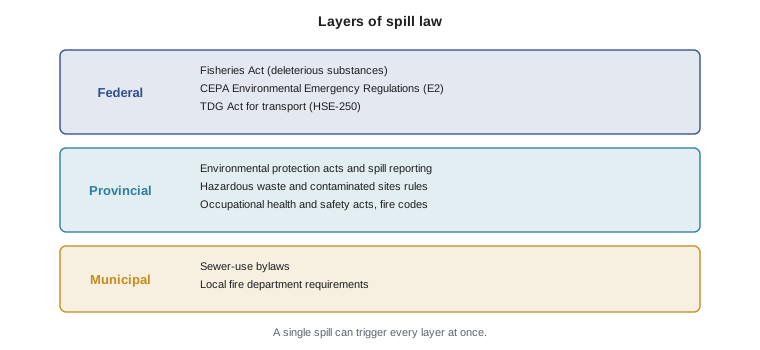
Spills are governed by several layers of law at once. Environmental laws protect water, soil and air and require spills to be prevented, reported and cleaned up. Occupational health and safety laws protect the workers who handle chemicals and respond to releases. Transport laws, covered in HSE-250, apply while goods are moving. Municipal bylaws control what can go into sewers. Knowing which layer applies, and who is responsible under each, is the first step to compliance.
In Canada, environmental protection is shared between the federal government and the provinces and territories. The federal government regulates fisheries, toxic substances, federal lands and works, and interprovincial and international matters. The provinces regulate most of the day-to-day activities at workplaces, including spill reporting, waste management and contaminated sites. Municipalities control sewers through bylaws. In practice most workplace spills trigger provincial rules, and spills that reach water frequented by fish also trigger the federal Fisheries Act.
Federal environmental law
The Fisheries Act is the most important federal spill law for most workplaces. Subsection 36(3) prohibits depositing a deleterious substance in water frequented by fish, or anywhere it may enter such water, unless a regulation allows it. A deleterious substance is anything that would degrade the water so that it is harmful to fish or fish habitat, and courts have interpreted this broadly: oil, fuel, chemicals, silt, concrete washout and even milk have all led to convictions. The offence does not require proof that a fish was actually harmed. Section 38 requires anyone who owns or has charge of a substance that is deposited, or is in serious and imminent danger of being deposited, to report it and to take reasonable measures to prevent or reduce the harm.
The Canadian Environmental Protection Act, 1999 deals with toxic substances and environmental emergencies. Its Environmental Emergency Regulations, 2019, often called the E2 Regulations, list 249 substances that pose an acute hazard if accidentally released, with threshold quantities. A facility that has a listed substance at or above its threshold must notify Environment and Climate Change Canada, and above a second threshold must prepare, test and exercise an environmental emergency plan. Releases from such facilities must be reported. Common E2 substances at workplaces include anhydrous ammonia, chlorine, propane and certain acids.
Other federal rules may apply in particular settings: storage tank regulations for petroleum and allied products on federal land and at federally regulated sites, the Canada Shipping Act for spills from ships, and the Canadian Energy Regulator rules for federally regulated pipelines. Spills during transport also fall under Part 8 of the TDG Regulations, covered in HSE-250.
Provincial environmental law
Every province and territory has an environmental protection law that prohibits releasing contaminants that cause adverse effects and requires spills to be reported and cleaned up. The details differ. In Ontario, Part X of the Environmental Protection Act deals with spills: the owner of the pollutant and the person in control of it must notify the Ministry of the Environment, Conservation and Parks and the municipality without delay, through the Spills Action Centre, and must do everything practicable to prevent, eliminate and ameliorate the adverse effects and restore the environment. In British Columbia, the Spill Reporting Regulation under the Environmental Management Act requires an immediate report to the provincial spill line for spills above amounts set by substance in its schedule, and for any spill that enters or is likely to enter a body of water regardless of amount, followed by written reports. In Alberta, the Environmental Protection and Enhancement Act and its Release Reporting Regulation require a release that may cause an adverse effect to be reported as soon as possible, with a written report afterwards. Quebec's Environment Quality Act requires immediate notice to the ministry through its Urgence-Environnement line.
Provinces also regulate hazardous waste, including waste from spill cleanup; contaminated sites, which sets the standards soil and groundwater must meet after cleanup; and fuel storage tanks, often through fire codes and petroleum storage regulations. Lessons 10 and 11 cover waste and reporting in more detail.
| Province | Spill reporting starting point |
|---|---|
| Ontario | EPA Part X: notify the Spills Action Centre and municipality without delay |
| British Columbia | Spill Reporting Regulation: immediate call to the provincial spill line; written reports follow |
| Alberta | Release Reporting Regulation: report as soon as possible; written report follows |
| Quebec | Environment Quality Act: immediate notice through Urgence-Environnement |
| Federal | Fisheries Act s. 38: report deposits or imminent deposits of deleterious substances |
Occupational health and safety law
Provincial occupational health and safety laws, and the Canada Labour Code for federally regulated workplaces, protect the workers who handle chemicals and respond to spills. Employers must identify hazards, provide training, supply protective equipment and have emergency procedures. WHMIS, introduced in HSE-102, gives workers labels and safety data sheets. Many provinces require written emergency response plans for workplaces with hazardous substances. Workers have the right to refuse work they believe is dangerous, including a spill response beyond their training.
The distinction between a small spill that trained workers can safely handle and an emergency that needs specialist responders runs through this course. Your employer's spill plan should spell out which spills you may clean up, with which equipment, and when you must evacuate and call for help.
Municipal rules
Municipal sewer-use bylaws prohibit discharging fuels, solvents, oils above set limits, and many chemicals into sanitary and storm sewers, and often require spills to sewers to be reported to the municipality immediately. Some require oil-water separators or grease interceptors at certain businesses. Fire departments enforce fire codes that govern how flammable liquids are stored.
Who is responsible
Canadian spill laws generally place duties on the person who owns the substance and the person who has charge, management or control of it at the time of the spill. Both may have to report and clean up. Directors and officers of corporations can be personally liable if they fail to take reasonable care. The polluter pays principle means the cost of cleanup falls on those responsible, not on the public.
Most environmental offences are strict liability offences. The prosecution does not have to prove you intended the spill or were careless. Instead, a company or person can defend itself by showing due diligence: that it took all reasonable steps to prevent the spill. Due diligence is shown by records: risk assessments, inspections, maintenance logs, training records, spill plans, drills and evidence that problems were fixed. This is why the paperwork in lessons 5 and 11 matters.
Worked problem
Which laws apply?
A contractor's excavator bursts a hydraulic hose beside a creek in Ontario. About 30 L of oil reaches the water and leaves a sheen. Which laws are triggered?
Show solution
- Provincial: a spill under Part X of the Environmental Protection Act, so the Spills Action Centre and municipality must be notified without delay.
- Federal: a deposit of a deleterious substance in water frequented by fish, so the Fisheries Act duty to report and to take reasonable measures applies.
- Occupational health and safety: workers responding need training and protective equipment.
- Both the contractor and the project owner may share responsibility, depending on who had control.
Answer: Both provincial and federal reporting are triggered, along with the duty to contain and clean up.
Worked problem
Strict liability and due diligence
A drum of solvent stored outdoors corrodes and leaks into the ground. The company is charged. What evidence would help it show due diligence?
Show solution
- A spill risk assessment that identified the drum storage area.
- Records of regular inspections of the drums, with dates and findings.
- Evidence that the drums were stored in secondary containment and under cover as the plan required.
- Training records for the staff responsible, and evidence that the leak was reported and cleaned up promptly once found.
Answer: Documented assessment, inspection, containment, training and prompt response. Without records, the company will struggle to prove it took reasonable care.
How the layers fit together in practice
A single spill can trigger several laws at once, and each has its own purpose. The provincial environmental law protects the land, water and air in the province and decides most cleanup requirements. The Fisheries Act protects fish and fish habitat anywhere in Canada. The E2 Regulations add planning and reporting for the most hazardous substances. Occupational health and safety law protects the workers who respond. The municipal bylaw protects the sewer system and the treatment plant. Transport law applies if the spill happens while goods are being moved. None of these replaces the others, so a company cannot satisfy one regulator and ignore the rest.
In practice, regulators often coordinate. A single call to a spill line may be shared with other agencies, and joint investigations are common after serious spills. But the legal duty to report and to clean up stays with the company and the people in control of the substance. That is why the site spill plan should translate the laws into a short, practical list: what to report, to whom, how fast and who makes the call.
Orders, inspections and enforcement
Environmental officers and inspectors have broad powers. They can enter a site to inspect, take samples, examine records and ask questions. After a spill, they can issue orders requiring a company to stop an activity, contain and clean up the spill, investigate the extent of contamination, monitor groundwater or improve its prevention measures. Orders can name the owner of the substance, the person in control, and sometimes previous owners or directors. Failing to comply with an order is itself an offence. Some provinces also use administrative monetary penalties, which are fines imposed without a court case, for certain violations.
Enforcement is not only about large spills. Inspectors regularly find violations at sites where nothing has spilled yet: missing secondary containment, no spill plan, out-of-date training, unlabelled waste, drums stored over drains. Fixing these before an inspection, or before a spill, is far cheaper than fixing them afterwards.
Keeping track of what applies to your site
Because so many rules can apply, many companies keep a short legal register for each site: a list of the laws, regulations, permits and bylaws that apply, what each one requires, who is responsible and when it was last checked. For spills, the register usually records which substances are stored and in what amounts, which reporting thresholds and phone numbers apply, what containment and inspection rules cover the tanks, which permits limit what may go down the drains and which waste rules govern cleanup material. The register should be reviewed at least once a year and whenever the site adds a new chemical, a new tank or a new process. A register does not need to be long. A clear two-page table that supervisors actually read is worth more than a thick binder nobody opens, and it is good evidence of due diligence if a spill is ever investigated.
Common mistakes
MistakeAssuming only the province needs to know about a spill to water.
InsteadSpills to fish-bearing water also trigger the federal Fisheries Act.
MistakeThinking you cannot be convicted unless you meant to spill.
InsteadMost environmental offences are strict liability; you need due diligence to defend yourself.
MistakeRelying on memory for reporting rules.
InsteadKeep current reporting numbers and thresholds in the site spill plan.
MistakeLetting untrained workers respond to a large chemical release.
InsteadLarge or dangerous releases need trained emergency responders.
MistakeKeeping no records of inspections and training.
InsteadRecords are your evidence of due diligence.
Summary and key terms
- Spills are governed by environmental, occupational safety, transport and municipal laws at the same time.
- The federal Fisheries Act prohibits depositing deleterious substances in water frequented by fish and requires reporting.
- The E2 Regulations require notification and plans for facilities with listed substances above thresholds.
- Each province has its own spill reporting rules, such as Ontario's Spills Action Centre.
- OHS laws protect workers and require training, equipment and emergency plans.
- Owners and those in control of a substance share responsibility for reporting and cleanup.
- Most offences are strict liability, so due diligence records are essential.
- Fisheries Act
- Federal law that protects fish and fish habitat, including the prohibition on depositing deleterious substances.
- E2 Regulations
- The Environmental Emergency Regulations, 2019, under CEPA, covering facilities with listed hazardous substances.
- Environmental protection act
- A provincial law that prohibits releasing contaminants and requires spills to be reported and cleaned up.
- Spills Action Centre
- Ontario's 24-hour line for reporting spills to the environment ministry.
- Adverse effect
- Harm to the environment, property, plant or animal life, or human health, as defined in provincial law.
- Charge, management or control
- Having practical authority over a substance, which brings legal duties when it spills.
- Strict liability
- An offence for which intent need not be proved, but due diligence is a defence.
- Due diligence
- Taking all reasonable steps to prevent an offence, shown by records and practice.
- Polluter pays
- The principle that those responsible for pollution pay for its cleanup.
- Sewer-use bylaw
- A municipal law that controls what may be discharged to sewers.
Practice problems
Work each problem on paper first, then reveal the answer to check.
What does subsection 36(3) of the Fisheries Act prohibit?
Show answer
Depositing a deleterious substance in water frequented by fish, or where it may enter such water.
Does a Fisheries Act prosecution need proof that a fish died?
Show answer
No. The substance only has to be deleterious, meaning harmful to fish or habitat.
How many substances are listed in the E2 Regulations?
Show answer
249.
Who must report a spill in Ontario under Part X?
Show answer
The owner of the pollutant and the person in control of it.
When must a spill to water be reported in British Columbia?
Show answer
Immediately, regardless of amount, if it enters or is likely to enter a body of water.
What is a strict liability offence?
Show answer
One where intent need not be proved but due diligence is a defence.
Give three records that help show due diligence.
Show answer
Any three of risk assessments, inspection logs, maintenance records, training records, spill plans and drill records.
What do municipal sewer-use bylaws control?
Show answer
What may be discharged into sanitary and storm sewers.
What fine range applies to a large corporation convicted on indictment of a first Fisheries Act deposit offence?
Show answer
$500,000 to $6 million.
Which law protects workers who respond to spills?
Show answer
Provincial occupational health and safety law, or the Canada Labour Code for federal workplaces.
Lesson quiz · 5 questions
Score 60% or more to complete this lesson.
Create a free account to save your progress, take quizzes and earn a certificate.