
HSE-245 · Lesson 9 of 12 · 29 min
Sharps, spills and exposure response
Sharps injuries and body fluid spills are the moments when bloodborne pathogen risk becomes real. A needle left in a bed sheet, a broken specimen tube, a piece of glass in a garbage bag, a used syringe in a park, a pool of blood after a fall, a child's vomit on a classroom floor: each needs a safe, practised response. This lesson covers preventing sharps injuries, safe disposal, cleaning up spills of blood and other body fluids, and what to do in the first minutes and hours after an exposure. The medical details of post-exposure care are decided by health care providers; this lesson explains the steps at an awareness level so workers act quickly and correctly.
Where sharps injuries happen
Sharps injuries happen during use, after use and before disposal, during disposal and, most avoidably, after disposal, when someone else meets a sharp that was not disposed of properly. Studies of health care workers show the same patterns: recapping needles, transferring blood between containers, handling sharps in a hurry, passing instruments hand to hand, overfilled sharps containers and sharps left on trays, beds or floors. Outside health care, custodians, waste and recycling workers, landscapers, police and laundry workers are injured by needles discarded in garbage, laundry, washrooms and public spaces.
| Stage | Common causes | Prevention |
|---|---|---|
| During use | Patient movement, difficult procedures, rushing | Plan the procedure, get help to position the patient, use safety-engineered devices |
| After use, before disposal | Recapping, carrying sharps, leaving sharps on trays or beds | Activate the safety feature immediately; take the sharps container to the point of use |
| During disposal | Overfilled containers, hands near the opening, poorly placed containers | Replace containers at the fill line; mount them at eye level within arm's reach |
| After disposal | Sharps in garbage, laundry, washrooms and public spaces | Dispose properly every time; train cleaners and waste staff; provide puncture-resistant gloves and tools for handling found sharps |
Safety-engineered sharps and safe practices
Several provinces require safety-engineered needles in health care. Ontario Regulation 474/07, for example, requires hollow-bore needles used in hospitals, long-term care homes, physicians' offices, labs and other health care settings to be safety-engineered, with limited exceptions, and other provinces have similar rules. Safety-engineered sharps have a built-in feature, such as a sliding shield, a retracting needle or a self-blunting tip, that covers the sharp point after use. They only work if staff are trained to use them and activate the feature immediately, and if front-line workers help choose devices that suit their work.
Safe practices include:
- never recapping used needles by hand; if recapping is unavoidable for a specific procedure, use a one-handed scoop technique or a recapping device;
- not bending, breaking or removing needles from syringes by hand;
- disposing of sharps immediately at the point of use, by the person who used them;
- using a neutral zone, such as a tray, to pass sharp instruments during procedures instead of passing them hand to hand;
- never reaching into containers or bags where sharps may be present;
- carrying sharps containers, not individual sharps.
Sharps containers
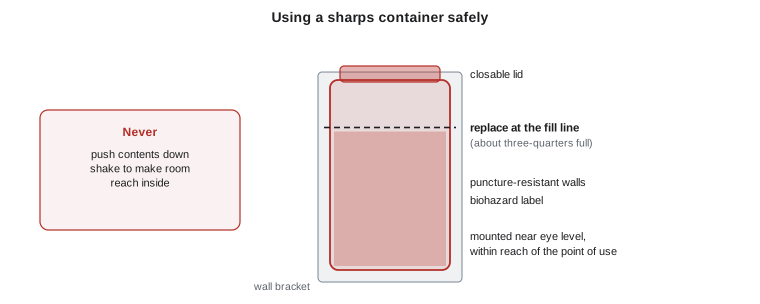
Sharps containers must be puncture-resistant, leak-proof on the sides and bottom, closable and labelled with the biohazard symbol or colour-coded as required. They should be upright, stable, mounted or placed within easy reach of where sharps are used, at a height where the user can see the opening (in many health care settings, about eye level for a standing worker), and replaced when they reach the fill line marked by the manufacturer, usually about three-quarters full. Never press down on contents or shake a container to make room.
# When will this sharps container reach its fill line? (illustrative)
capacity_l = 3.0                 # container volume in L
fill_line = 0.75                 # replace at three-quarters full
sharps_per_day = 40              # needles, lancets and small sharps on a busy clinic day
volume_per_sharp_ml = 15         # average space taken, including packing gaps
usable_ml = capacity_l * 1000 * fill_line
days = usable_ml / (sharps_per_day * volume_per_sharp_ml)
print(f"usable volume: {usable_ml:.0f} mL")
print(f"reaches fill line in about {days:.1f} days; schedule replacement every {int(days)} days")usable volume: 2250 mL reaches fill line in about 3.8 days; schedule replacement every 3 days
A simple estimate like this helps a clinic, studio or ward set a replacement schedule so that containers never become overfilled during a busy shift. Sharps waste is then handled as biomedical or regulated waste and collected by a licensed contractor under provincial, state or local waste rules.
Found sharps
Custodians, park workers, transit staff, librarians and others regularly find discarded needles. Workplaces where this may happen should have a procedure, tools and training:
- do not pick up a sharp with bare hands, and do not try to recap it;
- wear puncture-resistant gloves and use tongs, tweezers or a dustpan and brush;
- bring a sharps container to the needle rather than carrying the needle to the container;
- place the sharp in the container point first, and close the container;
- clean hands afterward;
- report the find, especially if needles are found repeatedly in one place;
- never reach blindly into garbage bags, under furniture, into toilet tanks or between seat cushions; look first and use tools.
Garbage bags should be held away from the body by the top, never compressed by hand or against the leg. Many needlesticks to waste workers happen when a full bag is squeezed or swung.
Cleaning up blood and body fluid spills
Spills of blood or other potentially infectious materials should be cleaned up promptly by trained workers using a spill kit. Spills of vomit and diarrhea, which may contain norovirus, need similar care. A typical procedure:
- restrict access to the area;
- put on protective equipment: disposable gloves, and eye protection, a mask and a gown or apron if splashing is possible; puncture-resistant gloves if broken glass or sharps are present;
- pick up any sharp items with tongs or a scoop, never with hands, and place them in a sharps container;
- cover the spill with absorbent material, such as paper towels or an absorbent powder, and remove the bulk of the material;
- clean the area with detergent and water to remove remaining organic material;
- apply a disinfectant with claims against bloodborne pathogens (and norovirus for vomit or stool), or a bleach solution as directed by local guidance, often about 5,000 ppm for blood spills, and leave it wet for the contact time;
- dispose of waste according to local rules, usually in a sealed bag, with heavily soaked material treated as biomedical or regulated waste;
- remove protective equipment carefully, gloves last, and clean hands.
Carpets and upholstery are hard to disinfect. Clean them as well as possible, then consider steam cleaning or replacing heavily contaminated items. For large spills, such as those at a trauma scene, specialized biohazard remediation companies are often used.
The first minutes after an exposure
If a worker has a needlestick or cut from a contaminated sharp, or blood or body fluid gets into their eyes, nose, mouth or broken skin, they should act immediately. Speed matters, because the best results for post-exposure treatment come when it starts within hours.
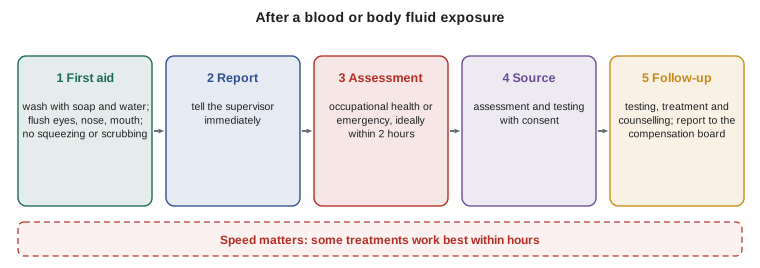
First aid. Wash needlestick wounds, cuts and exposed skin with soap and water. Flush splashes to the eyes with clean water or saline for several minutes, and rinse the mouth or nose with water. Do not squeeze the wound or scrub it hard, and do not apply bleach or other disinfectants to the skin; there is no evidence that squeezing helps, and harsh chemicals damage tissue.
Report. Tell the supervisor immediately, even if the exposure seems minor. Reporting starts the medical process and creates a record that protects the worker.
Medical assessment. The worker should be assessed as soon as possible, ideally within two hours, by occupational health, an emergency department or a designated clinic. The assessor considers the type of exposure, the source and the worker's immunity, and decides on testing and treatment.
Source assessment. Where the source person is known, health care providers may assess their risk factors and, with their consent, test them for HBV, HCV and HIV, following the consent and privacy rules in the jurisdiction. If the source is unknown, as with a discarded needle, the decision is based on the circumstances.
Follow-up. Depending on the assessment, the worker may receive hepatitis B immune globulin and vaccine (best within 24 hours if they are not immune), HIV post-exposure prophylaxis (ideally within two hours and no later than 72 hours, usually for 28 days), and baseline and follow-up blood tests over several months. There is no post-exposure medicine to prevent hepatitis C, but follow-up testing allows early treatment, which is curative in most cases. The worker is also offered counselling and advice about precautions during the follow-up period.
# Checking the timeline after a needlestick at 14:10 (illustrative)
from datetime import datetime, timedelta
injury = datetime(2026, 3, 12, 14, 10)
milestones = {
    "ideal start of HIV PEP (within 2 h)": injury + timedelta(hours=2),
    "HBIG for a non-immune worker (best within 24 h)": injury + timedelta(hours=24),
    "latest start of HIV PEP (72 h)": injury + timedelta(hours=72),
}
for what, when in milestones.items():
print(f"{what:<48} {when:%a %d %b %H:%M}")ideal start of HIV PEP (within 2 h) Thu 12 Mar 16:10 HBIG for a non-immune worker (best within 24 h) Fri 13 Mar 14:10 latest start of HIV PEP (72 h) Sun 15 Mar 14:10
The times in this example come from common guidance; the treating clinician decides what applies. The practical lesson is that a worker who waits until the end of the shift, or until Monday, to report a needlestick may lose the window for the most effective treatment.
Records and reporting
Exposures should be recorded in the employer's incident system and investigated so the cause can be fixed. Where the exposure leads to health care costs, lost time or infection, it must be reported to the provincial compensation board within the required time, and many boards encourage reporting all exposures so that a later infection can be linked to work. Medical information is confidential: the employer needs to know that an exposure occurred and what was done to prevent a repeat, not the worker's test results.
Worked problem
Responding to a needlestick in a laundry
A hospital laundry worker is stuck by a needle hidden in a bundle of sheets at 10:30 a.m. What should happen?
Show solution
- The worker washes the puncture with soap and water right away, without squeezing or scrubbing.
- The worker reports to the supervisor immediately, keeping the needle in a sharps container if it can be retrieved safely, for information about the device.
- The worker goes to occupational health or the emergency department for assessment as soon as possible, ideally before 12:30 p.m.
- Because the source is unknown, the clinician considers the circumstances, the worker's hepatitis B immunity and whether HIV prophylaxis is warranted, and orders baseline tests.
- The incident is recorded and investigated: how did a needle get into the linen? Was a sharps container available at the bedside? The fix might be better container placement and reminders to staff about disposal at the point of use.
Answer: Wash, report, get assessed within hours, follow medical advice and fix the system failure that let the needle reach the laundry.
Worked problem
Cleaning up vomit in a school hallway
A student vomits in a hallway during an outbreak of stomach illness. A custodian is called. What procedure should they follow?
Show solution
- Restrict access around the spill, because vomit can contain norovirus that spreads by aerosols and surfaces.
- Wear disposable gloves, a gown or apron, a mask and eye protection.
- Cover with absorbent material, remove the bulk into a plastic bag, then clean with detergent and water.
- Disinfect a generous area around the spill with a product with a norovirus claim or a bleach solution at the strength public health recommends, keeping it wet for the contact time.
- Bag waste, remove protective equipment carefully, wash hands with soap and water, and clean any equipment used.
Answer: Isolate the area, protect yourself, remove and clean, disinfect with a norovirus-effective product, and wash hands with soap and water.
Common mistakes
MistakeSqueezing a needlestick wound or soaking it in bleach.
InsteadWash gently with soap and water; harsh chemicals damage tissue and squeezing does not help.
MistakeWaiting until the end of the shift to report an exposure.
InsteadReport and get assessed immediately; some treatments work best within hours.
MistakeOverfilling sharps containers or pushing contents down.
InsteadReplace containers at the fill line.
MistakeCarrying a found needle to a sharps container across the room.
InsteadBring the container to the needle and use tools to pick it up.
MistakeDisinfecting a spill without removing the bulk material first.
InsteadAbsorb and clean first, then disinfect for the full contact time.
Summary and key terms
- Sharps injuries happen during use, before and during disposal, and after improper disposal.
- Safety-engineered sharps, immediate disposal at the point of use and no hand recapping prevent most injuries.
- Sharps containers must be puncture-resistant, within reach and replaced at the fill line.
- Found sharps should be handled with tools and puncture-resistant gloves, never bare hands.
- Spills are cleaned by restricting access, wearing protection, absorbing, cleaning, disinfecting and disposing safely.
- After an exposure: first aid, report, prompt medical assessment, source assessment and follow-up.
- HIV prophylaxis works best within two hours, and hepatitis B immune globulin within 24 hours for non-immune workers.
- Sharp
- Any object that can puncture or cut skin, such as needles, lancets, scalpels and broken glass.
- Sharps container
- A puncture-resistant, leak-proof, closable container for sharps disposal.
- Fill line
- The marked level at which a sharps container must be closed and replaced.
- Neutral zone
- A tray or area used to pass sharp instruments without hand-to-hand contact.
- Spill kit
- A ready-made kit of protective equipment, absorbents, tools, disinfectant and bags for body fluid spills.
- Exposure incident
- Contact of blood or other potentially infectious material with broken skin, mucous membranes or a sharps injury.
- Source person
- The person whose blood or body fluid was involved in an exposure.
- Hepatitis B immune globulin (HBIG)
- Antibodies given after exposure to protect a non-immune person against hepatitis B.
- Biomedical waste
- Waste such as sharps and blood-soaked materials that must be handled under special rules; called regulated medical waste in the United States.
- Sharps injury log
- A record of sharps injuries including the device and circumstances, required for many US employers.
Practice problems
Work each problem on paper first, then reveal the answer to check.
Name three common causes of needlestick injuries.
Show answer
Any three of recapping, overfilled containers, rushing, sharps left on trays or beds, hand-to-hand passing and improper disposal.
When should a sharps container be replaced?
Show answer
When it reaches the manufacturer's fill line, usually about three-quarters full.
What should a custodian use to pick up a found needle?
Show answer
Puncture-resistant gloves and tongs or a scoop, bringing the sharps container to the needle.
What is the first aid for a needlestick?
Show answer
Wash with soap and water without squeezing or scrubbing.
What is the first aid for a blood splash in the eyes?
Show answer
Flush with clean water or saline for several minutes.
Why should a worker report an exposure immediately?
Show answer
Treatment such as HIV prophylaxis works best when started within hours, and reporting creates a record.
Is there post-exposure medicine to prevent hepatitis C?
Show answer
No, but follow-up testing allows early, usually curative treatment.
List the main steps for cleaning a blood spill.
Show answer
Restrict access, wear protection, remove sharps with tools, absorb, clean, disinfect for the contact time, dispose of waste, remove protection and clean hands.
Why hold a garbage bag by the top and away from the body?
Show answer
Hidden sharps can pierce the bag when it is squeezed or swung against the body.
Who needs to see a worker's post-exposure test results?
Show answer
Only the worker and their health care providers; the employer needs to know the exposure occurred, not the results.
Lesson quiz · 5 questions
Score 60% or more to complete this lesson.
Create a free account to save your progress, take quizzes and earn a certificate.