
HSE-245 · Lesson 12 of 12 · 26 min
Capstone: an infection prevention plan
This lesson brings the course together by building an infection prevention plan for an invented workplace: Birch Lane Dental, a community dental clinic with eight operatories, a sterilization room, a front desk and waiting room, and 24 staff. The clinic sees about 90 patients a day, including children and older adults, and also runs a weekly outreach clinic at a seniors' residence. The clinic, its staff and its numbers are invented for teaching. The same structure works for a tattoo studio, a school, a long-term care home, a cleaning contractor or an office; only the details change.
The structure of a plan
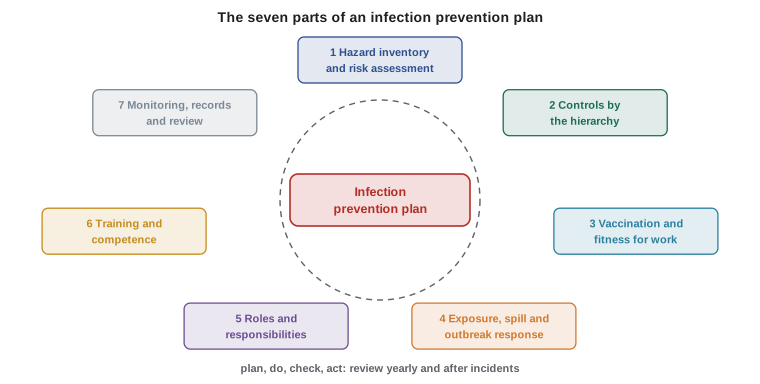
A good infection prevention plan is not a binder on a shelf. It is a short, practical document that answers seven questions, backed by procedures, training and records:
- What infection hazards do we have, where and in which jobs? (hazard inventory and risk assessment)
- What controls do we use, from most to least effective? (controls by the hierarchy)
- How do we protect people who are susceptible? (vaccination and fitness for work)
- What do we do when something goes wrong? (exposure response, spills and outbreaks)
- Who does what? (roles and responsibilities)
- How do people learn it? (training and competence)
- How do we know it works, and how do we keep improving? (monitoring, records and review)
Step 1: hazard inventory and risk assessment
The clinic's team, including a dentist, two hygienists, a dental assistant, the reprocessing technician, the office manager and the joint committee worker member, walks through the clinic and lists tasks, hazards and who is exposed. They rate each hazard by likelihood and severity before controls, using a simple scale from 1 (low) to 5 (high), then list existing controls.
| Task or area | Hazard | Who is exposed | Likelihood | Severity |
|---|---|---|---|---|
| Scaling, restorative and surgical procedures | Blood and saliva spatter; aerosols | Dentists, hygienists, assistants | 5 | 3 |
| Handling and cleaning instruments | Sharps injuries; contaminated instruments | Assistants, reprocessing technician | 4 | 4 |
| Sterilization room | Sterilization failure exposing patients; chemical exposure | Patients; reprocessing technician | 2 | 5 |
| Front desk and waiting room | Respiratory infections from patients and visitors | Front desk staff, all staff | 4 | 2 |
| Operatory turnover | Contaminated surfaces; disinfectant chemicals | Assistants | 4 | 2 |
| Outreach clinic at a seniors' residence | Outbreaks in a vulnerable population; limited facilities | Outreach team; residents | 3 | 4 |
| Waste handling | Sharps in waste; biomedical waste | Assistants, cleaning contractor | 2 | 4 |
# Rank Birch Lane Dental's hazards by risk score = likelihood x severity (invented ratings)
hazards = [
    ("procedures: spatter and aerosols", 5, 3),
    ("instrument handling: sharps", 4, 4),
    ("sterilization failure", 2, 5),
    ("front desk: respiratory", 4, 2),
    ("operatory turnover: surfaces", 4, 2),
    ("outreach clinic", 3, 4),
    ("waste handling", 2, 4),
]
ranked = sorted(hazards, key=lambda h: h[1] * h[2], reverse=True)
for name, likelihood, severity in ranked:
    score = likelihood * severity
    band = "high" if score >= 15 else "medium" if score >= 8 else "low"
print(f"{score:>2} {band:<6} {name}")16 high instrument handling: sharps 15 high procedures: spatter and aerosols 12 medium outreach clinic 10 medium sterilization failure 8 medium front desk: respiratory 8 medium operatory turnover: surfaces 8 medium waste handling
The ranking guides priorities, but it is a judgment aid, not a precise measurement. Sterilization failure scores in the middle because it is unlikely, yet its severity is so high, potentially exposing hundreds of patients, that the team decides to treat it as a top priority anyway. Risk matrices should never be used to ignore low-likelihood, high-severity hazards.
Step 2: controls by the hierarchy
For each hazard, the team records controls from most to least effective, noting what is already in place and what needs to be added.
| Hazard | Engineering | Administrative | Protective equipment |
|---|---|---|---|
| Spatter and aerosols | High-volume evacuation; rubber dams; portable HEPA units in two operatories with poor ventilation | Pre-procedure mouth rinse where recommended; scheduling aerosol-generating procedures with turnover time | Gowns, gloves, eye protection, masks; fit-tested respirators when the risk assessment calls for them |
| Sharps injuries | Safety syringes; instrument cassettes; sharps containers at each chair | No hand recapping; neutral zone for passing; container replacement schedule | Puncture-resistant utility gloves for instrument cleaning |
| Sterilization failure | Validated steam sterilizers with printouts; washer-disinfector | Written reprocessing procedures; daily physical checks; chemical indicators in every package; weekly biological indicators; recall procedure | Heat-resistant gloves and eye protection for the technician |
| Respiratory infections at the front desk | Plexiglass barrier at reception; ventilation checked; CO₂ monitor in waiting room | Screening questions at booking and arrival; masks offered to patients with symptoms; rebooking ill patients; staff stay home when sick | Masks for staff during community outbreaks |
| Contaminated surfaces | Barriers on hard-to-clean surfaces | Turnover checklist with one-minute-contact disinfectant; fluorescent marker audits monthly | Gloves during turnover |
| Outreach clinic | Portable sharps containers and sterilized instrument kits | Check with the residence for outbreaks before each visit; postpone during outbreaks unless urgent; staff immunity confirmed | Same equipment as in the clinic |
Step 3: vaccination and fitness for work
The clinic's vaccination section lists the vaccines recommended for dental staff: hepatitis B with post-vaccination antibody testing, MMR or proof of immunity, varicella immunity, Tdap, annual influenza and COVID-19 vaccination according to current guidance. The office manager keeps confidential immunization records separate from personnel files, offers vaccines at no cost or arranges them through occupational health, and documents informed declinations. The policy explains that non-immune staff may be excluded from work after exposures, such as to measles, as public health directs.
The fitness-for-work policy says staff with fever, vomiting, diarrhea or new respiratory symptoms stay home and report the absence, without penalty. Birch Lane pays for up to six sick days a year, more generous than Ontario's three unpaid days under the Employment Standards Act, and does not require a doctor's note for short absences. Staff with conditions that might affect patient safety, such as an infected cut on the hand, report to the clinic lead for a case-by-case decision.
# Checking staff immunity records before the outreach clinic (invented data)
staff = {
    "Asha":  {"hep_b_protected": True,  "measles_immune": True,  "flu_this_season": True},
    "Ben":   {"hep_b_protected": True,  "measles_immune": False, "flu_this_season": True},
    "Chloe": {"hep_b_protected": False, "measles_immune": True,  "flu_this_season": False},
    "Dev":   {"hep_b_protected": True,  "measles_immune": True,  "flu_this_season": False},
}
for name, rec in staff.items():
    gaps = [k for k, ok in rec.items() if not ok]
print(f"{name}: {'ready' if not gaps else 'follow up: ' + ', '.join(gaps)}")Asha: ready Ben: follow up: measles_immune Chloe: follow up: hep_b_protected, flu_this_season Dev: follow up: flu_this_season
Step 4: exposure, spill and outbreak response
The response section has three short procedures posted in the sterilization room and staff room:
- Blood exposure: wash or flush, report to the clinic lead, go immediately to the hospital emergency department or occupational health clinic named in the plan, ideally within two hours; the clinic lead assesses the source patient's consent to testing and records the incident; the office manager reports to WSIB as required.
- Spills: use the spill kit in each operatory hallway; absorb, clean, disinfect for the contact time and dispose of waste as biomedical waste where heavily soaked.
- Outbreaks: if two or more staff have similar illness within a short period, or public health reports an exposure linked to the clinic, the clinic lead contacts the local public health unit and follows its direction.
A sterilization failure procedure is added because of the high severity score: stop using the affected sterilizer, quarantine and recall instruments processed since the last passed biological indicator, call the service company, consult the professional college or public health about patient notification if instruments were used, and document every step.
Step 5: roles and responsibilities
| Role | Responsibilities in the plan |
|---|---|
| Clinic owner (employer) | Approves and funds the plan; provides equipment, vaccines and training; makes sure legal duties are met |
| Clinic lead for infection prevention (a senior hygienist) | Maintains the plan; coordinates training and audits; first contact for exposures and outbreaks; liaises with public health |
| Reprocessing technician | Runs reprocessing and sterilizer monitoring; keeps logs; stops use and reports any failure |
| Office manager | Keeps confidential immunization and training records; manages reporting to the compensation board or recordkeeping; orders supplies |
| All clinical staff | Follow routine practices, procedures and the turnover checklist; report exposures, hazards and illness |
| Joint committee or health and safety representative | Takes part in the hazard assessment, inspections and annual review |
| Cleaning contractor | Follows the clinic's cleaning and waste procedures; reports found sharps and exposures |
Step 6: training and competence
Every new staff member completes orientation on the plan, routine practices, hand hygiene, sharps safety, spill response and exposure reporting before working with patients, plus job-specific training: reprocessing for the technician, operatory turnover for assistants and screening for front desk staff. Clinical staff practise putting on and taking off protective equipment and are observed doing it. Everyone repeats the core training every year, and the clinic adds short refreshers when procedures change or audits find gaps. Training records list the date, content and trainer.
Step 7: monitoring, records and review
The plan sets a few measurable indicators and reviews them at monthly staff meetings and in a full annual review with the joint committee:
- hand hygiene audits in operatories each month, reported with sample sizes and confidence intervals;
- fluorescent marker audits of operatory turnover each month;
- sterilizer logs and biological indicator results, checked weekly by the clinic lead;
- sharps injuries and blood exposures, each investigated within a week;
- staff immunization coverage by vaccine;
- staff illness absences, watched for clusters;
- actions from inspections, audits and incidents, tracked to completion.
The annual review also checks the plan against current guidance and law, evaluates safer devices with front-line staff, updates the hazard inventory for new procedures or equipment, and records what changed and why. Reviewing the plan after any significant incident or outbreak, not just once a year, keeps it current.
Adapting the plan to other workplaces
The same seven-part structure scales up or down. A small office's plan might be two pages focused on stay-home policies, ventilation, hand hygiene, cleaning of shared surfaces and an outbreak contact. A tattoo studio's plan centres on single-use items, sterilization monitoring, bloodborne exposure response and public health rules for personal service settings. A long-term care home's plan is much larger, with formal surveillance, outbreak management with public health and detailed precautions for residents. In every case, the plan starts with a real look at the work and the people, uses the hierarchy of controls, prepares for things going wrong and checks whether it works.
Worked problem
Testing the plan with a scenario
During a busy Tuesday, an assistant is stuck by a used scaler tip while cleaning instruments at 3:40 p.m., and the source patient has already left. Walk through Birch Lane's plan.
Show solution
- First aid: the assistant washes the puncture with soap and water without squeezing.
- Report: she tells the clinic lead immediately; another assistant takes over her tasks.
- Assessment: she goes straight to the occupational health clinic or emergency department named in the plan, arriving well within two hours.
- Source: the clinic lead phones the patient, explains what happened, and asks for consent to testing, following the plan and privacy rules.
- Records and follow-up: the incident is recorded and reported as required, follow-up testing is scheduled, and the investigation finds she was hand-scrubbing instruments without puncture-resistant gloves because the washer-disinfector was full. The fix: an extra washer cycle in the afternoon and a reminder on utility gloves.
Answer: The plan works when every step is known in advance: wash, report, get assessed fast, contact the source, record, follow up and fix the root cause.
Common mistakes
MistakeWriting a long plan that nobody reads.
InsteadKeep the plan short and practical, with posted procedures and training.
MistakeUsing a risk matrix to dismiss low-likelihood, high-severity hazards.
InsteadGive catastrophic hazards such as sterilization failure high priority even if they are unlikely.
MistakeListing only protective equipment as controls.
InsteadWork down the hierarchy, starting with engineering and administrative controls.
MistakeReviewing the plan only when an inspector asks.
InsteadReview it every year and after any significant incident or outbreak.
MistakeLeaving contractors out of the plan.
InsteadInclude cleaning and other contractors in procedures, training and reporting.
Summary and key terms
- An infection prevention plan answers seven questions: hazards, controls, susceptibility, response, roles, training and monitoring.
- Start with a hazard inventory by task and job, rated for likelihood and severity.
- Use risk scores to set priorities, but never ignore rare, catastrophic hazards.
- Record controls by the hierarchy, from engineering to protective equipment.
- Include vaccination, fitness for work and sick leave that makes staying home possible.
- Prepare procedures for exposures, spills, outbreaks and sterilization failures in advance.
- Monitor a few indicators, review the plan yearly and after incidents, and adapt the structure to any workplace.
- Infection prevention plan
- A written program describing how a workplace identifies and controls infection hazards.
- Hazard inventory
- A list of tasks and areas with their infection hazards and who is exposed.
- Risk score
- A rating combining likelihood and severity to help set priorities.
- Indicator
- A measurable item used to monitor whether the plan is working, such as audit results.
- Recall procedure
- Steps to retrieve and reprocess items that may not have been properly sterilized.
- Turnover checklist
- A list of steps for cleaning and disinfecting a treatment area between patients or clients.
- Root cause
- The underlying reason an incident happened, which must be fixed to prevent a repeat.
- Plan-do-check-act
- A continuous improvement cycle for planning, carrying out, checking and improving a program.
- Outreach clinic
- A service delivered away from the main site, such as at a seniors' residence.
- Clinic lead for infection prevention
- The person responsible for maintaining the plan and coordinating its activities.
Practice problems
Work each problem on paper first, then reveal the answer to check.
List the seven parts of an infection prevention plan.
Show answer
Hazard inventory and risk assessment; controls by the hierarchy; vaccination and fitness for work; exposure, spill and outbreak response; roles and responsibilities; training and competence; monitoring, records and review.
Why did Birch Lane treat sterilization failure as a top priority despite a middle risk score?
Show answer
Its severity is catastrophic, potentially exposing many patients.
Give one engineering control for dental aerosols.
Show answer
High-volume evacuation, rubber dams or portable HEPA units.
What should happen to instruments after a failed biological indicator?
Show answer
Quarantine and recall those processed since the last passed test, and reprocess them after the sterilizer is fixed.
Why are immunization records kept separate from personnel files?
Show answer
They are confidential medical information.
Name three indicators Birch Lane monitors.
Show answer
Any three of hand hygiene audits, fluorescent marker audits, sterilizer logs, sharps injuries, immunization coverage, illness absences and action tracking.
When should the plan be reviewed besides the annual review?
Show answer
After any significant incident, outbreak or change in procedures or law.
Why is the cleaning contractor included in the plan?
Show answer
Cleaners face sharps and contamination hazards and must follow the clinic's procedures and report exposures.
What did the needlestick investigation find, and what was the fix?
Show answer
Hand-scrubbing without utility gloves because the washer-disinfector was full; an extra washer cycle and a glove reminder.
How would a small office's plan differ from the dental clinic's?
Show answer
It would be shorter, focusing on stay-home policies, ventilation, hand hygiene, cleaning and an outbreak contact.
Lesson quiz · 5 questions
Score 60% or more to complete this lesson.
Create a free account to save your progress, take quizzes and earn a certificate.