
HSE-245 · Lesson 11 of 12 · 27 min
Infection prevention in special settings
The principles in this course apply everywhere, but each setting has its own hazards, rules and practical problems. This lesson looks at seven settings where infection prevention needs particular attention: personal services such as tattooing and aesthetics, dental offices, schools and child care, laboratories, cleaning and waste services, first responders and corrections, and workers who travel or work with animals. For each, it highlights the main hazards and the controls that matter most.
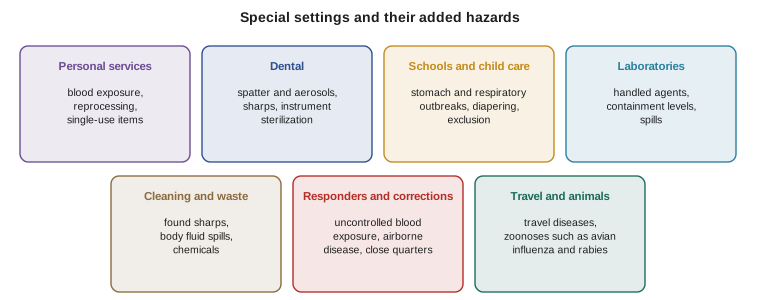
Personal service settings
Tattoo, piercing, electrolysis, microblading, manicure, pedicure, hairdressing and aesthetics businesses break or can break the skin, and some reuse equipment between clients. Outbreaks linked to these settings have included hepatitis B and C from contaminated equipment or ink, bacterial skin infections from contaminated pedicure foot baths and mycobacterial infections from contaminated tattoo ink diluted with tap water.
In Ontario, Regulation 136/18 under the Health Protection and Promotion Act sets requirements for personal service settings, including cleaning and disinfection, single-use items, reprocessing, client records and notifying public health of operations; other provinces have similar regulations or guidelines, and public health inspects these businesses. Key controls are:
- single-use, sterile needles, ink cups and other items that pierce or contact broken skin, opened in front of the client and discarded after use;
- reprocessing of any reusable critical items, such as stainless steel tubes or forceps, by cleaning and sterilization in a validated steam sterilizer, with routine monitoring and records;
- cleaning and disinfection of work surfaces, chairs and equipment between clients;
- covering equipment that cannot be easily disinfected, such as machine cords and clip cords, with single-use barriers;
- hand hygiene and new gloves for each client and whenever gloves are contaminated;
- hepatitis B vaccination for practitioners;
- sharps containers at each workstation and an exposure response plan;
- proper cleaning and disinfection of foot baths in nail salons between clients and at the end of the day.
Steam sterilizers (autoclaves) must be monitored to prove they work. Physical monitors record time, temperature and pressure for each cycle; chemical indicators inside each package change colour when exposed to steam conditions; and biological indicators, which contain heat-resistant bacterial spores, are run regularly, often weekly or as the manufacturer and local rules require, to show the cycle can kill spores. A failed biological indicator means items processed since the last good test may not be sterile and must be recalled and reprocessed.
# Reviewing a studio's steam sterilizer log (illustrative records)
cycles = [
    ("Mon", 132, 4, "pass", None), ("Tue", 132, 4, "pass", None), ("Wed", 128, 4, "fail", None),
    ("Thu", 132, 4, "pass", "pass"), ("Fri", 132, 2, "pass", None),
]
REQUIRED_TEMP, REQUIRED_MIN = 132, 4     # example cycle: 132 C for 4 minutes (check the manufacturer)
for day, temp, minutes, chem, bio in cycles:
    problems = []
    if temp < REQUIRED_TEMP: problems.append("temperature low")
    if minutes < REQUIRED_MIN: problems.append("exposure time short")
    if chem != "pass": problems.append("chemical indicator failed")
    note = "; ".join(problems) if problems else "ok"
    bio_note = f", spore test {bio}" if bio else ""
    print(f"{day}: {note}{bio_note}")
print("action: do not use loads with problems; reprocess and investigate the sterilizer")Mon: ok Tue: ok Wed: temperature low; chemical indicator failed Thu: ok, spore test pass Fri: exposure time short action: do not use loads with problems; reprocess and investigate the sterilizer
Dental offices
Dental care involves blood and saliva, sharp instruments and procedures that produce spatter and aerosols. Dental regulatory colleges and associations publish infection prevention standards that members must follow. Key controls include routine practices with eye protection, masks and gowns for every patient, respirators when a risk assessment calls for them, high-volume evacuation and rubber dams to reduce aerosols, safe handling of sharp instruments in cassettes, sterilization of critical and semi-critical instruments with monitoring, regular disinfection of operatory surfaces, and treatment and testing of dental unit waterlines, which can grow bacterial biofilms if not maintained.
Schools and child care
Young children touch everything, put things in their mouths, need help with toileting and diapers, and are still building immunity. Child care centres and schools see frequent outbreaks of norovirus, hand, foot and mouth disease, respiratory viruses, strep throat, pinkeye and head lice, and staff catch many of them. Pregnant staff need particular attention for infections such as rubella, chickenpox, cytomegalovirus and parvovirus B19 (fifth disease), which can harm a developing baby; they should check their immunity and talk to their health care provider.
Key controls include:
- scheduled, supervised hand washing for children and staff, especially before eating and after toileting and outdoor play;
- a diapering procedure at a dedicated change station away from food areas, with gloves, a cleanable surface, disposal of diapers in a lined, covered container and disinfection after every change;
- regular cleaning and disinfection of toys, especially mouthed toys, and shared surfaces;
- exclusion of ill children and staff according to public health rules;
- keeping records of staff and children's immunizations as required by law;
- reporting outbreaks to public health and following its direction;
- food safety practices for snacks and meals.
Teachers and education assistants who give first aid or care for students with medical needs should have training in routine practices, gloves and spill kits close at hand, and, where blood exposure is reasonably anticipated, access to hepatitis B vaccination.
Laboratories
Laboratories handle infectious agents on purpose, from clinical specimens to research cultures. In Canada, the Human Pathogens and Toxins Act and the Canadian Biosafety Standard, administered by the Public Health Agency of Canada, set licensing and containment requirements based on risk groups and containment levels 1 to 4. Laboratory biosafety is introduced in BIOL-107, lesson 4. Key infection prevention practices include a biosafety manual, training, biological safety cabinets for procedures that create aerosols, no mouth pipetting, decontamination of work surfaces and waste, spill procedures, medical surveillance and vaccination where appropriate, and reporting of laboratory exposures and incidents.
Cleaning, custodial and waste services
Cleaners and waste workers often face infection hazards created by others: needles in garbage and laundry, body fluid spills, contaminated washrooms, and medical waste that was not segregated properly. They may also be employed by contractors who do not know the client's hazards. Key controls include hazard information from the host employer, training in routine practices, spill clean-up and found sharps, appropriate gloves and tools, hepatitis B vaccination where exposure to blood is reasonably anticipated, sharps containers on cleaning carts where needles are found regularly, and clear procedures for reporting exposures. In health care, environmental services staff should be included in infection control training, outbreak communications and decisions about cleaning products. Chemical hazards from disinfectants, covered in lesson 5, are part of the same program.
First responders and corrections
Paramedics, firefighters, police and correctional officers can be exposed to blood and body fluids in uncontrolled situations: during resuscitation, at crashes and assaults, during arrests and searches, and from bites and spitting. They may also meet airborne diseases such as tuberculosis, which is more common in some correctional and shelter populations, and measles. Key controls include routine practices with gloves, eye protection and masks carried and used, puncture-resistant gloves and search techniques that avoid blind reaching into pockets, safety-engineered sharps in ambulances, cleaning and disinfection of vehicles and equipment after each call, hepatitis B vaccination, tuberculosis screening where indicated, and fast access to post-exposure assessment.
Some provinces have mandatory blood testing acts that let emergency workers, police and certain others apply for an order requiring a source person to be tested for HBV, HCV and HIV after an exposure, when the person does not consent. Ontario's Mandatory Blood Testing Act is one example. These processes are slower than immediate medical assessment, so exposed workers should not wait for them before starting post-exposure care.
Travel and work with animals
Workers who travel for work, such as engineers, aid workers, flight crews and sales staff, may be exposed to diseases rare at home, including malaria, dengue, typhoid, hepatitis A and yellow fever. Employers should arrange a travel health consultation well before departure, cover recommended vaccines and preventive medicines, provide information on food and water safety and insect bite prevention, and have a plan for medical care and evacuation abroad.
Workers with animals face zoonoses, infections passed from animals to people. Veterinary staff, farm workers, animal control officers, slaughterhouse workers and wildlife workers may be exposed to rabies, avian influenza, Q fever, brucellosis, ringworm and others. With H5N1 avian influenza circulating in birds, and in North America in dairy cattle, poultry and dairy workers are advised to use protective equipment such as respirators, eye protection, gloves and coveralls when handling sick animals or raw milk, to report symptoms such as conjunctivitis or fever, and to follow public health and agriculture authority guidance. Rabies pre-exposure vaccination is recommended for workers at ongoing risk.
Worked problem
Opening a nail salon safely
A new nail salon will offer manicures and pedicures with whirlpool foot spas. What infection controls are most important?
Show solution
- Pedicure foot spas have been linked to serious skin infections from bacteria growing in pipes and filters.
- Clean and disinfect foot spas between every client with a registered disinfectant at the labelled contact time, and clean behind filters and screens daily; disposable liners or pipeless units reduce the risk.
- Metal implements that may contact broken skin, such as cuticle nippers, need cleaning and sterilization or must be single use; files and buffers that cannot be disinfected must be single use.
- Workers clean hands between clients, use new gloves where blood contact is possible, and do not shave clients' legs before pedicures, which creates breaks in the skin.
- Follow the local public health rules for personal service settings, which may set specific requirements and inspections.
Answer: Foot spa disinfection, single-use or sterilized implements, hand hygiene and compliance with public health rules are the key controls.
Worked problem
Handling a spitting incident in a correctional facility
An inmate spits in a correctional officer's face during an altercation, and the saliva appears to contain blood. What should happen?
Show solution
- Saliva visibly contaminated with blood is potentially infectious, and the eyes, nose and mouth are mucous membranes.
- The officer flushes the eyes and rinses the mouth and nose with water as soon as safely possible.
- The officer reports immediately and is assessed promptly for hepatitis B, hepatitis C and HIV risk.
- The facility should review the incident, including whether spit hoods, face shields or other protection were available and used, following its policies.
Answer: Treat bloody saliva in the eyes or mouth as an exposure: flush, report, get assessed promptly and review the controls.
Common mistakes
MistakeReusing tattoo needles or ink cups after cleaning.
InsteadUse single-use sterile items and discard them after each client.
MistakeSkipping biological indicator tests because the sterilizer seems fine.
InsteadMonitor every cycle and run spore tests on schedule; recall loads after a failure.
MistakeChanging diapers on the same table used for snacks.
InsteadUse a dedicated change station away from food areas and disinfect after every change.
MistakeReaching blindly into pockets during a search.
InsteadUse search techniques that avoid blind reaching and wear puncture-resistant gloves.
MistakeSending a contract cleaner into a clinic without hazard information.
InsteadThe host employer and contractor must share hazard information, training and procedures.
Summary and key terms
- Personal service settings need single-use sterile items, validated sterilization, cleaning between clients and hepatitis B vaccination.
- Steam sterilizers need physical, chemical and biological monitoring, with recalls after failures.
- Dental offices manage spatter, aerosols, sharps and instrument reprocessing, and maintain waterlines.
- Schools and child care rely on supervised hand washing, safe diapering, toy cleaning, exclusion and outbreak reporting.
- Laboratories follow licensing and containment rules for the agents they handle.
- Cleaners, waste workers, first responders and correctional staff face exposures created by others and need tools, training and fast post-exposure care.
- Travelling workers and workers with animals need travel health advice, vaccines and protection against zoonoses such as avian influenza and rabies.
- Personal service setting
- A business providing services such as tattooing, piercing, aesthetics, nails or hairdressing.
- Steam sterilizer (autoclave)
- A device that sterilizes items using steam under pressure at set temperatures and times.
- Biological indicator
- A test containing heat-resistant spores used to confirm that a sterilization cycle can kill spores.
- Chemical indicator
- A strip or tape that changes colour when exposed to sterilization conditions.
- Dental unit waterline
- The tubing that delivers water to dental instruments, which can grow biofilm if not treated.
- Containment level
- A set of physical and operational requirements for safely handling infectious agents in a laboratory; called biosafety level in the United States.
- Zoonosis
- An infection that passes from animals to people.
- Diapering procedure
- A step-by-step method for changing diapers that limits contamination of hands and surfaces.
- Spit hood
- A mesh hood placed over a person's head to prevent spitting.
- Travel health consultation
- A pre-travel visit to assess risks and arrange vaccines, medicines and advice.
Practice problems
Work each problem on paper first, then reveal the answer to check.
Name three controls for a tattoo studio.
Show answer
Any three of single-use sterile needles and ink cups, validated sterilization, cleaning between clients, barriers on equipment, gloves and hand hygiene, hepatitis B vaccination, sharps containers.
What does a failed biological indicator mean?
Show answer
The sterilizer may not be killing spores; loads since the last good test must be recalled and reprocessed and the sterilizer investigated.
Why are dental unit waterlines treated and tested?
Show answer
They can grow bacterial biofilm that contaminates the water used in procedures.
Name two infections of special concern for pregnant child care staff.
Show answer
Any two of rubella, chickenpox, cytomegalovirus and parvovirus B19.
Where should diapers be changed in a child care centre?
Show answer
At a dedicated change station away from food areas, disinfected after every change.
Why do cleaners often face hazards created by others?
Show answer
Others leave needles, body fluids and improperly segregated waste that cleaners then handle.
What is a key search technique for police and correctional staff?
Show answer
Avoid blind reaching into pockets or bags and use puncture-resistant gloves.
What does Ontario's Mandatory Blood Testing Act allow?
Show answer
Certain workers can apply for an order requiring a source person to be tested after an exposure.
What protection is advised for dairy workers handling sick cattle during H5N1 circulation?
Show answer
Respirators, eye protection, gloves and coveralls, plus reporting symptoms and following public health advice.
When should a travelling worker get travel health advice?
Show answer
Well before departure, to allow time for vaccines and preventive medicines.
Lesson quiz · 5 questions
Score 60% or more to complete this lesson.
Create a free account to save your progress, take quizzes and earn a certificate.