
HSE-245 · Lesson 1 of 12 · 27 min
Why infection prevention matters at work
Every workplace is shared air, shared surfaces and shared people. A cold that passes around an office, a norovirus outbreak that closes a long-term care home, a needlestick in a dental clinic, a tattoo artist exposed to blood, a custodian who handles a contaminated mop, a paramedic who treats a patient with measles: all of these are infection hazards at work. Some are minor nuisances. Others can cause lifelong illness or death. Almost all of them can be reduced with the same small set of habits, controls and plans.
Infection prevention and control (often shortened to IPAC in Canada and IPC elsewhere) is the set of practices that stop germs from moving from where they are to where they can cause harm. In hospitals it is a profession of its own, with trained infection control practitioners, surveillance systems and committees. In most other workplaces it is part of the ordinary occupational health and safety program: a hazard to identify, assess and control like any other.
This course is written for workers, supervisors, joint health and safety committee members and owners in a wide range of workplaces: health care and long-term care, dental and medical offices, personal service settings such as tattoo, piercing and aesthetics studios, schools and child care, laboratories, cleaning and custodial services, first responders, offices and travel-heavy jobs. It is awareness training. It does not certify anyone as an infection control practitioner; in Canada and the United States that credential is the CIC, awarded by the Certification Board of Infection Control and Epidemiology, and it requires years of work in the field. Anyone with symptoms, an exposure or a question about their own health should contact their health care provider, their workplace occupational health service or their local public health unit.
Infections at work are common and costly
Respiratory infections are the most common reason people miss work for illness. Seasonal influenza alone causes millions of lost workdays each winter in North America, and colds, COVID-19 and other respiratory viruses add many more. When workers come to work sick, which many do because of pressure, lost pay or staffing gaps, they spread illness to co-workers, customers and patients, and their own work slows down. Economists call this presenteeism, and studies suggest it can cost employers as much as absenteeism.
In health care the stakes are higher. Infections that patients pick up while receiving care, called health care-associated infections, affect a significant share of hospital patients and kill thousands of people each year in Canada and tens of thousands in the United States. Health care workers are both at risk and a possible route of spread. Long-term care homes, where residents are frail and live close together, were devastated by COVID-19 in 2020 and 2021, and the lessons from that period shape much of today's guidance.
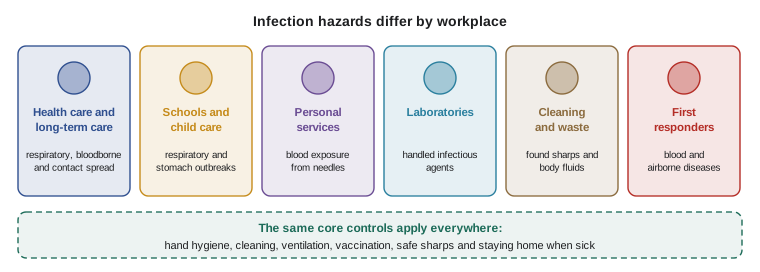
Other sectors have their own patterns. Child care centres and schools see waves of gastrointestinal illness and respiratory viruses. Laboratories handle infectious materials on purpose. Personal service workers pierce skin with needles every day. Cleaners and waste handlers meet sharps and body fluids that someone else failed to dispose of properly. Police, firefighters and paramedics deal with blood and body fluids in uncontrolled settings. Travelling workers may meet diseases that are rare at home.
Recent reminders
The last few years have kept infection prevention in the news. COVID-19 showed how fast a new respiratory virus can disrupt every workplace, and how much ventilation, staying home when sick and vaccination matter. In November 2025 Canada lost its measles elimination status after more than a year of continuous spread that began in 2024, the first time since elimination was declared in 1998; outbreaks were concentrated in communities with low vaccination coverage and spread into health care and school settings. Avian influenza H5N1 has spread widely in birds and in some mammals, and a teenager in British Columbia became seriously ill with it in late 2024, Canada's first locally acquired human case. None of these mean that every workplace is in danger, but they show why workplaces need plans that can be scaled up quickly.
Prevention works
The good news is that infection prevention is one of the best-proven areas of safety. Hand hygiene programs reduce infections in hospitals and absenteeism in schools and offices. Safety-engineered needles, introduced widely around 2000, cut sharps injuries sharply. Hepatitis B vaccination has nearly eliminated occupational hepatitis B among vaccinated health care workers, a disease that once infected thousands of them every year. Better ventilation lowers the concentration of airborne germs. Simple rules such as staying home when sick, cleaning high-touch surfaces and covering coughs work best when the workplace makes them easy to follow.
# How a small absenteeism cut pays for a hand hygiene and stay-home program (illustrative).
staff = 120
avg_daily_cost = 320          # wages plus benefits per worker-day, dollars
sick_days_before = 6.0        # infection-related sick days per worker per year
reduction = 0.15              # 15% fewer infection-related sick days
program_cost = 9500           # sanitizer, signage, training time, per year

days_saved = staff * sick_days_before * reduction
savings = days_saved * avg_daily_cost
print(f"worker-days saved per year: {days_saved:.0f}")
print(f"value of days saved: ${savings:,.0f}")
print(f"net benefit after program cost: ${savings - program_cost:,.0f}")worker-days saved per year: 108 value of days saved: $34,560 net benefit after program cost: $25,060
The numbers in this example are illustrative, but the pattern is typical. Even modest reductions in illness repay the cost of supplies and training, before counting the harder-to-measure benefits: fewer infections passed to clients or patients, less overtime to cover absent staff and better morale.
The hierarchy of controls applies
Infection hazards are controlled with the same hierarchy used for chemical or physical hazards, as introduced in HSE-103. The most effective controls remove or reduce the hazard at its source; the least effective depend on each person doing the right thing every time.
| Level of control | Infection prevention examples |
|---|---|
| Elimination | Remove unnecessary sharps; move routine services online so sick clients do not attend in person |
| Substitution | Use needle-free connectors; use single-use instruments where reprocessing is unreliable |
| Engineering controls | Ventilation and filtration, airborne infection isolation rooms, safety-engineered sharps, physical barriers, hands-free sinks and dispensers |
| Administrative controls | Screening, stay-home-when-sick policies, vaccination programs, cleaning schedules, training, signage, scheduling to reduce crowding |
| Personal protective equipment | Gloves, gowns, eye and face protection, medical masks and respirators (see HSE-240) |
In health care, some of these are organized into routine practices (standard precautions in US terms), which apply to everyone at all times, and additional or transmission-based precautions, which add controls for specific infections. Lessons 8 and 10 cover these in detail.
Everyone has a role
Employers provide the program: the risk assessment, the policies, the supplies, the training, the vaccination offers and the response plan. Supervisors make sure the program is followed day to day: that hand hygiene stations are stocked, that sick workers are sent home without penalty, that sharps containers are swapped before they overfill, that new workers are trained. Workers follow the procedures, report exposures and hazards, use the controls provided and look out for each other. Safety committees and representatives review the program, inspect the workplace and recommend improvements. Public health authorities set guidance, investigate outbreaks and may issue orders. Lesson 3 covers the legal duties.
What this course covers
Lesson 2 explains how infections spread, using the chain of infection. Lesson 3 covers the law and responsibilities. Lessons 4 and 5 cover hand hygiene and cleaning and disinfection. Lesson 6 covers respiratory infections, ventilation and outbreaks, and lesson 7 covers vaccination and fitness for work. Lessons 8 and 9 cover bloodborne pathogens, sharps, spills and exposure response. Lesson 10 covers transmission-based precautions and putting on and taking off personal protective equipment. Lesson 11 looks at special settings, and lesson 12 brings everything together in an infection prevention plan.
Some related topics are covered elsewhere. Respirator selection and fit testing are covered in HSE-240. Biosafety levels and laboratory containment are introduced in BIOL-107, lesson 4, and the biology of bacteria and viruses in BIOL-108, lesson 7. Clinical infection control in nursing practice is covered in the nursing courses.
Worked problem
Recognizing infection hazards in an ordinary workplace
A 40-person accounting office has shared kitchens, open-plan desks and a front reception area that meets clients. During tax season, staff work long hours and many come in sick. What infection hazards exist, and which controls are most practical?
Show solution
- Respiratory viruses spread through close contact, shared air and, to a lesser extent, shared surfaces.
- Working while sick during peak season greatly increases spread; this is the biggest driver.
- Practical controls: a clear stay-home-when-sick policy with remote work options, hand sanitizer at reception and in kitchens, regular cleaning of high-touch surfaces, checking that the ventilation system supplies enough outdoor air, and offering or promoting seasonal vaccination.
- Personal protective equipment is rarely needed in this setting except during local outbreaks or for staff at higher risk.
Answer: The main hazard is respiratory spread made worse by presenteeism. Administrative controls (stay-home and remote work), ventilation and hand hygiene give the most benefit for the least cost.
Worked problem
Thinking through a higher-risk setting
A tattoo studio has three artists. What makes infection prevention more demanding here than in an office?
Show solution
- Every tattoo breaks the skin, so there is routine contact with blood and the possibility of needlestick injuries.
- Bloodborne pathogens such as hepatitis B, hepatitis C and HIV can be passed from client to artist through a sharps injury, and from client to client through poorly reprocessed equipment or contaminated ink.
- Controls include single-use needles and ink cups, safe sharps disposal, cleaning and disinfection between clients, proper reprocessing of any reusable equipment, gloves, hand hygiene, hepatitis B vaccination for artists and an exposure response plan.
- Local public health rules for personal service settings usually apply, with inspections.
Answer: The routine blood exposure makes bloodborne pathogen controls, sharps safety and reprocessing central. Lessons 8, 9 and 11 cover these.
A note on language and stigma
Infection prevention works best when people feel safe reporting symptoms and exposures. Blaming a worker for bringing an infection to work, or treating people with hepatitis, HIV or tuberculosis as dangerous in ordinary contact, discourages reporting and drives illness underground. It can also break human rights and privacy law. Good programs talk about hazards and controls, not about who is to blame, keep medical information confidential and make it easy to do the right thing. The same applies to customers and clients: a respectful screening question at a front desk works better than a sign that treats every visitor as a threat. Throughout this course, examples use plain, neutral language for this reason.
Common mistakes
MistakeThinking infection prevention only matters in hospitals.
InsteadOffices, schools, studios, labs, cleaning services and first responders all have infection hazards.
MistakeRelying mainly on personal protective equipment.
InsteadStart with higher-level controls such as ventilation, safer sharps and stay-home policies, and use equipment as a backup.
MistakeTreating coming to work sick as dedication.
InsteadWorking while infectious spreads illness and lowers productivity; policies should make staying home possible.
MistakeTreating this awareness course as a certification or medical advice.
InsteadIt builds awareness; clinical credentials, medical advice and site-specific training are separate.
MistakeAssuming outbreaks are rare events that need no plan.
InsteadRecent measles, COVID-19 and avian influenza events show why plans that can be scaled up are needed.
Summary and key terms
- Infection hazards exist in almost every workplace, from offices to tattoo studios to ambulances.
- Respiratory infections are the most common cause of illness-related absence, and working while sick adds to the cost.
- In health care, infections acquired during care harm patients and workers, and long-term care is especially vulnerable.
- Recent measles outbreaks, COVID-19 and avian influenza show the need for plans that can be scaled up.
- Proven controls include hand hygiene, safer sharps, vaccination, ventilation and stay-home policies.
- The hierarchy of controls applies to infection hazards just as it does to other hazards.
- Infection prevention and control (IPAC)
- The practices that stop the spread of infectious agents between people, places and things.
- Infectious agent
- A microorganism or virus that can cause disease, such as a bacterium, virus, fungus or parasite.
- Health care-associated infection
- An infection a patient acquires while receiving care that was not present on admission.
- Presenteeism
- Working while ill, which lowers productivity and can spread infection.
- Outbreak
- More cases of an infection than expected in a particular place and time.
- Elimination (of a disease)
- The absence of continuous transmission of a disease in a country or region for at least 12 months.
- Routine practices
- The basic infection prevention practices used with everyone at all times; called standard precautions in the United States.
- Hierarchy of controls
- A ranking of control methods from most effective (elimination) to least effective (personal protective equipment).
- CIC
- Certification in Infection Prevention and Control, the professional credential for infection control practitioners.
- Public health authority
- The government body that sets disease control guidance, investigates outbreaks and can issue orders.
Practice problems
Work each problem on paper first, then reveal the answer to check.
List four workplaces outside hospitals where infection hazards are significant.
Show answer
Any four of schools, child care, tattoo and piercing studios, dental offices, laboratories, cleaning services, waste handling, first responders, long-term care and offices.
What is presenteeism, and why does it matter for infection control?
Show answer
Working while ill; it spreads infection to others and lowers productivity.
Give one engineering control and one administrative control for respiratory infections.
Show answer
Engineering: better ventilation or filtration. Administrative: a stay-home-when-sick policy, screening or vaccination program.
Why is personal protective equipment at the bottom of the hierarchy of controls?
Show answer
It depends on correct selection, fit and use by each person every time, and it does nothing to reduce the hazard itself.
What happened to Canada's measles elimination status in 2025?
Show answer
Canada lost it in November 2025 after more than a year of continuous transmission.
Name two controls that have dramatically reduced occupational hepatitis B or sharps injuries.
Show answer
Hepatitis B vaccination and safety-engineered sharps.
Who provides the infection prevention program, and who follows it day to day?
Show answer
The employer provides it; supervisors oversee it and workers follow it.
Why do tattoo studios need stronger bloodborne pathogen controls than offices?
Show answer
Tattooing breaks the skin and involves routine blood contact and needles.
Which course covers respirator selection and fit testing?
Show answer
HSE-240.
Where should a worker with symptoms or an exposure go for advice?
Show answer
Their health care provider, occupational health service or local public health.
Lesson quiz · 5 questions
Score 60% or more to complete this lesson.
Create a free account to save your progress, take quizzes and earn a certificate.