
HSE-245 · Lesson 6 of 12 · 29 min
Respiratory infections, ventilation and outbreaks
Respiratory infections cause more lost work than any other kind of infection. Colds, influenza, COVID-19, respiratory syncytial virus (RSV), pertussis (whooping cough), and less commonly tuberculosis and measles, all spread mainly through the air people breathe out. Lesson 2 explained that people exhale a range of particle sizes and that small aerosols can build up indoors. This lesson turns that understanding into practical controls: keeping sick people away from others, ventilation and filtration, masks and respirators, respiratory etiquette, and detecting and managing outbreaks.
Layers of protection
No single measure stops respiratory spread. Workplaces that do well use several layers, each of which removes part of the risk:
- staying home when sick, with policies and sick leave that make it possible (lesson 7);
- vaccination for the infections where vaccines are available (lesson 7);
- ventilation, filtration and, where appropriate, air cleaning;
- reducing crowding and the duration of close contact, for example by staggering breaks and using larger rooms;
- respiratory etiquette: covering coughs and sneezes, using tissues and cleaning hands afterward;
- masks for source control and personal protection, and respirators where the risk is higher (see HSE-240);
- screening for symptoms in higher-risk settings, such as health care and long-term care;
- early detection and response to clusters of illness.
Ventilation basics
Ventilation dilutes and removes airborne contaminants by replacing room air with outdoor air or with recirculated air that has passed through a filter. Two common measures describe it. Air changes per hour (ACH) is the volume of air supplied to a room in an hour divided by the room's volume. Outdoor air per person, usually in litres per second per person, describes how much fresh air each occupant receives; building codes set minimum rates based on occupancy and use.
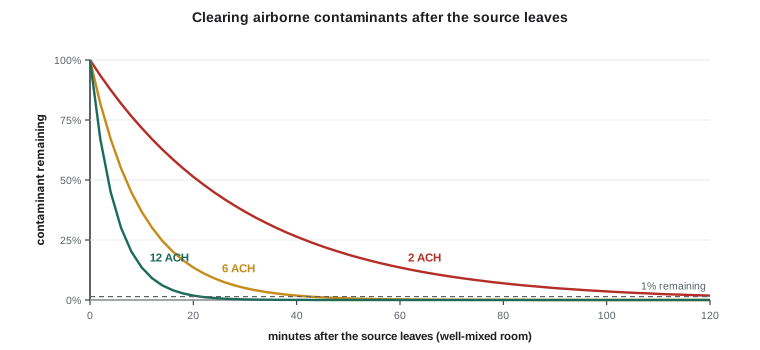
When a source stops emitting, for example when an infectious patient leaves a room, the concentration of airborne particles falls exponentially. The CDC's guidelines for environmental infection control in health care give a table of the time needed to remove 99 per cent or 99.9 per cent of airborne contaminants at different air change rates, assuming perfect mixing. Real rooms mix imperfectly, so actual times are longer.
import math
# Minutes to remove 99% and 99.9% of airborne contaminants (well-mixed room)
print("ACH   99%   99.9%")
for ach in (2, 4, 6, 12, 15):
    t99 = -math.log(1 - 0.99) / ach * 60
    t999 = -math.log(1 - 0.999) / ach * 60
print(f"{ach:>3} {t99:4.0f} {t999:5.0f}")ACH 99% 99.9% 2 138 207 4 69 104 6 46 69 12 23 35 15 18 28
The results match the CDC table: at 6 air changes per hour it takes about 46 minutes to remove 99 per cent of airborne contaminants and 69 minutes for 99.9 per cent; at 12 ACH, half that. This is why health care facilities keep a room closed for a set time after a patient with an airborne infection such as measles or tuberculosis leaves, and why that time depends on the room's ventilation rate.
Practical ventilation improvements
Most buildings are ventilated by heating, ventilation and air-conditioning (HVAC) systems designed to meet building codes and, for offices and schools, standards such as ASHRAE 62.1. Health care facilities in Canada follow CSA Z317.2:24, which sets minimum air change rates, pressure relationships and filtration for different rooms, including airborne infection isolation rooms kept at negative pressure. Practical steps in any building include:
- having a qualified person check that the system delivers the outdoor air it was designed for, that dampers work and that filters fit without gaps;
- upgrading filters to MERV 13 or higher where the system can handle the extra resistance;
- running ventilation during occupied hours and for a period before and after;
- using portable HEPA air cleaners sized for the room in spaces with poor ventilation, such as small meeting rooms or clinic rooms;
- opening windows where safe and practical;
- using carbon dioxide (CO₂) monitors as a rough indicator of whether ventilation is keeping up with occupancy.
Carbon dioxide is exhaled by everyone, so its concentration rises in a crowded, poorly ventilated room. Outdoor air is around 420 ppm. Indoor levels that stay below about 800 to 1,000 ppm in an occupied room usually indicate reasonable outdoor air supply for the number of people present. CO₂ does not measure germs and is not useful for spaces where air cleaners remove particles without bringing in outdoor air, but it is a cheap way to find rooms that need attention.
Portable HEPA air cleaners are rated by clean air delivery rate (CADR). Dividing the CADR by the room volume gives the additional effective air changes the unit provides.
# Equivalent air changes from a portable HEPA unit (illustrative)
room_l, room_w, room_h = 6.0, 5.0, 2.7          # m
volume = room_l * room_w * room_h               # m3
cadr_cfm = 300                                  # clean air delivery rate, cubic feet per minute
cadr_m3h = cadr_cfm * 1.699                     # 1 cfm = 1.699 m3/h
existing_ach = 2.0
added = cadr_m3h / volume
print(f"room volume {volume:.0f} m3")
print(f"HEPA unit adds about {added:.1f} air changes per hour")
print(f"total about {existing_ach + added:.1f} ACH")room volume 81 m3 HEPA unit adds about 6.3 air changes per hour total about 8.3 ACH
Masks, respirators and respiratory etiquette
Masks serve two purposes. As source control, a mask worn by an infected person reduces the particles they release into the air. As personal protection, a mask or respirator reduces what the wearer breathes in. Medical (surgical or procedure) masks protect against splashes and larger particles and offer some protection against smaller ones, but air leaks around their edges. Respirators such as N95 filtering facepieces are designed to fit tightly and filter at least 95 per cent of small particles, and their protection depends on fit testing and a good seal each time they are worn. HSE-240 covers respirator selection, fit testing and the law.
Health care settings decide whether to use medical masks or respirators for respiratory infections through a point-of-care risk assessment and the precautions required for each disease, as lesson 10 explains. Outside health care, masks are most useful during community outbreaks, for workers with symptoms who must be around others, for workers who are at higher risk of severe illness, and when public health recommends them.
Respiratory etiquette is simple: cover coughs and sneezes with a tissue or the inside of your elbow, put used tissues in the garbage, clean your hands afterward, and keep distance from others when you have symptoms. Workplaces can support it by providing tissues, no-touch waste bins and hand rub at entrances and in common areas.
Recognizing an outbreak
An outbreak is more cases of an illness than would normally be expected in a place and time. In long-term care, public health agencies set case definitions; a respiratory outbreak might be declared with two or more cases of acute respiratory infection with onset within a set number of days in a specific area. Workplaces outside health care rarely have formal definitions, but a cluster of absences with similar symptoms in one team, shift or location is a signal to act.
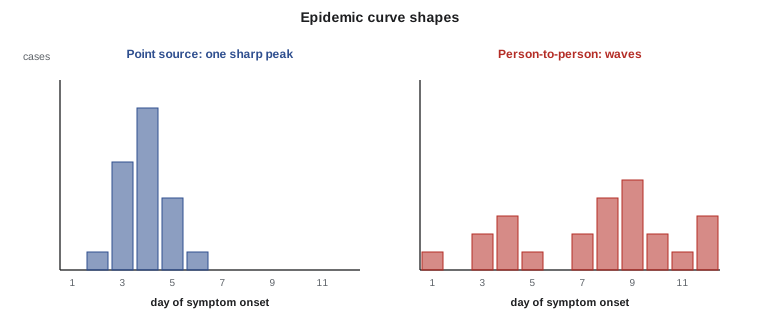
Simple measures describe an outbreak. The attack rate is the number of people who became ill divided by the number at risk. The secondary attack rate is the proportion of contacts of a case who became ill afterwards, which shows how readily the infection spreads from person to person. An epidemic curve is a histogram of new cases by date of symptom onset; its shape suggests whether the outbreak came from a single exposure (a sharp peak) or is spreading from person to person (successive waves).
from collections import Counter
# Line list of an invented respiratory cluster in a contact-handling office: (person, team, onset day)
cases = [("A", "north", 1), ("B", "north", 3), ("C", "north", 3), ("D", "south", 4),
         ("E", "north", 4), ("F", "north", 5), ("G", "south", 6), ("H", "north", 6),
         ("I", "south", 7), ("J", "north", 8)]
staff = {"north": 40, "south": 35}
for team, n in staff.items():
    ill = sum(1 for c in cases if c[1] == team)
    print(f"{team}: {ill}/{n} ill, attack rate {ill / n:.0%}")
curve = Counter(day for _, _, day in cases)
print("epidemic curve:")
for day in range(1, 9):
    print(f"day {day}: {'#' * curve.get(day, 0)}")
# Secondary attack rate among 12 close desk-mates of the first case
print(f"secondary attack rate: {3 / 12:.0%} of close contacts of case A")north: 7/40 ill, attack rate 18% south: 3/35 ill, attack rate 9% epidemic curve: day 1: # day 2: day 3: ## day 4: ## day 5: # day 6: ## day 7: # day 8: # secondary attack rate: 25% of close contacts of case A
Managing an outbreak
In long-term care, hospitals, child care and schools, report suspected outbreaks to the local public health unit as required, and follow its direction. Typical outbreak measures include:
- confirming the cause through testing where appropriate;
- excluding ill staff until they are no longer infectious, following public health guidance;
- increasing cleaning and disinfection of high-touch surfaces;
- cohorting: assigning staff to care only for affected residents or only for unaffected ones, and grouping affected residents;
- restricting admissions, transfers, group activities and visits as directed;
- reinforcing hand hygiene, respiratory etiquette and masking;
- offering vaccines or antiviral medication where public health recommends it, for example antivirals during influenza outbreaks in long-term care;
- communicating clearly with staff, residents, families and partners;
- declaring the outbreak over only when public health agrees, usually after a set period with no new cases.
Outside health care, the employer's response to a cluster of respiratory illness might include reminding staff to stay home when sick, allowing remote work, checking ventilation, increasing cleaning and following any public health advice. Medical information about individual workers must be kept confidential.
Tuberculosis and measles at work
Two airborne diseases deserve special mention. Tuberculosis is uncommon in most of Canada and the United States but remains a concern in health care, correctional facilities, shelters, some Indigenous and northern communities and among people born in countries with high rates. Only people with active tuberculosis of the lungs or throat are infectious, and spread usually requires prolonged close contact in shared air. Many health care employers screen workers on hire and after exposures. Measles is one of the most contagious diseases known; up to nine in ten non-immune contacts become infected. The best protection is two documented doses of measles vaccine, and health care workers are expected to have proof of immunity. With measles circulating in parts of North America since 2024, workplaces such as clinics, emergency departments, schools and airports have had exposure events that require contact tracing and, for non-immune workers, exclusion from work during the incubation period.
Worked problem
Clearing a room after an airborne exposure
A patient with suspected measles spent 30 minutes in a clinic exam room before being moved. The room has 6 air changes per hour. When can the next patient use it?
Show solution
- Measles particles remain infectious in room air after the patient leaves.
- At 6 ACH, removing 99.9 per cent of airborne contaminants takes about 69 minutes in a well-mixed room.
- Many public health agencies recommend leaving the room empty for about two hours after a measles patient in rooms with typical ventilation, longer than the minimum calculation because mixing is imperfect.
- Follow local public health advice, and list everyone who was in the area during and after the visit for follow-up.
Answer: Keep the room closed for the time public health recommends (often about two hours), which is longer than the 69-minute well-mixed estimate.
Worked problem
Using CO₂ to find a ventilation problem
An office manager places CO₂ monitors in meeting rooms. One small room with eight people reaches 1,900 ppm after 40 minutes, while others stay below 900 ppm. What does this suggest, and what should be done?
Show solution
- CO₂ at 1,900 ppm means the room is getting far less outdoor air than it needs for eight people.
- Respiratory aerosols from any infected person would build up in the same way.
- Ask the building operator to check the supply air to that room; it may be closed off, undersized or not running.
- Meanwhile, limit occupancy, shorten meetings, use a portable HEPA air cleaner and open a window if possible.
Answer: The room is under-ventilated; fix the supply air and use occupancy limits and air cleaning in the meantime.
Common mistakes
MistakeRelying on a single measure such as masks or distance.
InsteadLayer several controls: stay-home policies, vaccination, ventilation, masks and hygiene.
MistakeAssuming a room is safe immediately after an infectious patient leaves.
InsteadAllow time for ventilation to clear airborne particles, based on the air change rate and public health advice.
MistakeTreating CO₂ readings as a measure of germs.
InsteadCO₂ only indicates whether outdoor air supply matches occupancy.
MistakeWaiting to see whether a cluster of sick staff goes away.
InsteadAct early, report where required and follow public health direction.
MistakeSharing a worker's diagnosis with the team.
InsteadKeep medical information confidential; tell contacts what they need to know without identifying the person unless public health directs otherwise.
Summary and key terms
- Respiratory infections spread mainly through exhaled particles, and controls must be layered.
- Ventilation dilutes and removes airborne particles; air changes per hour and outdoor air per person describe it.
- At 6 ACH it takes about 46 minutes to remove 99 per cent of airborne contaminants in a well-mixed room; real rooms take longer.
- Filter upgrades, portable HEPA units and CO₂ monitoring are practical ways to improve and check ventilation.
- Masks provide source control and some protection; fit-tested respirators provide more (see HSE-240).
- Attack rates, secondary attack rates and epidemic curves describe outbreaks.
- Outbreak measures include reporting, exclusion of ill staff, cohorting, enhanced cleaning and following public health direction.
- Air changes per hour (ACH)
- The volume of air supplied to a room each hour divided by the room volume.
- HEPA filter
- A high-efficiency particulate air filter that removes at least 99.97 per cent of particles of 0.3 micrometres.
- MERV rating
- A rating of how well an HVAC filter captures particles; MERV 13 and higher capture most respiratory-sized particles.
- Clean air delivery rate (CADR)
- The volume of filtered air a portable air cleaner delivers.
- Negative pressure room
- A room kept at lower pressure than surrounding areas so air flows in, used for airborne isolation.
- Source control
- Measures, such as a mask on an infected person, that reduce the release of infectious particles.
- Attack rate
- The proportion of people at risk who become ill during an outbreak.
- Secondary attack rate
- The proportion of contacts of a case who become ill afterwards.
- Epidemic curve
- A histogram of new cases by date of symptom onset.
- Cohorting
- Grouping ill people together and assigning staff to care for only ill or only well people.
Practice problems
Work each problem on paper first, then reveal the answer to check.
A 75 m³ room receives 450 m³/h of air. What is its air change rate?
Show answer
6 air changes per hour.
How long does it take to remove 99 per cent of airborne contaminants at 12 ACH in a well-mixed room?
Show answer
About 23 minutes.
Why do health care facilities often wait longer than the calculated time before reusing a room?
Show answer
Real rooms do not mix perfectly, so clearing takes longer than the ideal calculation.
What does a CO₂ reading of 1,800 ppm in a busy meeting room suggest?
Show answer
The room is not getting enough outdoor air for the number of people.
A portable HEPA unit delivers 400 m³/h in an 80 m³ room. How many air changes does it add?
Show answer
5 air changes per hour.
What is the difference between source control and personal protection?
Show answer
Source control reduces what an infected person releases; personal protection reduces what the wearer breathes in.
Twelve of 48 workers on a shift became ill. What is the attack rate?
Show answer
25 per cent.
What does an epidemic curve with several waves suggest?
Show answer
Person-to-person spread rather than a single exposure.
Name three outbreak control measures in long-term care.
Show answer
Any three of reporting to public health, excluding ill staff, cohorting, enhanced cleaning, restricting activities and visits, reinforcing hand hygiene, offering antivirals or vaccines.
What is the best protection against measles for workers?
Show answer
Two documented doses of measles vaccine (or other proof of immunity).
Lesson quiz · 5 questions
Score 60% or more to complete this lesson.
Create a free account to save your progress, take quizzes and earn a certificate.