
HSE-245 · Lesson 10 of 12 · 27 min
Additional precautions and protective equipment
Routine practices apply to everyone. Some infections need more. In health care and long-term care, additional precautions are added for people known or suspected to have infections spread by contact, by droplets or by the airborne route, or by organisms that are hard to treat. This lesson explains the three main types of additional precautions, how protective equipment is selected for them, how to put it on and take it off without contaminating yourself, and how these ideas apply in settings outside health care.
Additional precautions
The precautions are chosen by the way the infection spreads, and often started as soon as an infection is suspected, before laboratory confirmation. Signs at the room entrance tell staff and visitors what is required without revealing the diagnosis.
| Type | Used for (examples) | Main measures |
|---|---|---|
| Contact precautions | MRSA, VRE, C. difficile, scabies, some diarrheal illnesses, draining wounds | Single room or cohort; gloves and gown for contact with the person or environment; dedicated equipment; enhanced cleaning |
| Droplet precautions | Influenza, pertussis, mumps, invasive meningococcal disease | Single room or spatial separation; medical mask and eye protection at close range (about 2 metres, or 6 feet); patient wears a mask outside the room |
| Airborne precautions | Tuberculosis, measles, chickenpox, disseminated shingles | Airborne infection isolation room at negative pressure with the door closed; fit-tested N95 or better respirator; only immune staff for measles and chickenpox |
| Combinations | Many respiratory viruses, such as COVID-19 and RSV, are managed with a combination such as droplet and contact | Follow the current national, provincial or state guidance for each disease |
In Canada, the Public Health Agency of Canada's guideline on routine practices and additional precautions and provincial guidance, such as PIDAC documents in Ontario, set the details. A point-of-care risk assessment can add protection beyond the minimum, for example wearing an N95 respirator for an aerosol-generating procedure on a patient with a respiratory infection.
Aerosol-generating procedures, such as intubation, open suctioning of airways, bronchoscopy and some dental procedures, produce more small particles and are usually done with respirators, in rooms with good ventilation and with as few people present as possible.
Choosing protective equipment
| Item | Purpose | Key points |
|---|---|---|
| Gloves | Protect hands from blood, body fluids and contaminated surfaces | Single use; change between people and between dirty and clean tasks on the same person; nitrile or vinyl where latex allergy is a concern; never wash and reuse disposable gloves |
| Gowns | Protect skin and clothing from contamination | Long-sleeved, fluid-resistant when splashes are likely; tied at the back; single use or laundered between uses |
| Medical masks | Protect the nose and mouth from splashes and larger particles; source control | Cover nose and chin; replace when wet or soiled; do not wear under the chin or reuse after touching |
| Respirators (N95 or better) | Protect against inhaling small airborne particles | Require fit testing and a seal check every time (see HSE-240); follow the manufacturer's limits on use |
| Eye protection | Protect eyes from splashes and sprays | Goggles or face shields; ordinary prescription glasses are not enough |
| Face shields | Protect the face and eyes from splashes | Worn with a mask or respirator, not instead of one |
Protective equipment protects only when it is the right item, fits, is put on before exposure and is taken off without self-contamination. Studies of health care workers using fluorescent markers or harmless viruses on their equipment show that skin and clothing often become contaminated during removal. That is why the sequence and technique matter as much as the equipment.
Putting on and taking off
The Canadian sequence widely taught in health care is shown below. Some employers use variations; follow your workplace's procedure and practise it until it is automatic.
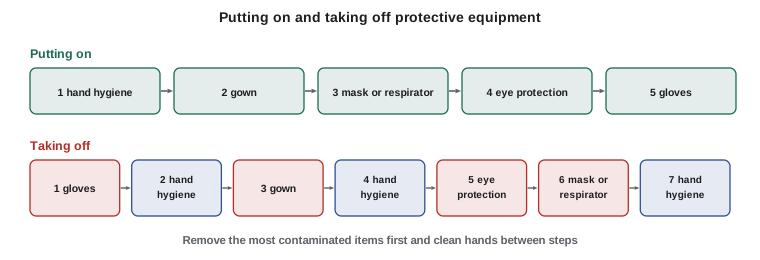
Some principles apply whatever the exact sequence:
- put on equipment before entering the room or starting the task, not after exposure has begun;
- remove the most contaminated items, usually gloves and the gown front, first;
- touch only the clean parts: the inside of gloves after the first glove is off, the ties of the gown, the band or ear loops of the mask;
- take off gloves using the glove-in-glove technique, peeling the first glove off with the other gloved hand and the second with a bare finger slid under the cuff;
- remove the respirator outside the room for airborne precautions, after the door is closed;
- clean hands between steps when hands may be contaminated, and always at the end;
- dispose of single-use items in the right container immediately.
Glove use in practice
Gloves are the most used and most misused item. Common problems include wearing the same gloves for several tasks or several people, touching clean surfaces such as door handles, phones and keyboards with contaminated gloves, wearing gloves when they are not needed, and skipping hand hygiene because gloves were worn. Overuse also creates waste and can increase skin problems. A simple rule helps: wear gloves when you expect to touch blood, body fluids, mucous membranes, non-intact skin or contaminated items; take them off as soon as that task is done; clean your hands.
Natural rubber latex gloves can cause allergies, from skin irritation to life-threatening reactions, in workers and patients. Many organizations have switched to nitrile gloves, which give good barrier protection without latex proteins. Where latex is still used, powder-free, low-protein gloves reduce the risk.
Planning supplies
During outbreaks and pandemics, protective equipment can run short, as it did in early 2020. Planning supplies by estimating how much each unit uses, called the burn rate, helps purchasing and helps show whether stock will last.
# PPE burn rate for one long-term care unit during a respiratory outbreak (illustrative)
residents_on_precautions = 12
entries_per_resident_per_day = 10     # care visits by all staff
items_per_entry = {"gloves (pairs)": 1, "gowns": 1, "medical masks": 0.5, "eye protection (disposable)": 0.5}
days = 14
stock = {"gloves (pairs)": 2000, "gowns": 1400, "medical masks": 900, "eye protection (disposable)": 600}
entries = residents_on_precautions * entries_per_resident_per_day
for item, per in items_per_entry.items():
    daily = entries * per
    need = daily * days
    status = "OK" if stock[item] >= need else f"short by {need - stock[item]:.0f}"
print(f"{item:<30} {daily:5.0f}/day, {need:6.0f} for {days} days, stock {stock[item]:5d}: {status}")gloves (pairs) 120/day, 1680 for 14 days, stock 2000: OK gowns 120/day, 1680 for 14 days, stock 1400: short by 280 medical masks 60/day, 840 for 14 days, stock 900: OK eye protection (disposable) 60/day, 840 for 14 days, stock 600: short by 240
In a shortage, health agencies may allow strategies such as extended use of masks and eye protection or reprocessing of some items, but these are temporary measures within agency guidance, not a substitute for adequate stockpiles. Many provinces, states and health systems now keep strategic stockpiles and track supplies after the lessons of the COVID-19 pandemic.
Outside health care
Workplaces outside health care rarely use formal transmission-based precautions, but the same reasoning applies. A first responder treating someone with a cough wears a mask and eye protection and puts a mask on the patient if possible. A dental office uses eye protection and masks for routine care and adds respirators when the risk assessment calls for them. A cleaning company sends staff to a home with a known C. difficile infection with gowns, gloves and a sporicidal disinfectant. A laboratory follows the containment level and biosafety practices for the agents it handles. A home care worker visiting a client with influenza wears a medical mask and eye protection within close range. In every case, the starting point is a risk assessment of the task, the likely exposure and the available controls, with equipment as the last layer.
Worked problem
Putting on equipment for a resident on contact and droplet precautions
A personal support worker needs to help a resident with influenza and MRSA colonization to wash. What should they wear, and in what order should they put it on?
Show solution
- Influenza calls for droplet precautions: a medical mask and eye protection within close range.
- MRSA calls for contact precautions: a gown and gloves for contact with the resident and their environment.
- Sequence: clean hands, put on the gown, then the mask, then eye protection, then gloves pulled over the gown cuffs.
- Enter the room only after the equipment is on.
Answer: Gown, mask, eye protection and gloves, put on in that order after hand hygiene, before entering.
Worked problem
Removing equipment without self-contamination
After the care, the worker is ready to leave. Describe how to remove the equipment.
Show solution
- Remove gloves first using the glove-in-glove technique, and clean hands.
- Untie the gown and peel it away from the body, rolling the contaminated outside inward, and discard it; clean hands.
- Leave the room, or move to the designated removal area, then remove eye protection by the arms or headband without touching the front.
- Remove the mask by the ear loops or ties and discard it.
- Clean hands again.
Answer: Gloves, hand hygiene, gown, hand hygiene, eye protection, mask, hand hygiene, touching only clean parts at each step.
Signs, visitors and communication
Precaution signs work only if people read and follow them. Good signs are posted at the entrance to the room or bed space, use pictures as well as words, list the equipment needed in the order it is put on, and avoid naming the infection, which protects the patient's privacy. Supplies of the listed equipment should be stocked right outside the room, with a waste container for removed items inside or at the exit according to the procedure. Visitors who will have close contact should be shown how to put on and remove equipment and how to clean their hands, and they should be told why the precautions matter. In long-term care, where residents may live with precautions for weeks, staff should balance infection control with residents' quality of life and dignity, for example by allowing safe visits and activities rather than isolating people longer than necessary.
Precautions should be reviewed regularly and removed when they are no longer needed, according to the criteria in the guidance for each disease, such as a set number of days after symptoms end or negative test results. Keeping precautions longer than necessary wastes equipment, adds work and can harm patients by limiting care, mobility and social contact. A daily review by the care team, prompted by a checklist, keeps precautions accurate.
Finally, protective equipment protects only the people who wear it correctly. Watching a colleague put on and take off equipment and giving friendly feedback, sometimes called a buddy check, catches mistakes such as an exposed neck, a mask under the nose or a contaminated glove touching the face. Many hospitals adopted trained observers for high-risk situations, such as caring for patients with viral hemorrhagic fevers, after experience showed that removal errors were common even among experienced staff.
Common mistakes
MistakeWaiting for a laboratory result before starting precautions.
InsteadStart precautions when an infection is suspected.
MistakeWearing a medical mask for a patient with suspected tuberculosis.
InsteadUse airborne precautions with a fit-tested N95 or better respirator.
MistakeUsing the same gloves for two residents.
InsteadChange gloves and clean hands between people and between tasks.
MistakePulling off a mask by the front.
InsteadRemove masks and respirators by the straps or loops, then clean hands.
MistakeWearing a face shield instead of a mask.
InsteadFace shields protect eyes and face from splashes and are worn with a mask or respirator.
Summary and key terms
- Additional precautions are added to routine practices for infections spread by contact, droplets or the airborne route.
- Contact precautions use gowns and gloves; droplet precautions use masks and eye protection; airborne precautions use negative pressure rooms and fit-tested respirators.
- Start precautions when an infection is suspected, and use signs that do not reveal the diagnosis.
- Protective equipment works only if it is the right item, fits and is removed without self-contamination.
- Follow a set sequence for putting on and taking off equipment, removing the most contaminated items first and cleaning hands between steps.
- Gloves are single use, changed between people and tasks, and never replace hand hygiene.
- Estimate burn rates to plan supplies, especially during outbreaks.
- Additional precautions
- Canadian term for measures added to routine practices for specific infections.
- Transmission-based precautions
- US term for contact, droplet and airborne precautions added to standard precautions.
- Contact precautions
- Measures, including gowns and gloves, for infections spread by direct or indirect contact.
- Droplet precautions
- Measures, including medical masks and eye protection, for infections spread at close range by larger respiratory particles.
- Airborne precautions
- Measures, including negative pressure rooms and respirators, for infections spread by small airborne particles.
- Airborne infection isolation room
- A single room kept at negative pressure with a set air change rate and exhaust.
- Aerosol-generating procedure
- A procedure, such as intubation, that produces many small respiratory particles.
- Donning and doffing
- Putting on and taking off protective equipment.
- Glove-in-glove technique
- A way of removing gloves that keeps the contaminated outer surfaces from touching skin.
- Burn rate
- The rate at which a unit uses protective equipment, used to plan supplies.
Practice problems
Work each problem on paper first, then reveal the answer to check.
Which precautions are used for C. difficile?
Show answer
Contact precautions, with soap-and-water hand washing and a sporicidal disinfectant.
Which precautions are used for measles?
Show answer
Airborne precautions: a negative pressure room, fit-tested respirators and only immune staff.
Why are precautions started before a diagnosis is confirmed?
Show answer
Spread can happen while waiting for results.
What is the purpose of a medical mask in droplet precautions?
Show answer
To protect the nose and mouth from splashes and larger respiratory particles at close range.
Why are ordinary glasses not enough as eye protection?
Show answer
They leave gaps at the sides, top and bottom.
What should be removed first when taking off protective equipment?
Show answer
Gloves, the most contaminated item.
Where should a respirator be removed after caring for a patient on airborne precautions?
Show answer
Outside the room, after the door is closed.
Why have many workplaces switched to nitrile gloves?
Show answer
To avoid latex allergy while keeping good barrier protection.
A unit makes 80 entries a day using one gown each. How many gowns are needed for 10 days?
Show answer
800 gowns.
Give an example of applying transmission-based reasoning outside health care.
Show answer
For example, a cleaner using gowns, gloves and a sporicidal disinfectant in a home with C. difficile, or a paramedic masking a coughing patient.
Lesson quiz · 5 questions
Score 60% or more to complete this lesson.
Create a free account to save your progress, take quizzes and earn a certificate.