
HSE-243 · Lesson 8 of 12 · 29 min
Cold stress and wind chill
For much of Canada, cold is the thermal hazard workers face most often. Outdoor crews work through months when temperatures stay below freezing, and wind chill regularly reaches values at which exposed skin freezes in minutes. Indoors, cold storage, food processing and refrigerated warehouses keep workers cold all year. This lesson explains how the body loses heat in the cold, how cold affects performance as well as health, and how wind chill is calculated and used. Lesson 9 covers cold injuries, and lesson 10 covers cold stress law and prevention.
How the body loses heat in the cold
The heat balance equation from lesson 2 applies in the cold too, but the terms change sign. Convection to cold, moving air is usually the largest loss, which is why wind matters so much. Radiation to cold surroundings, such as the night sky, snow, ice or freezer walls, adds to it. Conduction becomes important whenever the body touches cold ground, metal or water. Evaporation still removes heat through breathing and through sweat produced during heavy work, and sweat that soaks into clothing reduces its insulation and keeps cooling the body after the work stops.
Against these losses, the body has two main defences. It reduces blood flow to the skin and limbs, letting them cool to protect the core, and it increases heat production, by shivering and by voluntary activity. Clothing adds insulation, and shelter cuts wind and radiation. Cold stress becomes a problem when the losses exceed what the body can produce and what the clothing can hold in.
Factors that increase cold stress
Four environmental factors drive cold stress: low air temperature, wind, wetness and contact with cold surfaces or water. Wind strips away the thin layer of warm air next to the skin and clothing, increasing convective heat loss many times over. Wetness, from rain, snow, sweat, spray or immersion, matters even more: water conducts heat roughly 25 times faster than air, and wet clothing loses much of its insulating value. That is why hypothermia is common in wet weather at temperatures well above freezing, and why sweat management is so important for cold-weather work.
Personal factors also matter. Workers who are tired, hungry, dehydrated, ill, or who have been drinking alcohol are at higher risk. Alcohol widens skin blood vessels, giving a false feeling of warmth while increasing heat loss, and it impairs judgement. Smoking and nicotine narrow blood vessels and reduce blood flow to the fingers and toes, increasing frostbite risk. Some medications and medical conditions, such as diabetes, peripheral vascular disease, Raynaud's phenomenon, hypothyroidism and previous cold injuries, increase vulnerability. Older workers and very lean workers may lose heat faster or produce less.
Cold and performance
Cold affects work long before it causes injury. As skin temperature of the hands falls, fingers become stiff and clumsy. Manual dexterity declines noticeably when hand skin temperature falls below about 15 °C, and touch sensitivity is markedly impaired below about 8 °C. Grip strength falls, and workers fumble small parts, fasteners and controls. Bulky gloves, needed to keep hands warm, further reduce dexterity, creating a constant trade-off.
Cold also slows reaction times and impairs concentration and decision-making, especially as the body begins to cool. Shivering makes fine work hard. Workers in the cold may rush to finish and get warm, skip steps, or remove gloves to handle small parts, increasing the risk of both cold injury and other incidents. Cold, stiff muscles are more prone to strains. Slippery ice and snow, reduced daylight and fogged or frosted eyewear add to the hazards.
Contact with cold metal is a special hazard. Metal conducts heat away from the skin very quickly. Bare skin touching metal or other highly conductive surfaces below about minus 7 °C can freeze quickly, and wet skin can freeze to the metal. Tools, handles and controls used in the cold should be covered with insulating material, and workers should wear gloves when handling cold metal. Fuels such as gasoline and propane are particularly dangerous: spilled on skin at sub-zero temperatures, they cause rapid freezing injury through evaporation, as well as the fire and chemical hazards they always carry.
Wind chill
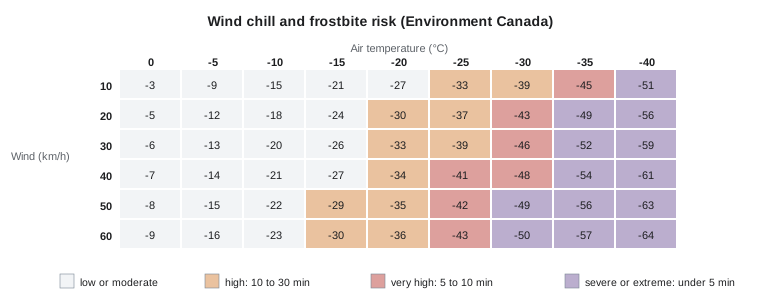
Wind chill describes how cold the combination of air temperature and wind feels on exposed skin, and how quickly exposed skin can freeze. The modern wind chill index was developed jointly by Canadian and US scientists and introduced by Environment Canada and the US National Weather Service in 2001. It is based on a model of heat loss from the human face at walking speed. In Celsius, using wind speed in kilometres per hour at a height of 10 metres, as weather stations report it, the formula is:
where W is the wind chill, T is air temperature in degrees Celsius and V is wind speed in kilometres per hour. Like humidex, wind chill is expressed without units in Canada but read as an equivalent temperature. The formula is used for air temperatures at or below 10 °C and wind speeds above about 5 km/h. The US version uses the same model in degrees Fahrenheit and miles per hour, with its own coefficients.
def wind_chill_c(t_c, v_kmh):
    if t_c > 10 or v_kmh < 4.8:
        return t_c
    f = v_kmh ** 0.16
    return 13.12 + 0.6215 * t_c - 11.37 * f + 0.3965 * t_c * f

def wind_chill_f(t_f, v_mph):
    if t_f > 50 or v_mph < 3:
        return t_f
    f = v_mph ** 0.16
    return 35.74 + 0.6215 * t_f - 35.75 * f + 0.4275 * t_f * f

def frostbite_risk(wc):          # Environment Canada risk bands for exposed skin
    if wc > -10:  return "low"
    if wc > -28:  return "moderate"
    if wc > -40:  return "high: skin can freeze in 10 to 30 min"
    if wc > -48:  return "very high: 5 to 10 min"
    if wc > -55:  return "severe: 2 to 5 min"
    return "extreme: under 2 min"

for t, v in [(-5, 20), (-15, 30), (-25, 20), (-30, 40), (-35, 50)]:
    wc = wind_chill_c(t, v)
    t_f, v_mph = t * 9 / 5 + 32, v / 1.609
    print(f"{t:4d} C, wind {v:2d} km/h -> wind chill {wc:6.1f} "
f"({wind_chill_f(t_f, v_mph):5.1f} F), risk: {frostbite_risk(wc)}")-5 C, wind 20 km/h -> wind chill -11.6 ( 11.2 F), risk: moderate -15 C, wind 30 km/h -> wind chill -26.0 (-14.8 F), risk: moderate -25 C, wind 20 km/h -> wind chill -36.8 (-34.2 F), risk: high: skin can freeze in 10 to 30 min -30 C, wind 40 km/h -> wind chill -47.5 (-53.4 F), risk: very high: 5 to 10 min -35 C, wind 50 km/h -> wind chill -55.8 (-68.4 F), risk: extreme: under 2 min
The output shows how much wind adds to the cold. At minus 15 °C with a 30 km/h wind, the wind chill is about minus 26, and at minus 30 °C with a 40 km/h wind it is about minus 47.5, a level at which exposed skin can freeze within 5 to 10 minutes. The Celsius and Fahrenheit versions of the formula give the same result once units are converted, as the Fahrenheit figures show.
What wind chill does and does not tell you
Wind chill is a measure of heat loss from exposed skin. It is excellent for judging frostbite risk to the face and other exposed areas, and for planning how much skin must be covered. It does not lower the temperature of objects below the air temperature: water will not freeze, and an engine will not cool below the actual air temperature, however strong the wind. It also does not directly measure the risk of hypothermia, which depends on clothing, wetness, activity and exposure time as well as temperature and wind.
Wind chill also understates exposure in some situations. Workers on moving equipment, such as snowmobiles, open-cab machines or the backs of trucks, experience the vehicle's speed as extra wind. Workers at height on towers, bridges and roofs often face stronger winds than ground-level weather stations report. Conversely, sheltered locations may be much less windy. Measuring wind at the work location, or adding vehicle speed, gives a better picture.
Environment and Climate Change Canada issues extreme cold warnings when temperature or wind chill is expected to reach regional thresholds, which vary across the country; in southern Ontario, for example, the threshold has been a temperature or wind chill of minus 30 or lower, while in parts of the North it is much lower. These public warnings are a useful trigger for workplace cold plans, but plans should take effect well before conditions reach warning levels.
Cold environments indoors
Indoor cold work, such as in freezers at minus 20 to minus 30 °C, coolers at around 0 to 4 °C, meat and fish processing plants and refrigerated warehouses, has its own features. There is usually little wind, but forced air from evaporator fans can create local drafts, and workers often move repeatedly between warm and cold areas, making it hard to dress correctly for both. Contact with cold product and metal racks is constant. Condensation and frost make floors slippery. Workers in cold storage may sweat during heavy order-picking and then chill when they slow down, so clothing systems must handle both.
Hand and foot protection is especially important indoors, because workers handle cold product for long periods. Rotation between cold and warm areas, regular warm-up breaks, insulated gloves with good grip, and anti-slip footwear are standard controls.
Wet cold and cold water
Cold water is dangerous in a way that cold air is not. Immersion in water below about 15 °C triggers a gasp reflex and rapid breathing, called cold shock, that can lead to inhaling water and drowning within the first minute or two. Within about 10 minutes, the muscles and nerves of the arms and legs cool enough that swimming and gripping become very difficult. Hypothermia takes longer, often 30 minutes to an hour or more depending on water temperature, body size and clothing. This sequence is sometimes taught as the 1-10-1 principle: about 1 minute to get breathing under control, about 10 minutes of meaningful movement to get out of the water or secure yourself, and up to about 1 hour before unconsciousness from hypothermia. Many cold water deaths are drownings from cold shock and loss of muscle control, not hypothermia.
This matters for work near water in any season, because water in lakes, rivers and the ocean is often below 15 °C even in summer. Personal flotation devices or life jackets keep a person's head above water during cold shock and loss of muscle control, which is why they are so important for work on or near water and on ice. Lesson 10 covers working on ice.
Worked problem
Calculating wind chill and choosing face protection
A survey crew will work on an open plain at minus 22 °C with a forecast wind of 35 km/h. Calculate the wind chill and decide what face and hand protection is needed.
Show solution
- V^0.16 = 35^0.16 ≈ 1.766.
- W = 13.12 + 0.6215 × (−22) − 11.37 × 1.766 + 0.3965 × (−22) × 1.766 ≈ 13.12 − 13.67 − 20.08 − 15.40 ≈ −36.
- A wind chill of about minus 36 is in the high-risk band: exposed skin can freeze in 10 to 30 minutes.
- Workers need full face covering, such as a balaclava and goggles, insulated mitts or gloves with liners, a windproof outer layer, a warm shelter or vehicle nearby and a buddy system to check each other's faces for frostbite.
Answer: Wind chill is about minus 36. Cover all skin, plan warm-up breaks and use buddies to watch for frostbite.
Worked problem
Accounting for vehicle speed
A worker rides on the back step of a slow-moving sanding truck at 20 km/h. The air is minus 18 °C with a 10 km/h wind blowing toward the truck's direction of travel. What wind chill does the worker experience on exposed skin?
Show solution
- The worker experiences the truck's speed plus the head wind: about 20 + 10 = 30 km/h of air movement.
- W = 13.12 + 0.6215 × (−18) − 11.37 × 30^0.16 + 0.3965 × (−18) × 30^0.16, with 30^0.16 ≈ 1.723.
- W ≈ 13.12 − 11.19 − 19.59 − 12.30 ≈ −30.
- The weather report's wind chill, using 10 km/h, would be about minus 25, understating the worker's exposure.
Answer: About minus 30, in the high-risk band. Riding positions should be enclosed, or exposure limited and skin fully covered.
Common mistakes
MistakeAssuming hypothermia only happens far below freezing.
InsteadWet, windy weather near freezing can cause hypothermia because wet clothing loses insulation.
MistakeUsing wind chill to predict whether water or equipment will freeze.
InsteadWind chill describes heat loss from skin; objects cannot cool below the air temperature.
MistakeUsing the weather station wind for workers on moving vehicles or at height.
InsteadAdd vehicle speed and account for stronger winds at height.
MistakeHandling cold metal tools or fuel with bare hands.
InsteadSkin can freeze quickly on metal below about minus 7 °C, and fuel causes rapid freezing; use gloves and insulated handles.
MistakeBelieving alcohol warms you in the cold.
InsteadAlcohol increases heat loss and impairs judgement.
Summary and key terms
- In the cold, convection, radiation, conduction and evaporation all remove heat from the body.
- Low temperature, wind, wetness and contact with cold surfaces or water drive cold stress.
- Cold reduces dexterity, grip, reaction time and judgement before it causes injury.
- Bare skin can freeze quickly on metal below about minus 7 °C.
- Wind chill combines temperature and wind to estimate heat loss and frostbite risk for exposed skin.
- Vehicle speed and height can make the effective wind much stronger than reported.
- Cold water causes cold shock and loss of muscle control within minutes; flotation is essential.
- Wind chill
- An index combining air temperature and wind speed to describe heat loss from exposed skin.
- Cold shock
- The gasp reflex and rapid breathing that occur on sudden immersion in cold water.
- 1-10-1 principle
- About 1 minute to control breathing, 10 minutes of useful movement and up to 1 hour before unconsciousness in cold water.
- Convective heat loss
- Heat carried away by moving air or water.
- Manual dexterity
- The ability to make fine, coordinated hand movements, which declines as hands cool.
- Contact cooling
- Heat loss through direct contact with cold surfaces such as metal or ground.
- Extreme cold warning
- An Environment and Climate Change Canada alert issued when temperature or wind chill reaches regional thresholds.
- Wet cold
- Cold conditions with rain, snow, spray or sweat that soak clothing and increase heat loss.
- Personal flotation device
- A buoyancy aid that keeps a person afloat in water.
- Cold storage
- Indoor refrigerated or frozen environments such as freezers and coolers.
Practice problems
Work each problem on paper first, then reveal the answer to check.
Name the four environmental factors that drive cold stress.
Show answer
Low air temperature, wind, wetness and contact with cold surfaces or water.
Why is wet clothing so dangerous in the cold?
Show answer
Water conducts heat much faster than air, and wet clothing loses much of its insulation.
Below roughly what hand skin temperature does dexterity decline noticeably?
Show answer
About 15 °C.
Why must workers avoid touching metal with bare skin below about minus 7 °C?
Show answer
Metal conducts heat away so quickly that skin can freeze, and wet skin can stick to it.
Calculate the wind chill at minus 10 °C with a 20 km/h wind.
Show answer
About minus 18 (V^0.16 ≈ 1.615; W ≈ 13.12 − 6.22 − 18.36 − 6.40).
What frostbite risk does a wind chill of minus 42 represent?
Show answer
Very high: exposed skin can freeze in 5 to 10 minutes.
Can wind chill make a parked vehicle's engine colder than the air temperature?
Show answer
No. Objects cannot cool below the air temperature; wind chill only describes heat loss from skin.
Why do workers on moving vehicles face a higher wind chill than reported?
Show answer
The vehicle's speed adds to the wind they experience.
Explain the 1-10-1 principle.
Show answer
About 1 minute to control breathing after cold shock, 10 minutes of meaningful movement and up to 1 hour before unconsciousness from hypothermia.
Why do cold storage workers often get chilled even with warm clothing?
Show answer
They sweat during heavy work and then cool when they slow down, and they move between warm and cold areas.
Lesson quiz · 5 questions
Score 60% or more to complete this lesson.
Create a free account to save your progress, take quizzes and earn a certificate.