
HSE-243 · Lesson 11 of 12 · 31 min
Emergency response for heat and cold
When prevention fails, what happens in the first minutes often decides whether a worker recovers fully, suffers lasting harm or dies. This lesson describes how to respond to heat and cold emergencies at an awareness level. Every workplace must have the first aid attendants, supplies and procedures required by its province or territory or by the Canada Labour Code, and workers who may need to respond should take recognized first aid and CPR training. What this lesson adds is the planning: making sure that the equipment, procedures and people needed for heat and cold emergencies are in place before they are needed.
Principles for every emergency
A few principles apply to every heat or cold emergency. First, make the scene safe: a worker who has collapsed on a roof, in a trench, in a confined space or beside traffic may need to be moved, but rescuers must not become casualties themselves. Second, call for help early: emergency services should be called at once for any suspected heat stroke, moderate or severe hypothermia, deep frostbite, cold water immersion, or anyone who is unconscious, confused, having trouble breathing or not improving. Third, start treatment on site while waiting: for heat stroke, that means cooling; for hypothermia, that means preventing further heat loss and handling gently. Fourth, never leave an affected worker alone.
Every site should know its exact location for emergency calls, how long an ambulance takes to arrive, and how to guide responders to the worker. Remote sites, where help may be an hour or more away, need more on-site capability: trained first aiders, cooling and rewarming equipment, communication devices that work without cell coverage, and a transport plan.
Heat stroke: cool first, transport second
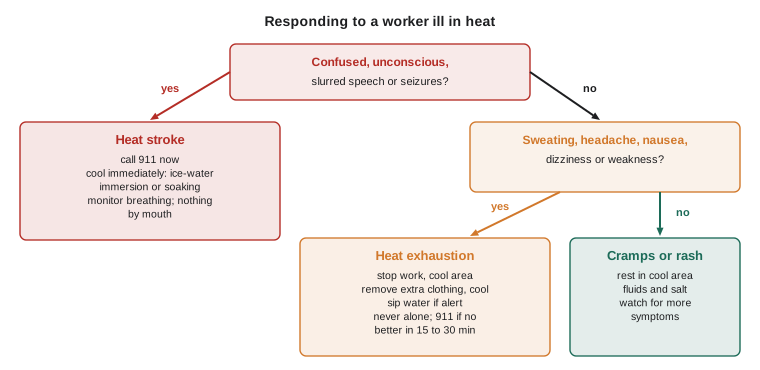
Heat stroke is the most time-critical thermal emergency. The extent of damage depends mostly on how long the core temperature stays above about 40 °C, so the priority is to cool the worker as quickly as possible, starting immediately, on site. Many sports medicine and military guidelines summarize this as cool first, transport second: when rapid cooling is available on site and medical help is present or on the way, cooling should not be delayed for transport. In a typical workplace, the practical approach is to call 911 immediately and cool aggressively while waiting for the ambulance, continuing cooling during transport if possible.
The most effective cooling method for exertional heat stroke is immersion of the body up to the neck in cold or iced water. Cold water immersion can lower core temperature at roughly 0.15 to 0.35 °C per minute, several times faster than other methods. Workplaces where heat stroke is a foreseeable risk, such as outdoor sites in hot weather, foundries and hazmat operations, can prepare for this with a large tub, a stock tank or a body cooling bag, or even a tarp held up at the edges and filled with water and ice, called the tarp-assisted cooling method. The worker's head must be kept above water and the person supported by at least two responders.
When immersion is not possible, use the next best methods together: move the worker to shade or an air-conditioned space, remove as much clothing and protective equipment as possible, soak the skin with cold water continuously while fanning vigorously, apply ice packs or cold wet towels to the neck, armpits and groin and, better still, cover as much of the body as possible with ice-water-soaked towels rotated every few minutes. A cold shower or hose can also be used. Ice packs on the neck, armpits and groin alone are much slower than immersion or whole-body soaking.
| Method | Approximate cooling rate | Notes |
|---|---|---|
| Cold or iced water immersion (neck down) | About 0.15 to 0.35 °C per minute | Fastest; needs a tub, tank, cooling bag or tarp and two or more helpers |
| Tarp-assisted cooling with ice water | Close to immersion | Practical field option; worker on a tarp, edges lifted, water and ice poured in |
| Rotating ice-water towels over the whole body | About 0.1 °C per minute | Good option when immersion is not possible |
| Water spray with vigorous fanning | About 0.05 to 0.1 °C per minute | Works best in dry air; keep the skin wet |
| Ice packs to neck, armpits and groin only | Below 0.05 °C per minute | Slow; use with other methods, not alone |
# Time to cool from 41.5 C to 39.0 C with different methods (approximate rates in C per minute)
start, target = 41.5, 39.0
methods = {
    "cold water immersion":         0.20,
    "rotating ice-water towels":    0.10,
    "spray and fan":                0.07,
    "ice packs at neck/armpit/groin": 0.03,
}
for m, rate in methods.items():
    minutes = (start - target) / rate
print(f"{m:32s} about {minutes:5.1f} minutes")cold water immersion about 12.5 minutes rotating ice-water towels about 25.0 minutes spray and fan about 35.7 minutes ice packs at neck/armpit/groin about 83.3 minutes
The difference is dramatic. Cold water immersion would bring the worker below 39 °C in roughly 12 minutes, while ice packs alone would take more than an hour, long after the window in which cooling is most protective. That is why workplaces with a foreseeable heat stroke risk should plan and stock for rapid whole-body cooling, not just a few ice packs in the first aid kit. Cooling is usually stopped at about 38.5 to 39 °C when a reliable temperature is available, to avoid overcooling, and medical personnel guide this; in the absence of a temperature reading, cooling continues until emergency responders take over or the worker clearly improves.
Do not give fluids by mouth to a worker who is confused, drowsy or vomiting, because they may choke. Do not give medications for fever such as acetaminophen or ibuprofen; they do not work for heat stroke and may harm the liver or kidneys. Watch breathing and be ready to place an unconscious worker in the recovery position and start CPR if they stop breathing normally.
Heat exhaustion and milder heat illness
For heat exhaustion, stop the work, move the worker to a cool place, loosen or remove heavy clothing and protective equipment, and cool them with cold water, wet cloths, fans and ice packs. If they are fully alert and not vomiting, give cool water or an electrolyte drink to sip. Have them lie down with legs raised if they feel faint. Stay with them and check them regularly. If they do not improve within 15 to 30 minutes, if they get worse, or if they become confused, treat as heat stroke and call 911.
For heat cramps, the worker should stop and rest in a cool place, drink water and eat a salty snack or drink an electrolyte drink, and gently stretch the affected muscle. For heat syncope, have the worker sit or lie down in a cool place and drink water slowly once fully alert; anyone who faints should be assessed, because fainting can also signal heat stroke or a heart problem. For heat rash, keep the skin cool and dry.
Workers who have had heat exhaustion or heat stroke should not return to work in heat that day, and workers who have had heat stroke need medical clearance and usually a gradual return with reacclimatization. Every heat illness should be reported and investigated so that the causes can be fixed.
Hypothermia
The response to hypothermia depends on its severity. For all stages, prevent further heat loss: get the person out of the wind, rain and cold, into a warm shelter or vehicle if possible, and insulate them from the ground. Remove wet clothing gently, cutting it off if necessary to avoid excessive movement, and replace it with dry clothing, blankets or a sleeping bag, covering the head and neck. A vapour barrier, such as a plastic sheet or emergency blanket, outside the insulation reduces evaporative and convective heat loss. A hypothermia wrap, sometimes called a burrito wrap, combines a ground pad, insulation and a vapour barrier.
For mild hypothermia, where the worker is shivering, alert and able to swallow, give warm, sweet drinks and high-energy food, which fuel shivering. Let the person rest in a warm place and rewarm gradually. Shivering is the body's own effective rewarming mechanism. The worker should not return to cold work that day and should be watched for worsening.
For moderate or severe hypothermia, where shivering has decreased or stopped, the person is confused, drowsy or unconscious, call 911 at once. Handle the person very gently and keep them horizontal, because a cold heart is prone to dangerous rhythms that rough movement can trigger. Do not let them walk or exercise. Do not give food or drink unless they are fully alert. Apply heat only to the trunk, such as warm packs or heating pads wrapped in cloth on the chest, armpits and back, never directly on skin, and never to the arms and legs, which can worsen afterdrop. Do not rub the limbs. Check breathing and pulse carefully for up to a minute, because they may be very slow and faint; if there are no signs of life, start CPR if trained and continue until help arrives. People with severe hypothermia have survived prolonged resuscitation, which is why responders say no one is dead until they are warm and dead.
Frostbite and other cold injuries
For frostbite, get the worker to a warm place, remove wet clothing and anything tight such as rings and watches, and protect the affected area. Do not rub frostbitten tissue, and never rub it with snow. Do not use direct high heat such as a heater, fire, heating pad or hot water bottle, because numb skin burns easily. Most importantly, do not thaw frozen tissue if there is any chance it will refreeze, for example if the worker must walk out through snow on frostbitten feet; refreezing causes much worse damage. If rewarming is appropriate, the recommended method is immersion in warm, not hot, water at about 37 to 39 °C until the skin becomes soft and colour returns, typically 15 to 30 minutes; this is painful, and medical care should follow. Do not break blisters. All but the most minor frostbite should be assessed by a health care provider.
Frostnip can be rewarmed by covering the area and holding it against warm skin, such as fingers in the armpits or a warm hand over a cheek, and it should recover fully. Trench foot is treated by gently drying and warming the feet, elevating them, and seeking medical care, as the injury can worsen after rewarming. Hypothermia takes priority over frostbite: treat the life-threatening condition first.
Cold water immersion
For a worker who has fallen into cold water, the priorities are to avoid becoming a second victim and to get the person out without delay. Reach or throw, do not go: use a pole, rope, ladder or throw bag from a secure position, and only trained rescuers with proper equipment should go onto ice or into the water. Once out, handle the person horizontally if possible, especially if they have been in the water for more than a few minutes, because blood pressure can drop dangerously when a person is lifted vertically after prolonged immersion. Treat for hypothermia and call 911. Anyone who has inhaled water, even if they seem fine, should be assessed because breathing problems can develop later.
Planning and equipment
Emergency response for thermal hazards depends on preparation. The heat and cold plans should identify who will respond, how they will be alerted, what equipment they will use and where it is kept, and how emergency services will be called and guided to the site. Practical items include:
| For heat | For cold |
|---|---|
| Cold water supply and ice in coolers on hot days | Heated shelter or vehicle close to the work |
| Tub, stock tank, cooling bag or large tarp for whole-body cooling | Blankets, sleeping bag, ground pad and vapour barrier for a hypothermia wrap |
| Towels and buckets for ice-water soaking; fans; shade | Dry spare clothing, socks, gloves and hats |
| Thermometer suitable for field use, where trained people can use it | Warm packs and heating pads for the trunk |
| Electrolyte drinks and water | Warm sweet drinks and high-energy food |
| Communication device and site location details | Throw rope, ice picks, flotation and communication device |
Drills help. A five-minute practice run of setting up a tarp for ice-water cooling, or of packaging a person in a hypothermia wrap, makes it far more likely that a crew will act quickly and correctly in a real emergency. After any thermal emergency, the incident should be investigated: what happened, why the prevention measures did not work, and what will change.
Worked problem
Responding to heat stroke at a remote site
On a pipeline right-of-way 45 minutes from the nearest hospital, a labourer collapses on a 33 °C afternoon. He is confused and combative, and his skin is hot and sweaty. The crew truck carries a cooler of ice water, a large tarp and a satellite phone. What should the crew do?
Show solution
- Call 911 or the site emergency number on the satellite phone, giving the location and saying heat stroke is suspected.
- Move him into shade and remove his outer clothing and protective equipment.
- Lay him on the tarp, have helpers lift the edges, and pour in the ice water to immerse as much of his body as possible, keeping his head up and supported.
- Keep cooling and monitoring his breathing while waiting for help, give nothing by mouth, and be ready for the recovery position or CPR.
Answer: Call for help immediately and start tarp-assisted ice-water cooling on site; do not wait for the ambulance to start cooling.
Worked problem
Responding to hypothermia and frostbite together
A worker is found after being stranded for three hours at minus 20 °C when his snowmobile broke down. He is drowsy, not shivering, slurring his words, and two fingers are hard and white. What should rescuers do?
Show solution
- Not shivering, drowsy and slurring suggests moderate hypothermia, which takes priority over frostbite.
- Call for emergency evacuation, handle him gently, keep him horizontal and do not let him walk.
- Protect him from wind and snow, insulate him from the ground, remove wet clothing gently and wrap him in dry insulation with a vapour barrier; apply heat only to the trunk.
- Protect the frozen fingers loosely without rubbing; do not thaw them in the field because refreezing during evacuation is likely.
Answer: Treat moderate hypothermia first with gentle handling, insulation and evacuation; protect the frostbitten fingers without thawing them.
Common mistakes
MistakeWaiting for the ambulance before starting to cool a worker with heat stroke.
InsteadCall 911 and start rapid cooling immediately; cool first, transport second.
MistakeUsing a few ice packs as the only cooling for heat stroke.
InsteadUse cold water immersion or whole-body ice-water soaking; ice packs alone are too slow.
MistakeGiving water to a confused or vomiting worker.
InsteadGive nothing by mouth unless the worker is fully alert and able to swallow.
MistakeRubbing the limbs of a hypothermic worker or warming the arms and legs first.
InsteadHandle gently, insulate and apply heat only to the trunk.
MistakeThawing frostbitten feet before a long walk out through snow.
InsteadDo not thaw tissue that may refreeze; protect it and evacuate.
Summary and key terms
- Call for help early, make the scene safe, start treatment on site and never leave the worker alone.
- Heat stroke needs immediate rapid cooling, ideally cold water immersion, while emergency services are on the way.
- Heat exhaustion is treated by stopping work, cooling and fluids if alert, calling 911 if not improving.
- Hypothermia response focuses on stopping heat loss, gentle handling, trunk rewarming and evacuation for moderate or severe cases.
- Frostbite is protected, not rubbed, and thawed in warm water only if refreezing can be prevented.
- Equipment, procedures and drills for heat and cold emergencies must be planned in advance.
- Cold water immersion
- Immersing a heat stroke victim up to the neck in cold or iced water for rapid cooling.
- Tarp-assisted cooling
- A field method in which a worker lies on a tarp held up at the edges and filled with ice water.
- Cool first, transport second
- The principle of starting rapid cooling on site rather than delaying it for transport.
- Recovery position
- A side-lying position that keeps the airway open in an unconscious person who is breathing.
- Hypothermia wrap
- A layered package of ground pad, insulation and vapour barrier to stop further heat loss.
- Vapour barrier
- A waterproof layer such as plastic sheeting that reduces evaporative and convective heat loss.
- Trunk rewarming
- Applying heat to the chest, back and armpits rather than to the limbs.
- Reach or throw, do not go
- The water rescue principle of helping from a safe position without entering the water.
- Refreezing injury
- Severe damage caused when thawed frostbitten tissue freezes again.
- Medical clearance
- Approval from a health care provider before returning to work after a serious illness.
Practice problems
Work each problem on paper first, then reveal the answer to check.
What are the four principles for responding to any thermal emergency?
Show answer
Make the scene safe, call for help early, start treatment on site and never leave the worker alone.
What is the most effective cooling method for exertional heat stroke?
Show answer
Immersion up to the neck in cold or iced water.
Describe tarp-assisted cooling.
Show answer
The worker lies on a tarp whose edges are lifted by helpers, and ice water is poured in to immerse the body, with the head supported.
At about 0.2 °C per minute, how long does it take to cool from 41 °C to 39 °C?
Show answer
About 10 minutes.
Why should a confused heat stroke victim not be given water?
Show answer
They may choke.
When should a worker with heat exhaustion be treated as heat stroke?
Show answer
If they become confused, get worse or do not improve within 15 to 30 minutes.
What should be given to a worker with mild hypothermia who is alert?
Show answer
Warm, sweet drinks and high-energy food, plus dry clothing and insulation.
Where should heat be applied in moderate or severe hypothermia?
Show answer
To the trunk only, wrapped in cloth, not directly on skin or on the limbs.
What water temperature is recommended for rewarming frostbite?
Show answer
About 37 to 39 °C, warm not hot.
Why should a person rescued from cold water after prolonged immersion be lifted horizontally?
Show answer
Lifting vertically can cause a dangerous drop in blood pressure.
Lesson quiz · 5 questions
Score 60% or more to complete this lesson.
Create a free account to save your progress, take quizzes and earn a certificate.