
HSE-243 · Lesson 6 of 12 · 30 min
Preventing heat stress: acclimatization, water, rest and shade
Most heat illness is preventable with measures that are simple, cheap and well understood. The core of every heat program can be summed up in four words: water, rest, shade and acclimatization. Add a written plan, trained supervisors and workers who look out for each other, and most serious heat illness disappears. This lesson covers those administrative and work-practice controls. Lesson 7 covers engineering controls, cooling equipment and special situations.
The hierarchy of controls still applies. Where it is practicable, engineering controls that reduce the heat at its source, such as insulating hot equipment, shading work areas or cooling enclosed spaces, should come first, because they do not depend on people remembering to do something. But for outdoor work in summer, much of the protection inevitably comes from how the work is organized, which is why these measures matter so much.
Acclimatization
Acclimatization is the set of physiological changes that happen when a person works in heat repeatedly over several days. The body starts sweating earlier and more heavily, sweat becomes less salty, blood plasma volume increases, heart rate during work in heat falls, and core temperature at a given workload is lower. An acclimatized worker can tolerate much more heat with much less strain than an unacclimatized one. Most of these changes develop within 7 to 14 days of daily exposure of at least an hour or two of work in heat.
Acclimatization is lost quickly. After a week or more away from heat work, through vacation, illness or a move to cooler duties, a significant part is lost, and after about three weeks most of it is gone. Workers returning from time off, and everyone in the first hot days of spring, need to be treated as not fully acclimatized. Cool weather followed by a sudden heat wave catches whole crews unprepared.
This is why so many heat deaths happen to new workers. Analyses of OSHA heat fatality investigations have found that a large share of deaths occurred in the worker's first few days on the job, and many on the first day. A gradual acclimatization schedule for every new and returning worker is one of the most important controls in any heat program.
Acclimatization schedules
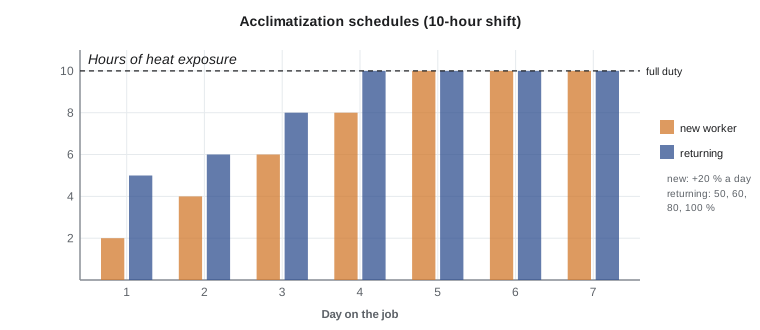
NIOSH recommends a simple schedule. Workers new to heat work should do no more than 20 per cent of the usual duration of heat exposure on the first day, increasing by no more than 20 per cent each day until they reach full duty. Workers who have previous experience with the job, such as those returning after time away, can start at 50 per cent on day one, 60 per cent on day two, 80 per cent on day three and full duty on day four. During acclimatization, workers should be watched more closely and should not work alone.
# NIOSH-style acclimatization schedules as hours of heat exposure in a 10-hour shift
shift = 10.0
new_worker = [min(1.0, 0.2 * d) for d in range(1, 8)]        # +20 % per day
experienced = [0.5, 0.6, 0.8, 1.0, 1.0, 1.0, 1.0]
print("day  new worker  experienced (returning)")
for d, (n, e) in enumerate(zip(new_worker, experienced), start=1):
print(f"{d:>3} {n * shift:5.1f} h {e * shift:5.1f} h")day new worker experienced (returning) 1 2.0 h 5.0 h 2 4.0 h 6.0 h 3 6.0 h 8.0 h 4 8.0 h 10.0 h 5 10.0 h 10.0 h 6 10.0 h 10.0 h 7 10.0 h 10.0 h
In practice, a new worker on a 10-hour shift does about 2 hours of heat work on day one, 4 hours on day two and so on, reaching full exposure on day five. The rest of the shift can be spent on cooler tasks, such as training, equipment maintenance in shade, or indoor work. Supervisors should plan these schedules when hiring, not after the first person falls ill.
Water
Workers in heat lose a great deal of water through sweat, often 0.5 to 1.5 litres an hour during heavy work, and sometimes more. Thirst lags behind need, so people who drink only when thirsty usually become progressively dehydrated during a hot shift. Losing even 2 per cent of body weight as water impairs physical and mental performance and increases heat strain; larger losses raise the risk of heat exhaustion and heat stroke.
The usual guidance for moderate activity in moderately hot conditions is to drink about one cup, roughly 250 millilitres or 8 ounces, every 15 to 20 minutes, which is about 0.75 to 1 litre an hour. Workers should start the shift well hydrated and keep drinking during breaks and after work. Very large intakes have their own risk: drinking more than about 1.5 litres an hour for several hours, especially of plain water without food, can dilute blood sodium dangerously, a condition called hyponatremia. NIOSH advises against drinking more than about 48 ounces, roughly 1.4 litres, an hour.
Water must be cool, clean and close. Workers will drink much more cool water than warm water, and they will not walk far to get it in the middle of a task. Put water stations where people work, not only in the site trailer. For long shifts with heavy sweating, typically more than two hours of continuous heavy sweating, electrolyte drinks or regular meals and snacks help replace salt. Energy drinks with high caffeine and sugar, and alcohol, are poor choices.
Checking hydration
Two simple methods help workers and supervisors check hydration. The first is urine colour: pale straw-coloured urine suggests good hydration, while dark yellow or amber urine suggests dehydration. Urine colour charts posted in washrooms are a common and effective prompt. The second is weighing before and after a shift. Each kilogram of weight lost during a shift is roughly one litre of fluid not replaced, and a loss of more than about 1.5 per cent of body weight suggests that the hydration plan is not keeping up.
# Sweat rate from body weight change and fluid intake (illustrative)
def sweat_rate(pre_kg, post_kg, drank_l, urine_l, hours):
    loss = (pre_kg - post_kg) + drank_l - urine_l      # 1 kg ~ 1 L
    return loss / hours, 100 * (pre_kg - post_kg) / pre_kg

rate, pct = sweat_rate(pre_kg=82.0, post_kg=80.6, drank_l=3.0, urine_l=0.4, hours=4)
print(f"Sweat rate about {rate:.2f} L per hour; body weight change {pct:.1f} %")
needed = rate * 0.8           # aim to replace most, not necessarily all, of the loss
print(f"Target intake about {needed:.2f} L per hour, in cups of 250 mL every 15 min: "
f"{needed / 4 * 1000:.0f} mL per cup")Sweat rate about 1.00 L per hour; body weight change 1.7 % Target intake about 0.80 L per hour, in cups of 250 mL every 15 min: 200 mL per cup
The example worker lost 1.4 kg despite drinking 3 litres over four hours, a sweat rate of about 1 litre an hour and a body weight loss of 1.7 per cent. That is more than the recommended maximum loss, so this worker should drink a little more and more regularly, and the employer should check that water is close enough to the work and that breaks are long enough to drink. Aiming to replace most of the loss, about 0.8 litres an hour here, keeps intake within safe limits.
Rest
Rest lets the body shed stored heat. When conditions exceed what workers can tolerate continuously, work must be broken up with rest periods, and the hotter the conditions and the heavier the work, the more rest is needed. Lesson 5 showed how the ACGIH screening criteria set the share of each hour that can be spent working. A work-rest cycle is only effective if the rest really allows recovery: rest should be taken in a cooler place, preferably shaded or air-conditioned, with water available and protective clothing loosened or removed if safe.
Rest breaks must be planned and enforced by supervisors, not left to individual choice. Workers often skip breaks to finish a task, keep up with a crew, avoid looking weak or because they are paid by the piece. A good rule is that breaks are mandatory at specified intervals once the heat plan is triggered, and that any worker may take additional rest at any time when they feel symptoms, without penalty. Self-pacing, letting workers slow down or stop when they need to, is protective, but it does not replace scheduled rest, because people under pressure or with early heat illness do not always judge their state accurately.
Shade
Shade is one of the most effective outdoor controls, because it removes direct solar radiation, the largest source of radiant heat outdoors. Lesson 4 showed that shade can lower WBGT by several degrees. Shade should be provided for rest breaks at a minimum, and over work areas where practicable, using tents, canopies, umbrellas, tarps on scaffolding, or scheduling work on the shaded side of a building. Shade structures must be large enough for everyone on break to sit in comfortably, close to the work, and open to air movement; a closed vehicle without air conditioning is not shade.
Scheduling
The heat load can be cut substantially by doing heavy work when it is cooler. Outdoor crews can start earlier in the morning, move the heaviest tasks to the early part of the shift, and save lighter work or indoor tasks for the hottest afternoon hours. On extreme days, it may be necessary to stop non-essential outdoor work entirely, or to split shifts. Indoors, hot processes such as furnace maintenance can be scheduled for cooler seasons or night shifts. Work can be rotated among crew members so that nobody spends too long on the hottest, heaviest task.
Monitoring workers: the buddy system
Because heat illness can affect judgement, workers are often the last to recognize it in themselves. A buddy system pairs workers so that each watches the other for signs such as confusion, stumbling, unusual irritability, heavy sweating that suddenly stops, or a flushed or pale face. Supervisors should check on workers regularly, more often in the hottest hours and for new workers. Workers who work alone in heat need a reliable check-in system, such as a phone call every hour, and a plan for what happens if they do not respond.
The heat stress plan
All of these measures work best as part of a written heat stress plan. A good plan defines who is responsible, how heat conditions will be monitored each day, the trigger levels that start each stage of the plan, the specific actions at each stage, the acclimatization procedure for new and returning workers, the water, rest and shade arrangements, how workers will be trained, and what to do in an emergency, including how to reach emergency services and how to cool a worker on site.
| Stage | Example trigger | Example actions |
|---|---|---|
| Awareness | Humidex 30 to 34, or forecast heat | Remind crews; check water and shade; identify new and returning workers |
| Caution | Humidex 35 to 39 | Water at work areas; mandatory breaks in shade, for example 15 minutes each hour; buddy system; supervisor checks |
| High | Humidex 40 to 44 | Longer breaks, for example 30 minutes each hour; reschedule heavy work; extra monitoring; consider stopping non-essential work |
| Extreme | Humidex 45 or more, or a heat warning with heavy work | Stop heavy and non-essential outdoor work; essential work only with strict controls and physiological monitoring |
Training
Workers and supervisors need training before the hot season and whenever new workers start. Training should cover the risk factors for heat illness, the signs and symptoms of each heat illness, the importance of acclimatization, water, rest and shade, how to recognize heat illness in co-workers, the heat stress plan and its trigger levels, and what to do in an emergency, including how to call for help and how to cool a worker. Supervisors need additional training on monitoring conditions, adjusting work and enforcing the plan. Training is more effective when it is short, practical, in the language the workers understand best, and repeated in tailgate talks during hot weather.
Worked problem
Planning acclimatization for a summer hire
A roofing company hires three students in June for 8-hour shifts on hot roofs. Two have never done heat work; one did the same job last summer but has been at school since September. How should their first week be scheduled?
Show solution
- The two new workers follow the 20 per cent rule: about 1.6 hours of roof work on day 1, 3.2 on day 2, 4.8 on day 3, 6.4 on day 4 and full duty on day 5.
- The returning worker has been away for months and has lost acclimatization, but has job experience, so can start at 50 per cent: 4 hours on day 1, 4.8 on day 2, 6.4 on day 3 and full duty on day 4.
- Remaining hours can be spent on ground-level tasks in shade, training and material handling in cooler areas.
- All three should be paired with experienced workers, and the supervisor should check on them more often, especially in the afternoon.
Answer: Schedule gradually increasing roof time for all three, faster for the returning worker, with close supervision and a buddy for each.
Worked problem
Fixing a hydration problem
At a vegetable farm, workers are weighed before and after a hot shift. Several have lost 2 to 3 per cent of body weight. Water is available in the packing shed, about 400 metres from the field. What should change?
Show solution
- Losses above about 1.5 to 2 per cent of body weight show that fluid intake is not keeping up.
- Water 400 metres away means workers will not walk to it during tasks, especially if paid by the piece.
- Move cool water to the field, close to the workers, and provide cups or bottles.
- Schedule paid water and rest breaks in shade, and remind workers to drink a cup every 15 to 20 minutes.
Answer: Bring cool water to the field, schedule paid breaks in shade, and recheck body weight changes to confirm the fix works.
Common mistakes
MistakePutting new workers on full heat duty from the first day.
InsteadUse a gradual acclimatization schedule; many heat deaths occur in the first days on the job.
MistakeTelling workers to drink when they are thirsty.
InsteadThirst lags behind need; drink about a cup every 15 to 20 minutes in heat.
MistakeEncouraging unlimited water intake.
InsteadDo not exceed about 1.5 L per hour; use electrolytes or food for long, heavy-sweating shifts.
MistakeKeeping water only in the site office or trailer.
InsteadProvide cool water close to where people work.
MistakeLeaving breaks to each worker's judgement.
InsteadSchedule and enforce breaks when the plan is triggered, and allow extra rest whenever symptoms appear.
Summary and key terms
- Water, rest, shade and acclimatization are the foundation of heat illness prevention.
- Acclimatization takes about 7 to 14 days and is largely lost after a few weeks away.
- New workers should start at no more than 20 per cent of full heat exposure, increasing 20 per cent a day.
- Drink about a cup of cool water every 15 to 20 minutes, without exceeding about 1.5 L per hour.
- Urine colour and weight change before and after a shift are simple hydration checks.
- Rest breaks must be in a cooler, shaded place, planned and enforced by supervisors.
- A written, staged heat plan with training ties the controls together.
- Acclimatization
- Physiological adaptation to heat that develops over 7 to 14 days of repeated exposure.
- Acclimatization schedule
- A plan that gradually increases a worker's heat exposure over the first days of work.
- Dehydration
- A deficit of body water, which increases heat strain and impairs performance.
- Hyponatremia
- Dangerously low blood sodium, which can result from drinking very large volumes of plain water.
- Electrolytes
- Salts such as sodium and potassium lost in sweat.
- Work-rest cycle
- Planned periods of work and rest within each hour.
- Self-pacing
- Letting workers adjust their own pace or take extra rest as needed.
- Buddy system
- Pairing workers so that each watches the other for signs of heat illness.
- Heat stress plan
- A written plan setting out monitoring, triggers, controls, training and emergency response for heat.
- Trigger level
- A heat index value or condition that starts a specific stage of a heat stress plan.
Practice problems
Work each problem on paper first, then reveal the answer to check.
Name the four core heat prevention measures.
Show answer
Water, rest, shade and acclimatization.
How long does acclimatization take to develop, and how quickly is it lost?
Show answer
About 7 to 14 days to develop; much is lost after a week away and most after about three weeks.
Describe the NIOSH schedule for a new worker.
Show answer
No more than 20 per cent of usual heat exposure on day one, increasing by no more than 20 per cent a day.
How much water should a worker drink in heat, and what is the upper limit?
Show answer
About a cup (250 mL) every 15 to 20 minutes; no more than about 1.5 L per hour.
A worker weighs 75.0 kg before and 73.8 kg after a shift. What percentage of body weight was lost?
Show answer
1.6 per cent, slightly above the recommended maximum, so intake should increase.
What does dark yellow urine suggest?
Show answer
Dehydration.
Why should breaks be scheduled rather than left to workers?
Show answer
Workers often skip breaks under pressure, and heat illness can impair their judgement.
Give three ways to provide shade for outdoor work.
Show answer
Any three of tents, canopies, umbrellas, tarps on scaffolding or working on the shaded side of a structure.
List four elements of a written heat stress plan.
Show answer
Any four of responsibilities, monitoring, trigger levels, actions at each stage, acclimatization, water, rest and shade, training and emergency procedures.
How should a worker who works alone in heat be protected?
Show answer
With a reliable regular check-in, such as an hourly call, and a plan if they do not respond.
Lesson quiz · 5 questions
Score 60% or more to complete this lesson.
Create a free account to save your progress, take quizzes and earn a certificate.