
HSE-243 · Lesson 3 of 12 · 31 min
Heat illnesses
Heat-related illness is not one condition but a range, from a nuisance rash to a medical emergency that kills within hours. The milder conditions are common and treatable, but they are also warnings: a worker with heat cramps or heat exhaustion is telling the supervisor that the heat stress on that crew is too high. Heat stroke, at the far end, is a true emergency in which minutes matter. This lesson describes each condition, how to recognize it and why it happens. Lesson 11 covers what to do about it.
The heat illness continuum
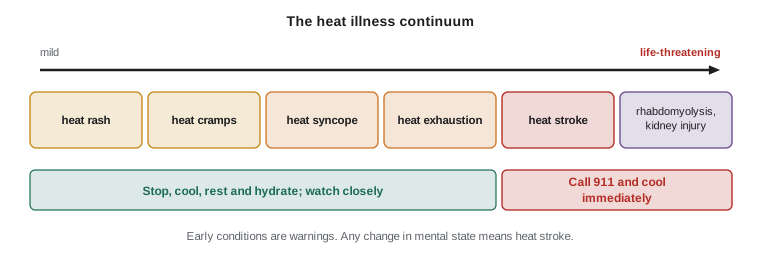
It helps to picture heat illnesses along a line of increasing severity. At the mild end are heat rash and heat cramps. In the middle are heat syncope (fainting) and heat exhaustion. At the severe end are heat stroke and the complications that can follow it, including rhabdomyolysis and acute kidney injury. Workers do not always move neatly from one end to the other. A worker can go from feeling fine to heat stroke in less than an hour during very heavy work in hot conditions, especially in protective clothing. But in most cases there are earlier signs, and a crew trained to recognize them can stop the progression.
Heat rash
Heat rash, sometimes called prickly heat or miliaria, is caused by blocked sweat ducts. Sweat trapped under the skin produces clusters of small red bumps or blisters that itch or prickle, usually where clothing is tight or skin folds rub, such as the neck, chest, groin, under the breasts and in the elbow creases. Heat rash is not dangerous in itself, but it is uncomfortable, it can become infected, and widespread heat rash reduces the skin's ability to sweat, which increases the risk of more serious heat illness.
Heat rash is prevented by keeping skin as cool and dry as possible: loose, breathable clothing, rest breaks in cooler areas, showering after work and changing out of sweat-soaked clothing. Treatment is mostly the same: cool the skin, keep the area dry and avoid heavy creams that block pores further.
Heat cramps
Heat cramps are painful, involuntary muscle spasms, usually in the legs, arms or abdomen, that occur during or after heavy work in heat. They are thought to result from a combination of muscle fatigue and loss of salt and water through heavy sweating. Workers who sweat heavily and drink large amounts of plain water without eating may be more prone to them. Cramps can come on hours after work, even at night.
Heat cramps are a warning sign that the worker has been sweating heavily and may be short of fluid and salt. The worker should stop the activity, rest in a cool place, drink water and eat a snack, or drink an electrolyte drink, and not return to strenuous work for a while. Cramps that last more than about an hour, or occur in a worker with heart problems or on a low-sodium diet, need medical advice. Cramps accompanied by other symptoms, such as nausea, dizziness or confusion, may signal heat exhaustion or heat stroke rather than simple cramps.
Heat syncope
Heat syncope is fainting or near-fainting caused by heat. In heat, blood vessels in the skin widen, and when a worker stands still for a long time, or stands up suddenly after sitting or lying down, blood pools in the legs and not enough reaches the brain. The worker feels light-headed, dizzy or weak, and may faint briefly. Heat syncope is most common in workers who are not acclimatized, who are dehydrated, or who stand for long periods, such as flaggers and traffic control workers, security staff or workers on an assembly line.
A fainting episode is dangerous at work because of what the worker might fall into or from: off a ladder or scaffold, into traffic or onto machinery. The worker should sit or lie down in a cool place, with legs raised if lying down, and drink water slowly once fully alert. Fainting can also be a sign of heat stroke or of a heart problem, so a worker who faints should be assessed, especially if they do not recover quickly, are confused, or have chest pain.
Heat exhaustion
Heat exhaustion is the body's circulation failing to keep up with the combined demands of working muscles, skin cooling and fluid loss. It is the most common serious heat illness at work. The worker may have heavy sweating, pale or flushed and clammy skin, headache, dizziness, nausea or vomiting, weakness, thirst, irritability, fast heart rate and a core temperature that is raised but usually below 40 °C. They may feel they cannot continue. Importantly, they are still mentally clear: they answer questions sensibly and know where they are.
Heat exhaustion is serious and must be treated at once, because it can progress to heat stroke. The worker must stop work, be moved to a cool, shaded or air-conditioned place, have excess clothing and protective equipment removed, and be cooled with water, wet cloths, fans and ice packs. If alert and not vomiting, they should sip cool water or an electrolyte drink. They must not be left alone. If symptoms do not improve within about 15 to 30 minutes, if they get worse, or if the worker becomes confused, emergency services should be called because heat stroke must be assumed.
Workers with heat exhaustion should not return to work that day. Some programs require a medical clearance before return; even when they do not, the worker and supervisor should review why it happened and change the conditions, the work plan or the worker's acclimatization before the next shift.
Heat stroke
Heat stroke is a life-threatening failure of the body's temperature control. Core temperature rises to about 40 °C or higher, and the brain is affected. The key sign is a change in mental state: confusion, slurred speech, strange or aggressive behaviour, poor coordination, seizures or loss of consciousness. The skin may be hot and dry, but in exertional heat stroke, the kind most common in workers, the skin is often still wet with sweat. Do not wait for dry skin before suspecting heat stroke.
Heat stroke damages the brain, liver, kidneys, muscles and blood clotting system, and it kills. The risk of death and permanent damage depends mostly on how long the core temperature stays high. Rapid cooling within the first 30 minutes greatly improves survival; evidence from athletes and military recruits with exertional heat stroke shows that people cooled quickly by immersion in cold water almost always survive. Heat stroke is a 911 emergency, and cooling must start on site while waiting for help, as lesson 11 describes.
There are two types. Classic heat stroke develops over days in people who are older, ill or unable to cool themselves during a heat wave, often at home. Exertional heat stroke develops over minutes to hours during hard physical work or exercise in heat, often in young, fit people who push on. It is the type most supervisors will encounter, and it can happen even at moderate temperatures in workers doing heavy work in protective clothing.
| Feature | Heat exhaustion | Heat stroke |
|---|---|---|
| Mental state | Clear, though tired, irritable or anxious | Confused, slurred speech, odd behaviour, seizures or unconscious |
| Core temperature | Raised, usually below 40 °C | About 40 °C or higher |
| Skin | Sweaty, pale or flushed, clammy | Hot; may be dry or still sweaty in exertional heat stroke |
| Other signs | Headache, nausea, dizziness, weakness, thirst | Collapse, vomiting, rapid breathing, rapid pulse |
| Response | Stop work, cool, hydrate, observe; call 911 if not improving | Call 911, cool aggressively at once, do not give fluids if not alert |
Rhabdomyolysis and kidney injury
Rhabdomyolysis is the breakdown of muscle tissue, which releases muscle proteins, including myoglobin, and potassium into the blood. It can follow heavy exertion in heat, especially in workers who are not acclimatized or are new to a task, and it often accompanies heat stroke. Symptoms include muscle pain, cramping, swelling and weakness out of proportion to the work done, and dark, tea- or cola-coloured urine. Rhabdomyolysis can cause acute kidney injury and dangerous heart rhythm problems. It needs medical assessment the same day; a worker reporting dark urine with muscle pain after hard work in heat should be sent for medical care.
Repeated heat exposure with chronic dehydration may also harm the kidneys over the long term. Researchers have documented clusters of chronic kidney disease of unknown cause among agricultural and other outdoor workers in hot regions, and while the causes are debated, repeated heat stress and dehydration are among the leading hypotheses. Consistent hydration and rest are prudent for long-term kidney health as well as for preventing acute illness.
Heat and other injuries
Heat affects more than the body's temperature. It slows reaction time, reduces vigilance and concentration, makes hands sweaty and grip less secure, fogs safety glasses and respirator lenses, and makes people irritable. Workers in heat also tend to remove or loosen protective equipment to feel cooler. Studies linking temperature data to compensation claims have found that the risk of injuries of all kinds, from falls to machine contact, rises on hot days. Heat also worsens the effects of air pollution, and smoke from wildfires often arrives with heat waves, adding a respiratory hazard (respiratory protection is covered in HSE-240).
# Classify a worker's presentation using simple rules (illustrative screening, not diagnosis)
def classify(confused, temp_c, cramps, fainted, symptoms):
    if confused or (temp_c is not None and temp_c >= 40.0):
        return "suspect HEAT STROKE: call 911, cool immediately"
    if symptoms >= 2 or (temp_c is not None and temp_c >= 38.5):
        return "suspect heat exhaustion: stop, cool, hydrate, observe"
    if fainted:
        return "heat syncope: lie down, cool, assess for other causes"
    if cramps:
        return "heat cramps: rest, fluids with salt, watch for more symptoms"
    return "no heat illness signs: continue with planned breaks"

workers = [
    ("A", False, None, True,  False, 0),
    ("B", False, 38.9, False, False, 3),
    ("C", True,  39.4, False, False, 2),   # confusion overrides temperature
    ("D", False, None, False, True,  0),
]
for name, *args in workers:
print(name, "->", classify(*args))A -> heat cramps: rest, fluids with salt, watch for more symptoms B -> suspect heat exhaustion: stop, cool, hydrate, observe C -> suspect HEAT STROKE: call 911, cool immediately D -> heat syncope: lie down, cool, assess for other causes
The script is a teaching aid, not a diagnostic tool, but it shows the logic that every worker and supervisor should carry in their head. Confusion or any change in mental state comes first and overrides everything else, including a temperature reading that seems only moderately high. Worker C has a measured temperature below 40 °C but is confused, and must be treated as heat stroke. Temperature measured at the mouth, ear or forehead is often lower than true core temperature during heat illness, so a normal-looking reading never rules out heat stroke.
Who is most at risk
Anyone can develop heat illness, but some groups are at higher risk. New workers and those returning after a week or more away are the classic group: a large share of heat deaths at work happen in the first few days on the job, before the worker has acclimatized. Workers doing heavy work, wearing heavy or impermeable clothing, working in direct sun or near radiant sources, and those who cannot take breaks when they need to, such as piece-rate workers or workers paced by machines, are also at higher risk.
Personal factors add to the risk: older age, poor fitness, obesity, a previous episode of heat illness, heart disease, diabetes, kidney disease, recent fever or gastrointestinal illness, pregnancy, alcohol use in the previous day, lack of sleep, and many medications. None of these means a person cannot work in heat, but they mean the person may need more protection, more gradual acclimatization or closer monitoring.
Worked problem
Spotting heat stroke in a sweating worker
On a 31 °C afternoon, a roofer who has been carrying shingles starts dropping tools and gives a confused answer when asked what day it is. His shirt is soaked with sweat. A co-worker says he cannot have heat stroke because he is still sweating. What should happen?
Show solution
- Confusion is the key sign of heat stroke, regardless of sweating.
- In exertional heat stroke, the skin is often still wet with sweat.
- The crew should call 911 and get him safely off the roof and into shade.
- Cooling must start at once, ideally by immersion in cold water or by soaking with water and fanning with ice packs, while waiting for help.
Answer: Treat as heat stroke: call 911, move him safely, and start rapid cooling immediately. Sweating does not rule out heat stroke.
Worked problem
Reading a near miss
Over two days in the first week of June, three new workers on a landscaping crew report headache, nausea and dizziness in the afternoon, and one faints. The crew lead says they are just not used to the work. What does this pattern tell the employer?
Show solution
- Several workers with symptoms of heat exhaustion and one with heat syncope are warning signs that the heat stress is too high for this crew.
- They are new workers early in the season, so they are probably not acclimatized.
- The employer should introduce a gradual acclimatization schedule for new workers, more frequent breaks in shade, and water and electrolytes close by.
- The heaviest work should be moved to the morning, and a buddy system should watch for symptoms.
Answer: The cluster of mild heat illnesses is a warning of a likely serious case. The employer must change the work plan and acclimatization now, not wait for a heat stroke.
Common mistakes
MistakeWaiting for dry skin before suspecting heat stroke.
InsteadIn exertional heat stroke the skin is often still sweaty; confusion is the key sign.
MistakeSending a worker with heat exhaustion back to work after a short rest.
InsteadWorkers with heat exhaustion should not return to strenuous heat work that day.
MistakeTrusting a mouth or forehead temperature to rule out heat stroke.
InsteadThese readings often underestimate core temperature; any confusion means heat stroke until proven otherwise.
MistakeIgnoring dark urine and muscle pain after hard work in heat.
InsteadThese can signal rhabdomyolysis and need same-day medical assessment.
MistakeTreating repeated mild heat illness on a crew as normal toughening up.
InsteadClusters of mild illness show heat stress is too high and the work plan must change.
Summary and key terms
- Heat illnesses range from heat rash and cramps to heat syncope, heat exhaustion and heat stroke.
- Mild heat illnesses are warnings that the heat stress on a crew is too high.
- Heat exhaustion causes heavy sweating, headache, nausea and weakness, with a clear mind.
- Heat stroke causes confusion or other changes in mental state and a core temperature of about 40 °C or more.
- Exertional heat stroke often occurs with sweaty skin and must be treated with immediate cooling and a 911 call.
- Rhabdomyolysis, with muscle pain and dark urine, can cause kidney injury and needs medical care.
- New and returning workers, heavy work, protective clothing and many personal factors increase risk.
- Heat rash
- Itchy red bumps caused by blocked sweat ducts.
- Heat cramps
- Painful muscle spasms during or after heavy sweating in heat.
- Heat syncope
- Fainting or light-headedness caused by blood pooling in the legs in heat.
- Heat exhaustion
- A serious heat illness with heavy sweating, weakness, headache and nausea, but a clear mind.
- Heat stroke
- A life-threatening heat illness with core temperature about 40 °C or higher and altered mental state.
- Exertional heat stroke
- Heat stroke that develops during physical work or exercise, often with sweaty skin.
- Classic heat stroke
- Heat stroke that develops over days during heat waves, usually in older or ill people at rest.
- Rhabdomyolysis
- Breakdown of muscle tissue that releases myoglobin and potassium into the blood.
- Acute kidney injury
- A sudden loss of kidney function that can follow heat stroke or rhabdomyolysis.
- Altered mental state
- Confusion, disorientation, slurred speech, odd behaviour or reduced consciousness.
Practice problems
Work each problem on paper first, then reveal the answer to check.
List the heat illnesses from mildest to most severe.
Show answer
Heat rash, heat cramps, heat syncope, heat exhaustion, heat stroke (with complications such as rhabdomyolysis and kidney injury).
What is the single most important sign that separates heat stroke from heat exhaustion?
Show answer
A change in mental state, such as confusion or slurred speech.
Why does heat syncope occur?
Show answer
Blood pools in the widened vessels of the legs, reducing blood flow to the brain, especially when standing still.
Why is a worker who faints at work in heat in danger even if heat syncope is mild?
Show answer
They may fall from height, into traffic or onto machinery, and fainting may signal heat stroke or a heart problem.
What should happen if a worker with heat exhaustion does not improve within 15 to 30 minutes?
Show answer
Call emergency services and treat as possible heat stroke.
Can a person with heat stroke still be sweating?
Show answer
Yes, especially in exertional heat stroke.
What two symptoms together suggest rhabdomyolysis?
Show answer
Muscle pain or weakness out of proportion to the work, and dark tea- or cola-coloured urine.
Why are new workers at particular risk of heat illness?
Show answer
They have not acclimatized, and many heat deaths occur in the first few days on the job.
Give three personal factors that increase heat illness risk.
Show answer
Any three of older age, poor fitness, obesity, previous heat illness, heart or kidney disease, diabetes, recent illness, pregnancy, alcohol, lack of sleep or medications.
How does heat increase the risk of non-heat injuries?
Show answer
It slows reactions, reduces concentration and grip, fogs eyewear and leads workers to remove protective equipment.
Lesson quiz · 5 questions
Score 60% or more to complete this lesson.
Create a free account to save your progress, take quizzes and earn a certificate.