
HSE-243 · Lesson 5 of 12 · 28 min
Heat stress law and limits
Heat stress law in Canada is a patchwork. Each province and territory regulates most workplaces within its borders, and the federal government regulates federally regulated industries such as interprovincial transport, banking, telecommunications, ports and the federal public service under the Canada Labour Code. Some jurisdictions have specific heat stress rules with numerical limits; others rely on the general duty to protect workers plus guidance documents. Almost all of them point, directly or indirectly, to the same technical standard: the American Conference of Governmental Industrial Hygienists (ACGIH) threshold limit values for heat stress and strain. This lesson explains that standard and how the main jurisdictions use it. It describes the law as of October 2026; check current requirements before relying on any detail.
The ACGIH heat stress TLVs
The ACGIH publishes threshold limit values, or TLVs, for heat stress as part of its annual TLV booklet. The heat stress TLV is designed so that nearly all acclimatized, adequately hydrated, unmedicated, healthy workers can be repeatedly exposed without adverse health effects, with core temperature kept at or below about 38 °C. Alongside the TLV, the ACGIH sets a lower action limit intended to protect workers who are not acclimatized; when conditions exceed the action limit, a heat stress management program is expected.
The TLV and action limit are expressed as WBGT values in degrees Celsius that depend on two things: the metabolic rate of the work, from light to very heavy, and the proportion of each hour spent working rather than resting. The heavier the work and the larger the share of each hour spent working, the lower the allowable WBGT. The WBGT is first adjusted for clothing, as described below.
| Work in each hour | Light | Moderate | Heavy | Very heavy |
|---|---|---|---|---|
| 75 to 100 % | 31.0 (28.0) | 28.0 (25.0) | not given | not given |
| 50 to 75 % | 31.0 (28.5) | 29.0 (26.0) | 27.5 (24.0) | not given |
| 25 to 50 % | 32.0 (29.5) | 30.0 (27.0) | 29.0 (25.5) | 28.0 (24.5) |
| 0 to 25 % | 32.5 (30.0) | 31.5 (29.0) | 30.5 (28.0) | 30.0 (27.0) |
The screening criteria are a first step. ACGIH notes that if the adjusted WBGT exceeds the criteria, or if workers wear clothing that is not covered by the adjustment factors, a more detailed analysis or physiological monitoring of heat strain is needed. Conversely, meeting the criteria does not guarantee that every worker is safe; individuals vary, and workers should still be watched for symptoms.
Clothing adjustment factors
Clothing affects heat stress because it blocks evaporation and adds insulation. ACGIH provides clothing adjustment values, in degrees Celsius WBGT, that are added to the measured WBGT before comparing it with the criteria. Ordinary work clothes, such as a long-sleeved shirt and pants, and cloth coveralls have an adjustment of zero. Double-layer woven clothing adds about 3 °C. Limited-use, vapour-barrier coveralls add about 11 °C, which is why workers in impermeable suits may be at risk even in mild conditions; for such clothing, ACGIH says the screening criteria should not be used and physiological monitoring is needed instead. A hood adds about 1 °C to the value for the garment.
| Clothing type | Adjustment (°C WBGT) |
|---|---|
| Work clothes (long sleeves and pants) | 0 |
| Cloth (woven material) coveralls | 0 |
| Double-layer woven clothing | 3 |
| SMS polypropylene coveralls | 0.5 |
| Polyolefin coveralls | 1 |
| Limited-use vapour-barrier coveralls | 11 (use physiological monitoring instead) |
| Hood worn with any of the above | add 1 |
# Find the work-rest band allowed by illustrative ACGIH-style screening criteria
TLV = {   # work fraction band -> {metabolic class: WBGT limit}, acclimatized
    "75-100%": {"light": 31.0, "moderate": 28.0, "heavy": None, "very heavy": None},
    "50-75%":  {"light": 31.0, "moderate": 29.0, "heavy": 27.5, "very heavy": None},
    "25-50%":  {"light": 32.0, "moderate": 30.0, "heavy": 29.0, "very heavy": 28.0},
    "0-25%":   {"light": 32.5, "moderate": 31.5, "heavy": 30.5, "very heavy": 30.0},
}
CAF = {"work clothes": 0.0, "double-layer woven": 3.0, "polyolefin coveralls": 1.0}

def allowed(wbgt, work, clothing, hood=False):
    eff = wbgt + CAF[clothing] + (1.0 if hood else 0.0)
    for band, limits in TLV.items():          # from most work to least
        lim = limits[work]
        if lim is not None and eff <= lim:
            return eff, band
    return eff, "exceeds screening criteria: monitor physiologically"

for wbgt, work, cloth, hood in [(27.0, "moderate", "work clothes", False),
                                (27.0, "heavy", "work clothes", False),
                                (27.0, "moderate", "double-layer woven", False),
                                (29.5, "heavy", "polyolefin coveralls", True)]:
    eff, band = allowed(wbgt, work, cloth, hood)
print(f"WBGT {wbgt}, {work:8s}, {cloth:20s} hood={hood!s:5s} -> adjusted {eff:4.1f}: {band}")WBGT 27.0, moderate, work clothes hood=False -> adjusted 27.0: 75-100% WBGT 27.0, heavy , work clothes hood=False -> adjusted 27.0: 50-75% WBGT 27.0, moderate, double-layer woven hood=False -> adjusted 30.0: 25-50% WBGT 29.5, heavy , polyolefin coveralls hood=True -> adjusted 31.5: exceeds screening criteria: monitor physiologically
In the first case, moderate work in ordinary clothes at a WBGT of 27 °C is within the criteria for continuous work. Making the same work heavy drops the allowance to 50 to 75 per cent work in each hour. Adding double-layer clothing to moderate work pushes the adjusted WBGT to 30 °C and limits work to 25 to 50 per cent of each hour. In the last case, heavy work in coveralls with a hood at 29.5 °C exceeds the screening criteria entirely, so the employer must reduce the heat stress, change the clothing or the work, or monitor workers physiologically.
How the law uses these limits
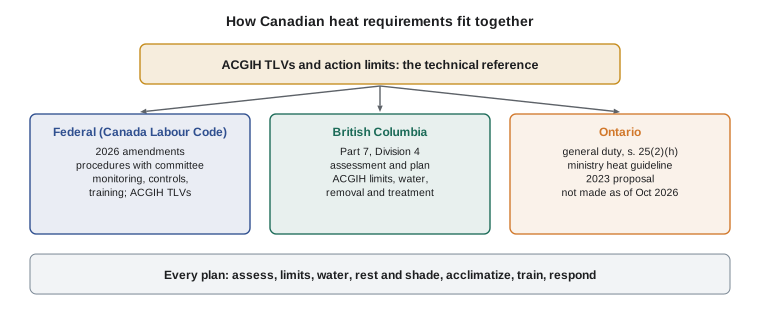
Federal: the Canada Labour Code
Under the Canada Labour Code, Part II, and the Canada Occupational Health and Safety Regulations, federally regulated employers must assess and control thermal hazards. Amendments made under the Code in 2026 (SOR/2026-10) updated references to external standards, including those of the ACGIH, so that the current versions apply, and strengthened thermal stress requirements: employers must develop workplace-specific procedures to mitigate heat stress, in consultation with the workplace health and safety committee or representative, covering environmental monitoring, protective equipment, administrative controls such as work-rest cycles, and training on symptoms and response. Federal guidance tells employers to use the ACGIH TLVs for heat and cold and tools such as humidex and wind chill, and to protect indoor workers whenever exposures exceed the TLVs, not only during declared heat waves.
Ontario
Ontario has no heat-specific regulation. Employers must take every precaution reasonable in the circumstances for the protection of workers under section 25(2)(h) of the Occupational Health and Safety Act, and supervisors have a matching duty under section 27(2)(c). The Ministry of Labour's heat stress guideline recommends a heat stress program and refers to the ACGIH TLVs and to humidex-based plans, and inspectors use this guidance when assessing whether an employer took reasonable precautions. In 2023 the ministry consulted on a stand-alone heat stress regulation that would have adopted ACGIH-based exposure limits, required written measures and procedures developed with the joint health and safety committee, cool drinking water near work areas, training and notice of Environment and Climate Change Canada heat warnings to outdoor workers. That regulation had not been made as of October 2026. Opposition private member's bills, the Heat Stress Act, 2024 (Bill 222) and the Heat Stress Act, 2025 (Bill 36), proposed a worker heat protection standard but had not passed.
British Columbia
British Columbia has the most detailed heat rules among the provinces, in Division 4 of Part 7 of the Occupational Health and Safety Regulation. They apply where workers may be exposed to heat stress, including where core body temperature could exceed 38 °C or conditions exceed the ACGIH screening criteria for unacclimatized workers. The employer must conduct a heat stress assessment and develop and implement a heat stress exposure control plan (section 7.29); keep exposures within the ACGIH screening criteria, with clothing corrections (section 7.28); use engineering controls first, then administrative controls such as acceptable work-rest cycles or effective personal protective equipment (section 7.30); provide an adequate supply of cool potable water close to the work area (section 7.31); and remove workers showing signs of heat stress and have them treated (section 7.32).
Other provinces
Other jurisdictions vary. Some, such as Manitoba, Saskatchewan and Quebec, have regulatory provisions on heat or thermal conditions, and the CNESST in Quebec publishes a humidex-based tool for planning work in heat. Others, such as Alberta, rely on the general requirements to assess hazards and control them, supported by government guidance that refers to ACGIH limits. Wherever you work, the practical expectation is the same: assess heat hazards, follow recognized limits, put a written plan in place for hot conditions, provide water, rest and shade, acclimatize workers, train them and respond to symptoms.
Duties of employers, supervisors and workers
Whatever the specific rules, the general duties are clear. Employers must identify heat hazards, assess them using recognized methods, put controls and a written plan in place, provide water, rest areas and suitable clothing and equipment, acclimatize new and returning workers, train workers and supervisors, and respond to heat illness. Supervisors must know the plan, watch workers for symptoms, enforce breaks, adjust work when conditions change and act immediately when someone shows signs of heat illness. Workers must follow the plan, drink regularly, report symptoms in themselves and others, and use the right to refuse work they believe is dangerous where conditions are severe and controls are missing. Joint health and safety committees and representatives should be involved in developing and reviewing the plan.
Records and documentation
A heat stress program should be documented. Records typically include the written plan, heat stress assessments and WBGT or humidex measurements, daily weather checks and the actions taken, acclimatization schedules for new workers, training records, and records of heat illness incidents and how they were investigated. Heat illnesses that meet recording criteria, such as those needing medical treatment beyond first aid or causing days away from work, must be recorded and reported under the injury reporting rules that apply. Good records also show inspectors, and the employer's own management, that the program is working.
Worked problem
Applying the screening criteria
Workers shovel gravel (heavy work) in ordinary work clothes. The measured WBGT in full sun is 28.4 °C. The crew is acclimatized. Using the illustrative table in this lesson, what work-rest pattern meets the TLV, and what if the crew were new and not acclimatized?
Show solution
- Clothing adjustment for work clothes is zero, so the adjusted WBGT is 28.4 °C.
- For heavy work, the TLV is 27.5 °C at 50 to 75 per cent work and 29.0 °C at 25 to 50 per cent work.
- 28.4 °C exceeds 27.5 but is below 29.0, so acclimatized workers should work no more than 25 to 50 per cent of each hour, for example 30 minutes work and 30 minutes rest.
- For unacclimatized workers, the action limits for heavy work are 24.0, 25.5 and 28.0 °C; 28.4 exceeds even the 0 to 25 per cent action limit, so the employer must reduce the heat stress or the work rate, or monitor physiologically, before new workers do this task.
Answer: Acclimatized workers: no more than half of each hour working. New workers should not do this work under these conditions without changes to the task or close physiological monitoring.
Worked problem
Deciding what Ontario requires
An Ontario landscaping company asks whether it must follow the ACGIH TLVs, since Ontario has no heat regulation. What should it be told?
Show solution
- Ontario's OHSA requires employers to take every precaution reasonable in the circumstances.
- The ministry's guidance points to a heat stress program using ACGIH-based limits or humidex-based plans.
- If a worker is harmed and the company had no plan, it would be hard to show it took reasonable precautions.
- The company should adopt a written heat stress plan based on ACGIH limits or a humidex-based tool, with training, water, rest and shade.
Answer: There is no heat-specific regulation, but the general duty makes a recognized heat stress plan the practical requirement.
Common mistakes
MistakeConcluding there are no heat requirements because there is no heat-specific regulation.
InsteadGeneral duties still require reasonable precautions, and regulators expect recognized limits and a plan.
MistakeApplying the TLV table without adjusting for clothing.
InsteadAdd the clothing adjustment to the measured WBGT before comparing it with the criteria.
MistakeUsing the acclimatized TLV for new workers.
InsteadUse the lower action limit for unacclimatized workers.
MistakeUsing screening criteria for workers in vapour-barrier suits.
InsteadFor impermeable clothing, use physiological monitoring instead.
MistakeTreating a proposed rule as if it were in force.
InsteadCheck the current status; follow the rules that actually apply and recognized good practice.
Summary and key terms
- The ACGIH heat stress TLVs and action limits are the common technical reference for heat limits.
- Limits depend on metabolic rate and the share of each hour spent working, with WBGT adjusted for clothing.
- The action limit protects unacclimatized workers; the TLV assumes acclimatized, healthy workers.
- Federal, BC and some other Canadian rules set specific heat requirements; Ontario relies on the general duty and guidance.
- Ontario consulted on a heat regulation in 2023, but it had not been made as of October 2026.
- Employers, supervisors and workers all have duties, and the plan should be developed with worker input.
- Heat stress assessments, plans, training and incidents should be documented.
- Threshold limit value (TLV)
- An ACGIH guideline level of exposure to which nearly all workers can be repeatedly exposed without adverse effects.
- Action limit
- An ACGIH heat stress level, lower than the TLV, intended to protect unacclimatized workers and trigger a heat stress program.
- Screening criteria
- WBGT values by work rate and work-rest pattern used to decide whether further analysis is needed.
- Clothing adjustment factor
- A value added to the measured WBGT to account for clothing that reduces heat loss.
- Work-rest cycle
- A pattern of work and rest within each hour to limit heat strain.
- Metabolic rate category
- A class of work intensity, from light to very heavy, used with heat stress limits.
- General duty
- The legal duty to take every precaution reasonable in the circumstances to protect workers.
- Heat stress exposure control plan
- A written plan required in BC describing how heat stress will be assessed and controlled.
- Physiological monitoring
- Measuring heart rate, core temperature or other signs of strain in individual workers.
- Heat illness prevention plan
- A written program covering assessment, controls, water, rest, shade, acclimatization, training and emergency response.
Practice problems
Work each problem on paper first, then reveal the answer to check.
What two factors determine the ACGIH heat stress TLV for a task?
Show answer
The metabolic rate of the work and the proportion of each hour spent working.
What is the difference between the TLV and the action limit?
Show answer
The TLV assumes acclimatized workers; the lower action limit protects unacclimatized workers.
What clothing adjustment applies to double-layer woven clothing?
Show answer
About 3 °C WBGT.
Why should the screening criteria not be used for vapour-barrier suits?
Show answer
They block evaporation so completely that physiological monitoring is needed instead.
Moderate work in cloth coveralls at a WBGT of 29.5 °C. Using the illustrative table, what work fraction is allowed for acclimatized workers?
Show answer
25 to 50 per cent of each hour (limit 30.0 °C), since 29.5 exceeds 29.0 for 50 to 75 per cent.
What section of Ontario's OHSA sets the employer's general duty?
Show answer
Section 25(2)(h).
Name three requirements in BC's heat stress rules.
Show answer
Any three of heat stress assessment, an exposure control plan, ACGIH limits, engineering controls first, cool potable water, and removal and treatment of affected workers.
Had Ontario's proposed heat stress regulation been made as of October 2026?
Show answer
No.
List four records a heat stress program should keep.
Show answer
Any four of the written plan, assessments and measurements, daily weather checks and actions, acclimatization schedules, training records and incident records.
Why does meeting the screening criteria not guarantee every worker is safe?
Show answer
Individuals vary in fitness, health, hydration and medications, so workers must still be watched for symptoms.
Lesson quiz · 5 questions
Score 60% or more to complete this lesson.
Create a free account to save your progress, take quizzes and earn a certificate.