
HSE-243 · Lesson 12 of 12 · 29 min
Capstone: a year-round heat and cold stress program
This capstone brings the course together by building a heat and cold stress program for an invented company, Northline Civil, a mid-sized contractor based in southern Ontario. Northline Civil, its sites and its people are invented for teaching. The company employs about 120 field workers. In summer, its crews do road paving, curb and sidewalk work, and underground utility installation. In winter, the same crews do utility repairs, snow and ice control for municipal contracts, and some work in an unheated indoor storage yard. It hires about 30 seasonal workers each spring, many of them students, and it has had two heat exhaustion cases and one frostbite case in the past two years.
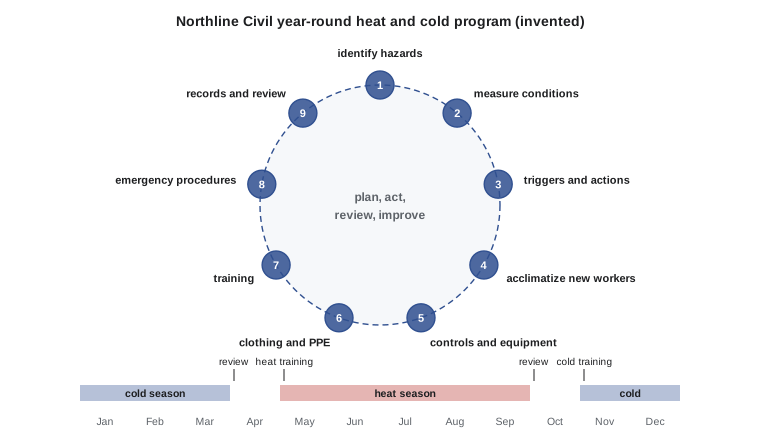
The goal is a program that a site supervisor can actually use: clear responsibilities, daily monitoring, simple trigger levels with specific actions, acclimatization for new workers, the right equipment on every truck, training, emergency procedures and a way to learn from incidents. The steps below follow the order a health and safety coordinator would use.
Step 1: identify the hazards and who is exposed
The coordinator begins by listing the tasks and conditions that create thermal hazards, season by season, and the workers exposed to each. This is the hazard assessment that the rest of the program rests on.
| Season | Task or condition | Main thermal hazard | Who is exposed |
|---|---|---|---|
| Summer | Asphalt paving and raking | Radiant heat from hot asphalt (about 140 to 160 °C at laying) and sun; heavy work | Paving crews, rakers, screed operators |
| Summer | Concrete curb and sidewalk | Sun, reflected heat from concrete, heavy work | Concrete crews |
| Summer | Trench work for utilities | Sun, still air in trenches, heavy digging; respirators for silica cutting | Pipe crews, labourers |
| Summer | Equipment operation | Hot cabs if air conditioning fails | Operators |
| All year | New and returning seasonal workers | Lack of acclimatization; unfamiliar with cold clothing systems | About 30 seasonal hires |
| Winter | Utility repairs in excavations | Cold, wind, wet ground, water in trenches | Pipe crews, labourers |
| Winter | Snow and ice control | Wind chill on open equipment, long shifts at night, fatigue | Plow and sander operators, sidewalk crews |
| Winter | Unheated storage yard | Cold metal, still cold air, long periods of light work | Yard staff |
Step 2: choose how conditions will be measured
For outdoor work, the coordinator chooses forecast humidex for daily planning in summer, because it is available every morning from Environment and Climate Change Canada and easy to explain, with adjustments for sun and heavy work. Because paving combines direct sun, radiant heat from the asphalt and heavy work, the company also buys two WBGT meters to check conditions on the paving line on hot days and compare them with the ACGIH screening criteria. In winter, the coordinator uses forecast air temperature and wind chill, checked each morning and again before night shifts, with the work/warm-up schedule for severe cold.
Step 3: set trigger levels and actions
The heart of the program is a staged plan that tells supervisors exactly what to do at each level. Northline Civil's plan lowers the heat triggers for paving, because of the radiant heat and heavy work, and treats any worker in their first week as needing the next stage's protections.
| Stage | Summer trigger (general work) | Summer actions | Winter trigger | Winter actions |
|---|---|---|---|---|
| 1 Awareness | Humidex 30 to 34 | Tailgate reminder; water and shade on site; identify new workers | Wind chill 0 to −9 | Tailgate reminder; dry spares on truck; warm shelter available |
| 2 Caution | Humidex 35 to 39 (paving: 33) | Water at work face; 15 min break in shade each hour; buddy checks | Wind chill −10 to −27 | Face and hand protection; warm-up breaks each 1 to 2 hours; buddy checks |
| 3 High | Humidex 40 to 44 (paving: 38) | 30 min rest each hour; heavy work before 11:00; WBGT check on paving line; supervisor checks every 30 min | Wind chill −28 to −39 | Full face cover; work/warm-up schedule; heated shelter at each site; limit non-essential work |
| 4 Extreme | Humidex 45 or more, or heat warning with heavy work | Stop heavy and non-essential outdoor work; essential work only with WBGT-based limits and close monitoring | Wind chill −40 or colder, or extreme cold warning | Stop non-emergency outdoor work; emergency work only with short rotations and standby rescue |
The coordinator tests the plan against a season of weather. Using an invented but realistic set of daily forecasts, a simple script estimates how many days each stage would be triggered. This helps the company plan for lost productive hours, schedule early starts, and budget for shelters, water and cooling equipment.
import random
random.seed(243)
# Invented daily forecast maxima for a summer (humidex) and a winter (wind chill)
summer = [round(random.gauss(31, 5)) for _ in range(92)]      # Jun to Aug humidex
winter = [round(random.gauss(-14, 9)) for _ in range(90)]     # Dec to Feb wind chill

def heat_stage(h, paving=False):
    cuts = (33, 38, 45) if paving else (35, 40, 45)
    if h >= cuts[2]: return 4
    if h >= cuts[1]: return 3
    if h >= cuts[0]: return 2
    return 1 if h >= 30 else 0

def cold_stage(wc):
    if wc <= -40: return 4
    if wc <= -28: return 3
    if wc <= -10: return 2
    return 1 if wc <= 0 else 0

for label_, data, fn in [("summer, general", summer, heat_stage),
                         ("summer, paving", summer, lambda h: heat_stage(h, True)),
                         ("winter", winter, cold_stage)]:
    counts = [sum(1 for d in data if fn(d) == s) for s in range(5)]
print(f"{label_:16s} days at stage 0-4: {counts}")summer, general days at stage 0-4: [25, 36, 26, 4, 1] summer, paving days at stage 0-4: [25, 17, 38, 11, 1] winter days at stage 0-4: [4, 19, 60, 7, 0]
The invented season shows the value of the lower paving triggers: the paving crews would be at stage 2 or above on noticeably more days than general crews, and at stage 3 on several days where general crews would only be at stage 2. In winter, most days fall in stages 1 and 2, with a handful of stage 3 days and no stage 4 days in this invented season. Real planning would use historical weather data for the company's locations.
Step 4: acclimatization and new workers
Because Northline Civil hires about 30 seasonal workers each spring, and because its past heat cases involved new workers, acclimatization is a priority. The plan requires that every new worker follow a 20 per cent per day schedule for heat exposure, with remaining time spent on shaded or lighter tasks, and that returning workers who have been away for a week or more follow the 50, 60, 80, 100 per cent schedule. New workers are paired with experienced buddies for their first two weeks. Supervisors receive the names of workers in acclimatization each morning. When a heat wave arrives after cool weather, the whole crew is treated as partly unacclimatized, and stage 3 protections apply one stage earlier for the first few days.
In winter, new workers receive a briefing on layering and a check of their clothing and boots before their first cold shift, and they work with a buddy until the supervisor is satisfied they can manage cold conditions.
Step 5: engineering controls and equipment
The coordinator looks for ways to reduce the heat or cold itself. For summer, every crew truck carries a pop-up canopy large enough for the whole crew, a 40-litre water cooler, ice and electrolyte drinks, and the paving crews get a shade trailer with a misting fan for breaks, since the local summers are humid only part of the time. Equipment cab air conditioning is checked weekly, and an operator whose air conditioning fails in stage 2 or above stops and reports it. Pavers with screed-mounted shade canopies are specified for the next equipment purchase. For winter, each site has a heated shelter or a crew truck designated as a warm-up space with carbon monoxide alarms; tools with metal handles are fitted with insulating grips; windbreaks are set up around fixed work in exposed locations; and the storage yard gets radiant heaters at the work bench and insulated floor mats.
Each truck also carries an emergency kit for thermal emergencies: a large tarp and two buckets for ice-water cooling in summer, and a hypothermia wrap kit with a ground pad, sleeping bag, vapour barrier and chemical warm packs in winter, plus spare dry clothing for every crew member.
Step 6: clothing and personal protective equipment
Summer clothing guidance specifies light-coloured, breathable, long-sleeved high-visibility shirts, hard hat sun shades and neck flaps, and sunscreen. Workers cutting concrete with silica exposure wear the respirators required by the company's silica program (see HSE-242 and HSE-240), and the plan recognizes that respirators add to heat strain by scheduling cutting for cooler hours. Winter guidance specifies a three-layer system with synthetic or wool base layers, insulated waterproof boots with room for warm socks, hard hat liners, balaclavas and goggles for stage 3, and liner gloves under insulated mitts. The company provides the outer high-visibility winter layers and a clothing allowance for base layers.
Step 7: training and communication
All field workers receive two hours of thermal stress training: a heat module in May and a cold module in November, plus a refresher at the first hot and first cold spell. Training covers the risk factors, the symptoms of each heat and cold illness, the staged plan and its triggers, water, rest, shade and warm-up breaks, buddy checks, and emergency response, including a hands-on practice of tarp-assisted cooling and the hypothermia wrap. Supervisors get an extra half day on monitoring conditions, using the WBGT meters, applying the work/warm-up schedule, enforcing breaks and responding to emergencies. Daily tailgate meetings announce the stage for the day and the actions required. Materials are provided in the languages workers use.
Step 8: emergency procedures
Every site has a written emergency plan that includes the site address or GPS location, the nearest hospital and expected ambulance time, the names of trained first aiders on each crew, and the location of the thermal emergency kit. The plan states clearly that any worker with confusion in heat is treated as having heat stroke: call 911 and start ice-water cooling on site immediately. Any worker with suspected moderate hypothermia is handled gently, insulated and evacuated. First aiders are trained in a recognized first aid program; this course alone does not qualify them.
Step 9: records, review and continual improvement
The program records daily stage decisions and actions, WBGT readings, acclimatization schedules, training attendance, equipment checks and every heat or cold illness, including near misses. Each incident is investigated to find out why the controls did not work, and the findings are shared with crews. The joint health and safety committee, or the safety committee and worker representatives, reviews the program at the end of each summer and winter, looking at incidents, days lost, worker feedback and changes in the law, and updates the plan. Changes in regulations, such as new heat stress rules, trigger an immediate review.
At the time of writing, Ontario had no heat- or cold-specific regulation, so Northline Civil's program is built on the general duty to take every precaution reasonable in the circumstances and on ministry guidance referring to the ACGIH TLVs. The coordinator monitors for any new provincial heat stress regulation, since one was proposed in 2023, and would update the program to meet it.
Worked problem
Applying the plan on a hot paving day
On a July day, the forecast humidex is 39 and the paving crew includes two students in their third day. At 10:30, the WBGT on the paving line reads 29.5 °C. What does the Northline plan require?
Show solution
- For paving, humidex 39 exceeds the stage 3 paving trigger of 38, so stage 3 applies: 30 minutes rest each hour, heavy work early, WBGT checks and supervisor checks every 30 minutes.
- The two students are in acclimatization, at about 60 per cent of full heat exposure on day 3 (20 per cent per day), and need the next stage's protections, so they are treated as stage 4: no heavy raking, shaded tasks and close monitoring.
- A WBGT of 29.5 °C for heavy raking work exceeds the illustrative TLV of 29.0 °C for 25 to 50 per cent work, so heavy raking must be limited to no more than 25 per cent of each hour, or rotated among more workers.
- Water, electrolytes, shade, the ice-water cooling kit and buddy checks are in place, and the crew is reminded of heat stroke signs.
Answer: Stage 3 for the crew with WBGT-based limits on raking, and stage 4 protections for the two new students.
Worked problem
Applying the plan on a cold night
In January, a sidewalk crew is clearing snow overnight. The forecast is minus 24 °C with winds of 25 km/h. One crew member is a new hire on his first night. What does the plan require?
Show solution
- Wind chill at minus 24 °C and 25 km/h is about minus 37, which falls in stage 3 (minus 28 to minus 39).
- Stage 3 requires full face cover, a heated shelter at each site, the work/warm-up schedule and limiting non-essential work.
- The new hire receives a clothing and boot check before the shift and works with a buddy who checks his face and hands for frostnip at every break.
- Warm-up breaks are scheduled; the supervisor ensures the warm-up truck has a working carbon monoxide alarm and that spare dry gloves and socks are available.
Answer: Stage 3 cold protections, with extra checks and buddying for the new hire.
Common mistakes
MistakeWriting a heat and cold plan that says only to use common sense.
InsteadSet clear triggers, specific actions and responsibilities that supervisors can apply.
MistakeUsing the same heat triggers for paving as for general work.
InsteadLower triggers where radiant heat, heavy work or protective clothing add to heat stress.
MistakeTreating seasonal hires as ready for full duty on day one.
InsteadAcclimatize new and returning workers and pair them with experienced buddies.
MistakeKeeping emergency cooling or rewarming supplies only at head office.
InsteadPut thermal emergency kits on every truck and practise using them.
MistakeReviewing the program only after a serious incident.
InsteadReview at the end of each season with worker input, incident data and legal changes.
Summary and key terms
- A year-round program starts with a hazard inventory by season, task and worker group.
- Daily monitoring uses forecast indices for planning and WBGT or wind chill tools where conditions are severe.
- A staged plan with clear triggers and actions is the core tool for supervisors.
- Triggers should be lowered for radiant heat, heavy work, protective clothing and new workers.
- Acclimatization, buddies and briefings protect seasonal hires.
- Engineering controls, clothing, emergency kits, training and drills put the plan into practice.
- Records, investigations and seasonal reviews with worker input keep the program improving.
- Hazard inventory
- A list of tasks and conditions that create hazards, with the workers exposed.
- Staged plan
- A plan that sets increasing levels of protection as conditions worsen.
- Trigger adjustment
- Lowering trigger levels for tasks with extra heat or cold load.
- Thermal emergency kit
- Equipment kept on site for cooling heat stroke victims or rewarming hypothermia victims.
- Tailgate meeting
- A short pre-shift safety meeting at the work site.
- Seasonal review
- An evaluation of the program at the end of each hot or cold season.
- Near miss
- An event that could have caused injury or illness but did not.
- Joint health and safety committee
- A committee of worker and employer representatives required in most Ontario workplaces with 20 or more workers.
- Continual improvement
- Regularly reviewing results and updating the program to work better.
- Program owner
- The person responsible for maintaining and coordinating the program.
Practice problems
Work each problem on paper first, then reveal the answer to check.
List the nine steps of the Northline Civil program.
Show answer
Identify hazards, choose measurement, set triggers and actions, acclimatize new workers, engineering controls and equipment, clothing and PPE, training and communication, emergency procedures, and records and review.
Why are heat triggers lowered for paving crews?
Show answer
Because radiant heat from hot asphalt and sun, plus heavy work, add to heat stress.
Why does the plan treat workers in acclimatization as needing the next stage's protections?
Show answer
They are not yet acclimatized, so their heat tolerance is lower.
What should every crew truck carry for heat emergencies?
Show answer
A large tarp, buckets, ice and water for ice-water cooling, plus water, electrolytes and shade.
What should every crew truck carry for cold emergencies?
Show answer
A hypothermia wrap kit, warm packs and spare dry clothing.
Why does the plan schedule silica cutting for cooler hours?
Show answer
Respirators add to heat strain, so cooler hours reduce the combined load.
Wind chill at minus 22 °C and 30 km/h is about minus 35. Which winter stage applies?
Show answer
Stage 3 (minus 28 to minus 39).
What should happen if an operator's cab air conditioning fails at stage 2 or above?
Show answer
The operator stops and reports it.
Name four types of records the program keeps.
Show answer
Any four of daily stage decisions, WBGT readings, acclimatization schedules, training attendance, equipment checks and incident records.
When should the program be reviewed?
Show answer
At the end of each summer and winter, after incidents, and whenever the law changes.
Lesson quiz · 5 questions
Score 60% or more to complete this lesson.
Create a free account to save your progress, take quizzes and earn a certificate.