
HSE-223 · Lesson 8 of 12 · 31 min
Bowtie analysis and critical control management
The bowtie diagram is one of the clearest ways to show how a major accident can happen and what stands in the way. It was developed in the oil and gas industry in the late 1980s and 1990s, popularized by Shell after the Piper Alpha disaster, and is now used in mining, aviation, health care, utilities and many other sectors. A bowtie combines a simplified fault tree on the left with a simplified event tree on the right, joined at a central event. HSE-103 showed the shape. This lesson explains how to build a bowtie properly, how to judge the barriers on it, and how bowties feed critical control management, the approach the International Council on Mining and Metals (ICMM) recommends for preventing fatal events.
The parts of a bowtie
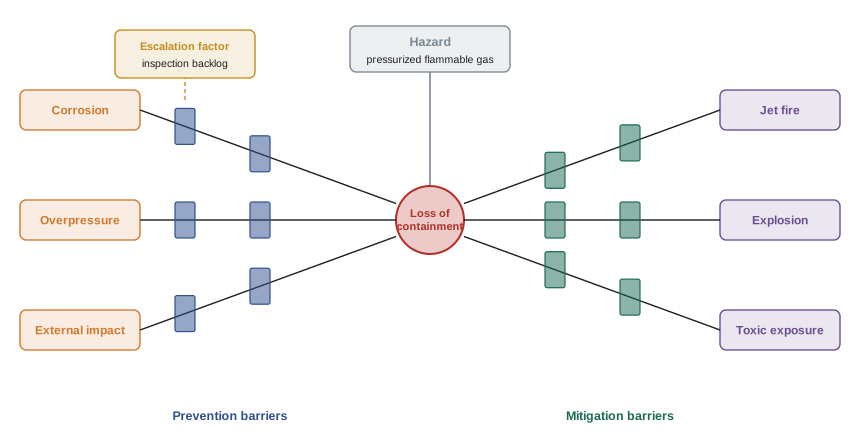
At the centre is the top event: the moment control is lost over a hazard, such as "loss of containment of hydrocarbon from the pipeline", "vehicle collision with a pedestrian" or "loss of control of suspended load". The hazard itself, such as the hydrocarbon under pressure, sits above the top event. On the left are threats: the causes that could lead to the top event, such as corrosion, external impact or overpressure. On the right are consequences: the outcomes if the top event happens, such as fire, explosion, toxic exposure or environmental damage.
Between threats and the top event are prevention barriers, which stop a threat from causing the top event. Between the top event and consequences are mitigation barriers, which reduce or stop the escalation to each consequence. Escalation factors are conditions that can make a barrier fail, such as poor maintenance, and escalation factor barriers are the controls that protect against them. Each barrier can be linked to an owner, an activity that keeps it working and a performance standard.
Choosing the top event and hazard
Choosing the right top event is the most important decision. It should be a loss of control, not a consequence and not a cause. "Fire" is usually a consequence; "corrosion" is a threat; "loss of containment" is the top event between them. A top event that is too broad, such as "process safety incident", makes the diagram vague; one that is too narrow, such as "flange leak on line 4", makes it trivial. Organizations usually build bowties for their major accident hazards or material unwanted events, the handful of events that could cause fatalities or catastrophic damage.
What counts as a barrier
Not everything that sounds like a control is a barrier. The Center for Chemical Process Safety and the Energy Institute's guidance on bowties define a barrier as something that can, on its own, stop a threat from developing into the top event or stop the top event from developing into a consequence. To do that, a barrier must detect the condition, decide what to do and act. A pressure safety valve detects overpressure, decides (it opens at its set point) and acts (it relieves). A gas detector alone only detects; with an alarm, a trained operator and a shutdown valve it becomes a complete barrier.
Training, procedures, maintenance and inspection are usually not barriers by themselves; they support barriers and appear as barrier activities or escalation factor controls. A common error is to list "training", "PPE", "procedures" and "supervision" as barriers on every threat line, making the bowtie look well protected when the real barriers are thin. Each barrier should also be independent of the threat and of the other barriers on the same line.
| Proposed item | Barrier? | Reason |
|---|---|---|
| Pressure safety valve | Yes | Detects, decides and acts on its own |
| Operator training | No | Supports the operator response barrier; not a barrier on its own |
| High pressure alarm with operator response and isolation valve | Yes | Complete detect, decide and act chain |
| Gas detector alone | No | Detects only; needs a decision and action element |
| Corrosion inspection program | Usually no | Barrier activity that keeps the pipe wall barrier effective |
| Emergency shutdown system | Yes | Detects, decides and acts automatically |
Worked problem
Cleaning up a threat line
A draft bowtie for the top event "loss of control of suspended load" has the threat "rigging failure" with these barriers: training, PPE, supervision, lift plan, rated and inspected rigging, exclusion zone. Which are true barriers, and where should the others go?
Show solution
- Rated and inspected rigging is a prevention barrier: correctly rated slings, inspected before use, prevent the rigging failure from causing loss of control.
- The exclusion zone is not a prevention barrier on this line: it does not stop the load falling. It is a mitigation barrier on the consequence side (person struck by falling load).
- Lift plan is a supporting activity that ensures correct rigging selection; it supports the rigging barrier.
- Training and supervision support the rigging barrier; PPE does little against a falling load and could appear as minor mitigation only.
Answer: Prevention barrier: rated and inspected rigging. Mitigation barrier: exclusion zone. Supporting activities: lift plan, training and supervision.
Judging barrier quality
Once the barriers are in place, the team judges each one. Is it effective, meaning that, if it works, it stops the sequence? Is it independent of the threat and of other barriers? Is it auditable, meaning its condition can be checked? What is its current condition: is it maintained, tested and working? Many bowtie software tools allow each barrier to be rated, for example as good, adequate or poor, and colour-coded. A line with two poor barriers is a priority even if the bowtie looks complete.
Worked problem
Barrier independence
On a tank overfill bowtie, the threat "incoming flow exceeds outflow" has two prevention barriers: "level control loop closes inlet valve" and "high level alarm with operator response". Both use the same level transmitter. A third proposed barrier is "independent high-high level switch trips the inlet valve". How many independent barriers does the threat line really have?
Show solution
- The control loop and the alarm share the transmitter. If the transmitter fails, both fail: they count as one barrier for independence.
- The independent high-high switch has its own sensor and its own trip: a second independent barrier, if it uses a separate final element or a valve tested for this duty.
- Without the switch, the line has effectively one barrier, which is weak for a major hazard.
Answer: Two independent barriers with the high-high switch; only one without it.
Critical control management
A bowtie becomes a working tool when its most important barriers are actively managed. The ICMM Critical Control Management good practice guide (2015) and its implementation guide describe a process. Identify the material unwanted events, the events with fatal potential. Build a bowtie for each. Select the critical controls: those that are crucial to preventing the event or reducing its consequences, and whose absence or failure would significantly increase risk. For each critical control, define its objective, its performance requirements, the activities that keep it working, who is accountable and how it will be verified. Then verify regularly in the field and report the results to management.
Critical controls are usually few, typically three to ten per material unwanted event. They are chosen because they are effective, independent and essential, not because they are easy to check. Verification uses critical control checklists done by supervisors and workers in the field: is the guard in place, is the gas detector bump-tested, is the exclusion zone established? Failures are reported and acted on immediately, and trends are reviewed by senior management. This turns the bowtie from a diagram on a wall into a living system.
Worked problem
Critical control verification results
Over a month, supervisors made 120 field verifications of the critical control "isolation and verification before entering the crusher". In 111 the control was fully in place, in 6 it was partly in place (lock applied but no try-start verification), and in 3 it was absent. Calculate the compliance rate and say what should happen.
Show solution
- Full compliance: \( 111 \div 120 = 92.5 \% \).
- Partial or absent: \( 9 \div 120 = 7.5 \% \).
- The 3 absences are potential fatal exposures; each should have been stopped and investigated immediately.
- The 6 partial cases show the try-start step is being skipped; find out why (time pressure, access to the start button) and fix the cause.
Answer: Full compliance 92.5 per cent; investigate the 3 absences and fix the cause of skipped verification.
Strengths and limits
Bowties are excellent for communication. A single page shows managers, supervisors and workers how a major event could happen and what they must keep working to prevent it. They link the technical analysis to everyday activities and accountabilities. But a bowtie is not a calculation. It does not show how likely the top event is, how reliable each barrier is or whether the barriers are enough. For that, the bowtie should be supported by HAZOP to identify threats, LOPA or fault tree analysis to check sufficiency, and good barrier data. A bowtie built without those inputs can look reassuring while hiding weak barriers.
In Canada, bowties and critical control management are used widely in mining, oil sands and pipelines. The Canada Energy Regulator's management system requirements expect companies to identify hazards and manage controls, and many operators use bowties for this. The Mining Association of Canada's Towards Sustainable Mining program and provincial mining regulations also encourage the approach for fatal hazards.
Building a bowtie in a workshop
Bowties are best built in a facilitated workshop with operations, maintenance, engineering and safety people, using results from HAZOP and incident history as inputs. The usual order is hazard, top event, threats, consequences, prevention barriers, mitigation barriers, escalation factors and their controls, then barrier owners and activities. A good facilitator limits the number of threats and consequences to the important ones, typically three to eight of each; a bowtie with 25 threats is unreadable and usually means the top event is too broad or the threats are really barrier failures.
Worked problem
Threat or barrier failure?
A draft bowtie for "loss of containment from a storage tank" lists these threats: corrosion, overfilling, relief valve fails, operator ignores alarm, external impact from vehicle. Which items are genuine threats, and which are barrier failures that belong elsewhere?
Show solution
- Genuine threats: corrosion, overfilling and external impact from vehicle; each can cause loss of containment by itself.
- "Relief valve fails" is the failure of a barrier against overpressure, not a threat; it belongs as an escalation factor or in the barrier's assessment.
- "Operator ignores alarm" is the failure of the alarm and response barrier on the overfilling line; it is an escalation factor on that barrier.
Answer: Threats: corrosion, overfilling, vehicle impact. The relief valve and operator items are barrier failures.
Once complete, the bowtie should be reviewed by people who were not in the workshop, especially frontline supervisors, to check that it reflects how the site really operates. It should be updated after incidents, when barriers change and at the same interval as the related hazard studies.
Bowtie software can also record barrier condition from inspections and incident investigations, so that the diagram shows in colour which barriers are degraded. When investigators find that a barrier failed in an incident, they should update the bowtie and ask whether the same barrier is weak on other lines or at other sites. Used this way, the bowtie links risk assessment, verification and learning from incidents into one picture.
Common mistakes
MistakeChoosing "fire" or "corrosion" as the top event.
InsteadChoose the loss of control between causes and consequences, such as loss of containment.
MistakeListing training and PPE as barriers on every line.
InsteadCredit only items that detect, decide and act; show training as a supporting activity.
MistakeCounting barriers that share a sensor as separate.
InsteadCheck independence; shared components count as one barrier.
MistakeTreating the bowtie as proof that risk is acceptable.
InsteadUse LOPA or fault trees to check sufficiency.
MistakeSelecting critical controls and never checking them.
InsteadVerify critical controls in the field and act on failures.
Summary and key terms
- A bowtie joins threats, prevention barriers, a top event, mitigation barriers and consequences.
- The top event is the loss of control, not a cause or a consequence.
- A barrier must detect, decide and act on its own and be independent.
- Training, procedures and inspection support barriers rather than being barriers.
- Judge barriers for effectiveness, independence, auditability and condition.
- ICMM critical control management selects, defines, verifies and reports critical controls.
- Bowties communicate well but do not calculate; support them with HAZOP and LOPA.
- Bowtie
- A diagram showing threats, barriers, a top event and consequences.
- Top event
- The point where control over a hazard is lost.
- Threat
- A cause that could lead to the top event.
- Prevention barrier
- A barrier that stops a threat from causing the top event.
- Mitigation barrier
- A barrier that reduces the consequences after the top event.
- Escalation factor
- A condition that can make a barrier fail.
- Critical control
- A control crucial to preventing or mitigating a fatal event.
- Material unwanted event
- An event with fatal or catastrophic potential.
- Barrier activity
- A task that keeps a barrier working, such as testing.
- Verification
- Checking in the field that a control is in place and working.
Practice problems
Work each problem on paper first, then reveal the answer to check.
What is the top event in a bowtie?
Show answer
The point where control over the hazard is lost.
Classify "fire" for a gas leak bowtie.
Show answer
A consequence.
What three functions must a barrier perform?
Show answer
Detect, decide and act.
Is a gas detector alone a barrier?
Show answer
No; it only detects.
Where does training belong on a bowtie?
Show answer
As a supporting activity or escalation factor control.
Two barriers share a level transmitter. How many count for independence?
Show answer
One.
Which organization published critical control management guidance in 2015?
Show answer
The International Council on Mining and Metals (ICMM).
How many critical controls are typical per material unwanted event?
Show answer
About three to ten.
Of 80 verifications, 76 were fully compliant. What is the rate?
Show answer
95 per cent.
What does a bowtie not show?
Show answer
How likely the top event is or whether the barriers are enough.
Lesson quiz · 5 questions
Score 60% or more to complete this lesson.
Create a free account to save your progress, take quizzes and earn a certificate.