
HSE-223 · Lesson 3 of 12 · 32 min
Job hazard and task analysis in depth
HSE-103 introduced the job hazard analysis (JHA), also called job safety analysis (JSA): break a job into steps, list the hazards at each step and record the controls. That basic form is useful, but it has well-known weaknesses. Steps are written at the wrong level of detail, hazards are listed as vague words such as "slips" or "pinch points", the controls column fills up with "be careful" and "wear PPE", and the analysis is never checked against how the job is really done. This lesson turns the JHA into a disciplined method: choosing and prioritizing jobs, decomposing tasks with hierarchical task analysis, describing hazards as specific energy releases, rating risk before and after controls, and testing the result in the field.
Task-based methods matter because many serious injuries happen during non-routine work: maintenance, cleaning, changeovers, start-up, shutdown and troubleshooting. Process-focused methods such as HAZOP look at the equipment under normal and abnormal conditions, but they can miss what a person does with a wrench at two in the morning. A well-built task analysis complements them by looking directly at human actions, the energy people are exposed to and the errors they might make.
Choosing and prioritizing jobs
Most workplaces have hundreds of tasks, so the first step is deciding which to analyze in depth. Useful selection criteria include injury and near-miss history, the severity of the worst credible outcome, how often the task is done, how many people do it, whether it is new or recently changed, and whether it is non-routine. A simple scoring scheme helps a joint committee agree on the order. Jobs with a potential for fatality or permanent disability should come first even if they are rare, because frequency-based ranking alone tends to push rare, high-severity tasks to the bottom of the list.
| Criterion | Score 1 | Score 3 | Score 5 |
|---|---|---|---|
| Worst credible outcome | First aid | Lost time injury | Death or permanent disability |
| Incident history (3 years) | None | Near misses | Recordable injuries |
| Frequency | Yearly or less | Monthly | Daily or more |
| Novelty | Unchanged for years | Minor change | New or non-routine |
| People exposed | 1 | 2 to 5 | More than 5 |
Worked problem
Prioritizing three jobs
Using the table, score three jobs: (A) daily forklift loading by 6 operators, with near misses, unchanged for years, worst outcome lost time; (B) annual entry into a mixing tank by 2 workers, no history, non-routine, worst outcome fatality; (C) monthly filter change by 1 maintainer, recordable injuries, minor change last year, worst outcome lost time. Rank them.
Show solution
- A: outcome 3, history 3, frequency 5, novelty 1, people 5. Total 17.
- B: outcome 5, history 1, frequency 1, novelty 5, people 3. Total 15.
- C: outcome 3, history 5, frequency 3, novelty 3, people 1. Total 15.
- By total, A comes first. But B has a potential fatality, so the rule puts it first regardless of total.
Answer: Order: B (fatality potential), then A (17), then C (15).
Breaking the job into steps
The most common JHA fault is getting the level of detail wrong. Too few steps ("maintain the pump") hide the hazards; too many ("pick up the wrench, turn it a quarter turn") bury them. A useful rule is 5 to 15 steps per job, each starting with an action verb and describing what is done, not how to do it safely. If a job needs more than about 15 steps, split it into sub-jobs.
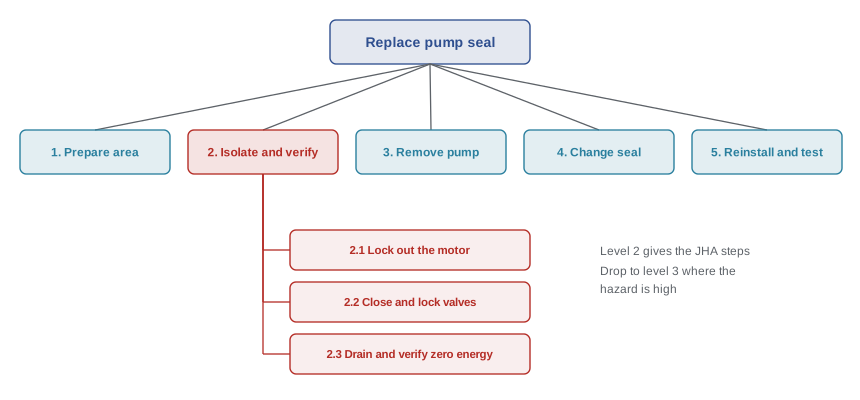
Hierarchical task analysis (HTA), developed in human factors research, gives a structured way to do this. The overall goal sits at the top, broken into sub-goals, each broken into operations, with a plan stating the order and conditions. For example, the goal "replace pump seal" breaks into: prepare the work area, isolate and verify, remove the pump, change the seal, reinstall and test. Each of these breaks into smaller operations. The JHA then uses one level of the hierarchy, usually the second, as its steps, and drops to a lower level only where the hazard demands it.
Describing hazards as energy
A vague hazard leads to a vague control. Instead of "pinch point", say "hand caught between the coupling guard and rotating shaft if the motor starts". Instead of "chemicals", say "splash of 30 per cent caustic from the drain valve when the line is opened". One reliable way to be specific is to ask what energy could be released at each step and how it would reach a person: gravity, motion, mechanical, electrical, pressure, temperature, chemical, biological, radiation, sound. This energy-based approach, used in the energy wheel and in many serious injury and fatality (SIF) programs, also makes it easier to identify high-energy hazards that need the strongest controls.
Research on SIF prevention, including work by the Construction Safety Research Alliance, suggests that hazards involving high energy, above roughly 1,500 joules or equivalent thresholds such as a fall from more than 1.2 metres, a vehicle above 30 km/h or exposure to more than 50 volts, account for most fatalities. Asking whether a high-energy hazard is present at each step, and whether a direct control such as a guard, barrier or isolation is in place, helps the team focus on what can kill rather than what is merely annoying.
Worked problem
Rewriting vague hazards
A JHA for cleaning a conveyor lists these hazards: "moving parts", "slips", "electrical". Rewrite each as a specific energy release with its route to the person.
Show solution
- Moving parts: hand or sleeve drawn into the in-running nip between the belt and tail pulley if the conveyor is started or coasts while cleaning (motion energy).
- Slips: worker slides on wet product residue on the walkway while carrying a scraper and falls against the conveyor frame (gravity and motion energy).
- Electrical: contact with exposed terminals in the local control box if the cover is removed to reach a jam, at 600 volts (electrical energy, a high-energy hazard).
Answer: Each hazard now names the energy, the source and the way it reaches the worker, which points directly to controls.
Rating risk before and after controls
A basic JHA lists controls but does not say how much they help. An improved method rates the risk at each step twice: the inherent or current risk without the proposed controls, and the residual risk with them in place. This shows where the controls do the most work and where the residual risk is still too high. Use the company's calibrated risk matrix (Lesson 4) and be honest: administrative controls and PPE reduce likelihood less than engineering controls, and almost never reduce severity.
The hierarchy of controls applies at every step. Elimination and substitution are best: can the task be done without entering the hazard zone, such as a clean-in-place system instead of manual cleaning? Engineering controls such as fixed guards, interlocks and local exhaust come next. Administrative controls, including procedures, permits and training, and finally personal protective equipment, rely on people doing the right thing every time. A JHA whose controls column contains only procedures and PPE for a high-energy hazard should be treated as incomplete.
| Step | Hazard (energy) | Current risk | Proposed controls | Residual risk |
|---|---|---|---|---|
| Isolate pump | Unexpected start: motion, electrical | High (5 by 3) | Lockout with personal locks; verify zero energy by trying start | Low (5 by 1) |
| Drain casing | Hot fluid release: temperature, pressure | High (4 by 3) | Cool to below 40 °C; drain to closed system; face shield | Medium (4 by 2) |
| Lift pump | Dropped load: gravity | Medium (4 by 2) | Inspected lifting lug and sling; tag line; exclusion zone | Low (4 by 1) |
| Change seal | Hand cuts: mechanical | Medium (2 by 4) | Seal tool; cut-resistant gloves | Low (2 by 2) |
Worked problem
Finding where controls work hardest
Using the table, calculate the reduction in risk score (severity times likelihood) for each step and identify which step's controls achieve the largest reduction and which step still has the highest residual score.
Show solution
- Isolate: \( 15 - 5 = 10 \).
- Drain: \( 12 - 8 = 4 \).
- Lift: \( 8 - 4 = 4 \).
- Seal: \( 8 - 4 = 4 \).
- Lockout achieves the largest reduction. Draining still has the highest residual score, 8, because the face shield is PPE and cooling depends on waiting; a closed drain with a temperature check before opening would help.
Answer: Isolation gives the largest reduction (10); draining has the highest residual score (8) and needs a stronger control.
Human error in tasks
Task analysis is also the natural place to think about human error. The skill-rule-knowledge framework from human factors research (Rasmussen and Reason) distinguishes slips and lapses in familiar, skill-based actions, such as opening the wrong valve on a crowded manifold, from rule-based mistakes, such as applying a rule that worked before but does not fit this situation, and from knowledge-based mistakes in unfamiliar situations. Violations, where someone knowingly departs from a rule, are a separate category, often driven by poorly designed procedures or production pressure.
Some organizations use a structured method such as the Systematic Human Error Reduction and Prediction Approach (SHERPA), which applies a set of error modes, such as action omitted, action too late or wrong object selected, to each step of the hierarchical task analysis. A simpler approach is to ask at each step: what could be missed, done in the wrong order, done to the wrong item, or done too much or too little? The answers often lead to design fixes such as labelling, valve position indicators, interlocks and checklists rather than more training.
Testing the JHA against real work
There is often a gap between work as imagined, written in the procedure, and work as done. A JHA written in an office by a supervisor alone will describe work as imagined. The best practice is to build the JHA with the people who do the job, observe the task being done, ask what makes the job hard, and revise the analysis. Workers know the workarounds, the tools that do not fit and the steps that are skipped when the shift is short. Joint health and safety committees and safety representatives in Canada, and safety committees and worker representatives in the US, should be involved in reviewing high-risk JHAs.
A JHA should be reviewed after any incident or near miss involving the task, when equipment, materials or the work area change, and at a set interval for high-risk jobs. It should be used: briefed at the start of the work, kept at the job site, and linked to the permit system where one applies. A JHA filed and forgotten is paperwork, not risk control.
In Canadian practice, the JHA is a common way to meet written hazard assessment duties such as Alberta OHS Code Part 2 and the hazard identification requirements of CSA Z1002. Field-level hazard assessments, done at the start of each shift or task, complement the formal JHA by catching site-specific conditions such as weather, nearby work and changed ground.
Worked problem
Observation finds a gap
The written JHA for changing a filter says to close the inlet and outlet valves, open the vent and wait 2 minutes for pressure to fall. During observation, the safety coordinator sees the maintainer close the valves, crack the filter lid immediately and stand back as it hisses. When asked, the maintainer says the vent valve is seized and the pressure gauge was removed last year. What should happen?
Show solution
- The real task differs from the written one in two ways: no venting, and no way to verify zero pressure.
- This is a pressure energy hazard with potential for a lid to be thrown or a spray of process fluid: high severity.
- Immediate action: stop the task until the vent valve is repaired and a pressure gauge or other zero-energy verification is restored.
- Update the JHA to add a verification step, and add the vent valve and gauge to the preventive maintenance list so the control does not decay again.
Answer: Stop the task, fix the vent and gauge, add a verification step and maintain the controls.
Common mistakes
MistakeListing hazards as single words such as "chemicals".
InsteadDescribe the energy, the source and how it reaches the worker.
MistakeWriting a JHA with 40 steps or with 2 steps.
InsteadAim for 5 to 15 steps, using hierarchical task analysis to choose the level.
MistakeFilling the controls column with "be careful" and PPE.
InsteadApply the hierarchy of controls, especially for high-energy hazards.
MistakeWriting the JHA in the office without the workers.
InsteadBuild it with the people who do the job and observe the real task.
MistakeRanking jobs by frequency alone.
InsteadAnalyze jobs with fatal or permanent disability potential first, even if rare.
Summary and key terms
- Task methods complement process methods by looking at human actions and non-routine work.
- Prioritize jobs by severity, history, frequency, novelty and exposure, with fatal potential first.
- Use hierarchical task analysis to set the right level of detail: about 5 to 15 steps.
- Describe hazards as specific energy releases; high-energy hazards need direct controls.
- Rate risk before and after controls and apply the hierarchy of controls.
- Consider slips, lapses, mistakes and violations at each step and design them out.
- Test the JHA against work as done, review it after changes and use it in the field.
- Job hazard analysis
- A method that breaks a job into steps and identifies hazards and controls for each.
- Hierarchical task analysis
- A method that breaks a goal into sub-goals and operations with plans.
- Energy-based hazard identification
- Identifying hazards by the type of energy that could be released.
- High-energy hazard
- A hazard with enough energy to cause serious injury or death.
- Residual risk
- The risk remaining after controls are applied.
- Slip
- An unintended action during a familiar task.
- Lapse
- A memory failure, such as forgetting a step.
- Violation
- A deliberate departure from a rule or procedure.
- Work as done
- How a task is actually performed, as opposed to how it is written.
- Field-level hazard assessment
- A short assessment done at the work site before starting work.
Practice problems
Work each problem on paper first, then reveal the answer to check.
Why should jobs with fatal potential be analyzed first even if rare?
Show answer
Frequency-based ranking pushes rare, high-severity jobs down the list.
What is a good number of steps for a JHA?
Show answer
About 5 to 15, each beginning with an action verb.
What does hierarchical task analysis provide?
Show answer
A goal broken into sub-goals and operations, with plans, to set the level of detail.
Rewrite "noise" as a specific hazard for a grinding task.
Show answer
Exposure to about 100 dBA from the angle grinder for 2 hours per shift, risking hearing loss.
Name four types of energy used to identify hazards.
Show answer
Gravity, motion, electrical, pressure, temperature, chemical (any four).
A step has current risk 4 by 4 and residual 4 by 2. What is the reduction?
Show answer
16 minus 8, a reduction of 8.
Why do PPE and procedures rarely reduce severity?
Show answer
They do not change the energy present, only the chance of exposure or its effect on some people.
What is the difference between a slip and a mistake?
Show answer
A slip is an unintended action; a mistake is a wrong plan or rule.
Why observe the task being done?
Show answer
To find the gap between work as imagined and work as done.
Give two triggers for reviewing a JHA.
Show answer
An incident or near miss, or a change in equipment, materials or work area.
Lesson quiz · 5 questions
Score 60% or more to complete this lesson.
Create a free account to save your progress, take quizzes and earn a certificate.