
HSE-223 · Lesson 5 of 12 · 31 min
What-if and checklist reviews
What-if analysis and checklist analysis are the two simplest structured hazard identification methods, and they are named first in the list of acceptable process hazard analysis methods in the US PSM standard. They are also used everywhere else: in management of change reviews, pre-start-up safety reviews, new equipment purchases, event planning and office moves. Because they are simple, they are often done badly. This lesson explains how to run each method properly, how to combine them into the what-if/checklist method, and how to recognize when they are not enough.
Checklist analysis
A checklist is a list of questions or items based on codes, standards, company experience and past incidents. The team works through the list for the system being reviewed, marking each item as satisfactory, not satisfactory or not applicable, and recording actions. Checklists capture lessons learned: every item on a good checklist is there because something went wrong somewhere. They are fast, require little training and give consistent coverage of known hazards, which makes them ideal for standard designs, audits and routine changes.
Their weakness is equally clear: a checklist can only find what is on it. A new process, an unusual combination of conditions or a hazard nobody has thought of will not appear. Checklists can also become long, generic and mechanical, with reviewers ticking boxes without thinking. Good checklists are specific to the type of system, kept short enough to be used, reviewed after incidents and written as open questions where possible, such as "How is the tank protected against overfilling?" rather than "Is overfill protection provided? Yes/No".
| Topic | Example checklist question | Source of the item |
|---|---|---|
| Overpressure | What relieves pressure if the outlet valve is closed with the pump running? | Codes such as ASME and CSA B51; incident history |
| Overfill | How is the tank protected against overfilling, and is the alarm independent of the level gauge? | API 2350; Buncefield 2005 |
| Ignition sources | What is the hazardous location classification and does the equipment match it? | CSA C22.1 Canadian Electrical Code |
| Isolation | Can each item of equipment be isolated and verified at zero energy for maintenance? | CSA Z460 |
| Human factors | Are valves and instruments labelled, reachable and visible from where they are operated? | Human factors guidance; incident history |
Worked problem
Turning closed items into open questions
A storage area checklist contains these closed items: "Fire extinguishers provided? Y/N", "Incompatible chemicals separated? Y/N", "Spill kit available? Y/N". Rewrite each as an open question that forces the reviewer to think.
Show solution
- "What type and size of extinguisher covers each fire risk in the area, and how far is it from the farthest point?"
- "Which incompatible pairs are stored here, and how are they separated: by distance, by wall or by secondary containment?"
- "What is the largest container here, and is the spill kit sized and suitable for that chemical and volume?"
Answer: Open questions ask how and what, which exposes gaps that a tick in a box can hide.
What-if analysis
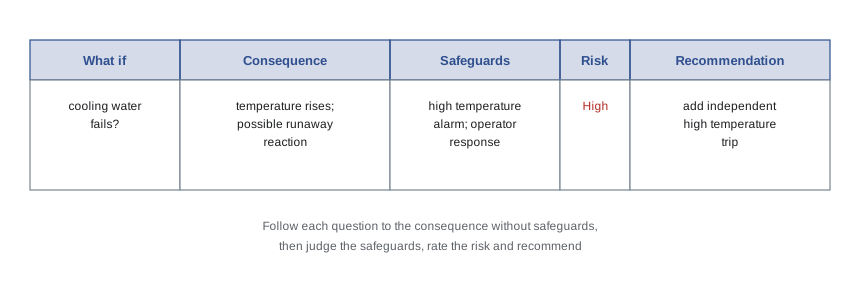
A what-if analysis is a structured brainstorm. A team familiar with the system asks questions beginning "What if…?" about each part of the process, procedure or activity, and for each question records the consequence, the existing safeguards and any recommendations. Typical questions are "What if the cooling water fails?", "What if the wrong material is delivered?", "What if the operator opens the drain while the tank is under pressure?" and "What if power is lost during the batch?".
What-if analysis is flexible. It works on a concept sketch, a procedure, a building layout or an event plan, and it can be done quickly. Its strength is that it uses the team's experience and imagination. Its weakness is the same: if the team lacks imagination, experience or diversity, important scenarios will be missed. Unlike HAZOP, there is no systematic set of prompts forcing every deviation to be considered, so coverage depends on the facilitator.
Running a what-if review well
A good what-if review has a defined scope and boundary, an experienced facilitator, a scribe, and a team that includes operations, maintenance, engineering and safety, with at least one person who knows the system well and one who will ask naive questions. The facilitator divides the system into sections, such as receiving, storage, transfer, processing and loading, and for each section prompts questions in categories: equipment failure, utility failure, human error, external events, and unusual operating modes such as start-up, shutdown and maintenance.
Pre-written questions help the team get started but should not limit it. Experienced facilitators use the pre-written list as a warm-up, then ask, "What else could go wrong here?" until the team runs dry. Each question is followed to a consequence assuming no safeguards work, then the existing safeguards are listed and judged, and only then is the risk rated. Recommendations should be specific and assigned to an owner with a date.
Worked problem
Completing a what-if row
A team reviews a truck unloading station for 93 per cent sulphuric acid into a storage tank. The question is "What if the driver connects the hose to the wrong fill point, the caustic soda tank next door?" Complete the consequence, safeguards and recommendations.
Show solution
- Consequence (no safeguards): acid mixes with caustic in the tank, producing a violent exothermic reaction, boiling, possible tank failure and spray of corrosive liquid near the driver.
- Existing safeguards: fill points labelled; driver trained; operator supervises unloading.
- Judgement: labels and supervision are administrative and can fail together, especially at night. Severity is major.
- Recommendations: use different, incompatible couplings for acid and caustic; lock each fill point and have the operator unlock only the correct one after checking the bill of lading; separate the fill points physically.
Answer: Consequence: violent reaction and spray. Recommend incompatible couplings, locked fill points and physical separation.
The combined what-if/checklist method
The what-if/checklist method, described in the Center for Chemical Process Safety (CCPS) Guidelines for Hazard Evaluation Procedures, uses both. The team first brainstorms what-if questions to draw on its creativity, then works through a checklist to fill gaps in coverage. Or the order is reversed: the checklist provides structure and the what-if questions extend it. The combination gives more complete coverage than either alone and is widely used for PHAs of simpler processes and for management of change.
Even combined, these methods have limits. They are less systematic than HAZOP for complex continuous processes, they do not quantify risk unless a matrix is added, and they depend heavily on the team. A reasonable rule is: what-if/checklist for small, simple or well-understood systems and changes; HAZOP or FMEA for complex or novel ones; and LOPA or fault trees when a specific high-consequence scenario needs its safeguards checked.
In Canada, what-if and checklist methods are widely used to meet management of change and pre-start-up review elements of CSA Z767, and many provincial regulators and insurers accept them for lower-hazard facilities. They are also a natural way to carry out the hazard assessment required by OHS law before new equipment or a new process is introduced, as in Alberta OHS Code Part 2.
Documentation and follow-up
Both methods should produce a record listing the scope, team, date, drawings or procedures reviewed, each question or item, consequences, safeguards, risk ratings and recommendations. Recommendations need owners, due dates and a tracking system; a review with 30 open recommendations two years later has not reduced any risk. Where a recommendation is rejected, the reason should be documented and accepted by a responsible manager. Under process safety rules, regulators routinely cite facilities for unresolved PHA recommendations.
Worked problem
Tracking recommendations
A what-if/checklist review produced 24 recommendations. Six months later, 9 are closed, 4 were rejected with documented reasons approved by the plant manager, 7 are in progress and on schedule, and 4 are overdue. What percentage are resolved, and what should happen with the overdue items?
Show solution
- Resolved means closed or formally rejected: \( 9 + 4 = 13 \).
- Percentage resolved: \( 13 \div 24 \approx 54 \% \).
- The 4 overdue items should be escalated to the manager responsible, with a revised date or interim measures, and the reason for delay recorded.
Answer: About 54 per cent resolved; escalate the 4 overdue items with interim measures and new dates.
Using what-if beyond process plants
What-if analysis is not just for chemical plants. It works well for construction lifts, temporary works, special events, shutdowns and turnarounds, laboratory experiments, office relocations and new software that controls equipment. In each case the facilitator chooses sections that suit the activity, such as phases of an event (setup, entry, performance, exit, teardown) or stages of a lift (planning, rigging, lifting, landing, de-rigging), and prompts the same categories of questions. The method's flexibility is its great advantage: it needs no drawings, only a clear description of the activity and people who know it.
For a special event, for example, questions might include: What if a thunderstorm arrives during the show? What if a stage structure is loaded beyond its rating by crowd surge? What if the main exit is blocked by a vehicle? What if the public address system fails during an evacuation? Each question is followed to consequence, safeguards and recommendations exactly as in a process review, and the output can feed the emergency plan.
Worked problem
Estimating review time
A facilitator plans a what-if/checklist review of a small solvent recovery unit divided into 6 sections. Experience suggests about 12 what-if questions per section at about 6 minutes each, plus a 40-item checklist at about 2 minutes per item, plus 20 per cent for introductions and breaks. How many hours should be scheduled, and how many 4-hour sessions?
Show solution
- What-if: \( 6 \times 12 \times 6 = 432 \) minutes.
- Checklist: \( 40 \times 2 = 80 \) minutes.
- Total with 20 per cent: \( (432 + 80) \times 1.2 = 614.4 \) minutes, about 10.2 hours.
- Sessions: \( 10.2 \div 4 \approx 2.6 \), so 3 sessions.
Answer: About 10 hours, scheduled as three 4-hour sessions.
A facilitator should also plan what the review will not cover. If the scope excludes the electrical substation or the tank truck route, the report must say so and name who will assess those areas. Gaps between the scopes of separate reviews are a common place for hazards to hide.
Checklists themselves need maintenance. A useful habit is to review the company's checklists once a year and after every significant incident, adding items for new lessons and removing items that no longer apply or that duplicate others. A checklist that has grown to 400 items is rarely used properly; splitting it into short, system-specific lists, such as one for tank farms, one for loading racks and one for warehouses, usually improves both speed and quality. Each item should also show its source, so that reviewers understand why it matters and can judge whether it applies.
Common mistakes
MistakeUsing a generic checklist for a novel process.
InsteadUse a system-specific checklist and add what-if or HAZOP for new hazards.
MistakeWriting checklist items as yes/no boxes.
InsteadWrite open questions that ask how and what.
MistakeRunning a what-if with only engineers from one discipline.
InsteadInclude operations, maintenance, engineering and safety, with someone who asks naive questions.
MistakeRating risk with safeguards assumed to work before listing them.
InsteadFind the consequence without safeguards, then judge each safeguard, then rate.
MistakeLeaving recommendations untracked.
InsteadAssign owners and dates and document any rejection with reasons.
Summary and key terms
- Checklists capture lessons learned and give consistent coverage of known hazards.
- A checklist only finds what is on it; write open questions and keep lists specific.
- What-if is a structured brainstorm that follows each question to consequence, safeguards and actions.
- What-if coverage depends on the team and facilitator; use categories to prompt questions.
- The combined what-if/checklist method uses creativity and structure together.
- These methods suit simple or well-understood systems; escalate complex ones to HAZOP or FMEA.
- Document the review and track every recommendation to closure or documented rejection.
- Checklist analysis
- Review of a system against a list of questions based on codes and experience.
- What-if analysis
- A structured brainstorm asking what could go wrong and following each question through.
- What-if/checklist
- A combined method using brainstorming and a checklist together.
- Safeguard
- A measure that prevents a scenario or reduces its consequence.
- Scope
- The boundaries of a review: what is included and excluded.
- Facilitator
- The person who leads a hazard review and keeps it on track.
- Scribe
- The person who records the discussion and findings.
- Management of change
- A process for reviewing hazards before changes are made.
- Pre-start-up safety review
- A check that a new or changed system is ready to operate safely.
- CCPS
- Center for Chemical Process Safety, which publishes hazard evaluation guidelines.
Practice problems
Work each problem on paper first, then reveal the answer to check.
What is the main strength of a checklist?
Show answer
Consistent, fast coverage of known hazards based on experience.
What is the main weakness of a checklist?
Show answer
It cannot find hazards that are not on the list.
Rewrite "Guard in place? Y/N" as an open question.
Show answer
How is the operator prevented from reaching the moving parts during normal work and clearing jams?
Give four categories of what-if questions.
Show answer
Equipment failure, utility failure, human error, external events, unusual modes.
Why find the consequence before listing safeguards?
Show answer
To see the full severity and judge whether the safeguards are enough.
Which publisher describes the what-if/checklist method in its hazard evaluation guidelines?
Show answer
The Center for Chemical Process Safety (CCPS).
When is what-if/checklist enough?
Show answer
For small, simple or well-understood systems and changes.
Name two people who should be on a what-if team.
Show answer
An operator, a maintainer, an engineer, a safety specialist (any two).
A review has 30 recommendations, 18 closed and 3 rejected with reasons. What percentage is resolved?
Show answer
70 per cent.
What should happen when a recommendation is rejected?
Show answer
Document the reason and have it accepted by a responsible manager.
Lesson quiz · 5 questions
Score 60% or more to complete this lesson.
Create a free account to save your progress, take quizzes and earn a certificate.