
HSE-220 · Lesson 8 of 12 · 27 min
Operating safely: travel, overhead hazards and entrapment
Once the platform is inspected and set up, the hazards shift to what happens while it moves. Most entrapment deaths happen during ordinary movements: raising toward a ceiling, driving under a beam, slewing a boom alongside structure. Most struck-by injuries to ground workers happen when a machine travels or swings near people. This lesson covers the operating rules that prevent these events and the supervisor's role in enforcing them.
Entrapment
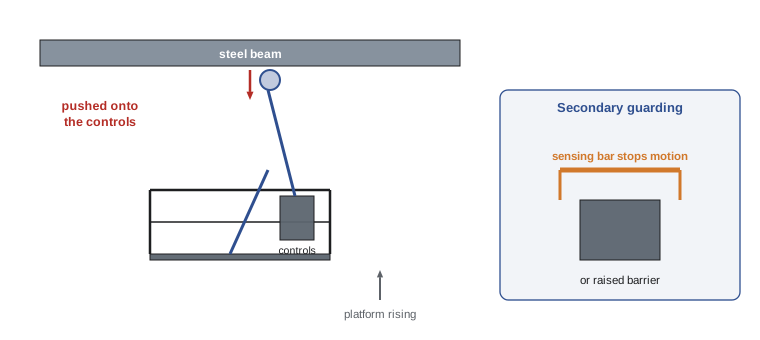
Entrapment happens when the operator is caught between the platform, usually the guardrail or control box, and an overhead or adjacent object such as a steel beam, joist, pipe, duct, door header or tree limb. The operator, looking down at the control or at the work, does not see the object until their head or back reaches it. As they are pushed forward over the control box, their body may hold the joystick in the direction of travel, so the machine keeps moving and the force increases. Workers have been killed in seconds this way.
| Situation | Why it is dangerous | Controls |
|---|---|---|
| Raising under ceiling structure | Head and shoulders reach joists, pipes or ducts before the operator notices | Measure clearance; raise slowly while looking up; set a stop height; secondary guarding |
| Driving elevated under beams or doors | The operator watches the floor or the route, not the ceiling | Lower before travelling under obstructions; use a spotter; mark low points |
| Slewing a boom near structure | The platform or the operator's body swings into columns or walls | Plan the swing; keep clear distance; use slow speeds near structure |
| Reaching through openings | Platform or boom catches on the edge of an opening | Choose a machine with the right reach and jib; use a spotter |
| Working beside racking or machinery | The platform drifts or the operator leans into moving parts | Lock out machinery; keep clear distance; use restraint |
Secondary guarding
Secondary guarding is a device on the platform that reduces the risk of an operator being trapped against the controls. It does not replace planning, but it is a valuable engineering control where entrapment risk is high, such as work under steel, ductwork or in plants. Types include:
- pressure-sensing bars or cables above the controls that stop or reverse motion when the operator is pushed onto them;
- proximity or presence sensors that detect an object near the operator and stop motion;
- physical barriers that rise above the control panel and keep space around the operator;
- enhanced control enabling that stops motion if the operator is pushed off a foot switch or lets go of a hold-to-run control.
The current safe use standards expect the user's risk assessment to consider entrapment and whether a machine with secondary guarding is needed. Many large contractors and owners now require it on all booms. Supervisors should never let crews disable or bypass these devices because they cause nuisance stops; repeated stops are a sign that the work is too close to structure.
Worked problem
How far does the platform travel before the operator reacts?
A scissor lift raises its platform 10 m in 40 seconds. An operator looking down at the work does not notice a sprinkler pipe until it touches their hard hat, and it takes them 1.5 seconds to react and release the control. How far does the platform rise after the first contact, and what does that mean for the pressure on the operator?
Show solution
- Lift speed: \( \tfrac{10}{40} = 0.25 \) m/s (illustrative; actual speeds vary by model and load).
- Travel during the reaction time: \( 0.25 \times 1.5 = 0.375 \) m, about 38 cm.
- A person's head and neck cannot compress anything like 38 cm. The machine's hydraulic force, far greater than the operator's strength, presses the operator between the pipe and the platform.
- If the operator falls forward onto the control, the motion may continue.
Answer: Nearly 40 cm (15 in) of travel after first contact is enough to cause serious or fatal injury. Look up while raising, stop well short of structure, and use secondary guarding where clearance is tight.
Travel
Travel is when MEWPs strike people, drop off edges and overturn on obstacles. A few rules cover most of the risk.
- Plan the route and walk it first. Check the floor, slopes, edges, openings, cables and overhead clearance along the whole path.
- Travel stowed wherever possible. Drive elevated only within the manufacturer's limits and where the plan allows.
- Look in the direction of travel. On booms, check which way the drive control moves the machine; if the turntable has rotated, the drive direction may be reversed relative to the operator. Most machines have colour-coded arrows on the chassis and controls for this reason.
- Keep a safe distance from edges, ramps, loading docks and floor openings, and use barriers or wheel stops where the route passes near them.
- Use a spotter in congested areas, when visibility is limited or when travelling near people, vehicles or structure.
- Keep ground workers out of the travel path and the swing radius of the boom and counterweight.
Worked problem
Tail swing and the crush zone
A telescopic boom's counterweight extends 1.1 m beyond the chassis when the turntable is rotated 90 degrees. The machine is parked 0.8 m from a block wall in a plant. A labourer is stacking material between the machine and the wall. What hazard does the planned swing create, and what control is needed?
Show solution
- When the turntable rotates, the counterweight sweeps out to 1.1 m from the chassis.
- The wall is only 0.8 m away, so the counterweight would strike the wall.
- Anyone standing between the chassis and the wall would be crushed.
- The operator on the platform may not be able to see the counterweight or the worker behind it.
Answer: Reposition the machine so the tail swing clears the wall, or restrict the swing; barricade the tail swing area so no one can enter it; and move the material stacking elsewhere while the boom is working.
Safe operating practices on the platform
Several platform rules come directly from incident investigations. They appear in the regulations, the standards and every manufacturer's manual.
| Rule | Reason |
|---|---|
| Stand on the platform deck; never sit or stand on guardrails, mid-rails or toeboards | Standing on rails raises the worker's centre of gravity above the guardrail and removes its protection |
| Never use ladders, planks, buckets or boxes on the platform to gain height | The guardrail no longer protects the worker; choose a taller machine |
| Keep the gate closed and latched; never tie it open | Open gates are a common route for falls |
| Keep both feet on the deck and body inside the rails | Leaning out shifts weight and removes guardrail protection |
| Do not exceed the rated load or persons | Overload reduces stability and structural margins |
| Do not use the platform as a crane or hoist | Suspended loads and side pulls are not in the design |
| Keep the platform tidy; secure tools and materials | Trip hazards and dropped objects injure people on and below the platform |
| Stop when a hazard appears and report it | Conditions change; the operator is the last line of defence |
Working near other activity
MEWPs often work in busy areas. On construction sites, they share space with forklifts, telehandlers, cranes, delivery trucks and other trades. In plants and warehouses, they work near forklifts, conveyors and pedestrians. Coordination matters: the MEWP's work area should be shown on the site plan or daily coordination board, other trades told when and where it will work, and vehicle routes adjusted or controlled. HSE-218 covers traffic management in warehouses and HSE-219 covers coordination with cranes; the same principles apply.
The exclusion zone around and beneath the platform protects people from falling objects and from the moving machine. Its size should allow for the platform's reach and swing and the height from which objects could fall. Lesson 10 covers dropped objects in more detail.
Spotters and communication
A spotter is only useful if the operator can see or hear them and both know the signals. Agree before work starts on how the spotter will communicate: radio on a dedicated channel, voice when close enough, or hand signals. Standard MEWP signals are simple, such as stop, emergency stop, raise, lower, move toward me and move away, but they must be agreed in advance. The spotter should stand where they can see both the hazard and the operator, out of the travel path and the tail swing, and their only task while spotting should be spotting.
| Signal or message | Meaning |
|---|---|
| Stop (arm extended, palm down, moved side to side) | Stop the current movement |
| Emergency stop (both arms extended, moved side to side) | Stop all movement immediately |
| Raise (forearm vertical, finger pointing up, small circles) | Raise the platform or boom |
| Lower (arm extended down, finger pointing down, small circles) | Lower the platform or boom |
| Distance (hands held apart, then closed together) | Shows remaining distance to an obstacle |
Fatigue and distraction
Operating a MEWP needs constant attention to the controls, the overhead and the surroundings. Long shifts, repetitive tasks, heat and phone use all reduce that attention. Plan breaks, rotate operators on long repetitive tasks, and set a rule that phones are not used while the platform moves. Many entrapment incidents involve an operator who had done the same movement dozens of times that day and stopped looking up.
Travel between work locations
Moving a MEWP between work locations is when many crews relax, and it is when many incidents happen. The machine may cross areas the site assessment did not cover, such as a gravel strip between two buildings, a ramp into a loading bay, or a corridor with low sprinkler pipes. Before moving, lower the platform fully, check the new route, and walk it if it has not been checked. Travel at a walking pace, watch for pedestrians at blind corners, and keep the platform lowered until the machine is set up at the new location and the overhead clearance has been checked again.
On construction sites, MEWPs are often loaded and unloaded from trailers. That task has its own hazards, such as ramps that shift, winches, and machines that slide on wet decks, and it should be done only by people trained for it, following the manufacturer's loading instructions.
Common mistakes
MistakeRaising the platform while looking only at the work.
InsteadLook up and around while raising, and stop well short of structure.
MistakeDisabling secondary guarding because it causes nuisance stops.
InsteadTreat nuisance stops as a sign the work is too close to structure; replan instead.
MistakeDriving elevated under beams and doorways.
InsteadLower before passing under obstructions, and use a spotter.
MistakeLetting ground workers stand between the machine and a wall.
InsteadBarricade the tail swing and travel path.
MistakeStanding on the mid-rail to reach a little higher.
InsteadStand on the deck and select a machine that reaches the work.
Summary and key terms
- Entrapment happens when an operator is pushed onto the controls by an overhead or adjacent object, often while raising or driving.
- A platform rising at 0.25 m/s travels nearly 40 cm during a 1.5 second reaction.
- Secondary guarding devices stop motion or shield the operator; never bypass them.
- Plan and walk the travel route, travel stowed where possible, look in the direction of travel and use spotters.
- Barricade the travel path and the tail swing of booms to protect ground workers.
- Stand on the deck, keep the gate closed, never use ladders on the platform and never use the platform as a crane.
- Entrapment
- Being caught between the platform and an overhead or adjacent object.
- Secondary guarding
- A device that reduces the risk of an operator being trapped against the controls.
- Tail swing
- The arc swept by the counterweight or turntable when a boom rotates.
- Spotter
- A person who watches travel or movement and warns the operator of hazards.
- Hold-to-run control
- A control that moves the machine only while it is held, stopping when released.
- Enable switch
- A foot switch or trigger that must be held for platform controls to work.
- Exclusion zone
- A marked area around and beneath a MEWP that unauthorized people must not enter.
Practice problems
Work each problem on paper first, then reveal the answer to check.
Describe how entrapment typically happens.
Show answer
The operator, looking down, raises or drives the platform into an overhead object, is pushed onto the controls and may hold them in the direction of travel.
A platform rises at 0.3 m/s and the operator takes 2 s to react. How far does it travel?
Show answer
0.6 m.
Name three types of secondary guarding.
Show answer
Pressure-sensing bars or cables, proximity sensors, physical barriers and enhanced enable controls.
Why should drive direction be checked on a boom whose turntable has rotated?
Show answer
The drive control may move the machine in the opposite direction to what the operator expects.
What should be done about the tail swing area of a boom?
Show answer
Barricade it so no one can be struck or crushed.
Why must workers never use ladders on the platform?
Show answer
The guardrail no longer protects them, and the ladder can slip or tip.
When should a spotter be used?
Show answer
In congested areas, with limited visibility, near people, vehicles, edges or structure.
What do repeated nuisance stops of secondary guarding indicate?
Show answer
The work is too close to structure and should be replanned.
Why is tying the platform gate open dangerous?
Show answer
It creates an opening in the guardrail through which workers can fall.
Why must the platform not be used as a crane?
Show answer
Suspended loads and side pulls are outside the design and reduce stability.
Lesson quiz · 5 questions
Score 60% or more to complete this lesson.
Create a free account to save your progress, take quizzes and earn a certificate.