
HSE-220 · Lesson 3 of 12 · 27 min
Types of MEWPs and their safety features
Choosing the right MEWP starts with knowing what each type can and cannot do. The machines look different, but they share the same basic parts: a chassis that carries the weight and provides stability, an extending structure that raises the platform, and a work platform with guardrails and controls. Differences in those three parts decide where each machine can go, how high and far it reaches, how much it can carry and which hazards are most important.
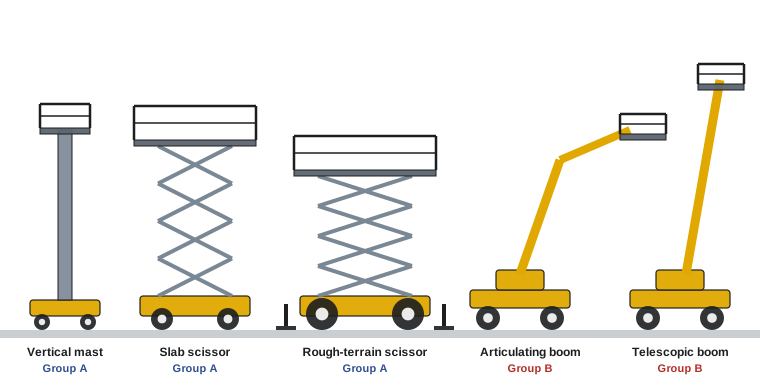
Group A machines
On a Group A machine, the centre of the platform stays within the tipping lines, the lines joining the wheels or outriggers that the machine would tip over. Because the load stays above the base, Group A machines are relatively stable in the vertical direction. Their main hazards are overturning on slopes, potholes and curbs; entrapment against overhead structure; and falls when workers climb on guardrails or lean out.
- Vertical mast lifts, sometimes called personnel lifts, carry one person on a small platform raised by a telescoping mast. Push-around versions must be moved with the platform lowered; self-propelled versions may drive elevated. They are used for light maintenance and stock picking in tight indoor spaces.
- Slab scissor lifts run on solid, non-marking tires and are designed for level, hard surfaces such as concrete floors. Most are electric. Platform heights range from about 4 m to about 15 m.
- Rough-terrain scissor lifts have pneumatic or foam-filled tires, more ground clearance and often outriggers or levelling jacks. Many are diesel, dual-fuel or hybrid. They are designed for compacted ground on construction sites, not for mud, soft fill or steep slopes.
Group B machines
On a Group B machine, the platform can move outside the tipping lines. The boom works like a lever: the further out the platform goes, the greater the overturning moment, and the counterweight and chassis must resist it. Group B machines bring reach, which lets workers get over obstacles and out to façades, but they add hazards that Group A machines do not have.
- Telescopic booms (straight booms) extend in a straight line and give the greatest horizontal reach. They are used for steel erection, façade work and work over obstacles.
- Articulating booms (knuckle booms) have two or more sections that fold, often with a short jib at the platform. They can reach up and over obstacles and down into spaces, which makes them useful around building structure and inside plants.
- Trailer-mounted and truck-mounted booms are towed or carried on a vehicle and set on outriggers. Vehicle-mounted aerial devices used by utilities and arborists are designed to their own standards and are often insulated for electrical work.
The extra hazards of Group B machines include the catapult effect, where a jolt at the chassis whips the boom and can throw the occupant out; entrapment against structure as the platform swings; and greater exposure to power lines because the platform can reach toward them. These are the reasons the regulations and manufacturers require occupants of boom lifts to wear a harness with a short lanyard attached to the platform anchorage.
Types 1, 2 and 3
The type describes how a machine travels.
| Type | Travel | Examples |
|---|---|---|
| Type 1 | Travel only in the stowed (lowered) position | Push-around vertical mast lifts; towed trailer booms |
| Type 2 | Travel with the platform raised, controlled from the chassis | Some truck-mounted units driven from the cab while elevated |
| Type 3 | Travel with the platform raised, controlled from the platform | Most self-propelled scissor lifts and boom lifts |
| Type 1 | Type 3 | |
|---|---|---|
| Group A | Push-around vertical mast lift (category 1a) | Self-propelled scissor lift or vertical mast lift (category 3a) |
| Group B | Trailer-mounted boom (category 1b) | Self-propelled telescopic or articulating boom (category 3b) |
IPAF's incident reports use these categories. In its report on 2025 incidents, Category 3b machines, self-propelled booms, appeared in about a quarter of reports, and Category 3a machines, self-propelled scissors and mast lifts, in about another quarter. Both families need attention.
Safety features built into current machines
Machines built to CSA B354.6 or the equivalent ISO standard carry safety features that older machines may lack. A supervisor should know what each feature does, so that a crew does not bypass it or treat an older machine as if it had it.
| Feature | What it does | What defeats it |
|---|---|---|
| Load sensing | Detects platform overload and stops normal operation with an alarm | Tampering, failed calibration, ignoring the alarm and lowering a person off to "fix" the load at height |
| Tilt alarm and cut-out | Warns and stops elevating or driving when the chassis is beyond its allowed slope | Driving onto slopes while stowed then raising; jumpering sensors |
| Pothole protection | Bars or plates drop on scissor lifts when raised, reducing the chance a wheel falls into a hole | Debris jamming the guards; holes larger than the guards can bridge |
| Drive speed limiting | Reduces travel speed when the platform is raised | Driving fast while stowed toward a slope or edge |
| Guardrails and self-closing gate | Keep occupants inside the platform | Tying the gate open; standing on mid-rails; leaning out |
| Emergency stop and lowering | Stop all motion; allow the platform to be lowered from the ground if the operator cannot | Lost keys, dead batteries, people who do not know where the controls are |
| Secondary guarding (on some machines) | Senses or physically protects against an operator being pushed onto the controls by an overhead object | Disabling sensors; not choosing a machine with it where entrapment risk is high |
| Motion alarms | Sound or flash during travel or lowering | Disconnecting the beeper because it is annoying |
Wind rating is another design feature. Machines rated for outdoor use are designed to remain stable in winds up to a stated speed, typically 12.5 m/s (about 45 km/h or 28 mph) under the current standards. Machines rated for indoor use only have a wind rating of zero: they must not be used outdoors at all, even on a calm day, because a gust can tip them. The rating is on the machine's decals and in the manual. Lesson 9 covers wind in detail.
Reading the specification plate
Every MEWP carries a manufacturer's plate and decals. They are the quickest way to check whether a machine fits the job.
Worked problem
Does this scissor lift fit the job?
A slab scissor lift's plate shows: platform height 7.9 m; rated load 227 kg indoors with 2 persons, 113 kg outdoors with 1 person; maximum wind speed 12.5 m/s outdoors; maximum slope stowed 25 per cent, elevated drive only on level surfaces; maximum wheel load 1,020 kg. A crew of two plans to install 30 kg of ducting each trip on an outdoor canopy 6.5 m above a level asphalt lot. Each worker weighs about 90 kg with tools. Does the machine fit?
Show solution
- Height: a platform height of 7.9 m gives a working height of about 9.7 m, more than enough for a canopy at 6.5 m.
- Load: outdoors, the machine is rated for one person and 113 kg. Two workers at 90 kg each is 180 kg before any ducting, so the crew plan breaks both the person limit and the load limit.
- With one worker: 90 kg plus 30 kg of ducting is 120 kg, which still exceeds 113 kg.
- Wind: the outdoor rating of 12.5 m/s must be checked against the forecast on the day.
Answer: The machine does not fit the plan. Outdoors it is limited to one person and a load that the worker and ducting together exceed. Choose a machine with a larger outdoor rating, or reduce the material per trip and check the total each time.
Many scissor lifts have a lower outdoor rating than indoor rating because wind force on people and materials adds to the overturning moment. Crews that work inside most of the time often miss this when they take the same machine outside.
Older machines and rental fleets
Machines built before the current standards took effect may lack load sensing, have different wind ratings or use older terms on their decals. They can still be used if they are maintained, inspected and used according to their manufacturer's instructions and the law, but supervisors should check what features they have rather than assume. Rental companies are a good source of information: they must provide the manual and familiarization information and can advise on which machine suits a task.
Worked problem
Group, type and the right card
A crew has three machines on site: a push-around vertical mast lift, a 32 ft electric scissor lift and a 45 ft articulating boom that drives from the platform. An apprentice's training card lists categories 3a only. Which machines may the apprentice operate after familiarization?
Show solution
- The push-around mast lift is Group A, Type 1 (category 1a), because it travels only when lowered.
- The self-propelled scissor lift is Group A, Type 3 (category 3a).
- The articulating boom that drives from the platform is Group B, Type 3 (category 3b).
- The card covers 3a only.
Answer: Only the scissor lift, after familiarization on that model. The apprentice needs training covering 1a for the push-around and 3b for the boom before operating them.
The categories are a convenient shorthand. When planning a job, write the group and type of the selected machine in the safe use plan and check them against each operator's training record.
Power sources
MEWPs run on batteries, internal combustion engines or both. The power source affects where a machine can work and what hazards it brings.
| Power source | Strengths | Hazards and limits |
|---|---|---|
| Battery electric (lead-acid or lithium-ion) | No exhaust, quiet, suited to indoor work | Limited run time; charging hazards such as hydrogen from lead-acid batteries; reduced capacity in cold |
| Diesel or gasoline engine | Long run time, power for rough terrain | Exhaust containing carbon monoxide and other contaminants; noise; fuel handling and fire |
| Propane or dual-fuel | Can switch between fuels | Carbon monoxide from propane combustion; cylinder handling |
| Hybrid | Electric operation indoors with engine charging outdoors | Engine hazards whenever the engine runs |
Supervisors often meet the power source question when a machine moves from outdoor to indoor work. A diesel boom that was fine in a parking lot can build up dangerous levels of carbon monoxide inside a building within minutes. Choose an electric or hybrid machine for indoor work, or plan ventilation and monitoring.
Common mistakes
MistakeUsing an indoor-only scissor lift outside on a calm day.
InsteadNever use a machine rated for zero wind outdoors; choose an outdoor-rated machine.
MistakeAssuming the indoor rated load applies outdoors.
InsteadCheck the outdoor rating, which is often lower in load and number of persons.
MistakeTreating a rough-terrain scissor as an all-terrain machine.
InsteadUse it only on ground and slopes within the manufacturer's limits.
MistakeIgnoring the catapult effect on booms.
InsteadWear a harness with a short lanyard on the platform anchorage and avoid driving elevated over rough ground.
MistakeAssuming an older machine has load sensing or secondary guarding.
InsteadCheck the features of each machine and plan controls for any that are missing.
Summary and key terms
- All MEWPs have a chassis, an extending structure and a work platform.
- Group A machines keep the platform within the tipping lines; Group B machines can reach outside them.
- Type 1 travels only stowed; Type 2 travels elevated from the chassis; Type 3 travels elevated from the platform.
- Current machines carry load sensing, tilt cut-outs, pothole protection, speed limiting and emergency controls.
- Outdoor-rated machines are typically designed for winds up to 12.5 m/s; indoor-only machines are rated for zero wind.
- Read the plate for height, rated load indoors and outdoors, persons, wind, slope and wheel load before choosing a machine.
- Tipping line
- The line joining wheels or outriggers about which a MEWP would overturn.
- Working height
- Platform height plus an allowance for a person standing on the platform, commonly about 2 m (6 ft).
- Load sensing system
- A system that detects platform overload and prevents normal operation.
- Pothole protection
- Guards that lower beneath a scissor lift chassis when it is raised to limit the effect of holes and drop-offs.
- Secondary guarding
- A device that reduces the risk of an operator being trapped against the controls by an overhead object.
- Category 3a and 3b
- Self-propelled Group A and Group B machines that travel elevated from the platform.
- Wind rating
- The maximum wind speed in which the manufacturer says a MEWP may be used.
Practice problems
Work each problem on paper first, then reveal the answer to check.
What three parts do all MEWPs share?
Show answer
A chassis, an extending structure and a work platform.
Classify a self-propelled telescopic boom by group and type.
Show answer
Group B, Type 3 (category 3b).
Why is a boom lift more exposed to the catapult effect than a scissor lift?
Show answer
The long boom acts as a lever, so a jolt at the chassis is amplified at the platform.
What wind rating does an indoor-only MEWP have?
Show answer
Zero; it must not be used outdoors.
A scissor lift is rated 227 kg indoors and 113 kg outdoors. Why might the ratings differ?
Show answer
Wind force on people and materials adds to the overturning moment outdoors.
What does pothole protection do?
Show answer
It lowers guards under the chassis when raised so a wheel is less likely to drop into a hole.
Name two hazards that are greater on Group B machines.
Show answer
Catapult ejection, entrapment as the platform swings, and reach toward power lines.
What is working height?
Show answer
Platform height plus about 2 m (6 ft) for a person standing on the platform.
Why should a supervisor check the features of an older machine?
Show answer
It may lack load sensing, secondary guarding or other features that current machines have.
Which category covers a push-around vertical mast lift?
Show answer
Category 1a: Group A, Type 1.
Lesson quiz · 5 questions
Score 60% or more to complete this lesson.
Create a free account to save your progress, take quizzes and earn a certificate.