
HSE-220 · Lesson 4 of 12 · 27 min
The safe use plan and site assessment
The current MEWP standards make planning a formal duty. Under CSA B354.7, the user, meaning the employer that directs the work, must prepare a safe use plan before a MEWP is used. The plan does not need to be long for simple jobs, but it must show that someone has looked at the task, the site and the people, chosen a suitable machine and controls, and planned how to get a worker down if something goes wrong.
A good plan is also the supervisor's best tool. It records the decisions that prevent the five fatal events from lesson 1, and it gives the crew something specific to check against on the day. A plan that sits in a binder in the site office and is never discussed with the crew does neither.
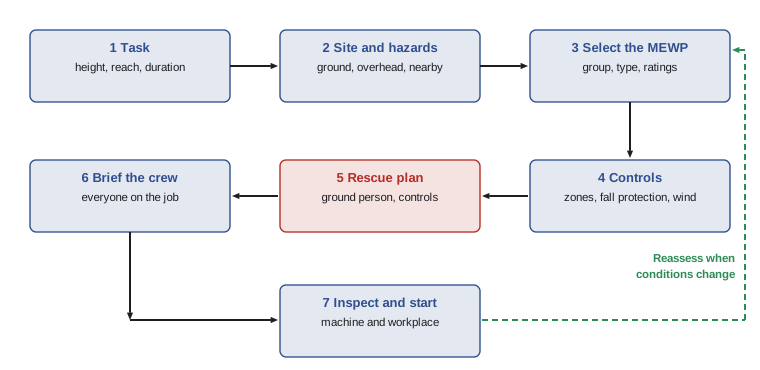
What the plan should contain
| Element | Questions to answer |
|---|---|
| Task | What work is being done, where, at what height and reach, for how long, with what tools and materials? |
| Risk assessment | Which of the five fatal events could happen here? What other hazards exist, such as traffic, noise, dust, hot work or confined areas? |
| Site and ground | What is the ground or floor made of? Its slope? Any trenches, voids, manholes, ramps, floor loading limits or soft spots? |
| Overhead and nearby | What structure, pipes, ducts, trees, signs, cranes or power lines are above or near the work? |
| MEWP selection | Which group, type and model? Indoor or outdoor rating? Rated load and persons? Ground pressure? Power source? |
| People | Who will operate and occupy the platform? Are they trained and familiarized? Who supervises? Who is the trained ground person? |
| Controls | Exclusion zone, barriers, spotters, traffic control, fall protection, mats, wind limits, permits, lighting |
| Rescue | How will a worker be brought down if the operator is hurt or the machine fails? Who can use the ground controls? How fast? |
| Communication | How will the platform and ground communicate? How will other trades and site traffic know the MEWP is working? |
| Review | Who approved the plan? When will it be reviewed? What changes would require stopping and replanning? |
The site assessment
The site assessment is the part of the plan most often skipped and most often behind serious incidents. It should be done by walking the actual route and work location, not by looking at drawings alone. Take a tape measure, a level or inclinometer app, and a camera.
- Route in: how will the machine get from the delivery point to the work area? Check doors, ramps, floor loading on suspended slabs, curbs, cables and hoses, other traffic and overhead clearance.
- Ground or floor: is it level, firm and able to carry the wheel or outrigger loads? Look for backfilled trenches, manholes, floor drains, recent excavation, frost, mud, soft asphalt on hot days and floor openings covered with plywood.
- Overhead: list everything the platform or boom could contact, including steel joists, sprinkler pipes, cable trays, door headers, tree branches, signs and power lines. Measure the clearance where the platform will be raised.
- Nearby: walls, racking, guardrails at mezzanine edges, glass, machinery, vehicles and pedestrians that the machine or its swinging tail could strike.
- Environment: indoor air quality for engine-powered machines, lighting, weather exposure, wind tunnels between buildings, temperature limits for batteries and hydraulics.
Worked problem
Measuring slope on site
A crew wants to use a slab scissor lift on a parking garage ramp. The manual says the machine may be driven stowed on slopes up to 25 per cent but must be on a firm, level surface (within the tilt alarm limit of 1.5 degrees side to side and 3 degrees front to back) to elevate. The crew measures a rise of 0.45 m over a horizontal run of 6 m. Can they raise the platform on the ramp?
Show solution
- Slope as a percentage: \( \tfrac{0.45}{6} \times 100 = 7.5 \) per cent.
- Slope as an angle: \( \arctan(0.075) = 4.3 \) degrees.
- Driving stowed at 7.5 per cent is within the 25 per cent limit.
- Elevating requires less than 3 degrees front to back. The ramp is 4.3 degrees, so the tilt alarm would sound and the platform would not rise, or should not be raised.
Answer: No. The machine may be driven on the ramp stowed, but the platform must not be raised there. Work from a level area, use a machine with levelling jacks or outriggers rated for the slope, or choose another method.
Slope is stated in two ways and they are easily confused. Manufacturers often give drive limits as a percentage, where 100 per cent is 45 degrees, and tilt limits for elevating in degrees. A 25 per cent slope is only 14 degrees. Always convert before comparing.
| Percentage grade | Angle (degrees) | Rise per 10 units of run |
|---|---|---|
| 2 per cent | 1.1 | 0.2 |
| 5 per cent | 2.9 | 0.5 |
| 10 per cent | 5.7 | 1.0 |
| 25 per cent | 14.0 | 2.5 |
| 45 per cent | 24.2 | 4.5 |
| 100 per cent | 45.0 | 10 |
Selecting the machine
Selection follows from the task and the site. The supervisor should be able to explain in the plan why the chosen machine suits the job. Typical reasons include:
- reach and height: the platform must reach the work without the worker leaning out, standing on rails or using a ladder on the platform;
- capacity: the rated load, in the configuration and environment used, must exceed the weight of all people, tools and materials;
- ground: the machine's wheel or outrigger loads must be within what the ground or floor can carry, with mats if needed;
- environment: indoor or outdoor rating, emissions, noise, non-marking tires, size for doors and aisles;
- hazards: an insulated aerial device for work that cannot avoid energized lines, secondary guarding where entrapment risk is high, a Group A machine where a boom is not needed.
Briefing the crew
Before work starts, the supervisor or a competent person should brief everyone involved: operators, occupants, ground persons and spotters. Cover the task, the hazards found in the site assessment, the controls, the fall protection to be used, the wind limit, the exclusion zone, communication and the rescue plan. Ask the crew what they see that the plan missed. The people who will be on the platform often know about a soft spot in the yard or a duct that has been moved since the drawings were made.
Worked problem
Spotting a change that needs replanning
A safe use plan for re-lamping a gymnasium assumed an empty floor. On the day, the school has set out bleachers and the crew proposes to drive the scissor lift around them with the platform raised to save time. The plan says the platform may travel elevated only on clear, level floor with a spotter. What should the supervisor do?
Show solution
- The bleachers are a change from the conditions assumed in the plan.
- Driving elevated around obstacles increases the risk of striking them and of entrapment against the ceiling structure as the operator looks down.
- The plan's condition of clear floor is not met, so elevated travel is not allowed under the plan.
- Options include lowering the platform before each move, moving the bleachers, rescheduling, or revising the plan with a spotter and marked route.
Answer: Stop and replan. Either restore the conditions the plan assumed or revise the plan and brief the crew before continuing. A change in conditions is one of the clearest triggers for reassessment.
When to review the plan
A safe use plan is not a one-time form. Review it when the task, the machine, the crew or the site changes; when weather changes, especially wind; after any incident or near miss; and at a set interval on long jobs. Many employers combine the daily review with the field-level hazard assessment or job hazard analysis described in HSE-230, so the crew checks the plan against conditions every shift.
A one-page plan for routine work
Many jobs repeat: re-lamping, sprinkler inspection, painting, sign maintenance. For these, employers often use a one-page safe use plan form that the supervisor completes for each location, with a fuller plan only for complex jobs. A good one-page form has short prompts for each element of the plan and space to record the machine, the people, the hazards and the rescue arrangements.
| Prompt on the form | Example entry |
|---|---|
| Task and location | Replace 12 high-bay fixtures, aisles 4 to 6, warehouse B |
| Machine (group, type, model, rating) | Electric slab scissor, Group A Type 3, 26 ft platform height, 2 persons indoors |
| Ground and route | Level sealed concrete; floor drain at aisle 5 end marked; route via door 3 |
| Overhead and nearby | Joists 1.0 m above fixtures; sprinkler mains in aisle 6; racking both sides |
| Controls | Height limit marked; forklifts excluded from aisles 4 to 6; cones at aisle ends; restraint when moving |
| People | Operator A (3a card, familiarized today); occupant B instructed; ground person C trained on ground controls |
| Rescue | C lowers with ground controls; manual descent knob at rear left of chassis; call 911 in parallel |
| Weather and review | Indoor; review if layout or crew changes; supervisor sign-off |
The form is only useful if it reflects what the supervisor actually saw. Pre-filled forms copied from job to job, with the same hazards listed regardless of location, are a warning sign that the site assessment is not being done. A quick way to test a plan is to ask the crew one question about it, such as where the manual descent control is or what the height limit is; if they cannot answer, the plan has not reached them.
Complex jobs need more: multiple machines, work near power lines, work over public areas, work on slopes or soft ground, exiting at height, or tasks that push close to a machine's limits. For these, a written plan with drawings, calculations and sign-off by a competent person, and sometimes an engineer, is appropriate.
Planning for several machines at once
On larger jobs, several MEWPs may work in the same area, sometimes with forklifts, telehandlers or cranes nearby. The safe use plan should show where each machine will work and when, how their working areas are separated, and who coordinates them. Booms working side by side can swing into each other, and a scissor lift raised in an aisle can block another machine's route or a fire exit. A simple site sketch with work zones, routes and parking and charging areas makes the plan much easier to follow than a written description alone, and it helps other trades see where they must not go while the platforms are up.
Common mistakes
MistakeWriting a safe use plan from drawings without walking the site.
InsteadWalk the route and work area, measuring slopes and overhead clearances.
MistakeComparing a slope in per cent with a tilt limit in degrees.
InsteadConvert both to the same unit before deciding.
MistakeLeaving the rescue plan for later.
InsteadPlan how to bring a worker down before the platform is raised.
MistakeKeeping the plan in the office.
InsteadBrief the crew on the plan and keep it at the work location.
MistakeContinuing when conditions change from those the plan assumed.
InsteadStop, reassess and revise the plan before continuing.
Summary and key terms
- The user must prepare a safe use plan before MEWP work, covering task, risks, site, selection, people, controls, rescue and communication.
- The site assessment should be done on foot along the route and at the work location.
- Slope limits for driving are often in per cent and tilt limits for elevating in degrees; a 25 per cent slope is 14 degrees.
- The machine must be selected for reach, capacity, ground, environment and specific hazards.
- Brief the whole crew, including ground persons and spotters, and invite them to add hazards.
- Review the plan whenever conditions change, after incidents and at regular intervals.
- Site assessment
- An on-site inspection of the route, ground, overhead and nearby hazards and environment for MEWP work.
- Percentage grade
- Slope expressed as rise divided by run times 100.
- Tilt alarm
- A device that warns, and on current machines stops certain functions, when the chassis exceeds its allowed slope.
- Ground person
- A trained person at ground level who can operate the ground controls and call for help in an emergency.
- Spotter
- A person who watches the MEWP's travel or position and warns the operator of hazards.
- Reassessment trigger
- A change in task, machine, crew, site or weather that requires the plan to be reviewed.
- Floor loading limit
- The maximum load a suspended slab or floor can carry, which must exceed the MEWP wheel loads.
Practice problems
Work each problem on paper first, then reveal the answer to check.
Who must prepare the safe use plan?
Show answer
The user, meaning the employer that directs the MEWP work.
Convert a 12 per cent slope to degrees.
Show answer
\( \arctan(0.12) = 6.8 \) degrees.
List four things to check overhead during a site assessment.
Show answer
Steel joists, sprinkler pipes, cable trays and ducts, door headers, tree branches, signs and power lines.
Why walk the route from the delivery point?
Show answer
To find doors, ramps, floor loading limits, curbs, openings and overhead obstructions along the way.
Give three triggers for reviewing a safe use plan.
Show answer
Changes in task, machine, crew, site or weather, incidents or near misses, and regular intervals on long jobs.
Why should the crew be asked what the plan missed?
Show answer
They often know about site changes or local hazards the planner did not see.
A ramp rises 0.3 m in 4 m. What is the grade and angle?
Show answer
About 7.5 per cent, or 4.3 degrees.
What should the plan say about rescue?
Show answer
How a worker will be brought down if the operator is hurt or the machine fails, who can use the ground controls and how quickly.
What is the risk of plywood over a floor opening?
Show answer
A wheel could break through, causing an overturn.
Why should engine-powered MEWPs be considered carefully indoors?
Show answer
Exhaust can build up carbon monoxide and other contaminants.
Lesson quiz · 5 questions
Score 60% or more to complete this lesson.
Create a free account to save your progress, take quizzes and earn a certificate.