
HSE-220 · Lesson 2 of 12 · 28 min
Law, standards and responsibilities
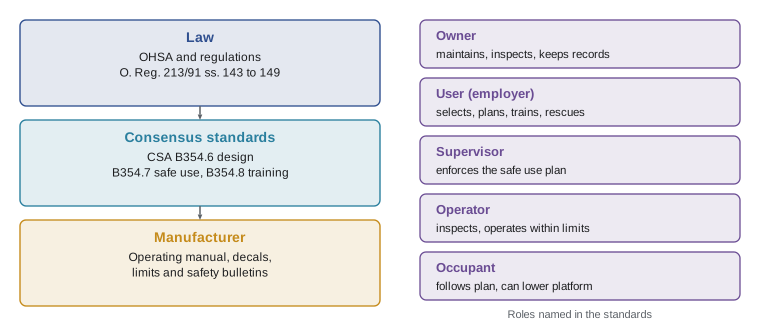
Several layers of rules govern MEWPs. At the top is occupational health and safety law, which sets general duties and, in most jurisdictions, specific requirements for elevating work platforms. Below it are national consensus standards for design, safe use and training, which the law often adopts by reference. Below those are the manufacturer's operating manual and safety decals, which apply to the specific machine. A supervisor needs to know enough about each layer to recognize when a job does not comply.
The consensus standards
Canada and the United States both rewrote their MEWP standards in the late 2010s, aligning them with international ISO standards. In Canada the CSA B354 suite took effect in May 2018. It replaced the older separate standards for self-propelled, boom-supported and other platforms with three standards that work together.
| Standard | Covers | Who it mainly affects |
|---|---|---|
| CSA B354.6:17 | Design, calculations, safety requirements and test methods for MEWPs | Manufacturers; owners checking that a machine meets current design rules |
| CSA B354.7:17 | Safety principles, inspection, maintenance and operation | Owners, users (employers), supervisors, operators and occupants |
| CSA B354.8:17 | Operator training, including occupants and supervisors | Employers, trainers, operators |
| CSA C225 | Vehicle-mounted aerial devices, such as utility bucket trucks | Utilities, arborists, sign and lighting contractors |
The B354 standards are not automatically law everywhere. Ontario's construction regulation still names the older CSA standards from the 1980s for design certification, while Quebec's construction safety code refers to B354.6, B354.7 and B354.8. In practice, rental fleets and manufacturers in Canada now build, inspect and train to the current suite, and an inspector will expect to see the safe use plan, familiarization and training records it calls for.
Groups and types
The new standards classify MEWPs by two simple ideas that matter for training, fall protection and set-up. They are described in detail in lesson 3.
- Group A: the centre of the platform stays inside the tipping lines in all positions, as on a scissor lift or vertical mast lift. Group B: the platform can move outside the tipping lines, as on a boom lift.
- Type 1: travel is allowed only in the stowed position. Type 2: travel with the platform raised is controlled from the chassis. Type 3: travel with the platform raised is controlled from the platform.
The roles
The standards assign duties by role rather than by job title. One person can hold several roles; a small contractor may be owner, user, supervisor and operator all at once. The table summarizes the main duties.
| Role | Main duties |
|---|---|
| Owner | Keeps the machine in safe condition; performs frequent and annual inspections; keeps records, manuals and decals; acts on manufacturer safety bulletins; provides familiarization information when renting |
| User (employer) | Selects the right MEWP; prepares a safe use plan with a risk assessment and rescue plan; ensures operators, occupants and supervisors are trained and familiarized; provides fall protection; controls the work area |
| Supervisor | Trained on the hazards and rules; makes sure the safe use plan is followed; checks that operators are trained and familiarized; stops unsafe work |
| Operator | Trained and familiarized; performs the pre-use inspection and function tests; inspects the workplace; operates within the manufacturer's limits; stops when a hazard appears |
| Occupant | Anyone else on the platform; must be instructed on the safe use plan, fall protection, emergency controls and how to lower the platform if the operator is incapacitated |
The supervisor role is new in the current standards and deliberately so. Many incidents investigated before 2018 involved a trained operator directed by someone who did not understand the machine's limits: a foreman who said to drive the scissor lift across a muddy yard, or a manager who wanted the job done in a wind that the operator thought was too strong. The standards now expect supervisors to be trained in the selection, hazards and rules for MEWPs, which is the purpose of this course.
Provincial and federal law
In Canada, MEWP rules come from provincial and territorial health and safety laws, or from the Canada Labour Code for federally regulated workplaces. The general duties are the same everywhere: employers must provide safe equipment, information, instruction and supervision; supervisors must make sure workers follow the rules and must take every reasonable precaution; and workers must use the equipment and protective devices as required and report hazards.
| Jurisdiction | Key MEWP provisions (as checked October 2026) |
|---|---|
| Ontario construction (O. Reg. 213/91) | Sections 143 to 149: engineer design and certification to the named CSA standard and at least 1.3 kN rated working load (s. 144); guardrails and signs showing rated load, limiting conditions and the standard (s. 144); daily inspection by a trained worker (s. 144); owner's permanent maintenance record and inspection tag (ss. 145 and 146); training with oral and written instruction on the class of platform (s. 147); no overloading, use only per the manufacturer, fall protection attached to the platform when moving and at all times on boom-type platforms (s. 148); manual kept with the machine (s. 149) |
| Ontario, all sectors | OHSA general duties; working at heights training under O. Reg. 297/13 for construction workers who may use fall protection; limits of approach to power lines (O. Reg. 213/91 s. 188) |
| Alberta | OHS Code Part 9, s. 156: fall arrest connected to the manufacturer's anchor on boom-supported platforms and aerial devices; travel restraint on scissor lifts unless the manufacturer allows guardrails alone and the lift is on a firm, substantially level surface |
| British Columbia | OHS Regulation Part 13: rated capacity marking, manuals kept at the workplace, inspection and maintenance records, automatic motion alarms, annual inspection and certification of boom-supported platforms, and fall protection requirements |
| Quebec | Safety Code for the construction industry: equipment to CSA B354.6, structural inspection under B354.7, training to B354.8 with a practical component and periodic refresher training, and on-site familiarization |
Reading the rules together
When the law, a standard and the manufacturer's manual say different things, follow the most protective requirement that applies. A few common situations show how this works in practice.
Worked problem
When the rules seem to disagree
A manufacturer's manual for a scissor lift says guardrails provide fall protection and an anchorage is provided for restraint if site rules require it. The project is an Ontario construction site and the crew plans to drive the lift elevated along a mezzanine edge. What fall protection is required?
Show solution
- O. Reg. 213/91 s. 148 does not allow an elevating work platform to be moved unless every worker on it is protected by fall protection attached to an adequate anchorage on the platform.
- The manufacturer provides an anchorage on the platform, so restraint can be attached to it.
- Driving elevated along an edge also adds a hazard of the lift dropping off the edge, which needs its own controls.
- The regulation is more protective than the manual's default, so it governs.
Answer: Every worker must be attached to the manufacturer's anchorage on the platform while it moves, using a restraint lanyard short enough to keep them inside the guardrails. The drop-off hazard also needs a barrier or a set-back distance.
Two principles stay constant. First, the manufacturer's limits are not optional: no regulation allows a platform to be used beyond its rated load, slope, wind or configuration limits. Second, anything that changes the machine, such as adding a material rack, extending the platform with planks or welding on a bracket, needs the manufacturer's written approval or an engineer's equivalent certification. OSHA's 1926.453(a)(2) and the CSA and ANSI design standards all say this in different words.
Worked problem
Checking an operator's qualifications
A subcontractor arrives with a 60 ft telescopic boom from a rental company and an operator whose wallet card shows MEWP operator training for Group A Type 3 and Group B Type 3 machines, completed two years ago. What else should the supervisor check before the operator starts work?
Show solution
- The card covers the right group and type, because a telescopic boom that drives from the platform is Group B, Type 3.
- Training alone is not enough. The operator must be familiarized on this make and model: controls, safety devices, emergency lowering, load charts and limits.
- The rental company should have provided familiarization information, the manual and the machine's inspection records on delivery.
- The supervisor should confirm the operator has done the pre-use inspection and function tests and knows the site's safe use plan and rescue plan.
- If fall protection is needed, check that the operator has a harness and restraint lanyard compatible with the platform anchorage, and in Ontario that working at heights training is current.
Answer: Confirm familiarization on the specific model, the pre-use inspection, the safe use and rescue plans, fall protection equipment and any jurisdiction-specific training before authorizing the operator to start.
Records matter here. If an inspector or investigator asks how you knew the operator was competent, a signed familiarization record, a copy of the training certificate and a completed pre-use checklist answer the question. A verbal assurance does not.
Rental machines and shared responsibilities
Most MEWPs on construction sites and in facilities are rented, which splits the duties between two organizations. The rental company is usually the owner. It must deliver a machine that has been inspected and maintained, with its manual, decals and records, and it must provide the information needed for familiarization, such as the location of the controls, the safety devices and the emergency lowering procedure. Many rental companies offer to familiarize operators on delivery, and that should be accepted and recorded.
The renting employer is the user. It takes on the duties of selecting the machine for the task, preparing the safe use plan, making sure operators are trained and familiarized, doing the pre-use inspection every shift and controlling the work area. When a machine develops a fault, the user must take it out of service and call the owner; the user should not repair it unless the rental agreement and the manual allow it and a qualified person does the work.
On multi-employer sites, the constructor or general contractor coordinates the work and often sets site rules that are stricter than the law, such as restraint on every MEWP or secondary guarding on every boom. Subcontractors bring their own machines and plans, but the site's rules apply to them. Supervisors should know which company is responsible for each machine on site and who to call when something goes wrong.
| Question | Usually answered by |
|---|---|
| Is the machine's annual inspection current? | Owner (rental company); check the decal or records on delivery |
| Is this the right machine for the task and site? | User (renting employer) in the safe use plan |
| Has the operator been familiarized on this model? | User, often with information or a session from the owner |
| Who repairs a fault found in the pre-use inspection? | Owner or a qualified mechanic it authorizes |
| What site rules apply? | Constructor or general contractor |
Common mistakes
MistakeAssuming the regulation is the only rule that matters.
InsteadApply the law, the consensus standards, the manufacturer's manual and site rules together, following the most protective.
MistakeTreating a training card as proof that a worker can operate any machine.
InsteadCheck that training covers the group and type, and that the worker has been familiarized on the specific model.
MistakeModifying a platform with planks, racks or brackets without approval.
InsteadGet written approval from the manufacturer or an equivalent engineering certification before any modification.
MistakeThinking supervisors need no MEWP training because they do not operate.
InsteadSupervisors must understand selection, hazards and rules so they can direct the work safely.
MistakeLeaving the operating manual in the rental office.
InsteadKeep the manual with the machine on site, as the regulations and standards require.
Summary and key terms
- MEWP rules come from OHS law, the CSA B354 standards and the manufacturer's manual, applied together.
- The current standards classify machines by group (A or B) and type (1, 2 or 3).
- Owners, users, supervisors, operators and occupants each have defined duties; one person may hold several roles.
- Ontario's O. Reg. 213/91 ss. 143 to 149 set design, inspection, training, use and manual requirements for elevating work platforms.
- Manufacturer limits are never optional, and modifications need written approval.
- Training covers the class of machine; familiarization covers the specific model; both are needed.
- User
- In the MEWP standards, the employer or organization that has control of the MEWP and directs its use.
- Owner
- The person or organization that owns the MEWP and is responsible for its maintenance and inspection.
- Occupant
- A person on the platform other than the operator.
- Safe use plan
- A written plan prepared by the user that assesses risks, selects the MEWP and controls, and includes a rescue plan.
- Group A and Group B
- Classification by whether the platform centre stays within the tipping lines (A) or can move outside them (B).
- Adopted by reference
- When a law names a standard so that it becomes part of the legal requirement.
- Rated load
- The maximum combined weight of people, tools and materials the manufacturer allows on the platform.
Practice problems
Work each problem on paper first, then reveal the answer to check.
Name the three CSA standards in the B354 MEWP suite and what each covers.
Show answer
B354.6 design, B354.7 safe use, inspection and maintenance, B354.8 training.
Which role prepares the safe use plan?
Show answer
The user, meaning the employer that controls the MEWP and directs the work.
What is the difference between Group A and Group B machines?
Show answer
On Group A machines the platform centre stays within the tipping lines; on Group B machines it can move outside them.
Under O. Reg. 213/91, when must workers on a boom-type platform be attached to an anchorage?
Show answer
At all times on self-propelled or vehicle-mounted boom-type platforms (s. 148).
What should a supervisor check besides an operator's training card?
Show answer
Familiarization on the specific model, the pre-use inspection, the safe use and rescue plans, and fall protection equipment.
A crew wants to bolt a pipe rack to a platform guardrail. What is required first?
Show answer
Written approval from the manufacturer or an equivalent engineering certification.
When rules seem to conflict, which should be followed?
Show answer
The most protective rule that applies.
Why did the current standards add supervisor training?
Show answer
Many incidents involved trained operators directed by supervisors who did not understand the machine's limits.
What does an owner keep for each machine?
Show answer
Inspection and maintenance records, the manual and decals, and responses to manufacturer safety bulletins.
Who must occupants be instructed on?
Show answer
The safe use plan, fall protection, emergency controls and how to lower the platform if the operator is incapacitated.
Lesson quiz · 5 questions
Score 60% or more to complete this lesson.
Create a free account to save your progress, take quizzes and earn a certificate.