
HSE-220 · Lesson 5 of 12 · 27 min
Pre-use inspection and function tests
A MEWP is a machine that people trust with their lives several metres above the ground. Hydraulic hoses wear, pins work loose, batteries lose charge, sensors fail and decals fade. Inspections are how these problems are found before the machine is raised. The standards and regulations set up several levels of inspection, each done by a different person with a different depth.
| Inspection | Who | When | Main reference |
|---|---|---|---|
| Pre-use inspection and function tests | Operator (trained and familiarized) | Before each shift or first use | O. Reg. 213/91 s. 144 (daily inspection by a trained worker); CSA B354.7; manufacturer's manual |
| Workplace inspection | Operator and supervisor | Before use and as conditions change | CSA B354.7; safe use plan |
| Frequent inspection | Qualified mechanic | Typically every 3 months or 150 hours, whichever comes first, or as the manufacturer says | CSA B354.7; manufacturer's manual |
| Annual inspection | Qualified mechanic | At least every 13 months | CSA B354.7; manufacturer's manual; some provinces require annual certification of boom-supported platforms |
| Structural or major inspection | Manufacturer or qualified person | At intervals set by the manufacturer or law, such as 10 years after manufacture in Quebec | CSA B354.7; provincial rules |
This lesson focuses on the inspection that operators do every day and that supervisors must make sure happens. The deeper inspections are the owner's job, but a supervisor should check that they are current before accepting a machine on site.
Checking the paperwork
Before walking around the machine, check the documents. They tell you whether the machine is in service and whether anyone has found problems.
- Operating manual: in the weatherproof manual holder on the machine. The regulations require it to stay with the machine.
- Inspection tag or decal: Ontario requires a maintenance and inspection tag near the operator's station showing the date of the last maintenance and inspection and who did it (O. Reg. 213/91 s. 146). Check that the frequent and annual inspections are current.
- Daily checklist: the previous operator's checklist should be in the machine or with the supervisor. Look for defects that were reported but not repaired.
- Rental documents: delivery paperwork should include familiarization information, the machine's serial number and the date of its last annual inspection.
The walk-around inspection
The manufacturer's manual lists the items to inspect, and many rental companies supply a checklist. The order varies, but a good walk-around covers the machine from the ground up.
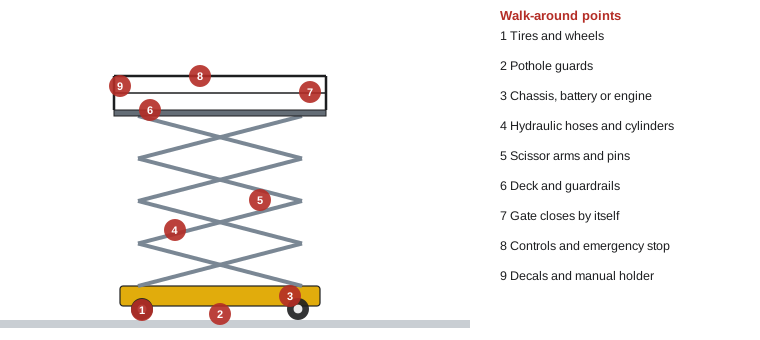
| Area | Look for |
|---|---|
| Tires and wheels | Cuts, chunks missing, low pressure on pneumatics, loose lug nuts, damaged rims |
| Chassis and guards | Cracks, bent metal, missing covers, pothole guards free to move, outriggers and pads undamaged |
| Power | Battery charge and fluid level, clean terminals, no corrosion; on engines, fuel, oil and coolant levels, no leaks |
| Hydraulics | Leaks, wet hoses or fittings, chafed or kinked hoses, cylinder rods free of scoring, fluid level |
| Structure | Scissor arms, boom sections, jib and turntable: cracks, bent members, loose or missing pins and retainers, damaged welds |
| Wear items | Boom wear pads, chains and cables on telescopic booms, slider pads on scissors |
| Platform | Deck damage, guardrails and mid-rails secure, gate closes and latches by itself, toeboards, anchorage points undamaged |
| Controls | Covers and guards in place, labels readable, joystick returns to neutral, foot switch works, emergency stop clear |
| Decals and manual | Capacity, wind and slope decals present and readable; manual in its holder |
Pay special attention to the anchorage points on the platform. They are designed and tested by the manufacturer to hold a restrained or arrested worker. A bent, cracked or modified anchorage must be reported and the machine taken out of service. Never substitute a guardrail or a mid-rail for a missing anchorage.
Function tests
After the walk-around, test the functions. Function tests check that controls and safety devices work, and they are done from both the ground controls and the platform controls, with the platform at a safe height and the area clear.
- Ground controls: test raising and lowering, emergency stop, the platform-and-ground selector and the emergency or auxiliary lowering system.
- Platform controls: test each function slowly, including drive, steer, raise, lower, boom functions, the enable or foot switch, the horn and the emergency stop.
- Safety devices: test what the manufacturer says to test, which may include the tilt alarm, pothole guard deployment, drive speed limiting when elevated, load sensing indicator and motion alarms.
- Brakes: on a level surface, the machine should stop promptly when the control is released, and the brakes should hold on the allowed slope.
Worked problem
Does this defect stop the job?
During the pre-use inspection on a 45 ft articulating boom, an operator finds: (1) a hydraulic fitting at the base of the main lift cylinder with a fresh wet film of oil; (2) one of two platform anchorages bent about 15 degrees; (3) the horn not working; (4) a torn but readable capacity decal. Which defects require the machine to be taken out of service?
Show solution
- A fresh oil film at a lift cylinder fitting means a leak in the system that holds the boom up. It must be reported and assessed by a qualified mechanic before use.
- A bent anchorage may have been loaded in a fall or struck; its strength is unknown. The machine must not be used until a qualified person assesses it.
- A horn that does not work is a defect that must be reported. The manual usually lists it as a required function, so the machine should not be used until it is repaired.
- A torn but readable decal should be reported and replaced, but if it is fully readable it may not prevent use, depending on the manufacturer's list.
Answer: Tag the machine out of service and remove the key for the leak, the bent anchorage and the horn. Report the decal. Do not let anyone use the machine until a qualified person repairs it and returns it to service.
Taking a machine out of service means more than telling the supervisor. Tag the controls with an out-of-service tag that says what is wrong, who found it and when; remove the key where possible; and record the defect on the checklist. A supervisor who finds a tagged machine being used should stop it immediately.
The workplace inspection
The pre-use inspection includes the workplace, not just the machine. Before raising the platform, the operator should check the ground under the machine and the route, the overhead clearance at the work location, the location of other workers and vehicles, the weather, and any changes since the safe use plan was written. This takes a minute and often reveals the hazard that would have caused an incident: a floor drain grate under a wheel, a forklift working in the same aisle, or a new run of conduit across the ceiling.
Worked problem
Battery charge and the length of a shift
An electric scissor lift has a battery pack rated at 220 ampere-hours at 24 V. The manufacturer says a typical work cycle draws an average of 25 A when lifting and driving, and the crew expects about 3 hours of actual lifting and driving in a 10-hour shift. The battery indicator shows 60 per cent at the start of the shift. Is there enough charge, keeping at least 20 per cent in reserve to protect the battery and allow emergency lowering?
Show solution
- Usable charge above the reserve: \( (0.60 - 0.20) \times 220 = 88 \) ampere-hours.
- Expected use: \( 25 \times 3 = 75 \) ampere-hours.
- Margin: \( 88 - 75 = 13 \) ampere-hours, which is small. Cold weather, heavy loads or more driving than planned could use it up.
- These figures are illustrative; real draw varies with load, slope, temperature and battery age.
Answer: Probably, but with little margin. Charge the machine at the break or start the shift fully charged. A flat battery at height can strand a worker if the emergency lowering system depends on battery power.
Battery charging has its own hazards: lead-acid batteries give off hydrogen while charging, and lithium-ion packs must be charged with the correct charger and protected from damage. HSE-218 covers charging areas, ventilation and battery handling in more detail; the same rules apply to MEWP batteries.
Supervisor checks
Supervisors do not need to repeat each operator's inspection, but they should check that it happens. A simple routine works: look for the completed checklist before work starts, spot-check one item yourself, ask the operator what they found, and follow up on any defect that was reported. Over time, crews learn that inspections matter because someone looks at them.
Manufacturer safety bulletins
Manufacturers issue safety bulletins and recall notices when they find a problem with a model, such as a weld that can crack, a sensor that can fail, or a control that can stick. The owner must act on them, usually by inspecting or modifying the machine within a set time. A supervisor accepting a machine on site can ask the owner whether all bulletins for that model have been completed. Older machines sold second-hand are the most likely to have outstanding bulletins, because the original owner may not have passed the information on.
Inspection in cold and wet conditions
Inspection is harder in winter and in rain, which is when shortcuts are most tempting. Snow can hide damaged tires and pothole guards, ice can hide cracks and leaks, and cold can make hydraulic functions sluggish so that a fault looks like normal stiffness. Clear snow and ice before inspecting, let hydraulic oil warm up as the manual directs, and repeat the function tests if they seem slow. Keep the checklist dry and legible; a soaked sheet that no one can read is no record at all.
| Condition | Inspection adjustment |
|---|---|
| Snow and ice | Clear deck, steps, rails and chassis; check tires and guards beneath the snow |
| Cold below the manufacturer's range | Warm up hydraulics; check battery charge, which drops in cold; check function speeds |
| Rain | Check for water in control boxes; dry the deck; check that platform controls respond normally |
| Dust and dirt | Clean sensors, decals and pothole guards; check air filters on engines |
Records that tell a story
Inspection records are more than paperwork. Over weeks, they show patterns: the same hydraulic fitting weeping every few days, a tilt alarm that trips on a floor that should be level, a battery that no longer lasts a shift. A supervisor who reads the checklists can spot these patterns and ask the owner to fix the cause before it becomes a failure. Keep the completed checklists for the period your employer's policy requires, and make sure defects that were reported have a recorded repair before the machine goes back into service. An investigator after an incident will ask to see these records, and so will a client auditing your safety program.
Finally, remember that the pre-use inspection is also a moment to check the operator. An operator who rushes through it, skips the function tests or cannot find the emergency lowering control may need more familiarization before they take the platform up.
Common mistakes
MistakeSkipping the pre-use inspection on a rented machine because it was just delivered.
InsteadInspect every machine before first use; damage can happen in transport.
MistakeTesting only the platform controls.
InsteadTest the ground controls, emergency stop and emergency lowering too.
MistakeUsing a guardrail as an anchorage when the platform anchorage is damaged.
InsteadTake the machine out of service until the anchorage is assessed and repaired.
MistakeTelling the supervisor about a defect but leaving the machine available.
InsteadTag it out of service, remove the key and record the defect.
MistakeInspecting the machine but not the workplace.
InsteadCheck ground, route, overhead clearance, people, vehicles and weather before raising.
Summary and key terms
- Inspections range from the operator's pre-use check to frequent, annual and major inspections by qualified mechanics.
- Check the manual, inspection tag or decal, previous checklist and rental documents before the walk-around.
- The walk-around covers tires, chassis, power, hydraulics, structure, platform, anchorages, controls and decals.
- Function tests cover ground and platform controls, emergency stop and lowering, and safety devices.
- Defects that affect safety require the machine to be tagged out of service until repaired by a qualified person.
- The pre-use inspection includes the workplace: ground, route, overhead, people, vehicles and weather.
- Pre-use inspection
- The inspection an operator performs before each shift, including a walk-around, function tests and a workplace check.
- Function test
- A test of each control and safety device to confirm it operates correctly.
- Frequent inspection
- A periodic inspection by a qualified mechanic, typically every 3 months or 150 hours.
- Annual inspection
- A detailed inspection by a qualified mechanic at least every 13 months.
- Out-of-service tag
- A tag on the controls stating that a machine must not be used and why.
- Emergency lowering system
- A means of lowering the platform from the ground if normal power or the operator fails.
- Ampere-hour
- A unit of battery capacity equal to a current of one ampere for one hour.
Practice problems
Work each problem on paper first, then reveal the answer to check.
Who performs the pre-use inspection?
Show answer
A trained and familiarized operator.
How often is a frequent inspection typically required?
Show answer
Every 3 months or 150 hours, whichever comes first, unless the manufacturer says otherwise.
Name three documents to check before the walk-around.
Show answer
The operating manual, the inspection tag or decal, the previous checklist and rental delivery documents.
Why must a bent anchorage take the machine out of service?
Show answer
It may have been loaded or struck and its strength is unknown.
Which controls must be function-tested?
Show answer
Both ground and platform controls, including emergency stop and emergency lowering.
What three things should be done when taking a machine out of service?
Show answer
Tag the controls, remove the key and record the defect.
What workplace items should be checked before raising the platform?
Show answer
Ground and route, overhead clearance, other workers and vehicles, weather and changes since the plan.
Why keep a battery reserve on an electric MEWP?
Show answer
To protect the battery and make sure emergency lowering and normal lowering remain available.
What gas do lead-acid batteries give off when charging?
Show answer
Hydrogen.
How can supervisors check that inspections happen?
Show answer
Look for the completed checklist, spot-check an item, ask the operator what they found and follow up on defects.
Lesson quiz · 5 questions
Score 60% or more to complete this lesson.
Create a free account to save your progress, take quizzes and earn a certificate.