
GEOM-420 · Lesson 2 of 12 · 21 min
Horizontal curves
A highway alignment is a chain of straight tangents joined by curves. The engineers choose the curves for speed, sight distance and the lie of the land, as CIV-390 described from the design side. The surveyor's job is different: to compute every point the crew will stake, to check that the computed alignment closes, and to put the curve on the ground so that the paving machine follows it smoothly. This lesson works through the geometry of the simple circular curve, the stakeout by deflection angles and by coordinates, and a brief look at the spiral transitions that connect tangents and curves on faster roads.
The realigned highway near the headworks crosses the main canal on the new bridge and then curves to the right to climb out of the coulee. The design gives a circular curve of radius 600 m with a deflection angle of 38°24′30″ between the tangents, and the point of intersection of the tangents, the PI, at chainage 2+347.812. Alberta, like other provinces, gives chainage in kilometres and metres, so 2+347.812 means 2,347.812 m from the start of the project.
The parts of a circular curve
A circular curve joins two tangents that meet at the PI with a deflection angle Δ, the change of direction from the back tangent to the forward tangent. The curve begins at the point of curvature, PC, and ends at the point of tangency, PT. The distance from the PI back to the PC, and from the PI forward to the PT, is the tangent length T. The curve itself has length L along the arc. The straight line from PC to PT is the long chord LC. The external distance E is from the PI to the middle of the curve, and the middle ordinate M is from the middle of the curve to the middle of the long chord. All of these follow from the radius R and Δ.
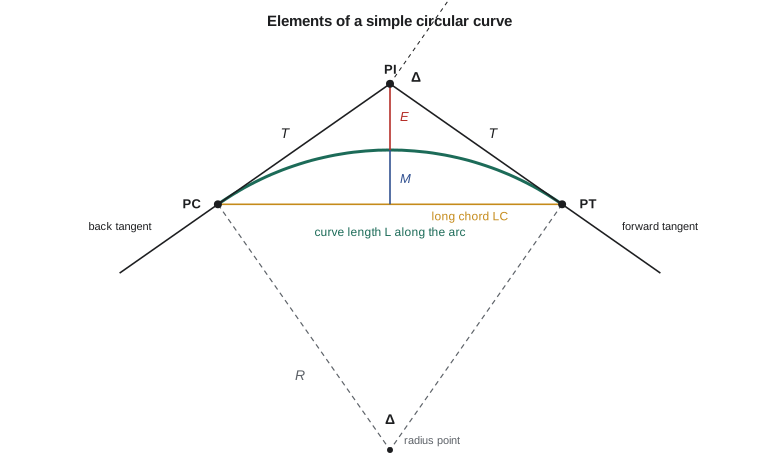
Canadian practice, like most metric practice, defines a curve by its radius. Older and some US practice defines it by the degree of curve, either the angle at the centre subtended by a 100 ft arc (the arc definition, used on highways) or by a 100 ft chord (the chord definition, still found on railways). In metric work the radius is used directly, and that is what the provincial design gives.
Stationing through the curve
Stationing, or chainage, runs continuously along the alignment. Along a tangent it is simply distance; through a curve it is measured along the arc, not along the tangents. So the station of the PC is the station of the PI minus T, but the station of the PT is the station of the PC plus L, not the station of the PI plus T. Because L is shorter than 2T, the stationing through a curve is shorter than the route along the tangents, and plans that show both a PI station and a PT station are a constant check on this.
The stakeout needs points at regular intervals along the curve, at full stations or at a set spacing, plus the PC and PT themselves. Each of those points has a station, an arc distance from the PC, a deflection angle from the back tangent at the PC, and a chord distance from the PC or from the previous point. The deflection angle to a point on a circular curve is half the angle the arc subtends at the centre, so it grows uniformly with arc length.
import math
# Horizontal curve on the realigned highway: elements, stationing and deflections (metres, stakes every 40 m)
R = 600.0                                  # radius, m
D = (38, 24, 30)                           # deflection angle between tangents, d m s
d = math.radians(D[0] + D[1] / 60 + D[2] / 3600)
T = R * math.tan(d / 2); L = R * d
E = R * (1 / math.cos(d / 2) - 1); M = R * (1 - math.cos(d / 2)); LC = 2 * R * math.sin(d / 2)
PI = 2347.812                              # chainage of the PI, m
PC = PI - T; PT = PC + L
fmt = lambda s: f"{int(s // 1000)}+{s % 1000:07.3f}"
print(f"T {T:.3f}  L {L:.3f}  E {E:.3f}  M {M:.3f}  LC {LC:.3f}")
print(f"PC {fmt(PC)}   PT {fmt(PT)}")
def dms(x):
    x = math.degrees(x); dd = int(x); mm = int((x - dd) * 60); ss = (x - dd - mm / 60) * 3600
    return f"{dd:2d}° {mm:02d}′ {ss:04.1f}″"
sta = math.ceil(PC / 40) * 40
prev = PC
print(" station       arc     deflection     chord from PC   sub-chord")
while sta < PT:
    a = sta - PC; defl = a / (2 * R)
    print(f"{fmt(sta)}  {a:8.3f}  {dms(defl)}  {2*R*math.sin(defl):10.3f}  {2*R*math.sin((sta-prev)/(2*R)):9.3f}")
    prev = sta; sta += 40
a = PT - PC
print(f"{fmt(PT)}  {a:8.3f}  {dms(a/(2*R))}  {2*R*math.sin(a/(2*R)):10.3f}  {2*R*math.sin((PT-prev)/(2*R)):9.3f}  (PT; check = half the deflection angle)")

# Entry spiral: length 80 m into the 600 m curve
Ls = 80.0
th = Ls / (2 * R)
Xs = Ls * (1 - th**2 / 10 + th**4 / 216); Ys = Ls * (th / 3 - th**3 / 42)
print(f"spiral angle {math.degrees(th):.4f}° Xs {Xs:.3f} Ys {Ys:.3f} shift p {Ys - R*(1-math.cos(th)):.3f}")T 208.991 L 402.211 E 35.356 M 33.389 LC 394.722 PC 2+138.821 PT 2+541.032 station arc deflection chord from PC sub-chord 2+160.000 21.179 1° 00′ 40.4″ 21.178 21.178 2+200.000 61.179 2° 55′ 15.9″ 61.153 39.993 2+240.000 101.179 4° 49′ 51.4″ 101.059 39.993 2+280.000 141.179 6° 44′ 26.9″ 140.854 39.993 2+320.000 181.179 8° 39′ 02.4″ 180.491 39.993 2+360.000 221.179 10° 33′ 37.9″ 219.929 39.993 2+400.000 261.179 12° 28′ 13.4″ 259.122 39.993 2+440.000 301.179 14° 22′ 48.9″ 298.027 39.993 2+480.000 341.179 16° 17′ 24.4″ 336.601 39.993 2+520.000 381.179 18° 11′ 59.8″ 374.801 39.993 2+541.032 402.211 19° 12′ 15.0″ 394.722 21.031 (PT; check = half the deflection angle) spiral angle 3.8197° Xs 79.964 Ys 1.777 shift p 0.444
The code gives a tangent length of 208.991 m and a curve length of 402.211 m, so the PC is at 2+138.821 and the PT at 2+541.032. The first full stake on the curve, at 2+160, is 21.179 m of arc beyond the PC; its deflection angle is 1°00′40.4″ and its chord from the PC is 21.178 m. Each 40 m of arc adds 1°54′35.5″ of deflection, and the last line, at the PT, shows a deflection of 19°12′15.0″, exactly half of Δ. That is the most important check in the table: if the deflection to the PT is not Δ/2, something in the computation is wrong.
Note also that the chord for a full interval is very slightly shorter than the arc. For short chords on a flat curve the difference is small, but a crew that tapes arc lengths between stakes instead of chords will accumulate an error around the curve. The table gives chords, and the crew measures chords.
Staking by deflection angles
The classical method is to set up the instrument at the PC, sight the PI (along the back tangent extended, or with the instrument set to zero on the back tangent), turn the deflection angle to each stake, and measure the chord from the previous stake or the total chord from the PC. When the line of sight is blocked, the instrument moves forward to a stake on the curve, backsights the PC with the angle set to the deflection of that stake plus 180°, and continues. It is a self-checking method: the crew should arrive at the PT with a deflection of Δ/2 and a closing chord that agrees with the computation.
Deflection staking still has a place on small jobs and where GNSS is poor, but it ties every stake to the PC and to the previous stake, so errors build up. On this project, as on most modern work, the crew stakes the curve by coordinates instead.
Staking by coordinates
With coordinate staking, Theo computes the coordinates of every stake from the alignment, and the crew stakes each one directly from the nearest control, by total station (bearing and distance) or by RTK GNSS. Each stake is independent: a bad stake does not carry into the next. The alignment geometry is still needed, of course, to compute the coordinates: the PC's coordinates come from the PI's coordinates and the back-tangent azimuth, the centre lies at distance R to the right of the PC, perpendicular to the back tangent, and each point on the curve is at distance R from the centre at an angle that grows with the arc length.
For a curve to the right, the azimuth from the PC to a point on the curve is the back-tangent azimuth plus the deflection angle; for a curve to the left it is minus. Theo computes both the deflection table and the coordinates, and checks that the PT computed through the curve agrees with the PT computed along the forward tangent from the PI. A mismatch of more than a millimetre or so means an error in Δ, R or the PI coordinates.
Offset stakes are computed the same way, with the radius increased or decreased by the offset. A stake 5 m to the outside of a right-hand curve lies on a circle of radius R + 5 about the same centre, at the same angle. The chord distances along an offset line are longer on the outside of the curve and shorter on the inside.
Worked problem
Curve elements by hand
A curve has radius 450 m and deflection angle 24°00′00″. The PI is at chainage 1+260.000. Find T, L, and the chainage of the PC and PT.
Show solution
- \[T = 450\tan 12^\circ = 95.651\ \text{m}\]
- \[L = 450 \times 0.418879 = 188.496\ \text{m}\]
- \[\text{PC} = 1260.000 - 95.651 = 1+164.349 \qquad \text{PT} = 1164.349 + 188.496 = 1+352.845\]
Answer: The PT is not the PI station plus T, because stationing follows the arc.
Spirals, briefly
On roads with higher speeds, a vehicle cannot go instantly from a straight path to a circular one; the driver must turn the wheel gradually, and the road must give room for the superelevation to change. A spiral, or transition curve, is inserted between the tangent and the circle. Its curvature grows uniformly from zero at the tangent-to-spiral point, TS, to 1/R at the spiral-to-curve point, SC. The most common spiral in highway work is the clothoid, in which curvature is proportional to distance along the spiral.
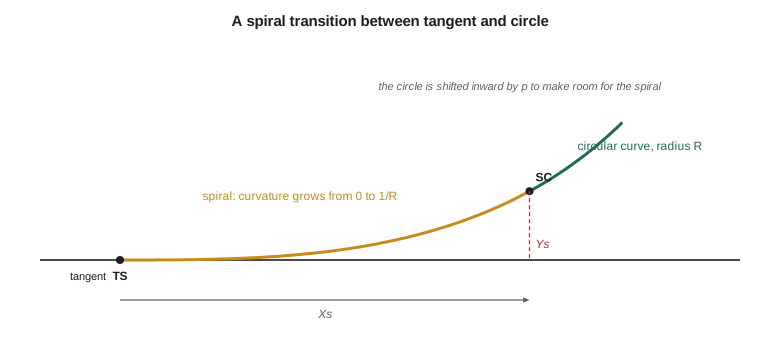
For the highway curve, an 80 m spiral at each end would have a spiral angle of 3.8197°, and its SC would lie 79.964 m along the tangent and 1.777 m off it. The circle would be shifted inward by 0.444 m to make room. The province's design gives the spiral lengths and their key points; the surveyor computes the stakeout points along each spiral from series like these, or more often lets the design software do it and checks a few points by hand. Spirals change the stationing and the tangent lengths, so a curve with spirals must be computed as a whole, not as a circle with pieces added.
Checks and records
Ruth's rule for alignment work is that every number is computed two ways. The deflection to the PT must equal Δ/2. The PT from the curve must equal the PT from the forward tangent. The stationing at the end of the alignment must agree with the designer's. And in the field, the crew checks every stake from a second control point or by measuring the chord to the previous stake, and records any stake that is moved or replaced. The stakes along a highway curve will guide the grading crew for weeks, and a single stake out by a few centimetres will show as a kink in the finished edge of pavement.
Safety is part of every stakeout on a live highway. Before the crew works near traffic, the traffic control plan required by the Alberta work-zone traffic accommodation rules must be in place, with signs, flaggers or a protective vehicle as the plan requires. Crews wear high-visibility clothing, work facing traffic where possible, and never stand in a closed lane without the protection the plan provides. A stake is never worth a step into a live lane.
Common mistakes
MistakeComputing the PT station as the PI station plus T.
InsteadPT station = PC station + L, because stationing follows the arc.
MistakeTaping arc lengths between stakes.
InsteadMeasure chords, which are slightly shorter than the arcs.
MistakeSkipping the Δ/2 check on the deflection table.
InsteadThe deflection to the PT must equal half the deflection angle.
MistakeUsing the chord definition of degree of curve on a highway plan drawn with the arc definition.
InsteadCheck which definition the plan uses before computing R.
Summary and key terms
- A circular curve is defined by R and Δ; T, L, E, M and LC follow from them.
- Stationing runs along the arc, so the PT station is the PC station plus L.
- Deflection angles grow at a/(2R) and reach Δ/2 at the PT.
- Coordinate staking computes each point independently and is the modern standard.
- Spirals transition curvature from zero to 1/R and shift the circle inward.
- Every alignment computation is checked two ways before it is staked.
- PI
- Point of intersection of the back and forward tangents.
- PC and PT
- Point of curvature and point of tangency, where the circular curve begins and ends.
- Deflection angle (Δ)
- The change in direction from the back tangent to the forward tangent.
- Tangent length (T)
- The distance from the PI to the PC or PT.
- Degree of curve
- The angle at the centre subtended by a 100 ft arc (arc definition) or chord (chord definition).
- Long chord
- The straight line from PC to PT.
- Spiral
- A transition curve whose curvature changes uniformly with length.
Practice problems
Work each problem on paper first, then reveal the answer to check.
A curve has R = 800 m and Δ = 20°. Find T and L.
Show answer
T = 800 tan 10° = 141.06 m; L = 800 × 0.349066 = 279.25 m.
What is the deflection angle to the PT of any simple circular curve?
Show answer
Half the deflection angle Δ.
Why does coordinate staking avoid the error build-up of deflection staking?
Show answer
Each stake is set independently from control rather than from the previous stake.
How do you compute an offset stake 3 units outside a curve?
Show answer
Use radius R + 3 about the same centre, at the same angle.
What does the shift p of a spiral represent?
Show answer
How far the circular curve is moved inward from the tangent to make room for the spiral.
Lesson quiz · 5 questions
Score 60% or more to complete this lesson.
Create a free account to save your progress, take quizzes and earn a certificate.