
GEOM-360 · Lesson 10 of 12 · 19 min
Standards for hydrographic surveys
The terminal's engineers ask a fair question at the progress meeting: how good is the survey? Mira's answer is not a single number but a statement against a standard. The survey meets a named order of the IHO's Standards for Hydrographic Surveys, with a stated uncertainty, coverage and feature detection, and it was carried out and processed in a way that can be checked. Standards make surveys comparable, let charting offices decide whether a survey can update a chart, and give clients and contractors a common language for specifications and acceptance. This lesson looks at the international standard, at the national specifications built on it, and at how a survey proves that it complies.
IHO S-44
The IHO publication S-44, Standards for Hydrographic Surveys, first issued in 1968, sets minimum standards for surveys intended for the compilation of nautical charts. Its sixth edition, published in 2020, defines five orders, from the least to the most demanding: Order 2, Order 1b, Order 1a, Special Order and Exclusive Order. The edition broadened the standard beyond navigation, describing how its criteria can be used for other purposes and introducing a matrix that lets specifications combine criteria from different orders. For each order it states the maximum allowable total vertical uncertainty (TVU) and total horizontal uncertainty (THU) of depths at the 95 percent confidence level, the size of features that must be detected, whether a feature search is required, and the bathymetric coverage.
| Criterion | Order 2 | Order 1b | Order 1a | Special | Exclusive |
|---|---|---|---|---|---|
| THU (95 %) | 20 m + 10 % of depth | 5 m + 5 % of depth | 5 m + 5 % of depth | 2 m | 1 m |
| TVU a | 1.0 m | 0.5 m | 0.5 m | 0.25 m | 0.15 m |
| TVU b | 0.023 | 0.013 | 0.013 | 0.0075 | 0.0075 |
| Feature detection | not specified | not specified | cubes over 2 m to 40 m depth | cubes over 1 m | cubes over 0.5 m |
| Feature search | recommended | recommended | 100 % | 100 % | 200 % |
| Bathymetric coverage | 5 % | 5 % | up to 100 % | 100 % | 200 % |
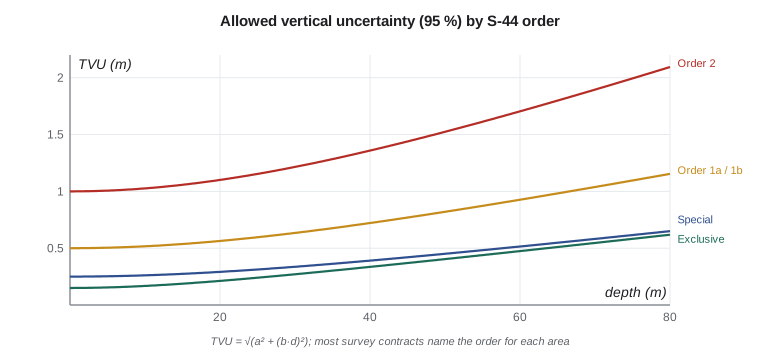
The vertical allowance grows with depth, because some errors, such as those from sound speed and beam angle, grow with depth:
where \(a\) is the part that does not depend on depth and \(b\) the depth-dependent coefficient. Special Order is intended for areas where under-keel clearance is critical, such as berths, harbours and critical channels; Exclusive Order, introduced in the sixth edition, for areas of minimal under-keel clearance where bottom characteristics are potentially hazardous, such as berths and their approaches with very tight margins. Order 1a covers areas shallower than about 100 m where features on the seabed may be a concern; Order 1b, similar areas where they are not; and Order 2, deeper water where a general description of the seabed suffices.
National specifications
The CHS has adopted S-44 for its hydrographic surveys and publishes hydrographic survey management guidelines that describe how CHS surveys are planned, carried out, processed and documented, drawing on international practice and its own experience. Contracts for surveys that the CHS may use, and many port authority contracts, specify an S-44 order and refer to these guidelines. Northshore's contract with the terminal operator specifies Exclusive Order in the berth pocket and its approach, where under-keel clearance will be tight, and Special Order on the side slopes and the buffer.
Building the uncertainty budget
Compliance with an order is proved by the uncertainty budget: the estimated total uncertainty of each sounding, from all sources, compared with the allowance at its depth. A budget lists every component as a standard uncertainty (one sigma), combines them as the root sum of squares on the assumption that they are independent, and multiplies by a coverage factor for 95 percent confidence: 1.96 for vertical, a one-dimensional quantity, and about 2.45 for horizontal, a two-dimensional one. Components that are not independent, or that are systematic rather than random, need more careful treatment; the budget is only as good as the honesty of its inputs.
import math
# IHO S-44 (6th edition) minimum standards for depth uncertainty at 95 %
ORD = [('Exclusive', 0.15, 0.0075, 1.0, 0.0), ('Special', 0.25, 0.0075, 2.0, 0.0),
       ('1a', 0.5, 0.013, 5.0, 0.05), ('1b', 0.5, 0.013, 5.0, 0.05), ('2', 1.0, 0.023, 20.0, 0.10)]
def tvu(d, a, b): return math.sqrt(a * a + (b * d) ** 2)
def thu(d, c, k): return c + k * d
print("depth   " + "  ".join(f"{o:>9s}" for o, *_ in ORD))
for d in (5, 10, 17, 30, 60):
    print(f"{d:4d} m  " + "  ".join(f"{tvu(d, a, b):9.2f}" for _, a, b, _, _ in ORD))

# Total propagated uncertainty of an outer-beam sounding at 17 m (1 sigma components, m)
d = 17.0
budgets = {
  'ellipsoid-referenced': {'GNSS height': 0.030, 'separation model': 0.050, 'sound speed': 0.045,
                           'range and beam angle': 0.030, 'roll and pitch': 0.026},
  'tide-reduced':         {'tide gauge and zoning': 0.080, 'heave': 0.050, 'draft and squat': 0.040,
                           'sound speed': 0.045, 'range and beam angle': 0.030, 'roll and pitch': 0.026}}
horz = {'GNSS position': 0.015, 'heading and lever arms': 0.030, 'beam pointing and refraction': 0.180}
th = 2.45 * math.sqrt(sum(v * v for v in horz.values()))
print(f"\nhorizontal TPU of an outer-beam sounding: {th:.2f} m (95 %)")
for name, vert in budgets.items():
    tv = 1.96 * math.sqrt(sum(v * v for v in vert.values()))
    best = next((o for o, a, b, c, k in ORD if tv <= tvu(d, a, b) and th <= thu(d, c, k)), 'none')
    print(f"{name}: vertical TPU {tv:.2f} m at {d:.0f} m -> highest order met: {best}")
# Feature detection: S-44 Special Order asks for cubic features larger than 1 m to be detected
print("\nfeature detection: Special Order 1 m cubes; Exclusive 0.5 m cubes; Order 1a 2 m cubes to 40 m depth")depth Exclusive Special 1a 1b 2 5 m 0.15 0.25 0.50 0.50 1.01 10 m 0.17 0.26 0.52 0.52 1.03 17 m 0.20 0.28 0.55 0.55 1.07 30 m 0.27 0.34 0.63 0.63 1.21 60 m 0.47 0.51 0.93 0.93 1.70 horizontal TPU of an outer-beam sounding: 0.45 m (95 %) ellipsoid-referenced: vertical TPU 0.16 m at 17 m -> highest order met: Exclusive tide-reduced: vertical TPU 0.23 m at 17 m -> highest order met: Special feature detection: Special Order 1 m cubes; Exclusive 0.5 m cubes; Order 1a 2 m cubes to 40 m depth
At 17 m the allowance is 0.20 m for Exclusive Order and 0.28 m for Special Order. The ellipsoid-referenced budget, with the separation model and sound speed as its largest components, comes to 0.16 m and meets Exclusive Order; the same sounding reduced with a tide gauge, zoning, a heave sensor and a measured draft comes to 0.23 m and meets only Special Order. The horizontal uncertainty of 0.45 m meets every order easily. The numbers explain Mira's choice of ERS for the berth: in a harbour with a large tide and a gauge some distance away, the water level chain alone would consume most of the Exclusive Order budget.
Coverage and feature detection
Uncertainty is necessary but not sufficient. An order also requires coverage, the proportion of the seabed actually measured, and feature detection, the ability to find objects of a given size. A survey with excellent uncertainty along widely spaced lines would fail Special Order because it does not cover the bottom. Coverage is demonstrated with a map of the grid cells that received enough soundings; feature detection with the sounding density and footprint analysis of Lesson 5, supported by side-scan where used, and by the record of features found and developed. Under Exclusive Order, 200 percent coverage and a 200 percent feature search mean that every part of the berth must be seen twice.
Beyond depth: other quality elements
S-44 also sets standards for other measurements a charting survey includes: the positions of fixed aids to navigation and of coastline features, the measurement of water levels and currents, and the classification of the seabed. Specifications add requirements for metadata, the documentation that tells a user who surveyed, when, with what equipment, to what datum, with what uncertainty and with what problems. Without metadata, even a perfect survey is of limited use, because nobody can judge it. The charting office uses this information to assign the survey a quality indicator, which appears on electronic charts as zones of confidence (CATZOC) in S-57 and, in S-101, as a more detailed quality of bathymetric data that tells the mariner how far to trust each area of the chart. A mariner who sees that an area was last surveyed by lead line a century ago, with low confidence, will leave a wider margin than one crossing an area surveyed last year to Special Order; the quality indicator is how the surveyor's care reaches the bridge of a ship.
Standards for other purposes
Many surveys are not for charting. Dredging contracts, reservoir capacity surveys, scour inspections and environmental monitoring have their own needs, and S-44's sixth edition explicitly invites users to borrow its criteria to write specifications for them. For the district's reservoir, Ines writes the specification in S-44 terms: a total vertical uncertainty of 0.15 m at 95 percent in the margins, full coverage there, and line-based coverage in the deep pool, with no feature detection requirement. The language makes the specification precise and the survey checkable, even though no chart will ever be made from it.
Proving compliance
At the end of the berth survey, the descriptive report states compliance area by area, with evidence. For the berth pocket and approach, it shows that 99.6 percent of grid cells have a 95 percent vertical uncertainty within the Exclusive Order allowance at their depth, and explains the remaining cells, all on the steep toe of the old wharf slope, where outer-beam soundings from the side dominate. It shows that every cell received soundings from at least two lines, that the cross-line comparison agrees within the allowance, and that all eleven side-scan contacts taller than half a metre were developed and their least depths recorded. For the side slopes it shows the same statistics against Special Order. It lists the equipment, calibrations, sound speed casts, separation checks and the daily position checks, and it notes the problems: the afternoon of refraction, the three holes near the wharf face and how they were filled.
Clients sometimes commission an independent check survey, a short survey by a different team over part of the area, to confirm a contractor's results, especially when large dredging payments depend on them. Charting offices review submissions against their own checklists and may reject a survey or accept it for a lower quality category. The berth survey's evidence is organized so that either kind of review can be done quickly, which is as much a part of meeting the standard as the survey itself.
Competence
Standards also apply to people. The IHO, with the International Federation of Surveyors and the International Cartographic Association, sets standards of competence for hydrographic surveyors at two levels, Category A and Category B, through an international board that recognizes education programmes around the world. Several countries and professional bodies certify hydrographers, and clients increasingly ask that a certified hydrographer be in charge of a survey. Mira holds such a certification, and Ruth plans for Ines and Leah to work toward it after the berth project, as Coulee builds its marine practice.
Worked problem
Does the sounding meet the order?
A sounding in 30 m of water has a vertical uncertainty budget of 0.08 m (separation), 0.06 m (sound speed), 0.04 m (range and angle) and 0.03 m (attitude), all one sigma. Which is the highest S-44 order its vertical uncertainty meets?
Show solution
- \[\sigma = \sqrt{0.08^2 + 0.06^2 + 0.04^2 + 0.03^2} = 0.113\ \text{m}\]
- \[\text{TPU}_{95} = 1.96 \times 0.113 = 0.22\ \text{m}\]
- \[\text{Exclusive at 30 m: } \sqrt{0.15^2 + (0.0075 \times 30)^2} = 0.27\ \text{m}\]
Answer: The 0.22 m vertical uncertainty is within the Exclusive Order allowance of 0.27 m at 30 m, so it meets Exclusive Order vertically; coverage and feature detection must also be shown.
Common mistakes
MistakeClaiming an order from the uncertainty budget alone.
InsteadShow coverage and feature detection as well.
MistakeUsing 1.96 for horizontal uncertainty at 95 percent.
InsteadUse about 2.45 for a two-dimensional quantity.
MistakeLeaving out components that are hard to estimate.
InsteadEstimate them honestly; a budget missing its largest term is worthless.
MistakeDelivering a survey without metadata.
InsteadWithout metadata nobody can judge or reuse the survey.
Summary and key terms
- IHO S-44 (6th edition, 2020) defines Order 2, 1b, 1a, Special and Exclusive.
- TVU max = √(a² + (bd)²); THU, feature detection, search and coverage complete each order.
- The CHS adopts S-44 and publishes survey management guidelines.
- Uncertainty budgets combine components as root sum of squares, times 1.96 (vertical) or about 2.45 (horizontal).
- Metadata and quality indicators tell users how far to trust each area.
- S-44 language is useful for non-charting specifications; competence standards apply to surveyors.
- S-44
- The IHO Standards for Hydrographic Surveys.
- TVU
- Total vertical uncertainty of a depth at 95 percent confidence.
- Special Order
- An S-44 order for areas where under-keel clearance is critical.
- Exclusive Order
- The most demanding S-44 order, for areas of minimal under-keel clearance.
- Uncertainty budget
- A list of uncertainty components combined into a total for comparison with an allowance.
- Metadata
- Information describing how, when and how well data were collected.
- Zone of confidence
- A chart quality indicator describing the reliability of bathymetric data in an area.
Practice problems
Work each problem on paper first, then reveal the answer to check.
What is the Special Order TVU allowance at 40 m?
Show answer
About 0.39 m.
Why does the TVU allowance grow with depth?
Show answer
Some errors, such as sound speed and beam angle effects, grow with depth.
What coverage does Exclusive Order require?
Show answer
200 percent bathymetric coverage.
Horizontal components 0.02, 0.05 and 0.15 m (1σ). THU at 95 percent?
Show answer
About 0.39 m.
Name two things besides uncertainty that an order requires.
Show answer
Coverage and feature detection (and feature search).
Lesson quiz · 5 questions
Score 60% or more to complete this lesson.
Create a free account to save your progress, take quizzes and earn a certificate.