
GCP-194 · Lesson 9 of 12 · 19 min
Practice strategy and timing
▶ Video coming soon A video version of this lesson is on the way.
Mateo's diagnostic gave him 60 minutes for 40 questions, which is 1.5 minutes each. He used all of it, and the last four questions were answered in the final two minutes, two of them wrongly. On the real exam the pace is gentler, but the questions are longer and the session is twice as long. Ravi was not worried. "Speed comes from knowing the material and from habits," he said. "We will practise both, and we will rehearse the clock twice before April."
This lesson covers two connected skills: pacing through the exam with checkpoints and a two-pass method, and a practice plan that builds knowledge first and speed second.
How much time each question gets
The exam allows 2 hours for 50 to 60 questions, and the candidate learns the exact number only when the exam starts. Planning for 60 is the safe choice: 120 minutes for 60 questions is 2 minutes each. But a plan that spends all 2 minutes on every question leaves nothing for the questions Mateo marks as uncertain. Ravi's plan keeps 15 minutes back for review. That leaves 105 minutes for the first pass, which is 1.75 minutes a question with 60 questions and 2.1 minutes with 50.
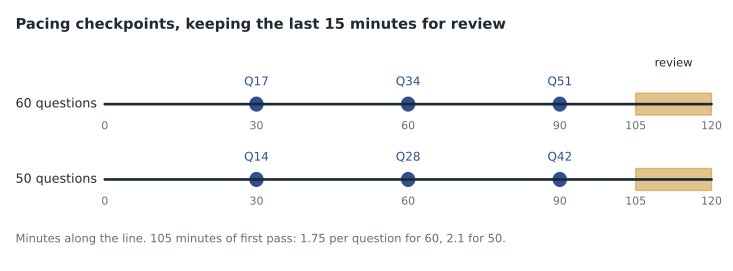
# Checkpoints for the first pass, keeping time back for review.
exam_minutes = 120
review_minutes = 15
first_pass = exam_minutes - review_minutes

for questions in (50, 60):
    pace = first_pass / questions               # minutes per question
    marks = [int(m / pace) for m in (30, 60, 90)]
    print(f"{questions} questions: {pace:.2f} min each; "
f"by 30, 60, 90 min reach questions {marks[0]}, {marks[1]}, {marks[2]}")50 questions: 2.10 min each; by 30, 60, 90 min reach questions 14, 28, 42 60 questions: 1.75 min each; by 30, 60, 90 min reach questions 17, 34, 51
What this code does
Two hours are available and fifteen minutes are kept for the end, so the first pass has 105 minutes. For a 50-question exam and a 60-question exam, the program divides that time by the number of questions to get the pace, then works out which question the candidate should have reached after 30, 60 and 90 minutes. Mateo learns those three numbers by heart so that he can glance at the timer and know at once whether he is on pace.
Mateo will see the number of questions on the first screen, so he learns both sets of checkpoints: 17, 34 and 51 for 60 questions; 14, 28 and 42 for 50. If he is more than three questions behind a checkpoint, he stops wrestling with hard questions and starts marking them for later.
Worked problem
Catching up after a slow start
At 60 minutes Mateo has answered 29 questions of 60. How many questions behind the checkpoint is he, and what pace does he need for the rest of the first pass to still finish it at 105 minutes?
Show solution
- The 60-minute checkpoint is question 34, so he is 5 behind.
- Questions left: 60 minus 29 is 31.
- Time left in the first pass: 105 minus 60 is 45 minutes.
- Pace needed: 45 divided by 31 is about 1.45 minutes a question.
- That is faster than his plan, so he marks any question that is not settled after a minute and moves on.
Answer: Five behind; he needs about 1.45 minutes a question, so he marks and moves on sooner.
The two-pass method
On the first pass, Mateo answers every question. If he is confident, he answers and moves on without marking. If he is down to two options, he chooses the likelier one, marks the question, and moves on. If he has no idea after a minute, he chooses his best guess and marks it. On the second pass, he returns only to marked questions.
| First-pass situation | Action | Why |
|---|---|---|
| Confident | Answer; do not mark | Marking confident answers wastes review time |
| Down to two options | Choose the likelier, mark | A later question may remind him of a fact; the guess counts if time runs out |
| No idea after a minute | Best guess, mark | A blank answer can only be wrong |
| Long scenario | Read the last sentence first, then the setting; guess and mark after two minutes | A long question is not worth more than a short one |
| Multiple select | Check the number to select; judge each option on its own | Each option is a separate true-or-false judgement |
Two rules hold the method together. First, never leave a question blank. Google reports results as pass or fail and does not describe any penalty for a wrong answer, so a guess can only help. Second, treat every question as worth the same. Five minutes spent rescuing one hard question costs two or three easy ones later. Aisha's phrase for it is "bank the easy marks first".
Changing answers
On the second pass, Mateo changes an answer only for a reason: he notices a qualifier he missed, a later question reminded him of a fact, or he sees that his choice does not meet a stated constraint. A vague feeling of doubt is not a reason. He will check this rule against his own practice sets. Each time he changes an answer in practice, he notes whether the change was right or wrong. If his changes turn out mostly wrong, he will trust his first choice more; if mostly right, his review is doing its job.
Kinds of practice
Practice serves two purposes: finding gaps in knowledge and building exam habits. Early practice should do the first; later practice should do both. Ravi's plan for Mateo has four kinds of practice, introduced in stages.
| Kind of practice | When (planned) | Purpose |
|---|---|---|
| Untimed sets of 10, notes allowed | November to January, after each review session | Learn the material and the reading method; look up anything unsure |
| Timed sets of 20, no notes | Weekly from January 9 | 20 questions in 35 minutes: pace and recall together |
| Full timed sets of 60, one sitting | Saturday, February 20 and Saturday, April 3, 2027 | Rehearse the whole exam: pacing, stamina, the two-pass method |
| Google's sample questions | Late March | A check of style and difficulty against Google's own examples |
Where do the questions come from? Mateo has the quizzes and final exams of GCP-220, GCP-221 and GCP-222, which he has already seen once, so they work for spaced review more than for testing. Google publishes a set of sample questions for the exam on the certification page, and the learning path on Google Skills includes labs and quizzes. For the full timed sets, Ravi and Aisha will each write 30 fresh scenario questions, weighted by section like the guide, so that neither set repeats anything Mateo has seen. Ravi has asked that nobody use collections of questions claiming to be from the real exam: they break the candidate agreement, and they are often wrong.
Rehearsing the full exam
A full practice set is a rehearsal, so it should feel like the real thing. Mateo's exam is at 9:00 on a Thursday at a testing centre, so the rehearsals start at 9:00 too, in a meeting room at Birchline's Toronto office, with his phone in a locker, no notes, no paper and a timer set to 120 minutes. He keeps his checkpoints in his head, because he cannot count on having anything to write on, and he does not stop the timer for interruptions. Aisha will sit in the room for the first set, partly to keep it quiet and partly to note when he looks at the clock.
Worked problem
Planning the 60-question rehearsal
Ravi wants the first full set to match the weights of the exam guide: about 30, 27, 18 and 25 in 100. How many of the 60 questions should come from each section?
Show solution
- Section 1: 60 times 0.30 is 18.
- Section 2: 60 times 0.27 is 16.2, so 16.
- Section 3: 60 times 0.18 is 10.8, so 11.
- Section 4: 60 times 0.25 is 15.
- Check: 18 plus 16 plus 11 plus 15 is 60.
Answer: 18, 16, 11 and 15 questions.
Reviewing a practice set
The hour after a practice set is worth more than the set itself. Mateo reviews every question, including the ones he got right, and sorts each into one of four groups.
| Result | What it means | What to do |
|---|---|---|
| Right and confident | Secure | Nothing; move on |
| Right but guessed | A gap that happened to score | Log it as a gap; it will not be lucky twice |
| Wrong: knowledge | He did not know the fact or the product | Log it; study the topic; retest in a week |
| Wrong: reading | He knew it but misread a qualifier or setting | Log the trap; practise the reading habit from lesson 3 |
The second group is the one most candidates skip, and it matters most. A lucky guess on a practice set is a mark that will probably be lost on the real exam. In the diagnostic, Mateo marked 5 of his 27 correct answers as guesses, so his secure score was really 22 of 40, not 27. Lesson 10 shows how the error log built from these reviews becomes a study plan.
What a practice score means
Google does not publish a passing score, and practice questions written by colleagues are not calibrated against the real exam, so no practice score can promise a pass. What practice scores can show is a trend and a balance. Ravi's rule of thumb for deciding that Mateo is ready is three things together: the April 3 set at or above about 80 in 100, no section below about 70 in 100, and the first pass finished with at least ten minutes to spare. If the April 3 set falls short, the plan in lesson 11 allows the exam to be moved, as long as the change is made at least 24 hours before the start.
Stamina and conditions
Two hours of careful reading is tiring, and fatigue shows up as reading errors in the second hour. In the diagnostic, which lasted only an hour, four of Mateo's seven reading errors came in the last fifteen questions. The full rehearsals are partly a stamina test: after each one, Mateo will count his errors in the first and second halves separately. If the second half is clearly worse, the answer is not more study but better conditions: a proper breakfast, a ten-second pause every twenty questions, and sleep the two nights before.
Conditions matter for the practice sets too. A practice set taken in the evening after a long day at work will understate what Mateo can do on a Thursday morning, and a set taken with notes open will overstate it. Ravi's rule is that a timed set only counts if it was taken in the conditions it is meant to rehearse. A set that was interrupted, or taken tired, is still useful for finding gaps, but its score does not go into the trend that decides whether the exam stays booked.
Finally, the practice plan has room for life. If a timed week is missed because of a release at work or a cold, Mateo does not double up the next week. He moves the plan along by a week and, if the slip reaches the February 20 rehearsal, he moves that date too. A plan that survives a bad week is better than one that collapses after the first. Ravi has seen more candidates derailed by a plan that was too tight than by one that was too loose, and he would rather see Mateo arrive at April 3 a little behind his schedule and rested than exactly on it and exhausted.
Common mistakes
MistakePlanning for 50 questions and hoping.
InsteadPlan for 60 and keep 15 minutes back; adjust down if the exam shows 50.
MistakeSpending five minutes rescuing one hard question.
InsteadGuess, mark and move on after about two minutes.
MistakeLeaving a question blank to come back to.
InsteadAlways choose an answer before moving on; mark it if unsure.
MistakeReviewing only the wrong answers in practice.
InsteadReview lucky guesses too; they are gaps.
MistakePractising only untimed until the last week.
InsteadAdd timed sets weeks ahead and rehearse the full exam twice.
Summary and key terms
- With 120 minutes for up to 60 questions and 15 minutes kept back, the first pass allows 1.75 minutes a question, or 2.1 for 50.
- Checkpoints at 30, 60 and 90 minutes are questions 17, 34 and 51 for 60 questions, and 14, 28 and 42 for 50.
- The two-pass method answers everything, marks the uncertain and returns only to marked questions.
- Never leave a blank, and change answers only for a reason.
- Practice moves from untimed sets to timed sets to two full rehearsals.
- Review every practice question in four groups, including lucky guesses.
- A practice score shows a trend and a balance, not a guaranteed result.
- First pass
- Answering every question once, quickly, and marking the uncertain ones.
- Second pass
- Returning only to marked questions in the time kept back.
- Checkpoint
- The question number to have reached at a given minute.
- Pace
- Minutes available per question on the first pass.
- Full rehearsal
- A timed practice set of exam length taken in exam conditions.
- Secure score
- The number of answers that were right and not guessed.
- Reading error
- A wrong answer caused by misreading a question rather than by not knowing the material.
- Lucky guess
- A right answer that was a guess, and so a gap to study.
Practice problems
Work each problem on paper first, then reveal the answer to check.
With 60 questions and 15 minutes kept back, what is the pace?
Show answer
105 divided by 60, which is 1.75 minutes a question.
At minute 90 of a 60-question exam, which question should Mateo have reached?
Show answer
About question 51.
Why does a lucky guess on a practice set go into the error log?
Show answer
It shows a gap; the same guess may not be lucky on the real exam.
Lesson quiz · 5 questions
Score 60% or more to complete this lesson.
Create a free account to save your progress, take quizzes and earn a certificate.