
GCP-194 · Lesson 11 of 12 · 18 min
The final week and exam day
▶ Video coming soon A video version of this lesson is on the way.
By the last week, the work that decides the result has mostly been done. What remains is to keep what Mateo knows fresh, to remove every avoidable risk on the morning, and to arrive rested. Ravi has watched good candidates undo months of preparation in the final week, either by cramming new material until midnight or by spending the morning of the exam lost in a parking garage. This lesson sets out Mateo's plan for the week of April 8 to 14, 2027, and for the morning of Thursday, April 15. All of it is a plan; today is November 15, 2026.
Deciding the exam is still on
The final week starts with a decision, made on Sunday, April 4, the day after the second full practice set. Lesson 9 gave Ravi's rule of thumb for readiness: the April 3 set at or above about 80 in 100, no section below about 70 in 100, and the first pass finished with at least ten minutes to spare. If all three hold, the exam stays booked. If one is close, Mateo keeps the date and spends the extra time on that section. If the set falls well short, he moves the exam, which costs nothing if he does it more than 24 hours before the start, and which buys him a month of study rather than a likely retake.
| April 3 result | Decision | Why |
|---|---|---|
| All three conditions met | Keep April 15 | The evidence says he is ready |
| One condition narrowly missed | Keep April 15; spend the week on that gap | One weak area can be lifted in a week |
| Overall score well below about 80 in 100 | Move the exam by about four weeks | A retake would cost a waiting period and a second fee |
Moving an exam can feel like failing, so Ravi makes the point plainly: moving the date is a planning decision, not a judgement on Mateo. A retake after a failed attempt costs a second fee and a waiting period of at least 14 days, as lesson 12 explains. A four-week move costs neither.
The shape of the final week
The final week is lighter than the weeks before it. Mateo will not learn anything new in it. Each day has one short review block, about an hour, built from his error log, and the evenings are free. The week also has two practical tasks: checking everything for the morning, and doing one last timed set early enough that a bad result can still be acted on.
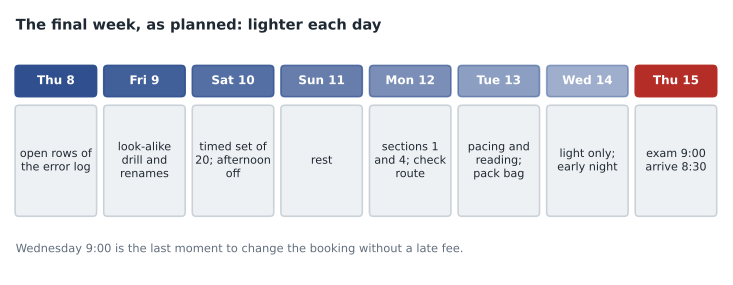
| Day (planned) | Review block, about an hour | Practical task |
|---|---|---|
| Thursday, April 8 | Every row still open in the error log, retested with a fresh question | None |
| Friday, April 9 | The look-alike drill from lesson 8; the table of renamed products | None |
| Saturday, April 10 | A timed set of 20 questions in 35 minutes, reviewed the same morning | Afternoon off |
| Sunday, April 11 | None | Rest; a long walk |
| Monday, April 12 | One-sentence lessons for sections 1 and 4, the two highest priorities | Reread the booking confirmation; check the route and travel time |
| Tuesday, April 13 | Pacing checkpoints and the reading habits, on ten questions | Pack the bag; check both IDs |
| Wednesday, April 14 | Twenty minutes of flashcards at most | The change deadline passes at 9:00; early night |
| Thursday, April 15 | None | The exam at 9:00 |
Two choices in the plan are deliberate. The last timed set is on Saturday, not Wednesday, so that a weak result still leaves three review blocks to act on it, and so that the last thing Mateo does before the exam is not a test that might shake his confidence. And Sunday is a day off, not a day to catch up. Aisha's experience is that one full day away from the material in the final week helps more than one more day of review, because tired candidates read carelessly, and careless reading was Mateo's largest source of errors.
What to review, and what not to
The final week's review comes from the error log, not from the textbook. The log already holds every gap Mateo found in five months, ranked by weight times gap and marked closed or open. The final week works through the open rows first, then the closed rows that took more than one retest to close, then the one-sentence lessons for the two highest-priority sections. That is a short list. By early April, if the plan has worked, the log should have about 20 open or fragile rows, which fit into two review blocks.
Things not to do in the final week are just as important. No new courses, videos or documentation pages: a new topic now is more likely to confuse a known one than to add a mark. No full-length practice sets after April 3: a full set takes a morning and leaves a candidate tired. No hunting for collections of questions claiming to be from the real exam, which break the candidate agreement and are often wrong anyway. And no late nights: the last two nights' sleep matter more than any hour of review.
Packing the night before
The night before an onsite exam, Mateo packs a small bag and leaves it by the door. Lesson 2 covered the rules: two forms of identification, at least one a current government-issued photo ID, both showing exactly the name on the booking. Personal items go into a locker at the centre before he enters the testing room.
| Item | Why |
|---|---|
| Two IDs, both matching the booking name | Without them he cannot sit the exam |
| The booking confirmation, printed or on the phone | The address, time and confirmation number in one place |
| A bottle of water and a small snack | For the waiting area before and after; not allowed in the room |
| A sweater | Testing rooms can be cold, and he cannot leave to fetch one |
| Transit fare or a loaded transit card | The subway is the fastest route downtown |
He also sets two alarms, and puts his phone on charge where he cannot reach it from bed. On Wednesday afternoon he stops reviewing by four in the afternoon. The rest of the evening is for an ordinary dinner and something that has nothing to do with data.
The morning of the exam
The exam starts at 9:00. Lesson 2 noted that Google's onsite requirements ask candidates to arrive about 15 minutes early. Mateo plans to arrive at 8:30, 30 minutes early, which leaves 15 minutes for anything unexpected on the way. He has visited the building once already, in March, so he knows the entrance, the floor and where the waiting area is.
His route is the subway from his apartment in the east end of Toronto to the downtown stop nearest the testing centre, then a five-minute walk. On an ordinary weekday morning the trip takes about 35 minutes, so he plans to leave at 7:45. If the subway is delayed, a streetcar runs along the same route, and a taxi from the station would still arrive before 8:45.
| Time (planned) | Step |
|---|---|
| 6:30 | Wake; an ordinary breakfast, not a large one |
| 7:15 | A five-minute look at his pacing checkpoints and nothing else |
| 7:45 | Leave home with the bag |
| 8:30 | Arrive; check in with both IDs; store the bag in a locker |
| 8:45 | Seated, if the centre is ready; read the on-screen rules |
| 9:00 | The two-hour exam starts |
| 11:00 | At the latest, the exam ends; a provisional result on screen |
Aisha's advice for the hour before is to keep it boring. No review on the way, no last look at the error log in the waiting area, no conversation about the exam with other candidates. The material he knows at 7:00 is what he will know at 9:00. What can still change is how calm he is when he reads the first question.
Inside the exam
Once the exam starts, Mateo follows the routine he has rehearsed twice. He notes the number of questions on the first screen, which tells him which set of checkpoints to use: 14, 28 and 42 for 50 questions, or 17, 34 and 51 for 60. He reads each question with the four habits from lesson 3: the last sentence first, then the setting, then the constraint, and only then the options. He answers every question on the first pass, marks the uncertain ones, and keeps the last 15 minutes for marked questions.
Three situations are worth planning for, because they unsettle candidates who have not thought about them.
| Situation | Plan |
|---|---|
| The first few questions feel hard | Expect it; difficulty is not spread evenly. Mark, move on and trust the checkpoints |
| A run of questions on a weak topic | Answer each on its own merits; a run says nothing about the result |
| A sudden blank on a fact he knows | Mark it and move on; it often returns a few questions later |
| Falling behind a checkpoint by more than three | Mark anything not settled after a minute until back on pace |
| A technical problem with the screen | Raise a hand and tell the proctor at once; do not try to fix it |
If he feels his attention slipping in the second hour, he takes ten seconds: hands off the mouse, a slow breath out, a look away from the screen, and back. The clock keeps running, but ten seconds is cheap compared with misreading a qualifier.
Worked problem
Using the review time
Mateo finishes the first pass of a 60-question exam at minute 101 with 9 questions marked. How much review time does he have, and how much is that for each marked question?
Show solution
- Review time: 120 minus 101 is 19 minutes.
- Per marked question: 19 divided by 9 is about 2.1 minutes.
- He keeps a minute in hand at the end to check that every question has an answer, so he plans about 2 minutes each.
Answer: About 19 minutes, or about 2 minutes for each marked question.
If the exam is online instead
Mateo chose a testing centre, but some colleagues will sit the exam online, so Ravi's plan includes the differences. For an online exam, the practical tasks move: the system test runs again on Monday, the room is cleared and the desk emptied on Wednesday evening, and on the morning the candidate logs in early for the check-in, which includes photographs of the ID and a scan of the room. Nobody else may be present, extra monitors must be disconnected, and the candidate cannot take a break. The rest of the plan, the final week's review and the routine inside the exam, is the same.
After submitting
When Mateo submits, the screen shows a provisional result. Lesson 2 noted that the official result follows after a review period, usually within 7 to 10 days, and lesson 12 covers what happens next. Whatever the screen shows, Ravi asks him to do one thing before leaving the building: write down, from memory, the topics that felt weakest. If he passes, those notes are useful for the work ahead. If he does not, they are the start of a new error log, written while the memory is fresh. He cannot write down questions, which the candidate agreement forbids, but he can write "several questions on Cloud SQL recovery" or "two on Bigtable row keys".
One last practical point concerns the week's sleep. Ravi's team has a rule that nobody schedules late deployments for a colleague in the week before an exam, and Mateo has already asked for Birchline's April 13 release to be handled by Aisha. It is a small courtesy, but a page at midnight on a Tuesday would cost more than any review block could recover.
Common mistakes
MistakeLearning a new topic in the final week.
InsteadReview the error log; nothing new after April 3.
MistakeTaking a full practice set the day before.
InsteadDo the last timed set on Saturday and keep it to 20 questions.
MistakeArriving exactly on time.
InsteadArrive about 30 minutes early; the requirement is about 15.
MistakeReviewing in the waiting area.
InsteadKeep the last hour calm; what you know at 7:00 is what you know at 9:00.
MistakeWriting down exam questions afterwards.
InsteadNote topics that felt weak, never the questions themselves.
Summary and key terms
- The final week starts with a decision on April 4: keep the date, keep it and focus on one gap, or move it at no cost more than 24 hours ahead.
- Each day has one short review block from the error log, and nothing new is learned.
- The last timed set is on Saturday, Sunday is a rest day, and Wednesday is light with an early night.
- Pack two matching IDs and the booking confirmation the night before.
- Arrive about 30 minutes early.
- Inside the exam, use the checkpoints for the number of questions shown, the reading habits and the two-pass method.
- After submitting, note weak topics from memory, never questions.
- Readiness decision
- The choice, after the last full practice set, to keep or move the exam date.
- Review block
- A short daily study session in the final week, built from the error log.
- Open row
- A gap in the error log that has not passed a delayed retest.
- Change deadline
- The latest time a booking can be changed without a late fee: 24 hours before the start.
- Check-in
- Confirming identity and storing belongings before the exam starts.
- Proctor
- The person who supervises an exam, onsite or online.
- Provisional result
- The pass or fail shown on screen right after submitting, before the official result.
- Candidate agreement
- The rules a candidate accepts, including not sharing exam questions.
Practice problems
Work each problem on paper first, then reveal the answer to check.
Why is the last timed set on Saturday rather than Wednesday?
Show answer
A weak result still leaves review blocks to act on it, and the last thing before the exam is not a test.
Mateo arrives at 8:30 for a 9:00 exam. How much earlier is that than the suggested arrival time?
Show answer
The suggestion is about 15 minutes early, 8:45, so 15 minutes more.
What may Mateo write down after the exam?
Show answer
Topics that felt weak, not the questions.
Lesson quiz · 5 questions
Score 60% or more to complete this lesson.
Create a free account to save your progress, take quizzes and earn a certificate.