
GCP-194 · Lesson 1 of 12 · 22 min
How the Associate Data Practitioner exam works
▶ Video coming soon A video version of this lesson is on the way.
On the afternoon of Friday, November 13, 2026, Mateo Alvarez finished the last lab of his data pipelines course in the sandbox project bl-sandbox-mateo, closed his laptop and walked down the hall to a meeting room at Birchline's head office in Toronto. Ravi Menon, who leads the analytics team, and Aisha Daniels, the data engineer Mateo had shadowed for the past three weeks, were already there. On the screen was a single document: the exam guide for the Google Cloud Certified Associate Data Practitioner certification.
"You have done the work," Ravi said. "Six weeks of preparing and loading data, six weeks of analysis, three weeks of pipelines and governance. This course is about turning that into a pass." Aisha added the part Mateo had not thought about: "Knowing the material and passing an exam are related, but they are not the same skill. You also have to know how the exam asks, how long you have, and where your blind spots are." The two of them had blocked out the rest of Friday and Saturday morning, November 14, for what Ravi called a readiness workshop. This course follows that workshop, lesson by lesson, and the study plan that came out of it.
This is GCP-194, the final course of the Associate Data Practitioner program on this site. GCP-220 covered data preparation and ingestion. GCP-221 covered analysis and presentation with BigQuery, notebooks, Looker, Data Studio and BigQuery ML. GCP-222 covered pipeline orchestration and data management. This course reviews all three against the current exam guide, and adds what an exam needs that a job does not: registration, delivery rules, reading questions, timing, practice and the day itself.
What the certification says about you
Google Cloud groups its certifications in three levels. Foundational certifications check broad knowledge of what the cloud can do, without hands-on depth. Associate certifications check that a person can do practical, day-to-day work with a set of services. Professional certifications check design and leadership across larger systems, and usually expect several years of experience. The Associate Data Practitioner sits in the middle level. It says that the holder can work with data on Google Cloud: get it in, clean it, store it in the right place, analyze it, present it, run simple pipelines on a schedule, and keep it secure and well governed.
The exam guide opens with a short description of the person it has in mind. In our own words, it describes someone who secures and manages data on Google Cloud and who uses Google's data services to ingest, transform and analyze data, build simple pipelines, use machine learning, and visualize results. The guide also says the candidate should understand basic cloud concepts such as infrastructure, platform and software offered as services. That description is worth reading slowly, because every question is written from that person's point of view. The exam is not looking for an architect who designs a company's whole data platform. It is looking for a practitioner who picks the sensible tool for a clear task, follows good practice, and avoids the mistakes that waste money or expose data.
Mateo noticed how closely the description matched his own job. He had started at Birchline as a store sales analyst two years earlier, writing spreadsheet reports from exported till data. In the last six weeks he had loaded nightly till files into BigQuery, cleaned supplier price lists, written views for a store manager dashboard, trained a simple return-risk model, and helped move the till pipeline to an event-driven design. "That is exactly the person the guide is describing," Ravi said. "Which is why I think you are ready to start preparing now, rather than in a year."
The facts about the exam
Google's certification page for this exam lists the facts that matter for planning. We read the page in November 2026. Google changes these details from time to time, so a candidate should check the page again before booking.
| Item | What Google's page said (November 2026) |
|---|---|
| Length | 2 hours |
| Number of questions | 50 to 60 |
| Question format | Multiple choice, including questions with more than one correct answer |
| Registration fee | 125 US dollars, plus tax where it applies |
| Languages | English and Japanese |
| Delivery | Online-proctored from a remote location, or onsite at a testing centre |
| Prerequisites | None |
| Recommended experience | Six months or more of hands-on experience working with data on Google Cloud |
| Validity | 3 years |
| Renewal | Through a renewal learning path on Google Skills, completed in the last year before the certification expires |
For a Canadian candidate, the fee is quoted in US dollars. The registration system may show the amount converted to Canadian dollars at checkout, with sales tax added, so the total Mateo pays will be somewhat more than 125, depending on the exchange rate and the tax that applies in Ontario. He writes it on his plan as an estimate and will check the exact amount when he books.
Two of these facts shape how he studies. First, the recommended experience is six months of hands-on work. Mateo's hands-on time is about two months of real work plus the labs. That is short, so his plan has to include more practice in the console and with the command-line tools, not just reading. Second, there is no published passing score. Google reports results as pass or fail and does not share numerical scores. There is no number to aim for; the only goal is to know the material well enough to pass with room to spare.
The four sections of the exam guide
The exam guide divides the exam into four sections, each with an approximate weight: the share of questions that section is likely to have. The weights are approximate and can change when Google revises the guide, but they are the best guide to where the marks come from. Unlike some exam guides, these four weights add up to exactly 100.
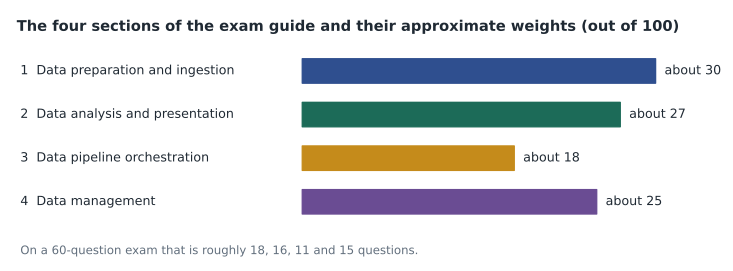
| Section | Approximate weight | What it covers (in brief) |
|---|---|---|
| 1. Data preparation and ingestion | about 30 in 100 | ETL, ELT and ETLT; transfer tools; data quality and cleaning; file formats; extraction and loading tools; choosing storage and location types; structured, semi-structured and unstructured data |
| 2. Data analysis and presentation | about 27 in 100 | SQL for reports and insights; notebooks such as Colab Enterprise; Looker dashboards and simple LookML; Looker compared with Data Studio; BigQuery ML, AutoML, pretrained models and Model Registry |
| 3. Data pipeline orchestration | about 18 in 100 | Choosing a transformation tool; ELT and ETL pipelines; scheduled queries and schedulers; monitoring jobs, logs and metrics; choosing an orchestrator; event-driven ingestion and Eventarc triggers |
| 4. Data management | about 25 in 100 | IAM and least privilege for BigQuery and Cloud Storage; sharing data; storage classes, deletion rules and archiving; backup, replication and location types; encryption keys and Cloud KMS |
Each section is broken into numbered objectives, and each objective lists the considerations it includes. Section 1, for example, has one objective about preparing and processing data and another about extracting and loading it. The second lists file formats, extraction tools, storage systems, location types and loading methods. The guide is not a textbook, but it is a precise list of what can be asked. Mateo prints it, and over the workshop he marks every consideration with one of three symbols: confident, unsure, or never seen.
One small oddity is worth knowing. In the copy of the guide we read, section 4 has two objectives both numbered 4.2: one about lifecycle management and a later one about security and compliance. It looks like a numbering slip rather than a change in content. When this course refers to the security objective, it calls it the encryption and compliance objective of section 4, so the numbering does not cause confusion.
New names and old names
Google renamed several of the products in this exam during 2026. The exam guide we read still uses some of the older names, and an exam written from that guide may too. Mateo needs both sets in his head, so Aisha writes them on the whiteboard and he copies them into his notes.
| Name in the exam guide or older documentation | Current name or status (November 2026) | What to remember |
|---|---|---|
| Looker Studio | Data Studio (renamed April 10, 2026); the paid tier is Data Studio Pro | The free, self-service reporting tool; Looker itself was not renamed |
| Dataplex, Dataplex Universal Catalog | Knowledge Catalog (renamed April 10, 2026) | APIs and roles still use the dataplex name |
| Cloud Composer | Being renamed Managed Service for Apache Airflow (announced April 15, 2026) | Still Apache Airflow; Gen 1 environments reached end of life on September 15, 2026 |
| Data Catalog | Shut down on June 1, 2026; its role moved to the new catalog | Policy Tag Manager for BigQuery column security was kept |
| Analytics Hub | BigQuery sharing | Shared datasets offered as listings to other projects or organizations |
"The exam does not test whether you know a product's newest label," Aisha says. "It tests whether you know what the product is for. If a question says Cloud Composer, think of Airflow. If it says Looker Studio, think of the free reporting tool. Answer the job, not the name."
How the sections map to the earlier courses
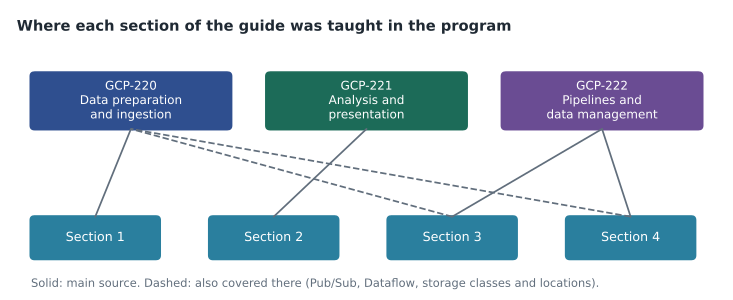
| Exam section | Where it was taught | Review lesson in this course |
|---|---|---|
| 1. Data preparation and ingestion | GCP-220, all lessons | Lesson 4 |
| 2. Data analysis and presentation | GCP-221, all lessons | Lesson 5 |
| 3. Data pipeline orchestration | GCP-222, lessons 1 to 5; GCP-220 for Pub/Sub and Dataflow | Lesson 6 |
| 4. Data management | GCP-222, lessons 6 to 11; GCP-220 for storage classes and locations | Lesson 7 |
Two topics in the guide got less attention in the earlier courses than the exam may give them. The first is the list of storage systems beyond BigQuery and Cloud Storage: Cloud SQL, AlloyDB, Firestore, Bigtable and Spanner. Birchline uses only some of them, so Mateo has seen the others only in comparison tables. The second is Transfer Appliance and Database Migration Service, which Birchline has never needed. Mateo writes both on his plan as known gaps before he has even finished marking the guide.
Turning weights into expected questions
Weights become more useful when they are turned into numbers of questions. If an exam has 60 questions and a section's weight is about 30 in 100, that section will have about 18 of them. The exact count varies from one form of the exam to another, and some questions touch two sections at once, but the estimate tells Mateo how much each section can lift or sink his result.
| Section | Weight | On a 50-question exam | On a 60-question exam |
|---|---|---|---|
| 1. Preparation and ingestion | 30 | about 15 | about 18 |
| 2. Analysis and presentation | 27 | about 13.5 | about 16.2 |
| 3. Pipeline orchestration | 18 | about 9 | about 10.8 |
| 4. Data management | 25 | about 12.5 | about 15 |
| Total | 100 | 50 | 60 |
The arithmetic is simple because the weights add up to 100: multiply the number of questions by the weight, then divide by 100. On a 60-question exam, preparation and ingestion contribute about 18 questions, analysis about 16, data management about 15, and orchestration about 11. Mateo draws the obvious conclusion. No section can be skipped, but a weak spot in section 1 costs nearly twice as much as one in section 3. And section 4, which he had thought of as the governance part that comes at the end, is worth about as many questions as analysis.
Worked problem
Estimating the cost of a weak section
Mateo estimates that he would answer about 9 in 10 questions correctly in sections 1 and 2, but only about 6 in 10 in section 3 and 7 in 10 in section 4. On a 60-question exam, how many questions does each weakness cost compared with a 9-in-10 standard?
Show solution
- Section 3 has about 60 × 18 ÷ 100 = 10.8 questions.
- At 9 in 10 he would get about 9.7 right; at 6 in 10, about 6.5. The weakness costs about 3.2 questions.
- Section 4 has about 60 × 25 ÷ 100 = 15 questions.
- At 9 in 10 he would get 13.5 right; at 7 in 10, 10.5. The weakness costs 3 questions.
- The two weaknesses cost about the same, even though the section 3 gap looks bigger, because section 4 is larger.
Answer: About 3.2 questions for section 3 and 3 for section 4: both deserve study time, and neither can be left to the end.
What kind of questions to expect
All questions are multiple choice. Most have one correct answer; some ask for two or three and say how many to choose. Most are short scenarios: a few sentences about an organization, its data and a goal or problem, then a question about what the data practitioner should do. Some ask for the best tool, some for the first step, and some for the option that meets a constraint such as lowest cost, least operational effort, or fewest people with access. Lesson 3 is devoted to reading these questions well, because many wrong answers come from missing a single word rather than from not knowing the material.
Google also links a short set of sample questions from the certification page. They are not a practice exam and they are not scored, but they show the style. Ravi asks Mateo not to open them yet. "Save them for a check in March," he says. "If you see them now, you will remember the answers, and they will tell you nothing about where you stand."
What a pass does and does not require
The exam does not require memorizing every flag of the bq tool or every menu in the console. It does require knowing what each service is for, roughly what it costs to run, what it does well and badly, and which one a sensible practitioner would choose for a stated need. A question might describe nightly files arriving in a bucket and ask how to load them with the least code; the answer depends on knowing the loading options, not on the exact syntax. Another might ask how to let an analyst query one table without seeing others; the answer is a predefined role granted at the right level, a pattern that runs through the whole of section 4.
Mateo finds that reassuring. Most of the material is patterns, and he has used many of them every week since October. Ravi adds one caution: the exam is written about data work in general, not about Birchline. Birchline made particular choices, such as staying on on-demand BigQuery pricing, using Dataform for transformations and moving simple jobs out of Airflow. Other organizations make other choices, and the exam expects him to know the options and when each fits.
Building the first study plan
Before ending the Friday session, they write the first version of the plan. It will change, but writing it now makes the next five months concrete.
| Period | Main work | Check |
|---|---|---|
| Late November and December 2026 | Mark every consideration in the guide; review sections 1 and 2 (lessons 4 and 5); hands-on practice with bq and gcloud in the sandbox | A short quiz Ravi writes from the guide at the end of December |
| January 2027 | Review sections 3 and 4 (lessons 6 and 7); fill the storage and migration gaps; shadow week on call with Aisha | Look-alike drill (lesson 8) |
| February 2027 | Practice strategy and timing (lesson 9); first full timed practice set on Saturday, February 20 | Error log and gap scores (lesson 10) |
| March 2027 | Close the gaps found in February; Google's sample questions | Retest the weakest considerations |
| April 2027 | Second full timed set on Saturday, April 3; final week (lesson 11) | Exam planned for Thursday, April 15, at 9:00 |
The exam date falls on a Thursday in mid-April, a little over two weeks after the Easter long weekend, which in Ontario includes Good Friday. Ravi points out that the second practice set on April 3 leaves twelve days to close the last gaps without cramming, and that booking a Thursday morning means the final week has one quiet weekend in it. Mateo keeps both dates.
Common mistakes
MistakeStarting to study from memory of the earlier courses without reading the exam guide.
InsteadRead the guide first and mark every consideration as confident, unsure or never seen.
MistakeSpending equal time on every section.
InsteadUse the weights: sections 1 and 2 carry more than half the exam, and section 4 carries a quarter.
MistakeAnswering from the way Birchline does things.
InsteadAnswer from what a careful practitioner in any organization would do, knowing the options and when each fits.
MistakeGetting thrown by an old or new product name.
InsteadLearn both names and answer by what the product does.
MistakeAiming for a particular score.
InsteadResults are pass or fail with no published passing score; aim to know the material with room to spare.
Summary and key terms
- The Associate Data Practitioner certification is an associate-level credential for people who work with data on Google Cloud.
- Google's page in November 2026 listed 2 hours, 50 to 60 multiple choice questions, a 125 US dollar fee plus tax, English and Japanese, online or testing centre delivery, and 3 years of validity.
- Results are pass or fail, with no published passing score.
- The exam guide has four sections weighted about 30, 27, 18 and 25 in 100.
- Turning weights into expected questions shows where marks come from.
- Several products were renamed in 2026, so a candidate should know both names.
- The exam tests judgement about tools and good practice more than syntax.
- Exam guide
- Google's published list of the sections, objectives and considerations an exam covers.
- Section weight
- The approximate share of questions a section of the exam guide is expected to have.
- Associate level
- The middle level of Google Cloud certifications, for people who do practical day-to-day work.
- Objective
- A numbered part of a section in the exam guide, such as 1.2 Extract and load data.
- Consideration
- A specific topic listed under an objective in the exam guide.
- Pass or fail result
- A result reported without a numerical score.
- Recommended experience
- Google's suggestion of six months or more of hands-on work with data on Google Cloud.
- Sample questions
- A short set of questions Google publishes to show the exam's style.
Practice problems
Work each problem on paper first, then reveal the answer to check.
Which two sections together carry more than half the exam?
Show answer
Section 1, preparation and ingestion (about 30), and section 2, analysis and presentation (about 27).
On a 50-question exam, about how many questions come from section 4?
Show answer
50 × 25 ÷ 100 = 12.5, so about 12 or 13.
A question mentions Cloud Composer. What should Mateo think of?
Show answer
Apache Airflow, the managed workflow orchestrator, now being renamed Managed Service for Apache Airflow.
Lesson quiz · 5 questions
Score 60% or more to complete this lesson.
Create a free account to save your progress, take quizzes and earn a certificate.