
GCP-194 · Lesson 12 of 12 · 18 min
After the exam: results, renewal and next steps
▶ Video coming soon A video version of this lesson is on the way.
The last lesson covers what happens after Mateo submits the exam on April 15: how the result is reported, what to do with a pass, what to do if an attempt fails, how the certification is kept current, and where his learning goes next. It is the shortest part of the journey in time, but some decisions made here, such as how to use a failed attempt or when to start renewing, have consequences for years. The details come from Google's certification pages and help articles as we read them in November 2026. Ravi's standing advice applies: read them again when the time comes, because Google changes its policies from time to time.
The provisional result
When Mateo submits, the screen shows a provisional result: pass or fail. The result is provisional because Google reviews each exam record, including whether the candidate kept to the exam terms, before confirming it. Google's certification FAQ asks candidates to allow about 7 to 10 days for the official result. A provisional pass is almost always confirmed, but Mateo plans not to announce anything until the confirmation arrives in his certification account.
Results are reported as pass or fail only. Google does not share a numerical score or publish a passing mark. For a candidate used to school exams marked out of 100 this can feel strange, but it fits the purpose: a certification says that a person met the standard, not by how much.
| Result | What Google provides | What Mateo plans to do |
|---|---|---|
| Provisional pass | Pass on screen; official confirmation after review, allowing about 7 to 10 days | Wait for the confirmation; write his topic note anyway |
| Official pass | Confirmation, certificate and a digital credential in the certification account | Share it; record the expiry date; set renewal reminders |
| Provisional fail | Fail on screen | Write the topic note on the way home; do not rebook the same day |
| Official fail | A report by section in the exam history of the candidate account | Use the report and the topic note to rebuild the error log |
If the result is a pass
An official pass appears in the certification account, which provides a certificate and a digital credential that can be shared, for example on a professional profile, in an email signature or on a résumé. The certification is valid for three years from the date it is earned, so a pass on April 15, 2027 would run to April 2030. Mateo will also add it to Birchline's training record, which the analytics team uses for its development plans and for showing customers and auditors that the people handling data are qualified.
Ravi suggests three things for the first week after a pass. First, record the expiry date and set reminders, because renewal has a window, as below. Second, write a short note for the next Birchline colleague who prepares: which resources helped, which did not, how long it took, and the study plan, but no exam questions, which the candidate agreement forbids sharing. Third, keep the habits that made the pass possible. several Google Cloud data products were renamed in 2026 alone, and the certification is only worth something if the knowledge behind it stays current.
If an attempt fails
A failed attempt is not the end, and it is not unusual for a first attempt. Mateo's plan, written now while he is calm, is to treat a fail as information. Google's help pages say that after a failed attempt a report by section is available in the exam history, except for beta and renewal exams. The report shows how he did in each section against the guide's sections. Together with the topic note he writes on the day, it tells him where the gaps were.
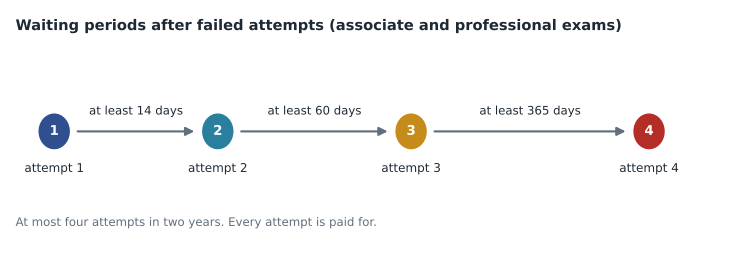
| After | Wait before the next attempt |
|---|---|
| A first failed attempt | At least 14 days |
| A second failed attempt | At least 60 days |
| A third failed attempt | At least 365 days |
| Overall limit | Four attempts in a two-year period |
The policy adds three points. Every attempt counts toward the limit, whatever the language or delivery method. Every attempt is paid for. And getting around the rules, for example by registering under another name, can lead to a certification being denied or revoked. The waiting periods are minimums, not targets.
Worked problem
Planning a retake
Suppose Mateo's first attempt on Thursday, April 15, 2027 fails, and the report shows sections 1 and 4 below the others. What is the earliest date he could retake, and how should he plan?
Show solution
- The first waiting period is 14 days: April 15 plus 14 days is Thursday, April 29, 2027.
- Rebuild the error log from the report and the topic note, and rerun the weight-times-gap calculation from lesson 10 with the new estimates.
- Estimate the hours needed for sections 1 and 4. At two and a half hours a week, closing two sections properly takes more than two weeks.
- Book a date that leaves room for at least one full timed practice set after the new study, for example in early June.
- Use the final-week plan from lesson 11 again for the new date.
Answer: The earliest retake is April 29, 2027, but a date in early June, after real study and a full practice set, is wiser.
There is a second reason not to rush. A second failed attempt brings a 60-day wait, and a third a full year. A hasty retake risks more than its fee; it risks months. Ravi's rule for his team is that nobody rebooks within 48 hours of a fail. The first day is for the topic note and a rest; the second is for reading the report with someone else.
Keeping the certification current
The certification is valid for three years. Google's certification page in November 2026 described renewal for this certification through continuing education on Google Skills: completing the designated courses or skill badges in the renewal learning path within the last year before the certification's inactive date. The candidate first links the Google Skills account to the certification account, using the same email address. Google's renewal help page adds three useful details: renewal reminders are sent about 180 and 90 days before expiry; renewal by continuing education adds one year to the inactive date; and some certifications can instead be renewed by a renewal exam, which adds two or three years depending on the certification.
The one-year extension matters. A renewal by continuing education is not a fresh three years; it moves the expiry date back by a year, so it is repeated each year while it remains available. Google has changed renewal methods before, so Mateo's note says: read the renewal page again in April 2029, a year before the expiry.
| Date (planned) | Reminder |
|---|---|
| April 2029 | One year before expiry: the renewal window opens; read the current requirements and link the Google Skills account |
| October 2029 | About 180 days before expiry: Google's first reminder; renewal path started |
| January 2030 | About 90 days before expiry: renewal complete, new inactive date recorded |
| April 2030 | The original expiry date |
The renewal learning path is easier for someone who has kept up. Aisha's routine is small rather than heroic: read the BigQuery and Cloud Storage release notes once a week, try anything new in the sandbox project, and spend one Friday afternoon a month on whatever renamed or new service has come up in the team's work. Over three years, that routine adds up to far more than any renewal path asks.
Using the certification at work
A certification changes what others expect. After a pass, colleagues will ask Mateo to choose storage classes, review access grants and recommend transfer tools, which is exactly what the exam tested. Ravi plans to give him two pieces of work that use the certification directly, both in the second quarter of 2027: running the next quarterly access review with Teresa Okonjo, and writing the design note for moving Birchline's supplier price files from a nightly batch to an event-driven load. Neither is new to him, but both will now be his to lead.
| Exam section | Where it shows up in Mateo's work after April |
|---|---|
| 1. Data preparation and ingestion | Choosing the transfer and loading method for new supplier and store data |
| 2. Data analysis and presentation | The store performance dashboard and the demand forecast in BigQuery ML |
| 3. Data pipeline orchestration | The event-driven supplier load and the nightly Airflow pipeline |
| 4. Data management | The quarterly access review, lifecycle rules on the raw buckets, and retention checks with Daniel Ferreira |
Next steps in learning
The Associate Data Practitioner is an associate-level certification. Google's certification page does not name a single next step, but Google's professional certifications build naturally on it. The right one depends on where Mateo's work goes.
| Direction | Why it fits | A certification to consider |
|---|---|---|
| Building and running pipelines at scale | Most of his day is ingestion and orchestration | Professional Data Engineer |
| Machine learning | The demand forecast grows into a family of models | Professional Machine Learning Engineer |
| Cloud foundations | He takes on more of the projects, networks and IAM around the data platform | Associate Cloud Engineer |
| Analytics engineering in Looker | He becomes the owner of the LookML model | Google's Looker training and documentation; check the current certification list |
Ravi's advice is to wait at least six months before starting another certification, and to let real work choose the direction. A professional-level exam expects judgement built from experience, and the best preparation for it is a year of solving the problems it asks about. In the meantime, the habits from this course carry over directly: read the exam guide, map it to what you know, turn weights into expected questions, log every miss, rank gaps by weight times gap, and rehearse the clock.
Looking back on the program
Over four courses, Mateo has gone from an analyst who wrote SQL against tables someone else had built to a practitioner who can build and govern the whole path from a till file to a dashboard. GCP-220 covered ingestion, quality and storage. GCP-221 covered analysis, Looker, Data Studio and BigQuery ML. GCP-222 covered pipelines, orchestration and governance. This course turned all three into preparation for a single exam, and along the way into a way of studying that he can use again.
The exam is a milestone, not the point. The point is the work: data that arrives on time, is cleaned once and correctly, is stored in the right place at the right cost, is shared only with the people who need it, and can be recovered when something goes wrong. If Mateo passes in April, the certificate will say so. If he does not pass the first time, the work will still say so, and the second attempt will be better prepared than the first.
What to keep from this course
Much of this course was about one exam, but the methods are general. Turning a guide's weights into expected questions works for any certification with a published guide. Reading a scenario for its setting, constraint and ask works for design reviews as well as exams: a good design note answers the same three things. An error log ranked by weight times gap is a fair way to plan any learning where time is short. And the habit of checking a fact against the current documentation, rather than against memory, is what kept this course accurate through a year in which several of the products it covers changed their names. Mateo plans to keep his error log after the exam, as a record of what he learned and how, and to start a new tab in it for the next certification, whenever that comes.
Common mistakes
MistakeAnnouncing a provisional pass at once.
InsteadWait for the official confirmation, which can take about 7 to 10 days.
MistakeRebooking the day after a fail.
InsteadWait at least 48 hours, read the report with someone, and choose a date that allows real study.
MistakeTreating the 14-day wait as a target.
InsteadIt is a minimum; book when the gaps are closed.
MistakeAssuming renewal gives three more years.
InsteadContinuing education on Google Skills adds one year; check the current renewal page.
MistakeSharing exam questions with the next colleague.
InsteadShare resources and the study plan, never questions.
Summary and key terms
- The screen shows a provisional pass or fail; the official result follows after a review, allowing about 7 to 10 days.
- Results are pass or fail, with no numerical score.
- A pass gives a certificate and digital credential valid for three years.
- After a fail, a report by section is available, and retakes wait at least 14, then 60, then 365 days, with four attempts in two years.
- Renewal for this certification is by continuing education on Google Skills in the last year, which adds one year; reminders come about 180 and 90 days before expiry.
- The certification is best used at work, and professional certifications such as Professional Data Engineer are natural next steps after real experience.
- Provisional result
- The pass or fail shown on screen before Google reviews the exam record.
- Official result
- The confirmed result in the certification account after review.
- Retake policy
- Google's rules on waiting periods and the number of attempts.
- Report by section
- A breakdown of performance by exam section, available after a failed attempt.
- Inactive date
- The date on which a certification expires unless renewed.
- Continuing education
- Renewing by completing designated learning on Google Skills in the final year.
- Renewal window
- The period in which a certification can be renewed, the last year before the inactive date for continuing education.
- Digital credential
- A shareable online record of a certification.
Practice problems
Work each problem on paper first, then reveal the answer to check.
Mateo fails a first attempt on April 15, 2027. What is the earliest retake date?
Show answer
April 29, 2027, 14 days later.
How much does renewal by continuing education add to the inactive date?
Show answer
One year.
What can Mateo share with the next colleague who prepares?
Show answer
Resources, timings and the study plan, but not exam questions.
Lesson quiz · 5 questions
Score 60% or more to complete this lesson.
Create a free account to save your progress, take quizzes and earn a certificate.