
GCP-193 · Lesson 11 of 12 · 18 min
The final week and exam day
▶ Video coming soon A video version of this lesson is on the way.
Owen's exam is planned for 9:00 on Tuesday, May 25, 2027, at a testing centre in Toronto. This lesson is the plan for the last seven days and for the day itself, written in November so that in May he only has to follow it. Sofia has a firm view about the final week: it is too late to learn much that is new, and it is easy to lose a pass through tiredness, panic or a missed detail. The week is for consolidating, resting and removing every avoidable risk.
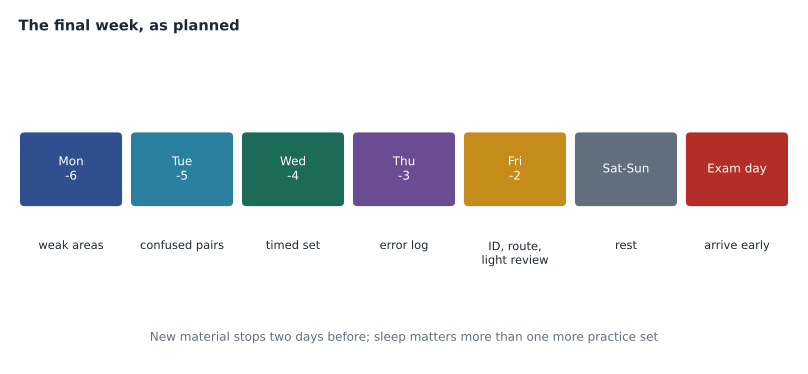
What the final week is for
By the final week, Owen will have reviewed all six sections, completed two full timed sets and worked through his error log. The marginal value of new material is low; the marginal value of a clear head is high. The week therefore has three aims: to refresh the topics most likely to cost marks, to keep the exam habits warm with one short timed set, and to make sure nothing practical can go wrong on the day.
| Day (as planned) | Study | Practical |
|---|---|---|
| Monday, May 17 (6 days before) | The two weakest sections from the latest gap estimates; 45 minutes each | Confirm the booking in the portal |
| Tuesday, May 18 (5 days before) | The look-alike card from lesson 8; explain each pair aloud to Sofia | Check the ID expiry dates |
| Wednesday, May 19 (4 days before) | One timed set of 30 mixed questions in 53 minutes, with the two-pass method | None |
| Thursday, May 20 (3 days before) | Review Wednesday's set and every open row in the error log | Plan the route and departure time |
| Friday, May 21 (2 days before) | Light review: the principles card from lesson 3; no new topics after today | Pack ID, confirmation, water and a snack; set two alarms |
| Saturday and Sunday | Nothing structured; a short look at the cards at most | Normal sleep times; exercise; time outdoors |
| Monday, May 24 | Rest | Victoria Day: confirm transit schedules for Tuesday morning |
Sofia explains the reasoning behind each choice. The weakest sections come first because the error log will show where marks are still being lost, and there is time to act on what Monday reveals. The look-alike card comes early because pairs are fixed best by explaining them, and explaining needs a fresh mind. The single timed set on Wednesday keeps the pacing habit alive without exhausting him; a full 60-question set four days before the exam would leave him tired for nothing. Thursday's review closes the loop. Friday is the last study day, and only for light review. The weekend is rest.
Why rest is part of the plan
Owen is tempted to do one more full practice set on the Sunday. Sofia talks him out of it. Memory consolidates during sleep, and a tired candidate reads less carefully, which is exactly the kind of error lesson 3 showed cost him seven questions in November. A rested candidate who knows 85 in every 100 questions will usually outscore a tired one who knows 88 but misreads more. There is also a practical risk: a bad result on a practice set two days before the exam can shake confidence without leaving time to fix anything.
She is not against all study at the weekend. Glancing at the two cards for a few minutes while having coffee is fine, and so is a walk spent mentally listing the six sections and their main topics. What she rules out is anything long, timed or new.
The two cards
Owen's study materials by May will fill a large folder: the marked guide, the error log, notes from every lesson, practice sets. For the final days he condenses everything into two cards, each a single page.
| Card | What is on it | Built in |
|---|---|---|
| Principles card | Google's recommended practices: least privilege, settings by OU and group, test on a small group first, 2SV with security keys for admins, built-in tools before scripts, two or more super admins, separate admin accounts; the reading method and the two-pass method | Lessons 3 and 9 |
| Look-alike card | Twelve pairs in the form "A does X; B does Y; clue for A; clue for B", chosen from the pairs he got wrong at least once | Lesson 8 |
The cards cannot go into the exam room; at a testing centre, everything goes into the locker. Their purpose is the act of making them and reading them in the final days. On the morning of the exam, Owen reads both cards once over breakfast, then puts them away.
Handling nerves
Some nervousness before an exam is normal and even useful, because it sharpens attention. Too much makes reading careless. Sofia's suggestions are practical rather than inspirational. Prepare everything the night before so the morning has no decisions in it. Arrive early enough to sit quietly for a few minutes rather than rushing in at the last moment. Before the first question, take three slow breaths, longer out than in, which slows the heart rate. Remind yourself that the plan for a fail is already written, so even the worst outcome is manageable: a 14-day wait, a fee and some more study.
Owen practises the breathing at the start of each full practice set, so that on the day it is a familiar routine rather than a new trick. He also rehearses the first five minutes of the exam in his head during the final week: checking in, sitting down, reading the instructions, noting the number of questions, choosing his checkpoints, and reading the first question slowly. Rehearsing the start removes much of the strangeness that makes the first questions feel harder than they are.
If he finds on the morning itself that he feels unwell, he has a decision to make. A minor cold is no reason to move the exam. A fever or a migraine is, but a change within 24 hours costs a late fee, and a no-show forfeits the fee. Sofia suggests he decide by the evening before if he can, and if he wakes up ill, weigh the late fee against the cost of sitting the exam at half strength.
The night before
The evening before is for preparation, not study. Owen's list: lay out clothes, comfortable in layers because testing rooms vary in temperature; pack the passport and the second ID; put the confirmation email on his phone and a printed copy in his bag; pack water and a snack for before and after; check the route and set the departure time with a 30-minute buffer; set two alarms. Then a normal dinner, no alcohol, and bed at his usual time. Sofia's only other advice is to avoid online forums about the exam that evening, where other people's worries are contagious and their claims about the exam are often wrong.
The morning
Owen plans a normal breakfast, because a two-hour exam on an empty stomach is harder than it needs to be, and enough water without overdoing it, since leaving the room during the exam may not be possible. He plans to leave home early enough to arrive 30 minutes before his 9:00 appointment, which meets Google's request to arrive at least 15 minutes early with time to spare for a delayed train or a slow lift. On the way, no studying: music or a podcast, or nothing.
At the testing centre, the staff check his identification against his booking, may take a photograph, and ask him to put everything in a locker: phone switched off, wallet, cards, keys, water. They explain the rules and show him to a workstation where the exam is ready. He reads the instructions on the screen carefully, even though they seem obvious, and notes the number of questions on the first screen to choose his checkpoints.
During the exam
Everything in the exam is what he has practised. He reads each question once, notes the qualifiers, predicts, reads every option, decides and moves on, marking questions he is unsure of. At 30, 60 and 90 minutes he glances at the timer and compares his question number with his checkpoint. At each checkpoint he takes one slow breath and looks away from the screen for a few seconds. After the first pass, he returns to marked questions and changes an answer only for a reason. With a minute or two left, he makes sure no question is unanswered.
Sofia prepares him for one feeling that surprises many candidates: in the middle of the exam, it is normal to feel that it is going badly. Questions on topics he knows well feel easy and are quickly forgotten; questions he struggles with stay in his mind and distort his sense of how it is going. A run of three hard questions says nothing about the result. The answer to the feeling is the plan: next question, same method.
| Moment | If this happens | Do this |
|---|---|---|
| Start | Mind goes blank on the first question | Guess, mark and move on; the second question will usually be easier |
| Middle | A run of hard questions | Same method; check the checkpoint; one slow breath |
| Any time | Two options seem equally right | Return to the qualifiers in the constraint and the ask |
| Late | Behind the checkpoint | Mark more readily; make sure every question has an answer |
| End | Time left over | Review marked questions only; do not reread every answer |
Submitting
When the review is done, or the time is up, the exam is submitted and a provisional result appears on the screen. Lesson 12 covers what it means and what happens next. Whatever it says, Sofia asks Owen to do one thing before he leaves the building: write down, on the way home or as soon as he can, which topics felt hard. He must not record or share the questions themselves, which the exam terms forbid, but a note of topics is his own, and if he ever needs a second attempt, it will be the most valuable document he has.
Worked problem
Planning the morning
Owen's exam starts at 9:00. The trip takes about 35 minutes. Google asks onsite candidates to arrive at least 15 minutes early, and Owen wants an extra 15-minute buffer on top of that for delays. He needs 45 minutes at home to get ready after waking. What time should he leave, and what time should his first alarm be set for?
Show solution
- Arrival target: at least 15 minutes early plus a 15-minute buffer, so 30 minutes before 9:00, which is 8:30.
- Travel takes 35 minutes, so he must leave at 8:30 minus 35 minutes, which is 7:55.
- Getting ready takes 45 minutes, so he must wake at 7:55 minus 45 minutes, which is 7:10.
- Set the first alarm for 7:10 and a second for 7:15 as a backup.
- Check the night before that transit or traffic on the day matches the usual 35 minutes.
Answer: Leave at 7:55 to arrive at 8:30; first alarm at 7:10, backup at 7:15.
Common mistakes
MistakeTaking a full practice exam the day before.
InsteadStop new material two days before; rest so you can read carefully.
MistakeBringing notes to read in the waiting area and into the room.
InsteadRead the two cards at breakfast and leave them at home or in the locker.
MistakeArriving exactly at the appointment time.
InsteadArrive at least 15 minutes early, with a buffer for delays.
MistakeJudging the result by how the middle of the exam feels.
InsteadExpect hard runs; keep to the method and the checkpoints.
MistakeWriting down exam questions afterwards to share.
InsteadNote only the topics that felt hard, for yourself; sharing questions breaks the terms.
Summary and key terms
- The final week is for consolidating, resting and removing practical risks, not learning new material.
- Owen's plan covers weak sections first, the look-alike card, one timed set of 30 questions, a review of the error log, light review on the last study day, and rest at the weekend.
- Two one-page cards, principles and look-alikes, condense his notes.
- The night before is for preparation: ID, confirmation, route, clothes, alarms and normal sleep.
- On the day, eat, arrive early, follow the testing centre's check-in and use the practised method with checkpoints.
- Feeling that it is going badly midway is normal.
- Afterwards, note the topics that felt hard, never the questions.
- Consolidation
- Strengthening what is already learned, rather than adding new material.
- Principles card
- A one-page summary of Google's recommended practices and Owen's exam methods.
- Look-alike card
- A one-page list of easily confused features, with clues for each.
- Buffer
- Extra time added to a plan to absorb delays.
- Check-in
- The identity check and briefing before an exam begins.
- Provisional result
- The pass or fail shown on screen when the exam is submitted.
- Topic note
- A personal note of topics that felt hard, written after the exam without recording questions.
- Final week
- The last seven days before the exam, planned in advance.
Practice problems
Work each problem on paper first, then reveal the answer to check.
Why does Owen stop studying new material two days before the exam?
Show answer
New material gives little benefit then, and rest makes careful reading more likely.
What two cards does he make, and what is on each?
Show answer
A principles card with Google's recommended practices and his methods, and a look-alike card with twelve pairs.
What should he do if the middle of the exam feels like it is going badly?
Show answer
Keep to the method and the checkpoints; a run of hard questions says nothing about the result.
Lesson quiz · 5 questions
Score 60% or more to complete this lesson.
Create a free account to save your progress, take quizzes and earn a certificate.