
GCP-111 · Lesson 4 of 12 · 18 min
Vertex AI as the AI platform
▶ Video coming soon A video version of this lesson is on the way.
The fourth session moved down the stack. Jules arrived with a printed sketch of the shopping assistant: a chat window in the corner of birchline.example, a customer typing "I'm doing a three-day canoe trip in Algonquin in September, what do I need?" and the assistant answering with a packing list, links to products, and a note that the 40-litre dry bag was in stock at the nearest store. "None of the products we've looked at so far can do this," he said. "It has to be ours."
"Then it gets built on the platform," Farah said. "The lesson title in your course still says Vertex AI, because that's the name most people know. Google relaunched it in April 2026 as the Gemini Enterprise Agent Platform. Same purpose, more agent tools, new name. When you read Vertex AI in older material, read Agent Platform." This lesson explains what the AI platform is, what it contains, who uses it, and why a company builds there rather than stitching together separate tools.
From Vertex AI to Gemini Enterprise Agent Platform
Vertex AI launched in 2021 as Google Cloud's unified machine learning platform: one place to prepare data, train models, deploy them and monitor them. As generative AI grew, it added access to Gemini and other foundation models, prompt design tools, grounding, tuning and agent building. In April 2026, at Google Cloud Next, Google relaunched the platform as the Gemini Enterprise Agent Platform, describing it as the successor to Vertex AI with a stronger focus on building, deploying and governing agents. Many feature names changed with it: for example, the exam guide now refers to Agent Search, Agent Platform AutoML, Agent Platform Feature Store and Agent Studio.
For a leader the change matters less than it seems. The platform's job is the same: give builders a managed, secure place to use models and turn them into applications and agents. The exam uses the new names, so learn them, but expect to meet the old names in documentation, job postings and colleagues' conversations for some time.
| Older name (Vertex AI era) | Current name in the exam guide | What it does |
|---|---|---|
| Vertex AI | Gemini Enterprise Agent Platform (Agent Platform) | The managed AI platform |
| Vertex AI Search | Agent Search | Search and grounding over company data for apps and agents |
| Vertex AI Studio | Agent Studio | Low-code prompt design, testing and agent building |
| Vertex AI AutoML | Agent Platform AutoML | Training custom models with little code |
| Vertex AI Feature Store | Agent Platform Feature Store | Managing and serving data features for models |
| Model Garden | Model Garden | The catalogue of models |
What the platform contains
Farah grouped the platform's capabilities by the job a builder is doing, because that is how people use it and how exam scenarios describe it.
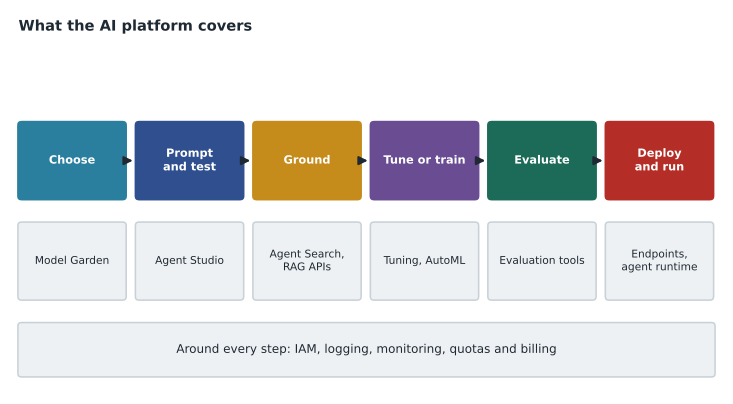
| Job | Platform capability | Covered in |
|---|---|---|
| Find and compare models | Model Garden: Google, partner and open models | Lesson 5 |
| Design and test prompts | Agent Studio: prompts, settings, saved versions | Lesson 6 |
| Connect company data | Agent Search, RAG APIs, grounding with Google Search | Lesson 8 |
| Adapt a model to a task | Tuning foundation models; AutoML for predictive models | This lesson |
| Check quality | Evaluation services that score outputs against criteria | This lesson and lesson 6 |
| Build agents | Agent Studio, the Agent Development Kit, agent runtime and tools | Lesson 7 |
| Deploy and operate | Managed endpoints, scaling, monitoring and logging | This lesson |
| Govern | IAM, audit logs, model registry, safety and security controls | Lesson 10 |
Who uses the platform
The platform serves several roles, each at a different depth. Developers call models through APIs and build applications and agents. Data scientists and machine learning engineers train, tune and evaluate models and manage their lifecycle. Business analysts may use low-code tools such as Agent Studio or AutoML. Platform and security teams set up projects, access, networking and policies so that everyone else builds safely. Leaders rarely use the platform themselves, but they decide whether a project belongs there and what skills it needs.
At Birchline the shopping assistant team would be small: two developers from the web team, Ravi's data engineer for the product catalogue, Teresa for security review, and Jules as product owner. Farah would design the architecture. Owen's role was to understand it well enough to explain choices to the steering committee.
Predictive AI and generative AI on one platform
The platform is not only for generative AI. It also supports traditional predictive machine learning, in which a model learns from labelled examples to predict a number or category, such as next month's demand for sleeping bags or whether an order is likely to be returned. GCP-110 explained the difference. Having both on one platform matters because real solutions often combine them: Birchline's demand forecast, already built with BigQuery ML in GCP-102, could feed the shopping assistant so it avoids recommending items about to run out.
Agent Platform AutoML lets a team train a predictive model on its own tabular, image or text data with little code: the team supplies labelled data and AutoML tries model types and settings, then reports how well the best model performs. It suits teams with good data but no machine learning specialists. Custom training, where data scientists write their own training code, suits unusual problems or teams that need full control.
Adapting a foundation model
Most generative AI projects start with a foundation model as it comes, plus careful prompting and grounding. When that is not enough, the platform offers ways to adapt a model, in rising order of effort.
| Technique | What changes | Effort | When it helps |
|---|---|---|---|
| Prompt design | Only the instructions and examples sent with each request | Lowest | Most tasks; always try first |
| Grounding | Relevant company data is added to each request | Low to moderate | Answers must reflect current, specific facts |
| Tuning | The model is further trained on the company's examples | Moderate to high | A consistent style or format that prompts cannot reliably produce |
| Training a model | A new model is built from data | Highest | Rare for leaders; specialist needs |
Farah's advice echoed GCP-110: try prompting first, add grounding when facts matter, and only consider tuning when there is good evidence that the first two cannot meet the need. Tuning needs a set of high-quality examples, costs money to run, and produces a model version that must be evaluated and maintained. For the shopping assistant, grounding in the product catalogue mattered far more than tuning, because products and stock change every day.
Evaluating before and after launch
How does a team know the assistant is good enough to put in front of customers? The platform includes evaluation tools that score a model's or an agent's answers against criteria such as accuracy, relevance, groundedness in the sources provided, safety and following instructions. Some scores compare an answer with a reference answer; others use a second model to judge qualities that are hard to measure automatically. Evaluation runs before launch, to choose between prompts or models, and continues afterwards, to catch quality slipping when products, policies or the model change.
# Illustrative evaluation summary for two prompt versions of the shopping assistant.
# Each score is the share of 200 test questions that reviewers marked acceptable (out of 1.0).
results = {
    "Prompt v1": {"accurate": 0.86, "grounded": 0.81, "on brand": 0.92, "safe": 0.995},
    "Prompt v2": {"accurate": 0.91, "grounded": 0.93, "on brand": 0.90, "safe": 0.995},
}
weights = {"accurate": 0.4, "grounded": 0.3, "on brand": 0.1, "safe": 0.2}
for name, scores in results.items():
    total = sum(scores[k] * w for k, w in weights.items())
    print(f"{name}: weighted score {total:.3f}")
    for k, v in scores.items():
print(f" {k:9} {v:.3f}")Prompt v1: weighted score 0.878 accurate 0.860 grounded 0.810 on brand 0.920 safe 0.995 Prompt v2: weighted score 0.932 accurate 0.910 grounded 0.930 on brand 0.900 safe 0.995
What this code does
Two prompt versions are compared on four review measures (accurate, grounded, on brand and safe), each the fraction of 200 test questions marked acceptable. The measures are combined with weights that make accuracy and grounding count most. Prompt v2 scores 0.932 against 0.878 for v1, mainly because its answers are better grounded, even though it is slightly less on brand.
The weights in this illustrative example reflect Jules's priorities: accuracy and groundedness matter most, and safety has to be near perfect in every version regardless of its weight. Version 2 gives more grounded answers at a small cost in brand tone, which the team could fix with an extra instruction. The point for a leader is that model and prompt choices should be made with numbers from a fixed test set, not from a handful of impressive demos.
Deploying and operating
Once a model or agent is ready, the platform runs it as a managed service. Google's foundation models are called through APIs and scale automatically; Birchline pays for what it uses, typically by the amount of input and output processed. Custom or open models can be deployed to managed endpoints, where the team chooses machine types and scaling. Agents run on a managed agent runtime. In every case the platform provides monitoring, logging and quotas, which plug into the Cloud Monitoring and Cloud Logging tools GCP-101 introduced.
gcloud services enable aiplatform.googleapis.com --project=bl-shop-dev
gcloud ai models list --region=REGION --project=bl-shop-dev
The API name in the command above still contains aiplatform, a reminder that product names on the surface change faster than the plumbing underneath.
Why build on the platform rather than piece it together
Jules asked why Birchline could not simply call a model API from the web server and skip the platform. Farah gave four reasons that also appear in exam scenarios.
- Security and governance come with it. The platform runs inside Birchline's projects, under its IAM roles, organization policies, audit logs and network controls.
- The pieces work together. Model access, grounding, evaluation, agent runtime and monitoring share data and settings, so the team builds less glue code.
- Choice without lock-in to one model. Model Garden lets the team switch or compare models as better or cheaper ones appear.
- Enterprise data commitments. Google states that customer data used with the platform's models is not used to train Google's models without permission, and the platform supports controls such as data residency and customer-managed encryption keys, covered in lesson 10.
Common mistakes
MistakeTreating Vertex AI and Agent Platform as two different products.
InsteadAgent Platform is the 2026 successor and new name of Vertex AI.
MistakeStarting a generative AI project by tuning a model.
InsteadStart with prompting and grounding; tune only with evidence that they fall short.
MistakeJudging a model by a few impressive demos.
InsteadEvaluate on a fixed set of real questions with agreed criteria, before and after launch.
MistakeBuilding on the platform for a need an application already meets.
InsteadUse the platform when custom behaviour, data or interfaces are truly required.
Projects, environments and the platform
Platform work follows the same structure GCP-101 set up. The shopping assistant would be built in bl-shop-dev, tested there against copies of the catalogue, and promoted to bl-shop-prod only after evaluation and security review. Each project has its own quotas for model requests, its own budget alerts and its own audit logs, so experiments in development cannot exhaust production capacity or hide in production costs. Dana asked for a separate budget line for AI usage in each project, so the finance team could see how much the assistant cost per conversation as it grew.
Worked problem
Is this a platform project?
Three proposals reach the steering committee: (a) staff want help writing meeting notes; (b) the merchandising team wants a model that predicts which products will be returned, using five years of order data; (c) the web team wants the shopping assistant. Which need the AI platform?
Show solution
- (a) Meeting notes are a built-in feature of Gemini in Meet and Docs. No platform work is needed.
- (b) Predicting returns is a predictive machine learning problem on Birchline's own data. Agent Platform AutoML, or BigQuery ML, can train it with little code. This uses the platform.
- (c) The shopping assistant needs a custom interface, grounding in the catalogue and tools to check stock. It is a custom agent on the platform.
Answer: Proposals (b) and (c) belong on the AI platform; (a) is met by Gemini for Google Workspace.
By the end of the session Owen could draw the platform's six jobs from memory. Jules left with a list of the skills his team would need, and a note to ask the web developers whether they had used the Agent Development Kit.
Summary and key terms
- Vertex AI, Google Cloud's AI platform since 2021, was relaunched in April 2026 as the Gemini Enterprise Agent Platform.
- It supports choosing models in Model Garden, designing prompts in Agent Studio, grounding with Agent Search and RAG APIs, tuning foundation models, training predictive models with AutoML or custom code, evaluating outputs, building agents, and deploying and operating them under IAM, logging and monitoring.
- Developers, data scientists, analysts and platform teams use it at different depths.
- Adapt models with prompting first, then grounding, then tuning.
- Building on the platform brings security, integration, model choice and enterprise data commitments.
- Gemini Enterprise Agent Platform
- Google Cloud's managed AI platform and the successor to Vertex AI.
- Vertex AI
- The earlier name of Google Cloud's AI platform.
- Agent Platform AutoML
- A tool that trains predictive models on a team's data with little code.
- Tuning
- Further training a foundation model on a company's examples.
- Evaluation
- Scoring model or agent outputs against agreed criteria.
- Endpoint
- A managed address where a deployed model receives requests.
- Predictive machine learning
- Models that predict a number or category from labelled examples.
Practice problems
Work each problem on paper first, then reveal the answer to check.
What should a team try before tuning a model?
Show answer
Prompt design and then grounding.
Name three jobs the AI platform supports.
Show answer
Any three of choosing models, prompting, grounding, tuning, evaluating, building agents, deploying and governing.
Why does evaluation continue after launch?
Show answer
Products, policies and models change, so quality can slip without anyone noticing.
Lesson quiz · 5 questions
Score 60% or more to complete this lesson.
Create a free account to save your progress, take quizzes and earn a certificate.