
GAS-120 · Lesson 10 of 12 · 22 min
Propane storage, cylinders and tank setbacks
▶ Video coming soon A video version of this lesson is on the way.
A week after the leak at the farm pit, the same customer outside Ancaster called Bayline again. She wanted to retire the row of 100 lb cylinders behind her farmhouse and switch to a single 500 US gallon tank, large enough to add a standby generator. Luis Ferreira took Jonah to look. Before he even opened the truck door, Luis was pacing the yard: from the back wall of the house, from the kitchen window, from the dryer vent, from the property line along the lane. "The propane company owns the tank and sets it," he said. "But if we pick a spot that doesn't meet the setbacks, we wasted everybody's morning. So we check first."
This lesson introduces the code for propane storage and handling: CSA B149.2, the Propane Storage and Handling Code. It covers the types of containers, how cylinders are filled and handled, the general rules for where cylinders and tanks may go, and how the storage code divides responsibility with the installation code. Propane systems are studied in depth in a later course; here the aim is to know what the storage code covers and how to read its location rules.
Two codes, one system
Propane systems are covered by two codes. B149.2 governs the storage, handling and transfer of propane: cylinders and tanks, their valves and fittings, where they may be placed, filling plants and container refill centres, cylinder exchange, and the transport of cylinders by the installer. B149.1 governs the piping, regulators downstream of the container, appliances, venting and air supply. In Ontario, B149.2:25 is adopted through the propane code adoption document, effective June 8, 2026, under O. Reg. 211/01, which also sets the licensing of propane facilities and the training needed to handle and fill cylinders.
Responsibility is usually divided in the field too. The propane supplier normally owns, sets and fills the tank, installs the first-stage regulator, and is responsible for the container installation. The gas contractor installs the piping, the second-stage regulator where agreed, the appliances and their venting. Both must make sure the parts meet. A tank in the wrong place is the supplier's problem to fix, but a contractor who designs the house piping around a tank location that cannot be approved has caused the problem.
Cylinders and tanks
Propane containers come in two broad types. A cylinder is a portable container built to a transport specification, Transport Canada's, such as a barbecue cylinder, a forklift cylinder or the 45 kg cylinders often used at houses. Cylinders are usually filled by weight at a filling station or exchanged, and they must be requalified at intervals; one past its requalification date must not be refilled. A tank is a larger stationary container built to the ASME pressure vessel code, registered under the provincial boiler and pressure vessel rules, filled on site from a delivery truck. Tank sizes are given as water capacity in US gallons in both countries, so a 1,893 L tank is commonly called a 500 US gallon tank.
Containers are never filled full. Liquid propane expands a great deal as it warms, so every container is filled to leave vapour space, typically to about 80 in 100 of its volume. Tanks have a fixed maximum liquid level gauge, a small bleeder valve whose dip tube marks the maximum fill level, and a float gauge. Small cylinders for vapour service, such as barbecue cylinders, must have an overfilling prevention device (OPD), recognized by its triangular handwheel. Every container has a pressure relief valve in the vapour space that opens if the pressure gets too high, discharging propane to the air.
Worked problem
How much energy is in the tank?
The new tank has a water capacity of 1,893 L (500 US gallons) and will be filled to 80 in 100 of its volume. Propane holds about 25.3 MJ per litre. How many hours could the full charge run the 26 kW furnace alone?
Show solution
- Find the volume of propane in a full fill:
- \[1893 \times 0.80 \approx 1514 \text{ L}\]
- Find the energy it holds:
- \[1514 \times 25.3 \approx 38{,}300 \text{ MJ}\]
- Convert the furnace input to the same units per hour and divide:
- \[26 \times 3.6 = 93.6 \text{ MJ/h} \qquad \frac{38{,}300}{93.6} \approx 409 \text{ h}\]
Answer: A full fill would run the furnace alone for about 409 hours at full fire, a little under three weeks of continuous running. Real use is spread over the season and shared with other appliances, and the supplier plans deliveries so the tank never runs low. Luis uses figures like these to explain why the generator and the furnace together need a larger tank or more frequent fills.
Where cylinders may go
The storage code keeps propane containers outdoors in almost all cases. Propane vapour is heavier than air and flows to low points, so a leak indoors can fill a basement. Cylinders connected to a building system are set outdoors on a firm, level, noncombustible base, upright so that the relief valve stays in the vapour space, and protected from vehicles and from falling ice and snow. Only a few specific uses, such as certain small cylinders in permitted occupancies, construction heaters and some industrial uses, may bring cylinders indoors, under strict limits.
The code sets distances from cylinders to building openings, sources of ignition and air intakes, measured from the relief valve discharge and, for cylinders filled on site, from the filling connection, because those are the places propane can escape. A cylinder's relief valve must not be close to a building opening below it, such as a basement window, where heavy vapour could flow in. The distances are larger for cylinders filled on site than for cylinders exchanged and taken away to be filled, because propane is vented during filling. Sources of ignition include air conditioner condensers, electrical outlets, dryer vents, appliance vent terminals and direct-vent air intakes.
Where tanks may go
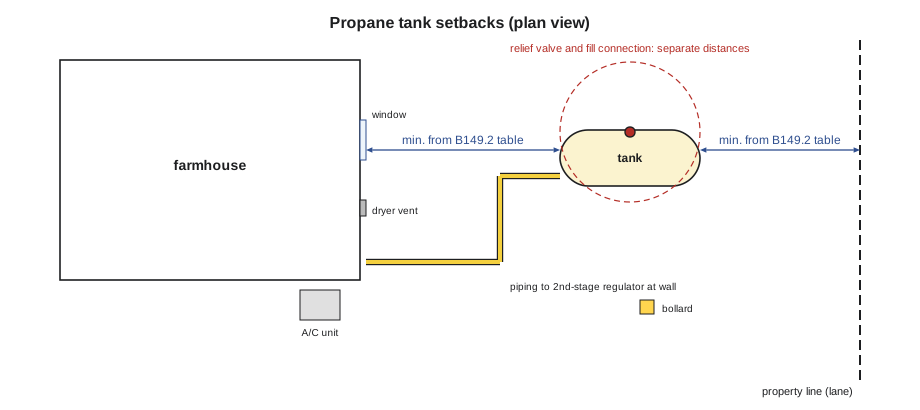
For tanks, B149.2 provides tables of minimum distances that grow with the tank's water capacity. The distances are measured from the tank to buildings, to the property line of adjoining land that could be built on, and to other features, and separately from the tank's relief valve discharge and filling connection to building openings, sources of ignition and mechanical air intakes. Underground tanks have their own distances. The code adds rules on protection from vehicles, separation from other fuels such as oxygen or fuel oil tanks, drainage, and keeping weeds and combustibles clear. Use the table in the adopted edition, read its notes, and check the Ontario CAD for changes.
Worked problem
Checking a proposed tank location
Luis measures a proposed spot 2.4 m from the back wall of the farmhouse and 9 m from the lane, which is also the property line. The B149.2 table, for this tank size, gives a minimum distance to the building and to the property line. Suppose the table value for this case is 3 m. Does the spot work, and how far must the tank move?
Show solution
- Compare the distance to the building with the minimum:
- \[2.4 \text{ m} < 3 \text{ m}\]
- Find how far it must move away from the house:
- \[3 - 2.4 = 0.6 \text{ m}\]
- Check that moving it keeps the property line distance:
- \[9 - 0.6 = 8.4 \text{ m} \ge 3 \text{ m}\]
- Check the relief valve and filling connection:
- Luis then measures from the tank's relief valve and fill connection to the basement window, the dryer vent and the new generator's air intake, and compares each with its own minimum.
Answer: The tank must move at least 0.6 m farther from the house, which still leaves ample distance to the lane. Luis marks a new spot with paint, notes that the generator must be placed so its exhaust and intake keep their distances from the tank's relief valve, and sends the sketch to the propane supplier.
Regulators, piping and putting propane into service
Propane leaves the tank at its vapour pressure, which rises and falls with temperature, from a few hundred kilopascals on a cold day to well over 1,000 kPa on a hot one. The codes require two-stage regulation for most building systems: a first-stage regulator at the tank reduces the pressure to about 70 kPa, and a second-stage regulator at the building reduces it to appliance pressure, about 2.75 kPa. Some systems use an integral two-stage regulator at the tank. Regulator vents must point down or be protected from rain, ice and insects, and must be placed away from building openings as the code requires.
Underground tanks and their buried steel piping need corrosion protection, usually by coating and sacrificial anodes. Tanks in flood areas must be anchored so that they cannot float away. Piping from the tank to the building follows the material rules of lesson 5, with plastic allowed underground only between the regulators where the code and the pipe certification permit.
When a propane system has been shut off or has run out of gas, it is not simply turned back on. The codes require a leak check of the system before service is restored, because appliance pilots may have gone out and valves may have been left open. In Ontario, propane suppliers and technicians follow the B149.2 and B149.1 requirements and their company procedures for an out-of-gas call. Every appliance is then relit and checked.
Propane appliances under the installation code
Downstream of the second-stage regulator, a propane system follows the same installation code as natural gas, with a few differences that matter. Appliances must be set up for propane, with the right orifices and regulator settings, and carry the conversion label if they were converted. Piping is sized from propane tables. And because propane is heavier than air, the codes restrict propane appliances in basements and pits in some situations and require extra care with relief valve discharges, regulator vents and the location of appliances below grade. Check the adopted code before installing a propane appliance in a basement.
Standby generators fuelled by propane are increasingly common on rural properties like the one outside Ancaster. The generator is an appliance with a large input, so the tank, the regulators and the piping must be sized for it running together with the furnace and other loads on a cold day. The tank's ability to vaporize liquid into gas falls as the temperature drops, so a tank that is large enough on paper may not supply a big load in deep cold. The supplier sizes the tank and regulator for the peak load, and the contractor sizes the piping. The generator's exhaust and air intake must also keep their distances from the tank's relief valve and filling connection and from the building's openings.
Handling and transporting cylinders
Cylinders are carried to job sites in service vehicles every day. The rules for transporting them come from transport regulations as well as the storage code: cylinders secured upright in a ventilated space, valves closed and plugged or capped, and quantities kept within the limits for the vehicle. Never carry cylinders in a closed car trunk or a closed van without ventilation, and never leave them in a hot vehicle. When a cylinder is connected or disconnected at a site, check the connection for leaks before leaving, and close the cylinder valve on any cylinder that is not in use.
Common mistakes
MistakeStoring a spare cylinder in the basement.
InsteadKeep cylinders outdoors, except for the few uses the code allows indoors.
MistakeMeasuring tank setback from the regulator instead of the tank.
InsteadMeasure from the container shell for buildings and property lines, and from the relief valve and filling connection for openings and ignition sources.
MistakeLying a vapour cylinder on its side.
InsteadKeep it upright so the relief valve stays in the vapour space.
MistakeRefilling an out-of-date cylinder.
InsteadDo not fill a cylinder past its requalification date.
MistakeTurning gas back on after a run-out without checking.
InsteadLeak check the system, then relight and check every appliance.
Summary and key terms
- B149.2 governs propane storage, handling and transfer, adopted in Ontario from June 8, 2026; B149.1 governs the piping and appliances downstream. Cylinders are portable, filled by weight or exchanged, and must be requalified; tanks are stationary ASME containers filled on site and rated in US gallons.
- Containers are filled to about 80 in 100 to leave vapour space.
- Containers stay outdoors.
- Setbacks are measured from the container to buildings and property lines, and from relief valves and filling connections to openings, ignition sources and intakes.
- B149.2's table sets distances by tank size. Systems use two-stage regulation and need a leak check after any interruption.
- Cylinder
- A portable propane container built to a transport specification, filled by weight or exchanged.
- Tank
- A stationary ASME propane container filled on site, rated by water capacity in US gallons.
- Vapour space
- The space left above the liquid in a container so the liquid can expand.
- Overfilling prevention device
- A device in small vapour cylinders that stops filling at the safe level.
- Setback
- A minimum separation distance between a container or its fittings and buildings, property lines, openings or ignition sources.
- Two-stage regulation
- Reducing tank pressure first at the container and again at the building to appliance pressure.
Practice problems
Work each problem on paper first, then reveal the answer to check.
Which code covers the propane tank, and which covers the house piping?
Show answer
B149.2 covers the tank; B149.1 covers the piping and appliances.
Why are containers never filled full?
Show answer
Liquid propane expands as it warms and needs vapour space.
From which points are distances to building openings and ignition sources measured?
Show answer
The relief valve discharge and the filling connection.
Why must a propane cylinder stay upright?
Show answer
So that its relief valve stays in the vapour space.
What must happen before gas is restored after a propane run-out?
Show answer
A leak check of the system, then relighting and checking each appliance.
Lesson quiz · 5 questions
Score 60% or more to complete this lesson.
Create a free account to save your progress, take quizzes and earn a certificate.