
FILM-320 · Lesson 9 of 12 · 27 min
Directing special situations: children, animals, non-actors and crowds
Most of this course assumes adult professional actors who can take direction, repeat a performance and work long days. Many films also involve performers who cannot do some or all of these things: children and babies, animals, people with no acting experience and large groups of background performers. Each brings its own possibilities, risks and legal obligations. Children and non-actors can give performances of startling freshness; animals and crowds can bring a world to life. All of them require more planning, more patience and a clear sense of the director's duty of care.
This lesson covers the law and practice of working with child performers in Canada and the United States, directing children of different ages, working with animals safely and humanely, directing non-actors, and staging and directing crowds. CINE-401 lesson 10 covers protocols for child performers from the camera department's side; this lesson focuses on the director's decisions.
Child performers and the law
Child performers are protected by specific laws because they cannot fully protect themselves and because the industry has a history of exploiting them. The rules differ between jurisdictions, and productions must follow the law of the place where the child works, along with any union agreement. The summary below reflects the rules as reported at the time of writing (October 2026); productions should always check current regulations and take advice.
In Ontario, the Protecting Child Performers Act, 2015 applies to performers under 18 in live and recorded entertainment. In recorded entertainment, children under 2 may work at most 4 hours a day and older children at most 8 hours, with at least 12 consecutive hours off each day and 48 hours off each week; split shifts are not allowed, and a call after 7 p.m. needs 48 hours' notice. A parent, guardian or designated adult chaperone must be present, a child performer coordinator must be designated at each workplace, the schedule must allow for tutoring, and 25 per cent of earnings above $2,000 on a production must generally be held in trust unless a collective agreement provides for trust holding.
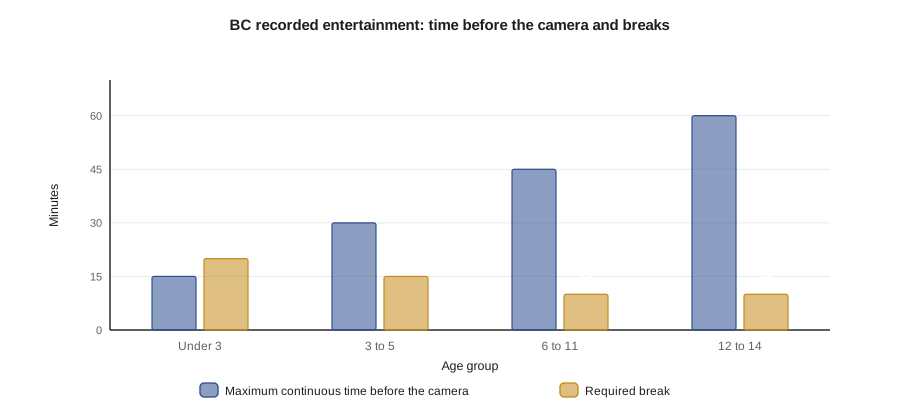
British Columbia regulates children under 15 in recorded entertainment under Part 7.1 of its Employment Standards Regulation. A shift must end within 8 hours of reporting for children under 12 and within 10 hours for ages 12 to 14; children may not report before 5 a.m.; and there are strict limits on continuous time in front of the camera, from 15 minutes for children under 3 to 60 minutes for ages 12 to 14, each followed by a break. A chaperone aged 19 or older must be present, with ratios that depend on age, and 25 per cent of earnings above $2,000 on a production must be remitted to be held in trust. Other provinces have their own rules, and the ACTRA Independent Production Agreement adds further protections.
| Protection | Canada (Ontario and BC examples) | United States (California example) |
|---|---|---|
| Who is covered | Under 18 in Ontario; under 15 under BC's recorded entertainment rules | Minors from 15 days to 18 years |
| Daily limits | Ontario: 4 hours under age 2, 8 hours over 2; BC: shift ends within 8 or 10 hours by age | Hours by age, from 20 minutes of work for infants to 6 hours on school days for 16 to 18 |
| Rest | 12 hours between days and 48 hours weekly | 12 hours between dismissal and next call |
| Supervision | Parent or adult chaperone present; Ontario child performer coordinator | Parent or guardian present; studio teacher and welfare worker |
| Earnings protection | 25 per cent of earnings above $2,000 held in trust | 15 per cent of gross earnings in a Coogan trust |
Directing children of different ages
Directing children well starts with understanding what is developmentally possible. Babies cannot act at all; they simply behave, and the production must work around their sleep, feeding and moods. Productions often cast twins or triplets so that babies can be rotated within the legal limits. Toddlers can follow very simple instructions but have short attention spans and will not repeat an action reliably. School-age children can understand stories and play pretend, which is the key to directing them. Teenagers can approach adult professional work but may be self-conscious and need careful handling of sensitive material.
| Age | What they can usually do | Useful approaches |
|---|---|---|
| Under 2 | Behave naturally; no direction possible | Shoot around their state; use twins; parent nearby off camera |
| 2 to 5 | Simple tasks, play, short attention | Games, real tasks, short takes, roll before they are ready |
| 6 to 11 | Imaginative play, understand simple stories | Explain situations as games, give tasks, avoid line readings, keep it fun |
| 12 to 17 | Approach adult technique; self-conscious | Treat as collaborators, explain context, protect from inappropriate material |
With young children, the most effective techniques use play and real tasks rather than acting. Instead of asking a five-year-old to look sad, give them a puzzle with a missing piece. Instead of asking them to say a line, play a game in which the line is their move. Keep takes short, keep rolling when they are engaged and stop before they are tired. Many directors avoid giving children the full script for sensitive scenes, sharing only what they need to play each moment.
Emotional material requires particular care. Children should not be led to believe that frightening or upsetting events in a story are real, and should not be pushed into real distress. Directors should work closely with parents, chaperones and, where appropriate, child psychologists or coaches, explain scenes in age-appropriate ways and debrief afterward. Scenes involving violence, sexual content or abuse should be designed so that the child is not exposed to the material at all, using doubles, separate shooting and editing.
Working with animals
Animals bring life and unpredictability to a film. They also require specialist handling and strict welfare standards. Professional productions engage animal trainers or wranglers who own or manage the animals, train them for the required behaviours and control them on set. Some productions also engage independent welfare monitors.
In the United States, American Humane's film and television unit monitors animal action on many productions and awards its "No Animals Were Harmed" end credit to productions that meet its guidelines. Productions in Canada also use American Humane monitoring, along with provincial animal welfare law and guidance from animal welfare organizations. Whatever the system, the principles are the same: animals' welfare comes before the shot, animals work only with their trainers, and dangerous or stressful actions are simulated.
For the director, working with animals means designing scenes around what the animal can do reliably, not what the script imagines. A dog can be trained to cross a room and sit; it cannot be trained to look wistfully at a photograph. Shoot animal action first in a set-up, while the animal is fresh, and be prepared to get it in pieces. Allow far more time than you think. Visual effects can extend or replace animal action where welfare or practicality requires.
Directing non-actors
Some directors deliberately cast people with no acting experience. Italian neorealism, from the 1940s onward, cast non-professionals in roles close to their own lives, and many directors since have followed, from documentary-influenced fiction to films made with communities playing versions of themselves. Non-actors can bring authenticity, specific knowledge and a quality of presence that trained actors find hard to imitate.
Directing non-actors requires different techniques. They usually cannot repeat a performance precisely or hit marks reliably, and may freeze when asked to act. Effective approaches include casting people close to the role, so they can draw on their own experience; giving situations and tasks rather than lines; allowing them to use their own words; shooting rehearsals and keeping the camera rolling; and building trust over time. Some directors give non-actors only their own lines, or none at all, and guide the scene through a professional actor playing opposite them.
Working with non-actors also raises ethical questions. People playing versions of themselves may reveal more about their lives than they realize, and the film may affect their reputation and relationships after release. Directors should explain clearly how the film will be used, obtain informed consent and appearance releases, pay fairly and consider the effects on participants, particularly in vulnerable communities. FILM-420 covers releases in more detail.
Crowds and background performers
Crowds give scenes scale and reality: the guests at a funeral reception, commuters in a bus station, fans at a game. Background performers are usually cast through background casting agencies and directed by the second assistant director and their team, with the director setting the overall picture.
The director's job is to describe what the crowd should be doing and feeling, and to make sure the background serves the story. A funeral reception should feel subdued, with small groups and quiet conversation; if the background performers look bored, chat loudly or watch the camera, they undermine the principal actors. Good background direction gives each group a specific task and relationship: two old friends sharing a memory, a neighbour organizing the casseroles, a child being kept quiet. Specific tasks produce natural behaviour.
Large crowd scenes need planning. The second AD divides the crowd into groups with action leaders, sets starting positions and cues for movement, and resets them between takes. For large exterior scenes, productions may combine a smaller number of background performers with visual effects crowd replication. Sound needs care too: background performers usually mime conversation during dialogue scenes so the principals can be recorded cleanly, with crowd sound added later, as FILM-310 lesson 7 describes.
Background performers in Canada may be engaged under ACTRA or UBCP/ACTRA agreements or as non-union performers, depending on the production and province. The agreements set rates, hours and rules about when a background performer who is given lines or specific direction must be upgraded to a principal or actor category with higher pay.
Worked problem
Planning a child performer's day
A seven-year-old plays the young Dana in two flashback scenes totalling 1.5 pages. Each set-up needs about 20 minutes of the child's time on set for blocking and takes, and the scenes need 6 set-ups. How should the director and first AD plan the day to respect the legal limits and the child's wellbeing?
Show solution
- Check the applicable rules for the location and age, including daily limits, breaks, schooling and chaperone requirements.
- Total time in front of the camera: 6 set-ups at about 20 minutes is about 2 hours, plus blocking and resets. This fits within typical limits but leaves little margin on a school day.
- Schedule the child's scenes early in the day, light with stand-ins and bring the child in only when the set is ready.
- Group set-ups that need the child and shoot the adult coverage separately with the child's lines read off-camera by a chaperone-approved reader or an adult actor.
- Plan breaks and schooling into the schedule, and keep the child's scenes as play rather than drama.
Answer: The day is built around the child's limits, not the other way round. Lighting on stand-ins, grouping the child's set-ups and shooting adult coverage separately keep the child's time short and their experience positive.
# start and end times of each block on set, in hours from call (0 = 8:00)
blocks = [("Blocking and takes, set-up 1-2", 0.5, 1.4), ("Break", 1.4, 1.8),
          ("Schooling", 1.8, 3.8), ("Lunch", 3.8, 4.5),
          ("Set-ups 3-6", 4.5, 6.0), ("Rest and wrap", 6.0, 6.5)]
work = sum(e - s for n, s, e in blocks if "set-up" in n.lower())
school = sum(e - s for n, s, e in blocks if n == "Schooling")
on_set = blocks[-1][2] - blocks[0][1]
print(f"Working time: {work:.1f} h")
print(f"Schooling: {school:.1f} h")
print(f"Total time at the set: {on_set:.1f} h")
limits = {"work": 4.0, "school": 3.0, "on_set": 8.0}   # example limits for this age
print("Within example work limit:", work <= limits["work"])
print("Meets example schooling time:", school >= limits["school"] - 1.0)
print("Within example time at set:", on_set <= limits["on_set"])Working time: 2.4 h Schooling: 2.0 h Total time at the set: 6.0 h Within example work limit: True Meets example schooling time: False Within example time at set: True
Real schedules must follow the precise law and agreements of the jurisdiction, and the first AD, production manager and child performer coordinator or studio teacher are responsible for compliance. The director's responsibility is to design the scenes so that compliance is possible without compromising the film or the child.
Common mistakes
MistakePlanning child performers' scenes around the adult schedule
InsteadBuild the day around the child's legal limits and wellbeing.
MistakeAsking young children to act emotions
InsteadUse play, games and real tasks that produce natural behaviour.
MistakeWriting animal action the animal cannot reliably perform
InsteadDesign scenes around trained behaviours, with trainers and welfare monitors.
MistakeGiving non-actors scripts to memorize and perform
InsteadCast close to the role and give situations, tasks and freedom to use their own words.
MistakeLeaving background performers without direction
InsteadGive each group a specific task and relationship that serves the scene.
Summary and key terms
- Child performers are protected by jurisdiction-specific laws on hours, rest, supervision, schooling and earnings.
- Ontario and BC set limits, chaperone rules and trust requirements; California requires permits, studio teachers and Coogan trusts.
- Directing children relies on age-appropriate play and tasks, short takes and protection from disturbing material.
- Animals work with trainers under welfare standards, and scenes should be designed around what they can do.
- Non-actors bring authenticity but need situations, tasks, trust and informed consent.
- Background performers need specific tasks and relationships to support the story.
- Union agreements set rules for background performers, including upgrades when they are given lines.
- Child performer coordinator
- A person designated under Ontario law to oversee child performers at a workplace.
- Studio teacher
- In California, a certified teacher who also acts as a welfare worker for minors on set.
- Coogan law
- California's requirement that part of a minor's earnings be placed in a blocked trust.
- Chaperone
- An adult responsible for a child performer on set.
- Entertainment work permit
- A permit required for minors working in entertainment in California.
- Animal wrangler
- A trainer or handler responsible for animals on set.
- Welfare monitor
- An independent observer who checks the treatment of animals on a production.
- Non-actor
- A performer with no professional acting experience.
- Background performer
- A performer who appears in the background of a scene without lines.
- Upgrade
- A change of a background performer's category, and pay, when given lines or special direction.
Practice problems
Work each problem on paper first, then reveal the answer to check.
Why are babies often cast as twins?
Show answer
So they can be rotated within strict legal time limits.
Under Ontario's Act, what is the daily limit for a child under 2 in recorded entertainment?
Show answer
Four hours.
What share of earnings is placed in trust under California's Coogan law?
Show answer
Fifteen per cent of gross earnings.
Suggest a way to get a sad look from a five-year-old without asking them to act.
Show answer
Give them a task with a disappointing outcome, such as a puzzle missing a piece.
How should scenes involving violence or abuse be shot with child performers?
Show answer
So the child is not exposed to the material, using doubles, separate shooting and editing.
What is the first principle when working with animals?
Show answer
The animal's welfare comes before the shot.
Why cast non-actors close to the role?
Show answer
They can draw on their own experience and behave naturally.
Name one ethical concern when working with non-actors.
Show answer
They may reveal more about their lives than they realize, affecting their reputation and relationships.
Who usually directs background performers?
Show answer
The second assistant director and their team, following the director's brief.
Why do background performers usually mime conversation during dialogue?
Show answer
So principal dialogue can be recorded cleanly, with crowd sound added later.
Lesson quiz · 5 questions
Score 60% or more to complete this lesson.
Create a free account to save your progress, take quizzes and earn a certificate.