
FILM-320 · Lesson 8 of 12 · 29 min
Directing on set
The shooting day is where all the director's preparation meets reality. Light changes, a location loses power, an actor arrives with a cold, a scene that worked in rehearsal falls flat, and the schedule slips by an hour before lunch. Through all of it the director must protect the performances, get the shots the film needs and keep a large crew working together safely. This lesson covers how a director works on set: the structure of the day, the relationship with the first assistant director, set protocol and communication, decisions about coverage under time pressure, safety culture and the director's responsibilities for it, and how to review the work through dailies.
CINE-340 covers set safety in depth from the crew's side, including stunts, special effects, firearms, and fatigue and hours of work. CINE-401 lesson 10 covers protocols for intimacy and child performers from the camera department's side. CINE-420 lesson 3 covers set protocol and etiquette for the camera department. This lesson connects those topics to the director's role.
The structure of a shooting day
A shooting day is governed by the call sheet, prepared by the assistant directors and distributed the evening before. It lists the scenes to be shot, the cast and crew call times, locations, weather, safety notes, special equipment and the next day's work. The director should read it carefully every evening and raise any concerns with the first AD before it is final.
A typical day begins with the crew call, followed by a blocking rehearsal for the first scene while the actors are still in early preparation. The day then cycles through scenes using the routine described in lesson 7: block, light, rehearse, shoot. Meal breaks are set by law and union agreements. The day ends with the wrap, when the last shot is completed, followed by the crew's wrap-out of equipment. Most union agreements and labour laws limit hours and set minimum rest between shifts, known as turnaround; CINE-340 lesson 11 explains why fatigue is one of the most serious safety risks on set.
The director and the first assistant director
The first AD runs the set. They schedule the day, call the rehearsals and takes, keep the crew informed, manage time, and are responsible for coordinating safety, including safety meetings before hazardous work. The director's relationship with the first AD is one of the most important partnerships on set. A good first AD protects the director's time and focus, warns early when the day is slipping and suggests solutions. A good director keeps the first AD informed of creative changes and listens when told that something cannot be done in the time available.
The division of labour is clear in principle: the director decides what is shot and how, and the first AD decides when and in what order, within the director's priorities. In practice the two negotiate constantly. A director who wants another take should ask the first AD how it affects the day; a first AD who needs to move on should tell the director what the cost of staying will be. Disagreements should be resolved quickly and privately, never in front of the crew.
| Decision | Usually decided by | Consulted |
|---|---|---|
| What the scene needs creatively | Director | Actors, cinematographer |
| Order of scenes and set-ups | First AD | Director, cinematographer |
| When to roll and cut | Director calls action and cut; first AD calls roll and manages the process | Camera, sound |
| Whether a take is good for camera or sound | Camera operator, sound mixer | Director decides whether to go again |
| Whether to stop for a safety concern | Anyone may stop work; the first AD coordinates | Safety officer, department heads |
| Moving on from a scene | Director, with the first AD | Script supervisor confirms coverage |
Set protocol and communication
Film sets run on a shared language and clear lines of communication. The first AD calls for rehearsals and takes with standard phrases: "picture's up", "roll sound", "roll camera". The camera assistant marks the slate, and the director calls "action" and "cut". After a take, the director tells the first AD whether to go again, and the first AD relays the information to the crew. Departments communicate through their heads, and a director who wants a change to the lighting speaks to the cinematographer, not to the electricians.
Who speaks to the actors matters too. On a professional set, notes about performance come from the director. Other crew members who notice a problem, such as an actor missing a mark, raise it through the first AD or the relevant department head. A set where many people give notes to actors confuses them and undermines the director's relationship with the cast.
| Phrase | Meaning |
|---|---|
| Picture's up | Shooting is about to start; settle and be quiet |
| Rolling | Camera and sound are recording |
| Action | The director's signal for the scene to begin |
| Cut | The director's signal to stop |
| Back to one | Actors and camera return to their starting positions |
| Checking the gate | Confirming the shot is technically clean before moving on |
| Moving on | The set-up is complete; prepare the next one |
| Martini shot | The last shot of the day |
Where the director stands
Modern sets usually have a video village, an area with monitors where the director, script supervisor, producers and others can watch the camera feed. Monitors let the director see the frame exactly as recorded and are essential for checking composition, focus and continuity. But many directors and actors feel that something is lost when the director watches from a tent far from the set. Actors perform for the person they trust, and the director's presence near the camera, close enough to see the actors' eyes, can make a difference.
Many directors split the difference: they watch rehearsals and the first takes of each set-up close to the camera, and use a small handheld or wireless monitor to check the frame. They go to the video village to review playback or to consult producers. Whatever the arrangement, the director should go to the actors to give notes rather than calling them over to the monitors.
Making the day
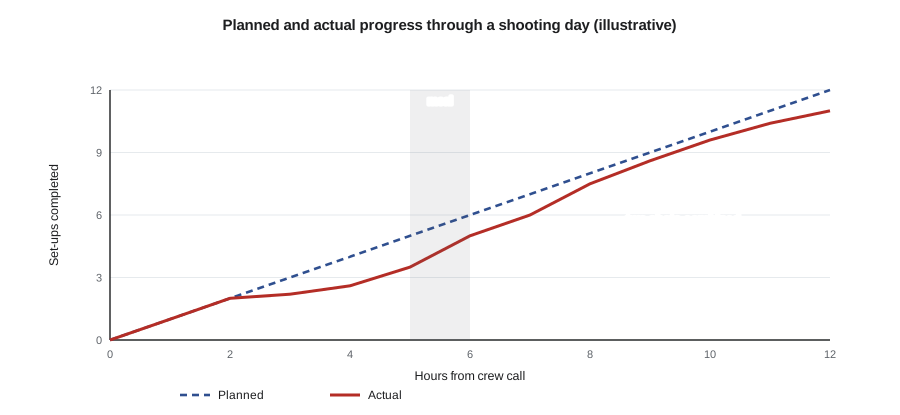
"Making the day" means completing the scheduled work within the day's hours. It is the first AD's constant concern and a large part of the director's responsibility. When a day falls behind, the director has several options: simplify the coverage, combine set-ups, shoot more efficiently by grouping shots from the same direction, drop low-priority shots, or move a scene to another day with the producer's agreement. Working overtime is costly and adds fatigue, so it should be the exception rather than the rule.
day_hours = 11.0          # shooting hours available after meal break
setups = [("Kitchen master", 75, "A"), ("Kitchen two-shot", 45, "A"),
          ("Kitchen singles", 60, "A"), ("Dana at sink", 40, "B"),
          ("Maya MCU", 35, "B"), ("Album insert", 20, "C"),
          ("Garden wide", 70, "A"), ("Garden singles", 55, "B"),
          ("Garden insert", 20, "C")]
planned = sum(m for _, m, _ in setups)
print(f"Planned: {planned} min = {planned / 60:.1f} h of {day_hours} h")
delay = 90  # minutes lost to a lighting problem
available = day_hours * 60 - delay
print(f"After a {delay}-minute delay, {available:.0f} min remain")
# drop C shots first, then B shots, until the plan fits
keep = list(setups)
for level in ("C", "B"):
    while sum(m for _, m, _ in keep) > available and any(p == level for _, _, p in keep):
        drop = max((s for s in keep if s[2] == level), key=lambda s: s[1])
        keep.remove(drop)
        print(f"Drop {drop[0]} ({drop[1]} min, priority {drop[2]})")
print(f"Kept plan: {sum(m for _, m, _ in keep)} min, {len(keep)} set-ups")Planned: 420 min = 7.0 h of 11.0 h After a 90-minute delay, 570 min remain Kept plan: 420 min, 9 set-ups
Real decisions are less mechanical: a director might keep a B shot that matters to a key moment and lose an A shot that can be picked up at another location. But the exercise shows why priorities set in prep, as described in lesson 3, are so valuable when time runs short. A director who knows exactly what each scene needs can make good choices quickly.
Choosing takes and moving on
After each take, the director decides whether to go again. The decision depends on performance, technical quality and coverage. The camera operator and sound mixer report technical problems; the script supervisor notes continuity issues and records the director's comments. When a take is particularly good, the director asks the script supervisor to circle it, marking it as a preferred take for the editor.
Knowing when to move on is a skill. Inexperienced directors often do too many takes, hoping for perfection, which tires actors and costs time needed later. Others move on too quickly, leaving the editor without the moment the scene needs. A useful test is to ask: do I have this moment in a usable form, and do I have at least one alternative in case the edit needs it? When the answer is yes, move on, and tell the actors why.
Safety is a directing responsibility
Safety on set is everyone's responsibility, and the director's influence over it is large. The director decides what is in the script, how stunts and effects are staged, how many takes of a risky action are attempted and how much time is allowed for safe preparation. A director who pressures the crew to rush a stunt, or who treats safety meetings as an interruption, puts people at risk.
Professional productions use specialists for hazardous work: stunt coordinators for stunts and fights, special effects coordinators for pyrotechnics and effects, armourers for weapons, marine and aerial coordinators for water and aircraft work, and safety officers on larger productions. These specialists plan the work, and the first AD holds safety meetings before it begins. The director's role is to design the action with them, accept their limits and make sure the schedule allows enough time.
The 2021 shooting on the set of the western Rust in New Mexico, in which cinematographer Halyna Hutchins was killed by a live round fired from a prop revolver, showed how catastrophically safety systems can fail. The armourer was convicted of involuntary manslaughter in 2024 and sentenced to 18 months in prison; the case against the actor who held the gun was dismissed during trial in 2024. Many productions have since banned functional firearms on set, moved to replica or non-firing guns with muzzle flashes added in post-production, and tightened procedures for weapons handling. CINE-340 lesson 10 describes these practices in detail.
In Canada, film productions must follow provincial occupational health and safety law, which gives every worker the right to refuse unsafe work. Industry safety guidelines, such as those produced by the Ontario Film and Television Section 21 Health and Safety Advisory Committee and by provincial bodies in British Columbia and elsewhere, cover hazards from stunts and firearms to working at heights, and the ACTRA and DGC agreements include safety provisions.
Intimacy, nudity and simulated sex
Intimate scenes require particular care. Current professional practice, set out in union guidance in both Canada and the United States, includes advance notice to performers of any nudity or simulated sex, written consent, a closed set with only essential crew, an intimacy coordinator who choreographs the scene with the performers and director, and modesty garments and barriers. Performers may withdraw consent for scenes not yet shot, and the director must respect their boundaries.
For the director, the key is planning. Discuss the purpose of the scene and what the audience needs to see with the intimacy coordinator and actors well before the shooting day. Agree the choreography and camera plan in advance, as CINE-401 lesson 10 describes. On the day, follow the agreed plan; changing an intimate scene's choreography on set without the performers' consent is not acceptable. Many directors find that clear choreography actually makes these scenes better, because the actors can commit to the performance knowing exactly what will happen.
Dailies
Dailies, also called rushes, are the unedited footage from each day's shooting, reviewed by the director, cinematographer, editor and producers. Today they are usually viewed as digital files, often the same evening or the next morning. Watching dailies helps the director judge performances, check continuity and coverage, spot technical problems while they can still be fixed, and adjust the plan for remaining days.
Directors should watch dailies with a clear purpose. Are the key moments captured? Are performances consistent across set-ups? Is the coverage sufficient for the editor? Are there technical problems that require a reshoot? Many directors also check in with the editor, who may already be assembling scenes and can point out missing pieces. Some actors like to see dailies; others prefer not to. Directors should respect each actor's preference and agree it in advance.
Leading under pressure
Every production has bad days. The light goes, a key location falls through, an actor is injured, or a scene simply does not work. How the director responds affects everyone. Calm, honest leadership helps the crew solve problems: acknowledge the difficulty, consult the first AD and heads of department, make a decision and move forward. Blaming others, shouting or freezing makes problems worse.
Directors also need to look after themselves. Long days, constant decisions and responsibility for a large team are exhausting. Sleep, food, a few minutes of quiet at lunch and a trusted collaborator to talk to are not luxuries; they are part of doing the job well. A director who is depleted makes poorer decisions and is less able to support the cast and crew.
Worked problem
Responding to a lost hour
At 2 p.m. on a 12-hour day, the first AD tells the director that a generator failure has cost an hour. Four set-ups remain for the kitchen scene: the two-shot (A), the close singles (A), Dana at the sink (B) and the album insert (C). How should the director respond?
Show solution
- Ask the first AD how much time remains realistically and whether any other scenes on the day can move.
- Check priorities: the two-shot and singles carry the key moments and must be shot.
- Look for combinations: can Dana at the sink be shot as part of a moving master or from the same direction as another set-up?
- Consider moving the album insert to a later day or a second unit, since it needs no actors.
- Tell the actors the plan so they can focus their energy on the key moments.
Answer: The director protects the A shots, folds Dana's moment into another set-up, moves the insert to a pickup list and communicates calmly, keeping the day achievable without rushing the performances.
Common mistakes
MistakeWatching every take from a distant video village
InsteadStay close to the camera when possible and go to actors to give notes.
MistakeLetting many crew members give notes to actors
InsteadRoute performance notes through the director only.
MistakeDoing take after take in search of perfection
InsteadMove on when you have the moment and a usable alternative.
MistakeTreating safety meetings as interruptions
InsteadDesign hazardous work with specialists and allow time for safe preparation.
MistakeChanging intimate choreography on the day
InsteadFollow the agreed plan and change only with performers' consent and the coordinator.
Summary and key terms
- The call sheet structures the day; read it each evening and raise concerns early.
- The director decides what and how; the first AD decides when and in what order, within the director's priorities.
- Clear set protocol and lines of communication keep the set efficient and protect actors.
- Making the day depends on priorities, combined set-ups and quick decisions.
- Circle preferred takes and move on when you have the moment and an alternative.
- Directors strongly influence safety; hazardous and intimate work must be planned with specialists and followed as agreed.
- Dailies let the director check performance, coverage and technical quality while fixes are still possible.
- Call sheet
- The daily schedule listing scenes, calls, locations and safety notes.
- Video village
- The area on set with monitors for the director and others.
- Making the day
- Completing the scheduled work within the day's hours.
- Circle take
- A take marked by the director as preferred for the editor.
- Back to one
- The instruction for actors and camera to return to starting positions.
- Martini shot
- The last shot of the shooting day.
- Armourer
- The specialist responsible for weapons on set.
- Intimacy coordinator
- A specialist who choreographs intimate scenes with performers and protects their consent.
- Closed set
- A set restricted to essential crew during sensitive scenes.
- Dailies
- The unedited footage from each day's shooting, reviewed by the production.
Practice problems
Work each problem on paper first, then reveal the answer to check.
When should the director read the call sheet?
Show answer
Each evening before it is final, raising concerns with the first AD.
What does the first AD decide, and what does the director decide?
Show answer
The first AD decides when and in what order; the director decides what is shot and how.
Why should only the director give performance notes?
Show answer
Multiple sources confuse actors and undermine the director's relationship with them.
What does "back to one" mean?
Show answer
Actors and camera return to their starting positions.
Give two options when a day falls behind.
Show answer
Simplify coverage, combine set-ups, drop low-priority shots or move a scene (any two).
What is a circle take?
Show answer
A take marked as preferred for the editor.
Give a test for knowing when to move on.
Show answer
Do I have this moment usably, and at least one alternative?
Name three safety specialists a director works with.
Show answer
Stunt coordinator, special effects coordinator, armourer, marine or aerial coordinator, safety officer.
What practices are standard for intimate scenes?
Show answer
Advance notice, written consent, closed set, intimacy coordinator, modesty garments and agreed choreography.
Why watch dailies with a clear purpose?
Show answer
To check key moments, performance consistency, coverage and technical problems while fixes are possible.
Lesson quiz · 5 questions
Score 60% or more to complete this lesson.
Create a free account to save your progress, take quizzes and earn a certificate.