
FILM-320 · Lesson 7 of 12 · 26 min
Blocking and staging
Blocking is the arrangement and movement of actors in a scene: where they stand, when they move, where they go and how they relate to each other in space. Staging is the broader art of arranging actors, camera and environment so that the audience sees the story. On stage, blocking is designed for an audience in fixed seats. On film, it is designed together with the camera, which can move, change size and cut, and the two must be planned as one choreography.
CINE-301 covers depth staging, blocking actors and camera, screen direction and eyelines from the camera department's point of view, and CINE-401 describes how the cinematographer plans lighting around blocking. This lesson takes the director's perspective: how to use space and movement to express relationships and story, how to discover blocking with actors, how to stage for the camera and the edit, and how to run the blocking process on set.
Why blocking matters
Audiences read space instinctively. When one character stands while another sits, when someone crosses the room to close a door, when two people who were arguing across a table end up side by side, the audience feels changes in power, intimacy and intention, often without noticing why. Blocking is a language of relationship.
Blocking also controls attention. Movement draws the eye; a character who moves in a still frame takes focus. Position in depth, height and the frame's composition tell the audience who matters at each moment. And blocking determines what the camera can do: a scene staged in a straight line across a room needs different coverage from one staged in depth toward the lens.
| Spatial choice | What it can suggest |
|---|---|
| Distance between characters shrinking | Growing intimacy, reconciliation or threat |
| One character standing over another who sits | Dominance, authority, pressure |
| A character turning their back | Refusal, protection, avoidance |
| An object between characters, such as a table | Separation, negotiation, conflict |
| A character blocking a doorway | Control, trapping, preventing escape |
| A character moving away during a speech | Avoidance, discomfort, a lie |
| Characters ending side by side, facing the same way | Shared purpose or understanding |
Distance and relationship
The anthropologist Edward T. Hall described how people use personal space, which he called proxemics. He identified rough zones of distance that people in North American culture tend to use for different relationships. Directors find the idea useful because moving characters between these zones changes how the audience perceives their relationship.
Hall's zones are approximately: intimate, up to about 45 cm; personal, about 45 cm to 1.2 m; social, about 1.2 to 3.6 m; and public, beyond about 3.6 m.
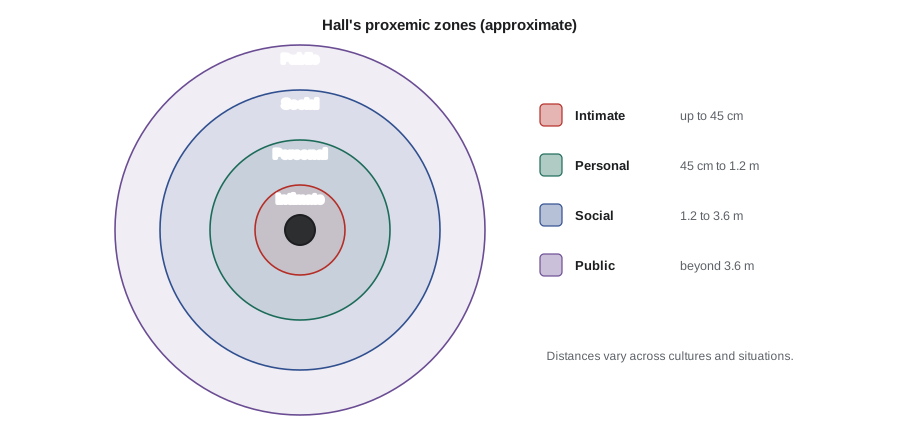
In the kitchen scene, the sisters begin at social distance, across the room, with Dana's back turned. The album draws them into personal distance at the table. The pushed box marks a line neither will cross into intimacy. Staging the scene this way makes the emotional story visible even with the sound turned off.
Proxemic norms vary between cultures, families and individuals, so the zones are a guide, not a rule. Characters from cultures with closer conversational distances may stand nearer without implying intimacy, and directors should check such choices with actors and, where relevant, cultural advisors.
Motivated movement
Movement in a scene should usually be motivated: the character moves because they want something. Dana dries her hands slowly and crosses to the table because she has decided to look at the photograph; the slowness tells us she is resisting the pull of memory. Unmotivated movement, added because a director worries that a scene looks static, tends to feel false and distracts the audience.
Actors often find motivated blocking themselves when they understand the scene's objectives and are given freedom to move in rehearsal. The director's job is then to shape what they find: keeping moves that express the story, adjusting them for the camera and the space, and removing moves that muddy the scene. Practical tasks, such as washing dishes, packing a bag or cooking, give actors natural reasons to move and something to do with their hands, and can carry subtext.
Worked problem
Blocking the kitchen scene
Design blocking for the kitchen scene that expresses its six beats and gives the camera clear key moments.
Show solution
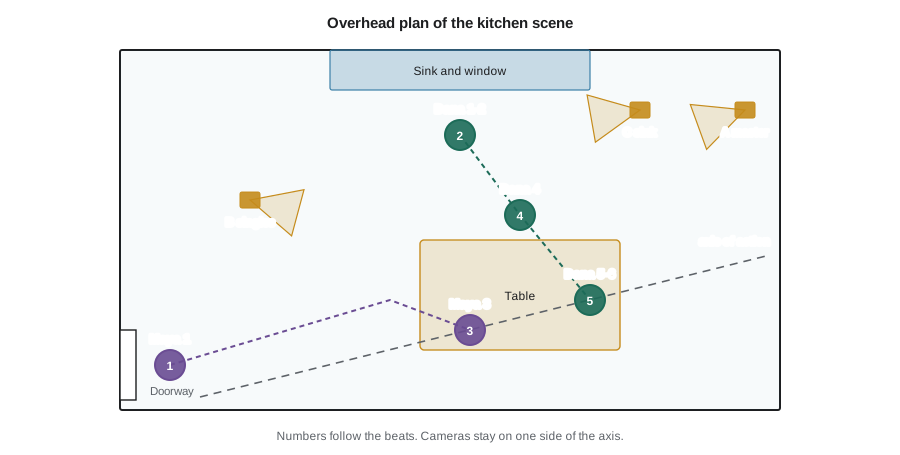
- Beat 1: Maya enters at the doorway and stops just inside, holding the box against her chest like a shield. Dana stays at the sink, back turned.
- Beat 2: Dana stops scrubbing but does not turn; on "You weren't here to ask" she turns her head, but not her body.
- Beat 3: Maya crosses to the table, sets the box down and opens it. She sits. Her retreat into the album physically takes her away from Dana.
- Beat 4: Dana dries her hands and crosses to stand behind Maya's chair, looking over her shoulder. They are close, but Dana is still standing.
- Beat 5: Dana sits on "She was still here", across the corner of the table from Maya. They are now at the same level for the first time.
- Beat 6: Maya pushes the box across the table; Dana pushes it back. The table, and the box, stay between them.
Answer: Distance shrinks from social to personal across the scene, and height changes from standing to sitting, but the table remains a barrier, matching a scene that ends unresolved.
Staging in depth
Staging in depth means arranging actors at different distances from the camera rather than side by side. It creates layered, dynamic frames, lets one shot show both a speaker and a listener, and can reduce the need for coverage. In the kitchen master, placing Dana at the sink in the foreground with Maya in the doorway in the background lets the audience see Dana's face, which Maya cannot see, along with Maya's entrance, in a single frame. The audience knows something Maya does not: that Dana is not as calm as her back suggests.
Depth staging requires coordination with the cinematographer, because focus, depth of field and lighting must support it. It also requires actors to be precise about marks. CINE-301 lesson 5 and CINE-401 lesson 10 describe the technical side. For the director, the key questions are which character the audience should watch at each moment and whether the frame should reveal or conceal something.
Moving the actors or moving the camera
A scene can be covered by many static set-ups or by fewer moving shots that follow the actors. Long takes with choreographed movement, sometimes called oners or plan-séquences, can be powerful: they preserve the actors' continuity of performance, create a sense of real time and let the audience discover the scene rather than being shown it. They also carry risks: if one moment fails, the whole take fails; they are difficult to change in the edit; and they take time to rehearse.
Walk-and-talks, in which characters converse while moving through a space with the camera leading or following, are a common form of moving staging, especially in television. They inject energy into exposition-heavy scenes and let the environment tell part of the story.
| Factor | Static coverage | Choreographed long take |
|---|---|---|
| Rehearsal time | Less per set-up | More, often much more |
| Editing flexibility | High: performance, pace and order can be adjusted | Low: the take is largely the scene |
| Performance continuity | Broken into pieces | Continuous, often more alive |
| Risk | Lower: problems fixed in single set-ups | Higher: one mistake ruins the take |
| Audience experience | Guided by cuts | Real time, discovery within the frame |
Many directors combine approaches: a moving master that resolves into a two-shot, with singles for the most important lines. The choice should follow the scene's purpose and the film's governing ideas, as discussed in lesson 3.
The axis of action and screen direction
When two characters talk, an imaginary line runs between them, called the axis of action or the 180-degree line. Keeping the camera on one side of it keeps each character facing the same direction on screen, so the audience understands where they are in relation to each other. Crossing the line without a deliberate transition can make characters appear to swap places. CINE-301 lesson 8 covers the rule and its exceptions in detail.
For the director, the line is a staging tool as well as a rule. When characters move, the line moves with them, and blocking can be designed to give the camera a new axis at a key moment. Deliberately crossing the line, for example when a relationship flips, can create a jolt the audience feels. The important thing is that crossings are planned rather than accidental, and the script supervisor tracks them.
Eyelines
Eyelines are the directions in which characters look. In close shots, an actor's eyeline is usually placed close to the side of the lens so the audience feels connected to their gaze. The closer the eyeline is to the lens, the more intimate the shot feels; a wider eyeline feels more observational. For singles, the off-camera actor should be placed where the eyeline needs to be, or a mark such as tape on a stand should be used.
Eyelines must match across shots. If Maya looks camera left at Dana in her single, Dana should look camera right at Maya in hers, and their heights should be consistent: if Dana is standing behind Maya's chair, Maya's eyeline should be raised. Mismatched eyelines confuse audiences about where characters are. Directors should check eyelines on the monitor and with the script supervisor at each set-up.
Blocking on set: the process
On a typical professional set, each scene follows a routine often summarized as block, light, rehearse, shoot. The director, actors and first AD, with the cinematographer and key crew watching, work out the blocking first. Marks are placed, usually with coloured tape, so actors can hit positions consistently. The actors then leave for final hair, makeup and wardrobe while stand-ins take their places for lighting. When lighting is ready, the actors return for a final rehearsal with camera, then the scene is shot.
The blocking rehearsal is a critical moment for the director. The crew is watching to understand what they must light, record and capture. A clear, decisive blocking rehearsal lets every department work efficiently. A confused one, in which the blocking changes repeatedly after lighting begins, wastes hours. Directors who arrive with a blocking plan from prep, but stay open to the actors' discoveries on the day, usually find the right balance.
| Stage | Who is involved | Purpose |
|---|---|---|
| Blocking rehearsal | Director, actors, first AD, cinematographer, key crew watching | Set positions, moves and the shot plan; show the crew |
| Marks | Second assistant camera, script supervisor | Tape positions for actors and record continuity |
| Lighting | Cinematographer, gaffer, grips, stand-ins | Light the blocking while actors finish preparation |
| Final rehearsal | Director, actors, camera, sound | Check timing, focus, boom and performance |
| Shooting | Everyone | Record takes and coverage |
Staging for the edit
Blocking affects editing. Movements that cross the frame, entrances and exits, and turns of the head all create natural cutting points. Characters who move between set-ups must match their movements from angle to angle, which becomes harder as blocking becomes more complex. Directors who stage with the edit in mind give the editor clean transitions: an actor's turn toward the window can motivate a cut to the window; a character crossing the frame can carry the audience to the next shot.
Complicated business, such as pouring drinks, eating or handling props, must be repeated identically across takes and set-ups, or the editor will struggle to match. Simplifying business, or planning which set-up will feature it, saves trouble. FILM-220 lesson 4 covers continuity editing from the editor's side.
Common mistakes
MistakeAdding movement so a scene does not look static
InsteadUse motivated movement that expresses what the characters want.
MistakeStaging all actors side by side across the frame
InsteadStage in depth to layer speaker and listener and reveal information.
MistakeChanging blocking repeatedly after lighting starts
InsteadArrive with a plan, finalize blocking in rehearsal and then let the crew light.
MistakeCrossing the axis of action by accident
InsteadPlan any crossing deliberately and track it with the script supervisor.
MistakeGiving actors complex business that changes every take
InsteadSimplify props and actions so they can be matched across set-ups.
Summary and key terms
- Blocking is a language of relationship and attention; audiences read space instinctively.
- Proxemic distance, height and barriers can express how relationships change across a scene.
- Movement should be motivated by what characters want; practical tasks give natural reasons to move.
- Depth staging layers information and can reduce the need for coverage.
- Long takes preserve performance but reduce editing flexibility and increase risk.
- Plan any crossing of the axis of action deliberately and keep eyelines consistent.
- The block, light, rehearse, shoot routine depends on a decisive blocking rehearsal.
- Blocking
- The positions and movements of actors in a scene.
- Staging
- Arranging actors, camera and environment to tell the story visually.
- Proxemics
- The study of how people use personal space and distance.
- Depth staging
- Placing actors at different distances from the camera within one frame.
- Oner
- A scene played in a single continuous take.
- Walk-and-talk
- A scene in which characters converse while moving, with the camera following or leading.
- Axis of action
- The imaginary line between characters that the camera stays on one side of.
- Eyeline
- The direction in which a character looks.
- Mark
- A position, usually taped on the floor, that an actor hits consistently.
- Stand-in
- A crew member who takes an actor's place during lighting.
Practice problems
Work each problem on paper first, then reveal the answer to check.
Give two things blocking can express about a relationship.
Show answer
For example: power through height, intimacy through distance, refusal through a turned back.
Name Hall's four proxemic zones.
Show answer
Intimate, personal, social and public.
Why should movement usually be motivated?
Show answer
Unmotivated movement feels false and distracts the audience.
How does the kitchen scene's table act as a barrier?
Show answer
It stays between the sisters even as they come closer, matching an unresolved ending.
What is one advantage of staging in depth?
Show answer
It shows speaker and listener in one frame and can reveal information.
Give one risk of a choreographed long take.
Show answer
One mistake ruins the take, and it is hard to change in the edit.
What happens if the camera crosses the axis of action accidentally?
Show answer
Characters may appear to swap places on screen.
Where is a close-up eyeline usually placed?
Show answer
Close to the side of the lens.
What happens during lighting while stand-ins take the actors' places?
Show answer
Actors finish hair, makeup and wardrobe while the crew lights the blocking.
Why simplify complex business such as pouring drinks?
Show answer
So it can be matched across takes and set-ups for the editor.
Lesson quiz · 5 questions
Score 60% or more to complete this lesson.
Create a free account to save your progress, take quizzes and earn a certificate.