
FILM-320 · Lesson 12 of 12 · 26 min
Capstone: directing a short scene from analysis to rough cut
This capstone brings the course together. You will direct a short dramatic scene of two to four pages from script analysis to rough cut, applying each stage of the director's process: interpretation, casting, rehearsal, visual planning, blocking, running the set and shaping the result in the edit. The emphasis is on the director's decisions and how well you can explain them, not on the size of your budget or the sophistication of your equipment. A thoughtful, well-performed scene shot on a phone teaches more than an elaborate shoot without a clear purpose.
The lesson works through the project with an original scene written for this course. You may direct this scene or one of your own, or another original short scene you have the right to use. Do not use copyrighted scripts without permission. If any performer is under 18 in your jurisdiction, or if the scene involves stunts, weapons, intimacy, animals, vehicles or public locations, you must follow the relevant rules described in lessons 8 and 9 and any requirements of your school or production.
The capstone scene
The following scene was written for this course. It runs a little over two pages.
INT. LAUNDROMAT — NIGHT. Fluorescent lights hum. One dryer turns. RAY (50s), in a delivery driver's jacket, sits on a plastic chair with a paperback he isn't reading. The door opens: his son TEO (19), backpack, rain on his hood. Teo stops when he sees Ray.
TEO: I didn't know you still came here.
RAY: Machines at the apartment are broken. Two months now.
Teo crosses to a washer at the far end. He loads clothes without sorting them.
RAY: You'll ruin that shirt.
TEO: It's my shirt.
Ray watches him feed coins into the machine. One coin drops and rolls under the bench. Teo crouches to look for it.
RAY: Your mother says you got in. The engineering thing.
TEO (still under the bench): It's a scholarship. Not a "thing".
RAY: In Halifax. (beat) That's far.
Teo finds the coin. He stands, puts it in the machine, starts it.
TEO: That's the point.
Silence but for the machines. Ray closes his book.
RAY: I drove past your school every day for a year. After.
TEO: I know. I saw the van.
RAY: You never waved.
TEO: Neither did you.
Ray's dryer buzzes. He doesn't move. Teo looks at the dryer, then at his father. He goes to it, opens it, takes out a warm armful of clothes and carries it to the folding table. Ray watches. Then he gets up and starts folding beside him.
Stage 1: interpretation and analysis
Begin with analysis, as in lesson 2. Read the scene several times. Write down your first reactions. Then identify the spine of the scene, its beats, each character's objective, obstacle, tactics and stakes, the given circumstances you need to invent and agree with the actors, the subtext of key lines and the key moments the audience must see.
Worked problem
Analysing the laundromat scene
Produce a director's analysis of the laundromat scene.
Show solution
- Spine of the scene: a father and son who cannot say what they feel find a way to be together through a small, practical act.
- Given circumstances to decide: what happened "after", for example a divorce or the father leaving; how long since they last spoke; why Teo uses this laundromat.
- Beats: 1, the surprise meeting and guarded small talk; 2, the shirt, a skirmish over control; 3, the coin and the scholarship, Ray reaching out clumsily; 4, "That's the point", Teo's rejection; 5, the van, the real history surfacing; 6, the dryer, Teo's wordless gesture and Ray's response.
- Objectives: Ray wants Teo to let him back in without having to apologize; Teo wants Ray to admit he left, without having to ask.
- Key moments: Teo stopping at the door; the coin rolling away; "That's the point"; "Neither did you"; Teo carrying his father's clothes; Ray rising to fold.
Answer: The analysis shows a scene whose climax is a gesture rather than a line. Staging, timing and the actors' listening in the final silence will decide whether it works.
Write your analysis up as a one-page director's note. It will guide every later stage and will form part of your assessment.
Stage 2: casting
Cast two actors who can play the relationship. If you can, hold short auditions using a page of the scene and give at least one adjustment, as lesson 4 describes. For this scene, a chemistry read is essential: the audience must believe these two share a history. Think about contrast and match: perhaps a guarded, physically restless Teo against a still, watchful Ray. Inclusive casting applies: unless the story requires otherwise, cast the actors who best embody the relationship, whatever their background.
If you cannot hold auditions, you may cast actors you know, but you should still read the scene with them before committing and note in your reflection what you looked for. Agree in writing how the footage will be used, and obtain appearance releases. If you are working with performers who are not professionals, adapt your approach as lesson 9 suggests.
Stage 3: rehearsal plan
Plan at least one rehearsal before the shoot, ideally two. In the first, talk through the given circumstances, read the scene, then improvise a moment from the characters' history, such as the last time Ray drove past the school. In the second, put the scene on its feet in a space similar to the location and begin to discover blocking. Mark the emotional peak of beat 5 rather than playing it at full intensity repeatedly, as lesson 6 advises.
| Session | Length | Activities |
|---|---|---|
| 1 | 90 minutes | Talk through history and circumstances; read the scene twice; improvise the van; discuss objectives |
| 2 | 90 minutes | On its feet in a similar space; discover blocking; work beats 1 to 4; mark beats 5 and 6 |
| On the day | 30 minutes | Blocking rehearsal at the location; final rehearsal after lighting |
Stage 4: visual plan and blocking
Develop a governing visual idea for the scene, as in lesson 3. One possibility: the laundromat's rows of machines separate father and son, and the camera keeps them in separate frames until the final fold, when they share a two-shot for the first time. Draw an overhead plan, decide the blocking for each beat and make a shot list with priorities.
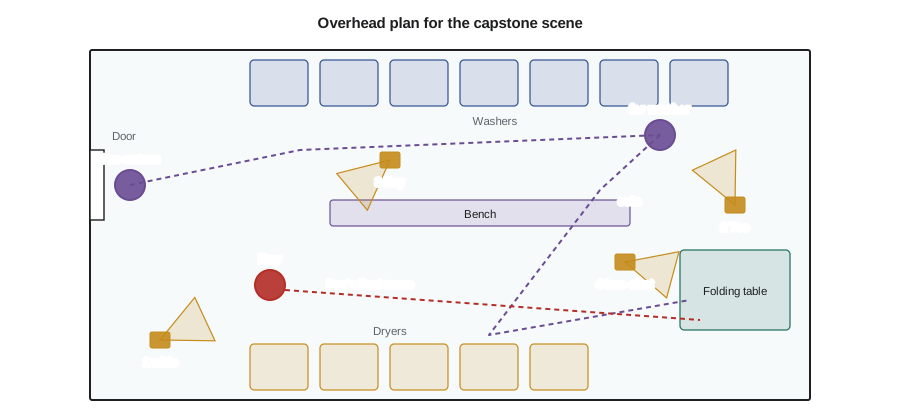
| Shot | Description | Priority |
|---|---|---|
| 1 | Wide from behind Ray's chair: door, Teo's entrance and the length of the room | A |
| 2 | Teo single at the far washer, covering beats 2 to 5 | A |
| 3 | Ray single in his chair, covering beats 1 to 5 | A |
| 4 | Two-shot at the folding table: Teo arrives with clothes, Ray joins and folds | A |
| 5 | Low angle under the bench: Teo searching for the coin, Ray's feet beyond | B |
| 6 | Insert: the coin rolling; the dryer drum stopping | C |
Stage 5: scheduling and the shoot
Estimate your shooting time realistically. A two-page scene with six set-ups and inexperienced crew may take most of a day. Plan the order of set-ups with whoever is acting as first assistant director, grouping shots that face the same direction. Plan the shoot around the location's availability, which for a real laundromat may mean late at night or early morning with the owner's permission, and around actors' availability and rest.
setups = [("1 Wide from Ray's chair", "north", 60), ("3 Ray single", "north", 40),
          ("4 Folding table two-shot", "east", 55), ("2 Teo single", "south", 45),
          ("5 Under the bench", "south", 30), ("6 Inserts", "any", 20)]
# group by camera direction to reduce relighting; inserts last
order = sorted(setups, key=lambda s: ({"north": 0, "south": 1, "east": 2, "any": 3}[s[1]]))
start = 22 * 60 + 30   # 10:30 p.m. call, after the laundromat closes
t = start + 45         # first 45 minutes: blocking rehearsal and first lighting
relight = 20
prev = None
for name, direction, minutes in order:
    if prev and direction != prev and direction != "any":
        t += relight
    h, m = divmod(t % (24 * 60), 60)
    print(f"{h:02d}:{m:02d}  {name} ({minutes} min)")
    t += minutes
    prev = direction
h, m = divmod(t % (24 * 60), 60)
print(f"{h:02d}:{m:02d} Wrap; total {(t - start) / 60:.1f} h on set")23:15 1 Wide from Ray's chair (60 min) 00:15 3 Ray single (40 min) 01:15 2 Teo single (45 min) 02:00 5 Under the bench (30 min) 02:50 4 Folding table two-shot (55 min) 03:45 6 Inserts (20 min) 04:05 Wrap; total 5.6 h on set
The illustrative timetable ends in the early morning, which shows why small productions must plan carefully for fatigue and for travel home. Consider shooting over two shorter nights, cutting the C-priority inserts or picking them up separately, and arranging safe transport. On the day, follow the routine from lessons 7 and 8: block, light, rehearse, shoot. Keep notes to actors private and playable, circle preferred takes and record continuity.
Stage 6: dailies and the rough cut
Review your footage the day after the shoot. Check that every key moment is captured, that performances connect across set-ups and that there are no technical problems that require a pickup. Then edit, or work with an editor, to produce a rough cut. Watch it whole before adjusting details. Pay particular attention to the final beat: how long to hold before Ray stands, which take of Teo carrying the clothes is most truthful, and where to end the scene.
Produce at least two versions of the ending, for example one that cuts as Ray begins folding and one that holds on both of them folding in silence. Show the versions to two or three viewers who were not involved and note their responses. As lesson 11 advises, listen for where viewers were confused or moved, then decide for yourself what serves the scene.
Stage 7: reflection and assessment
Finally, write a reflection of 800 to 1,200 words. Explain your interpretation, describe how it shaped casting, rehearsal, staging and the shot plan, discuss what changed during production and in the edit and why, and evaluate what worked and what you would do differently. Include your director's note, overhead plan, shot list, rehearsal plan, schedule and the rough cut.
| Criterion | Weight | What strong work shows |
|---|---|---|
| Interpretation and analysis | 20 per cent | A clear, specific spine; beats, objectives and key moments that are insightful and usable |
| Casting and rehearsal | 15 per cent | Thoughtful casting rationale; rehearsal that built relationship without over-fixing |
| Visual plan and blocking | 20 per cent | Staging and shots that grow from the interpretation and protect key moments |
| Performance direction | 20 per cent | Truthful, consistent performances; evidence of playable direction |
| Rough cut | 15 per cent | Clear storytelling, effective timing, a considered ending |
| Reflection and documentation | 10 per cent | Honest evaluation linking choices to intentions; complete paperwork |
Common capstone problems
A few problems appear again and again in student capstones. The most common is under-rehearsal: actors arrive on the day barely knowing each other or the scene, and the performances never settle. Another is over-ambitious coverage: too many set-ups for the time available, so the key moments are rushed. A third is unclear interpretation: the director never decided what the scene was about, and the performances drift. A fourth is neglecting sound, which ruins otherwise good scenes; FILM-310 lesson 4 describes the basics of recording usable dialogue.
All of these problems can be prevented in prep. A clear analysis, at least one rehearsal, a realistic shot list with priorities and a sound plan go a long way. The capstone is also a chance to practise the habits of good directing that matter beyond any single project: preparing thoroughly, communicating intentions clearly, listening, protecting the people you work with and taking responsibility for the result.
Where to go next
After this course, directors continue to learn mainly by directing: short films, scenes, music videos, theatre, documentary and any chance to work with actors. Working in other roles, especially as an assistant director, script supervisor or editor, teaches a great deal about how directors succeed and fail. FILM-410 covers producing and budgeting, which every director benefits from understanding; FILM-420 covers media law, copyright and releases; and CINE-499 and the other capstones offer chances to collaborate across disciplines. Watching films closely, reading scripts and observing how people behave in real life remain the director's lifelong training.
Common mistakes
MistakeStarting the shoot without a clear interpretation
InsteadWrite a director's note with spine, beats, objectives and key moments first.
MistakeSkipping rehearsal because time is short
InsteadHold at least one rehearsal to build the relationship and clarify the scene.
MistakePlanning more set-ups than the day allows
InsteadUse a prioritized shot list and group set-ups by direction.
MistakeNeglecting production sound
InsteadPlan dialogue recording with a dedicated sound person and record room tone.
MistakeChoosing the ending without testing alternatives
InsteadCut two versions and show them to fresh viewers before deciding.
Summary and key terms
- The capstone applies the full director's process to one short scene.
- Begin with a written analysis: spine, beats, objectives, given circumstances and key moments.
- Cast for the relationship, ideally with a chemistry read, and obtain releases.
- Rehearse to build history and discover blocking, marking emotional peaks.
- Derive the visual plan and blocking from the interpretation and prioritize shots.
- Schedule realistically, plan for fatigue and follow block, light, rehearse, shoot.
- Shape the rough cut with tested alternatives and reflect honestly on choices and outcomes.
- Capstone
- A final project that integrates the skills of a course or program.
- Director's note
- A short written analysis of a scene's interpretation and plan.
- Appearance release
- A signed permission to use a person's image and performance.
- Rough cut
- An early edit that shows the structure and performances before fine-tuning.
- Pickup
- A shot filmed later to fill a gap found in dailies or the edit.
- Rubric
- A set of criteria and weights used to assess work.
- Shooting order
- The sequence in which set-ups are shot on the day.
- Relight
- The time needed to change lighting when the camera direction changes.
- Reflection
- A written evaluation of choices, process and results.
- Fresh viewer
- Someone uninvolved in the production who watches a cut without prior knowledge.
Practice problems
Work each problem on paper first, then reveal the answer to check.
What is the spine of the laundromat scene in the example analysis?
Show answer
A father and son find a way to be together through a small practical act.
Why is a chemistry read essential for this scene?
Show answer
The audience must believe the father and son share a history.
Suggest an improvisation for rehearsal.
Show answer
The last time Ray drove past Teo's school.
What governing visual idea is proposed?
Show answer
Separate frames for father and son until a shared two-shot at the folding table.
Which shot is a C priority, and why?
Show answer
The inserts, because they can be picked up separately.
Why group set-ups by camera direction?
Show answer
To reduce relighting time.
What should you check in dailies?
Show answer
Key moments captured, performance continuity and technical problems.
Why cut two versions of the ending?
Show answer
To test alternatives with fresh viewers before deciding.
Name two common capstone problems.
Show answer
Under-rehearsal, over-ambitious coverage, unclear interpretation or poor sound (any two).
How long should the reflection be?
Show answer
About 800 to 1,200 words.
Lesson quiz · 5 questions
Score 60% or more to complete this lesson.
Create a free account to save your progress, take quizzes and earn a certificate.