
FILM-320 · Lesson 10 of 12 · 26 min
Tone, genre and style
Two films can tell almost the same story and feel completely different. A man trapped in an elevator with his estranged father could be a claustrophobic thriller, a bittersweet drama, a farce or a horror film. The events might be identical; what changes is tone, the emotional colour and attitude of the film toward its story, and genre, the set of conventions and expectations that tell the audience how to read it. Getting tone right is one of the director's most important and most difficult tasks, because tone emerges from every department at once and is easily broken by a single wrong note.
This lesson covers what tone is and how directors control it, how genres work as contracts with the audience, specific techniques for comedy, suspense and horror, and drama, how to handle tonal shifts within a film, and how individual style relates to serving the story. FILM-101 lesson 9 introduced genre and style from the viewer's side; here we look at them from the director's chair.
What tone is
Tone is the film's attitude to its material and the emotional register in which the audience experiences it. It answers questions such as: should we laugh at this character or with them? Should this violence shock, thrill or amuse us? Is this world safe or dangerous? Is the film sincere, ironic, playful or solemn? Tone is not the same as mood, which describes the feeling of a particular scene; a comedy can contain a sad scene without becoming a tragedy.
Directors control tone through every element of the film. Performance pitch, meaning how heightened or naturalistic the acting is, may be the most important. Pace, both within scenes and across the film, shapes tone strongly: fast cutting and overlapping dialogue push toward comedy or tension; long takes and silence push toward contemplation. Camera, lighting, colour, production design, music and sound all contribute. A tonal mismatch between departments, such as broad comic performances against grim, naturalistic photography, can confuse the audience about how to feel.
Finding and communicating tone
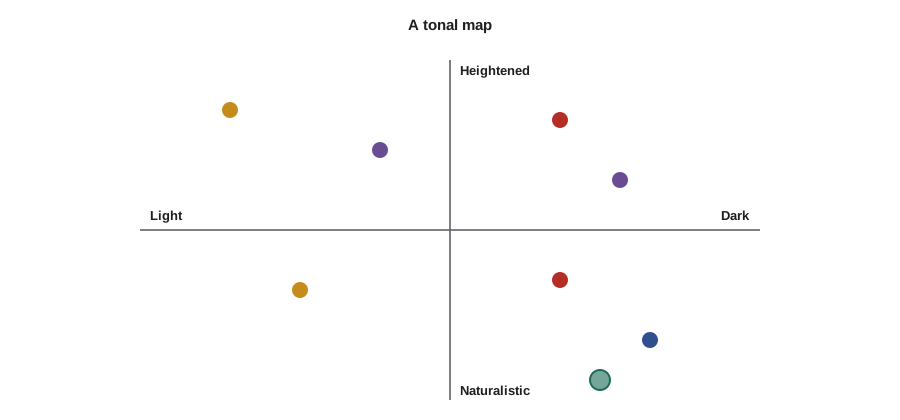
Directors usually find a film's tone through the script, their own instincts and references. Reference films, scenes and even music help communicate tone to the cast and crew, because tone is hard to describe in words. A director might tell the team that a film should feel "like a family drama that keeps threatening to become a thriller", then show scenes that capture that tension. The tonal map in the figure is another tool: placing the film on axes such as light to dark and naturalistic to heightened gives everyone a shared vocabulary.
Tone must also be communicated to the actors, who often face the greatest risk of getting it wrong. A scene played too broadly in a naturalistic film, or too small in a heightened one, stands out immediately. Directors set the performance pitch in rehearsal and keep it consistent across the shoot. When different actors work at different pitches, the director's job is to bring them into the same world, usually by adjusting the outliers rather than everyone else.
| Element | Toward lightness or comedy | Toward darkness or tension |
|---|---|---|
| Performance pitch | Heightened, playful, quick reactions | Contained, naturalistic, held silences |
| Pace | Quick cueing, brisk cutting | Slower rhythms, longer takes |
| Camera and framing | Wider frames that show reactions together | Tight, isolating frames; restricted views |
| Light and colour | Bright, high key, warm | Low key, deep shadows, desaturated |
| Sound and music | Light score, comic timing in effects | Low drones, silence, sudden sounds |
| Design | Colourful, ordered or absurd | Worn, cluttered, confined |
Genre as a contract
A genre is a set of conventions that audiences recognize: the settings, character types, plot patterns, visual styles and emotional experiences associated with westerns, romantic comedies, horror films, musicals and so on. Genres function like a contract. When an audience settles in to watch a horror film, they expect to be frightened and accept conventions they would find absurd elsewhere. The director's job is to honour the contract while finding something fresh within it.
Breaking genre conventions can be powerful, but only when the audience knows the rules being broken. A film that establishes itself as a gentle comedy and then turns violent can be shocking and memorable, or simply confusing, depending on whether the shift feels purposeful. Many contemporary films blend genres, such as horror and social satire, or romance and science fiction. Blending works best when the director is clear about which genre leads and how the others support it.
Directing comedy
Comedy depends on timing, rhythm and the audience's relationship to the characters. Timing in comedy is measured in fractions of a second: a reaction held a few frames too long or cut a few frames too short can kill a laugh. Rhythm matters across scenes too: comic scenes often build through patterns of repetition and escalation, such as the rule of three, in which a pattern is set up twice and broken the third time.
A widely shared principle among comedy directors is that comic characters should usually play their situation seriously. A character trying desperately to hide a broken vase from their mother-in-law is funny because they care so much; if the actor signals that they know it is funny, the laugh disappears. Directors keep actors focused on objectives and stakes, exactly as in drama, and let the situation and timing generate comedy.
Comedy also has particular staging and coverage needs. Reactions are often funnier than actions, so directors make sure to capture them. Wider frames that hold the action and the reaction together can be funnier than cutting between them, because the audience sees cause and effect at once. Improvisation is common in comedy, and directors often shoot scripted takes and then looser variations to give the editor options. Timing can be adjusted in the edit, but only if the coverage allows it.
fps = 24
# pause before a punchline reaction, in frames, from three takes
takes = {"Take 3": 9, "Take 5": 16, "Take 7": 28}
for take, frames in takes.items():
    print(f"{take}: {frames} frames = {frames / fps:.2f} s")
# a common editing adjustment: trim or extend by a few frames
for adjust in (-4, -2, 2, 4):
    f = takes["Take 5"] + adjust
    print(f"Take 5 adjusted by {adjust:+d} frames: {f} frames = {f / fps:.2f} s")
# running time of a scene at two cueing speeds
lines, words_per_line = 40, 9
for wpm, label in ((150, "relaxed"), (190, "brisk comic pace")):
    seconds = lines * words_per_line / wpm * 60
print(f"{label}: about {seconds:.0f} s of dialogue")Take 3: 9 frames = 0.38 s Take 5: 16 frames = 0.67 s Take 7: 28 frames = 1.17 s Take 5 adjusted by -4 frames: 12 frames = 0.50 s Take 5 adjusted by -2 frames: 14 frames = 0.58 s Take 5 adjusted by +2 frames: 18 frames = 0.75 s Take 5 adjusted by +4 frames: 20 frames = 0.83 s relaxed: about 144 s of dialogue brisk comic pace: about 114 s of dialogue
The arithmetic is simple, but it explains why comic editors and directors talk about frames. A difference of a quarter of a second can change whether an audience laughs, and a brisk cueing pace can shorten a scene by a third, changing its whole feel.
Directing suspense and horror
Suspense depends on the audience's knowledge and anticipation. Alfred Hitchcock famously distinguished suspense from surprise with a thought experiment: if a bomb under a table explodes without warning, the audience gets a few seconds of shock; if the audience is shown the bomb first and then watches characters chat unawares, every second becomes tense. Suspense comes from giving the audience information the characters lack and making them wait.
Horror shares suspense's mechanisms and adds dread and fear. Directors build dread through restricted information, such as darkness, off-screen space and obscured views, and through rhythm: long, quiet build-ups punctuated by sudden release. Sound is crucial, as FILM-310 explains; silence before a scare is often more effective than music. The audience's imagination is the director's best tool, which is why many horror directors show less rather than more.
Performances in suspense and horror must remain truthful under extreme circumstances. Actors need clear knowledge of what their characters know and fear at each moment, because the audience's tension comes from watching people respond realistically to danger. Directors also have to protect actors who spend long days in frightening or physically demanding situations, with breaks, clear safety procedures and attention to the emotional effects of the work.
Worked problem
Turning the kitchen scene toward suspense
Imagine a version of the film in which the audience knows, from an earlier scene, that Dana has found a letter from their mother that she is hiding from Maya, and that the letter is in the photo album box. How could the director shift the kitchen scene toward suspense without changing the dialogue?
Show solution
- Show the letter clearly in the earlier scene, so the audience knows exactly what is at stake and where it is.
- Stage Maya's handling of the box so the audience fears she will find the letter: she riffles through it; she lifts an album and the corner of an envelope shows.
- Hold on Dana watching the box rather than Maya's face, letting the audience share her anxiety.
- Lengthen pauses and slow the pace slightly; let the sound of pages turning become prominent.
- Resolve or extend the tension in the final push of the box: Dana pushes it back too quickly, or not at all.
Answer: The same lines now carry a new layer of tension because the audience knows something Maya does not. Staging, coverage and pace, not dialogue, create the suspense.
Directing drama and melodrama
Drama asks the audience to believe in characters and care about what happens to them. In naturalistic drama, the director's main concern is truthfulness: performances that feel lived, environments that feel real and emotional moments that are earned rather than signalled. Restraint is often more powerful than display; an actor fighting tears can move an audience more than one who weeps openly.
Melodrama is drama heightened: emotions are larger, coincidences more frequent, music more prominent and moral stakes clearer. It is sometimes used as a criticism, but melodrama is a legitimate and powerful tradition, from silent cinema to many popular series. Directing melodrama requires commitment: the heightened style must be consistent and sincere, with performances that are large but truthful within the world of the film.
Tonal shifts
Many films move between tones: a comedy with a heartbreaking final act, a drama with moments of absurd humour, a thriller that pauses for tenderness. Shifts work when they are prepared and when the characters remain consistent. The audience will follow a comedy into tragedy if they believe in the characters and if earlier scenes have hinted at what lies beneath the jokes.
Abrupt, unprepared shifts can feel like mistakes. Directors manage shifts through transitions in pace and sound, through scenes that bridge the tones, and by keeping performances anchored in truth even in the lightest moments. In the kitchen scene, the laugh at the old haircut is a small tonal shift inside a painful scene. It works because it grows from the characters' shared history, and it makes the return to pain sharper.
Style and serving the story
Style is the consistent pattern of choices that makes a film, or a director's body of work, recognizable. Some directors have strong signature styles; others adapt their approach to each project. Style can deepen a film's meaning when it grows from the story, as when a fragmented visual style expresses a character's breakdown. It can also become a distraction when it is applied regardless of story, drawing attention to the director rather than the film.
For emerging directors, the most useful approach is to let style follow from the spine and governing ideas described in lessons 2 and 3. Over several films, consistent choices and personal preoccupations will emerge naturally. Trying to develop a signature style before you have made films tends to produce mannerisms rather than meaning.
Common mistakes
MistakeAllowing each department to set its own tone
InsteadAgree a tonal map and references so performance, image and sound align.
MistakeLetting comic actors signal that a scene is funny
InsteadKeep them playing objectives and stakes seriously so the situation generates comedy.
MistakeRelying on surprise when suspense would be stronger
InsteadGive the audience information the characters lack and make them wait.
MistakeShifting tone abruptly without preparation
InsteadPrepare shifts through earlier hints, bridging scenes and consistent characters.
MistakeImposing a signature style on every story
InsteadLet style grow from the spine and governing ideas of each film.
Summary and key terms
- Tone is a film's attitude to its material; it emerges from every department together.
- Performance pitch and pace are among the strongest controls on tone.
- Reference films and a tonal map help communicate tone across departments.
- Genres are contracts with the audience; breaking conventions works only when the rules are known.
- Comedy depends on timing measured in frames and on characters playing their situations seriously.
- Suspense comes from audience knowledge and anticipation; horror adds dread through restricted information.
- Tonal shifts work when prepared and grounded in consistent characters; style should serve the story.
- Tone
- A film's attitude to its material and the emotional register of the audience's experience.
- Mood
- The feeling of a particular scene or moment.
- Genre
- A recognized set of conventions in setting, character, plot and style.
- Performance pitch
- How heightened or naturalistic acting is within a film's world.
- Rule of three
- A comic pattern set up twice and broken the third time.
- Suspense
- Tension created by audience knowledge and anticipation.
- Surprise
- A sudden shock without prior warning.
- Dread
- A sustained sense of approaching threat.
- Melodrama
- Heightened drama with large emotions and clear moral stakes.
- Style
- The consistent pattern of choices that makes a film recognizable.
Practice problems
Work each problem on paper first, then reveal the answer to check.
What is the difference between tone and mood?
Show answer
Tone is the film's overall attitude; mood is the feeling of a particular scene.
Name two elements that strongly control tone.
Show answer
Performance pitch and pace (also camera, light, design, sound and music).
Why use reference films to communicate tone?
Show answer
Tone is hard to describe in words but easy to recognize in examples.
In what sense is a genre a contract?
Show answer
Audiences expect certain experiences and accept certain conventions.
Why should comic characters usually play their situations seriously?
Show answer
The comedy comes from how much they care; signalling the joke kills it.
How many frames is a half-second pause at 24 fps?
Show answer
Twelve frames.
What is the difference between suspense and surprise?
Show answer
Suspense comes from the audience knowing a danger and waiting; surprise is a sudden shock.
Name two ways horror directors build dread.
Show answer
Darkness, off-screen space, obscured views, silence, slow build-ups (any two).
Why does the laugh in the kitchen scene work despite the painful context?
Show answer
It grows from shared history and makes the return to pain sharper.
How should emerging directors approach style?
Show answer
Let it follow from each film's spine and governing ideas rather than imposing a signature.
Lesson quiz · 5 questions
Score 60% or more to complete this lesson.
Create a free account to save your progress, take quizzes and earn a certificate.