
FAT-320 · Lesson 4 of 12 · 19 min
Signal types, formats and response at the monitoring centre
Marguerite gives Sasha a printout from the signal receiving centre's raw receiver log for one of Bramwell's buildings. It is a column of lines like '1234 18 1 110 01 012'. 'That is what your communicator actually says,' she says. 'Our automation turns it into words on the screen. When the words are wrong, you need to be able to read the line yourself.' This lesson covers how fire alarm signals are coded, how the centre sorts and handles them, and how false and unwanted alarms are managed without delaying a real one.
Kinds of signal
Every signal a fire alarm system sends off the premises falls into one of a few classes, and each class is handled differently:
- Fire alarm signals: a detector, manual station or waterflow switch has operated. These are dispatched to the fire department.
- Supervisory signals: a fire protection system needs attention, such as a valve closed, dry-pipe air low, a fire pump running or off power, or a low temperature in a valve room.
- Trouble signals: a fault in the fire alarm system itself, such as an open circuit, a ground fault, loss of primary power, a low battery or a failed communication path.
- Restorals: a condition has returned to normal.
- Test signals: periodic timer tests, and signals sent during maintenance while the account is on test.
Some systems also send other signals off the premises, such as carbon monoxide alarms, sprinkler supervisory signals from a separate panel, or signals from special hazard systems. The account record says how each is handled.
How signals are coded
Communicators and receivers use standard message formats so that equipment from different makers can work together. Two formats appear most often in Bramwell's work. Contact ID, developed for dialers and still widely used inside newer formats, sends a fixed set of digits: the account number, a message type, a qualifier that says whether the event is new or a restoral, a three-digit event code, a group or partition number, and a zone or user number. SIA DC-09, an internet protocol standard, wraps messages such as Contact ID in a frame with a sequence number, receiver and account identifiers, a time stamp and usually encryption.
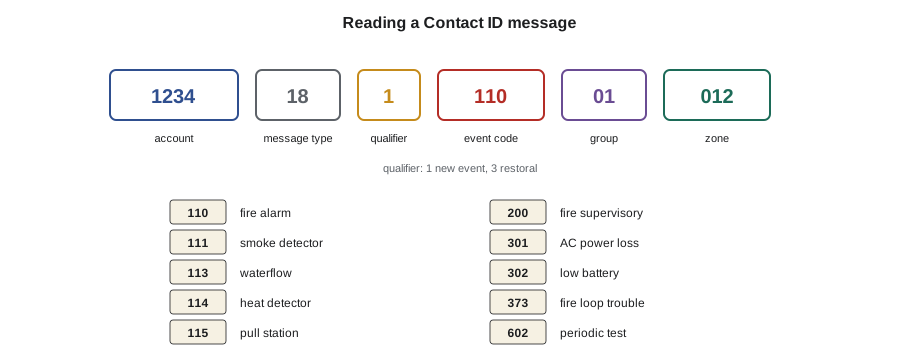
The event codes are grouped by type. In the 100 range are alarms: 110 is a general fire alarm, and codes such as 111 smoke, 113 waterflow, 114 heat and 115 pull station refine it. In the 200 range are fire supervisory signals. In the 300 range are system troubles, such as 301 for loss of AC power, 302 for low battery and 373 for a fire loop trouble. Test signals use codes in the 600 range, such as 602 for a periodic test. The qualifier digit is 1 for a new event and 3 for a restoral.
# Decode a Contact ID message (fire-related codes only; illustrative table)
codes = {"110": "fire alarm", "111": "smoke detector", "113": "waterflow", "114": "heat detector",
         "115": "pull station", "200": "fire supervisory", "301": "AC power loss", "302": "low battery",
         "373": "fire loop trouble", "602": "periodic test"}
def decode(msg):
    acct, mt, q, ev, grp, zone = msg.split()
    state = {"1": "new event", "3": "restoral", "6": "previously reported"}.get(q, "unknown")
    return f"account {acct}: {codes.get(ev, 'code ' + ev)}, {state}, group {int(grp)}, zone {int(zone)}"
for m in ["1234 18 1 113 01 004", "1234 18 3 113 01 004", "1234 18 1 200 01 007", "1234 18 1 602 00 000"]:
print(decode(m))account 1234: waterflow, new event, group 1, zone 4 account 1234: waterflow, restoral, group 1, zone 4 account 1234: fire supervisory, new event, group 1, zone 7 account 1234: periodic test, new event, group 0, zone 0
The decoder shows a waterflow alarm on zone 4, its restoral, a supervisory signal on zone 7 and a periodic test. When the centre's screen says 'zone 4, gym smoke' but the raw line says event 113 on zone 4, the code is right and the account's zone description is wrong.
# Read the fields of a DC-09 style frame (illustrative sample, no encryption)
frame = '"ADM-CID"0042R1L0#1234[#1234|1113 01 004]_14:22:07,11-03-2026'
proto = frame.split('"')[1]
seq = frame.split('"')[2][:4]
acct = frame.split("#")[1].split("[")[0]
data = frame[frame.index("[") + 1: frame.index("]")]
stamp = frame.split("_")[1]
print("protocol:", proto)
print("sequence:", seq, " account:", acct)
print("message:", data)
print("time stamp:", stamp)protocol: ADM-CID sequence: 0042 account: 1234 message: #1234|1113 01 004 time stamp: 14:22:07,11-03-2026
The frame carries a sequence number so the receiver can tell a new message from a repeat, and a time stamp so it can reject old or replayed messages. Real DC-09 traffic is normally encrypted, and the technician never sees it in plain text; the point of the exercise is to understand what the receiver checks.
Priority and handling
At the centre, signals are queued by priority: fire alarms first, then supervisory signals, then troubles. Within a priority, older signals come first. The operator works from the account's instructions. For a fire alarm, the operator calls the fire department's dispatch centre with the address, the type of alarm and the zone description, and then calls the premises or the owner's contacts. For a supervisory signal, the operator calls the owner's contacts and, where the instructions say so, the service company. For a trouble, the operator calls the owner or the service company, and follows up if the trouble does not restore within the time in the instructions.
Several alarms from the same building in quick succession, such as a smoke detector, then waterflow, then a second smoke detector, strongly suggest a real fire. The centre's procedures usually treat a second signal as confirmation, not as a reason to wait.
Verification and unwanted alarms
Unwanted alarms, from cooking, dust, steam, testing without notice or faulty devices, are a large share of the alarms that reach fire departments. Some fire departments allow the centre to make a quick verification call to the premises for certain signals, such as a single smoke detector in a residential suite, before dispatch. Where the authority and the standard allow it, the verification must be quick, and waterflow and manual station signals are normally dispatched at once without verification. Bramwell's role is to keep the system from producing unwanted alarms in the first place, and to make sure test signals are sent only when the account is on test.
# Unwanted-alarm rate from a year of monitoring records (illustrative)
year = {"Riverlight Tower": (14, 1), "Tamarind House": (3, 0), "Willowbank School": (6, 0), "Cartwright DC": (2, 1)}
for site, (unwanted, real) in year.items():
    total = unwanted + real
    share = 100 * unwanted / total if total else 0
print(f"{site:18s} alarms {total:3d} unwanted {unwanted:3d} ({share:4.0f} %) {'review causes' if unwanted >= 5 else ''}")Riverlight Tower alarms 15 unwanted 14 ( 93 %) review causes Tamarind House alarms 3 unwanted 3 ( 100 %) Willowbank School alarms 6 unwanted 6 ( 100 %) review causes Cartwright DC alarms 3 unwanted 2 ( 67 %)
At Riverlight, most unwanted alarms come from cooking near suite entry smoke detectors and from two parking garage detectors that foul quickly. The fix is not to slow down the monitoring but to change the devices: heat detectors where the code allows them in suites near cooking, and a different detector type in the garage, with the designer's agreement.
Putting an account on test
Before any work that could send signals, the technician calls the centre, gives the account number and a pass code, and asks for the account to be placed on test for a set time. Signals received while the account is on test are recorded but not dispatched. At the end of the work, the technician calls again, asks what was received, compares it with what was sent, and takes the account off test. An account left on test after the technician leaves is a building that cannot summon the fire department, so many centres put a time limit on test status and call back when it expires.
# Compare what was sent during testing with what the centre received
sent = ["110 zone 1", "113 zone 4", "200 zone 7", "373 zone 2", "301"]
received = ["110 zone 1", "113 zone 4", "373 zone 2", "301"]
missing = [s for s in sent if s not in received]
print("received", len(received), "of", len(sent))
for m in missing:
print("not received:", m, "- check programming and path")received 4 of 5 not received: 200 zone 7 - check programming and path
Records
The centre keeps every signal, call and action with the time. Bramwell can ask for an event history for any account, and the service report for a test includes the centre's confirmation of what it received. When a building has a fire, the records show when the first signal arrived, when the fire department was called and what the operator was told, which is why the account information and the zone descriptions matter so much.
Worked problem
Reading a log
The centre's log for Cartwright Distribution Centre shows: 02:14:07 '1234 18 1 200 01 007'; 02:14:09 '1234 18 1 113 01 004'; 02:14:40 '1234 18 3 200 01 007'. The account lists zone 7 as 'valve VS-2' and zone 4 as 'waterflow riser 4'. What happened, and what should the operator have done?
Show solution
- 02:14:07: supervisory, valve VS-2 off normal.
- 02:14:09: fire alarm, waterflow on riser 4. This is dispatched to the fire department at once.
- 02:14:40: VS-2 restored to normal.
- A valve moving and then waterflow on the same riser could be a pipe break, someone working on the system, or a fire. The operator dispatches on the waterflow and calls the owner's contacts about both signals.
Answer: Read the event code, the qualifier and the zone, then match them to the account's descriptions.
Common signal problems and their causes
When a building's signals arrive at the centre wrongly, the cause is usually one of a few things. Sasha keeps a list in her notebook:
- Wrong description: the panel's zone numbers changed and the account didn't. Fix the account and retest the points.
- Wrong signal type: the communicator reports a supervisory condition with a trouble code, or an alarm with a supervisory code, because of a programming error. The operator then follows the wrong procedure. Fix the communicator's programming.
- Missing restorals: the communicator reports a condition but not its restoral, so the centre's screen shows a building still in trouble after it was fixed. Check the communicator's settings for restoral reporting.
- Repeated signals: a device that keeps going in and out of trouble sends dozens of signals, burying more important ones. Fix the device, not the reporting.
- Late test signals: the communicator's test timer is set differently from what the centre expects, or the clock is wrong. Align them.
# Spot a chattering point in a day of events (illustrative)
events = ["zone 12 trouble", "zone 12 restore"] * 23 + ["zone 4 supervisory", "zone 4 restore", "AC loss", "AC restore"]
from collections import Counter
c = Counter(e.split()[0] + " " + e.split()[1] for e in events)
for point, n in c.most_common():
print(f"{point:9s} {n:3d} events {'chattering - repair the device' if n > 10 else ''}")zone 12 46 events chattering - repair the device zone 4 2 events AC loss 1 events AC restore 1 events
Each of these is fixed at the building, then proved by testing the affected points to the centre and checking the result on the operator's screen or the centre's event report.
Signals the fire department receives
Fire departments differ in what they want from monitoring centres. Some want only fire alarm signals; others also want supervisory signals from sprinkler systems in certain buildings; some want particular information, such as whether the building has a known hazard or a key box. The account instructions reflect the fire department's requirements, and the technician confirms them with the authority when setting up a new account.
Some fire departments also ask monitoring centres to pass on information about the building's condition when they report an alarm, such as whether the alarm is a second signal from the same building or whether the owner has reported work on the system. The account instructions record these requests so that every operator handles the building the same way.
Common mistakes
MistakeTrusting the description on the operator's screen.
InsteadCheck the raw code and zone against the account.
MistakeTesting without putting the account on test.
InsteadCall the centre first, and confirm signals afterwards.
MistakeLeaving an account on test.
InsteadTake it off test before leaving the building.
MistakeDelaying a waterflow signal for verification.
InsteadWaterflow and manual stations are dispatched at once.
MistakeTreating unwanted alarms as a monitoring problem.
InsteadFix the devices and locations that cause them.
Summary and key terms
- Signals are fire alarm, supervisory, trouble, restoral and test.
- Contact ID codes the event, its qualifier and the zone; DC-09 frames messages for internet transport.
- The centre handles fire alarms first and follows each account's written instructions.
- Verification, where allowed, must be quick; waterflow and manual stations are not delayed.
- Accounts are put on test before work and taken off test after it.
- Contact ID
- A common message format giving account, qualifier, event code, group and zone.
- Event code
- A three-digit code that says what happened, such as 113 for waterflow.
- Qualifier
- The digit that marks a new event or a restoral.
- SIA DC-09
- A standard for sending alarm messages over internet protocol.
- On test
- An account state in which signals are recorded but not dispatched.
Practice problems
Work each problem on paper first, then reveal the answer to check.
What does qualifier 3 mean in Contact ID?
Show answer
A restoral.
Which Contact ID event code means waterflow?
Show answer
113.
The raw code says 113 but the screen says gym smoke. What is wrong?
Show answer
The account's zone description.
What must happen before a technician tests a monitored system?
Show answer
The account is placed on test.
Why does a DC-09 frame have a time stamp?
Show answer
So the receiver can reject old or replayed messages.
Lesson quiz · 5 questions
Score 60% or more to complete this lesson.
Create a free account to save your progress, take quizzes and earn a certificate.